
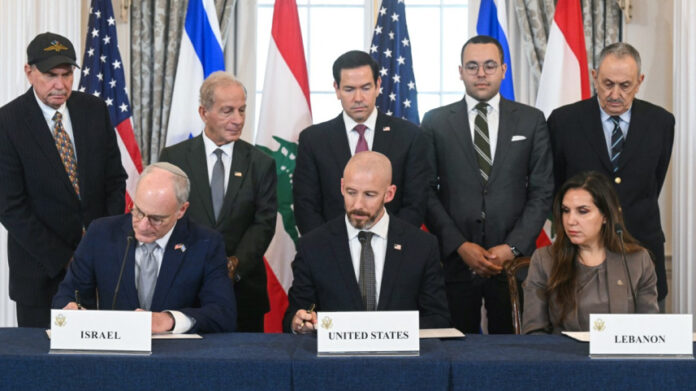
The National Human Rights Commission, including the Committee for the Prevention of Torture, is following with great attention the ongoing public discussion surrounding the text of the Trilateral Framework between the United States of America, the State of Israel, and the Republic of Lebanon, particularly the reported commitment to “the cessation of all hostile or adverse actions in international political or legal fora,” together with the pledge to work toward the search for and return of human remains and the release of detainees.
The Commission emphasizes that the prosecution of perpetrators of war crimes, crimes against humanity, and the crime of torture does not constitute a hostile act or a political position. Rather, it represents the legitimate exercise of the right of access to justice and the implementation of binding international legal obligations aimed at combating impunity, ensuring justice and redress for victims, and upholding the principle that those responsible for the gravest crimes affecting humanity must not escape accountability.
No Immunity for Perpetrators of International Crimes
The Commission warns that any interpretation or commitment requiring the suspension of, or abstention from initiating or pursuing, international legal proceedings would seriously undermine both the right of the Lebanese State and the rights of victims to have recourse to the international judicial and quasi-judicial mechanisms provided for under international law. This includes, in particular, the ability to institute or continue proceedings before the International Court of Justice where the Court’s jurisdiction is established; to support efforts aimed at holding perpetrators of international crimes accountable before the International Criminal Court in accordance with the applicable legal frameworks; and to pursue complaints and other procedures before the United Nations Security Council, the United Nations General Assembly, the United Nations Economic and Social Council, and other competent United Nations bodies, including independent international investigative mechanisms, fact-finding missions, and commissions of inquiry established by the Human Rights Council to investigate serious violations of international humanitarian law and international human rights law.
The Commission further emphasizes that recourse to these mechanisms does not constitute a hostile act or a breach of any political understanding. Rather, it is the legitimate exercise of rights guaranteed under international law and forms an integral part of the State’s obligation to protect its citizens and defend their rights. It also constitutes an essential component of victims’ rights to truth, justice, effective remedy, and reparation. Accordingly, any commitment or interpretation that would impede or restrict access to these mechanisms would serve to entrench impunity, undermine the rights of victims, and weaken the Lebanese State’s ability to avail itself of the international legal avenues available to hold those responsible for grave violations accountable.
In light of the legal and political interpretations that have arisen concerning paragraph (13) of the text, the National Human Rights Commission affirms that any commitment undertaken by the Lebanese State within the framework of its international relations or political understandings cannot, as a matter of law, extend to the individual rights of victims or their families. Nor may it be interpreted as restricting, preventing, or diminishing their inherent right to seek justice before national or international courts, to pursue accountability for perpetrators of war crimes, crimes against humanity, and other international crimes, or to claim reparation, redress, and justice.
Neither the State’s Nor Victims’ Right to Seek International Justice May Be Restricted
The Commission further affirms that, under its constitutional and international obligations, the Lebanese State cannot relinquish its duty to take all necessary legal, diplomatic, and judicial measures to address violations of international law, including through the use of available national, regional, and international mechanisms. Nor may it refrain from taking any action necessary to ensure accountability and combat impunity, or evade its responsibility to establish and activate national and international mechanisms that guarantee the right of access to justice and provide effective remedies and redress for victims.
The Commission stresses that the right of victims and their families to seek justice is an inherent and personal right that no public authority may waive, dispose of, or restrict. This right is protected under the Lebanese Constitution and the international treaties binding upon Lebanon, foremost among them the Geneva Conventions, the United Nations Convention against Torture, the International Covenant on Civil and Political Rights, and the United Nations Basic Principles and Guidelines on the Right to a Remedy and Reparation for Victims of Gross Violations of International Human Rights Law and Serious Violations of International Humanitarian Law.
The Commission further emphasizes that individual proceedings brought before national courts exercising jurisdiction on the basis of the principle of universal jurisdiction or any other internationally recognized basis of jurisdiction remain legally independent of any political understandings or agreements concluded between States. As a matter of law, such proceedings cannot be considered subject to, or affected by, governmental commitments relating to the conduct of international relations or the foreign policy of the State.
The Commission also notes that a number of Lebanese victims and their families have already initiated legal proceedings before competent foreign courts on the basis of the principle of universal jurisdiction. These judicial proceedings constitute a legitimate legal avenue protected under the domestic laws of the States concerned and under international law, and are expected to continue independently of any political or diplomatic commitments that governments may undertake.
The Right of Access to Justice Is a Personal Right That the State Cannot Waive
Pursuant to its mandate to protect human rights and promote respect for international law, the National Human Rights Commission, including the Committee for the Prevention of Torture, declares its full support for the right of victims and their families to seek justice before competent national or foreign courts, and to initiate or pursue individual legal proceedings aimed at holding Israeli officials suspected of committing war crimes, crimes against humanity, or other international crimes accountable, with a view to achieving justice, ensuring redress for victims, providing full reparation for the harm they have suffered, and guaranteeing that no person responsible escapes accountability under international law.
The Commission considers such proceedings to be an integral component of the international justice system. They play a fundamental role in combating impunity, establishing the truth, preserving the collective memory of violations, and ensuring the non-recurrence of serious violations in the future.
The National Human Rights Commission further affirms that, both legally and on humanitarian grounds, no linkage may be made between the case of Lebanese nationals who were detained and transferred into Israeli territory and who remain in detention or whose fate continues to be unknown, and the issue of the remains of Israeli soldiers who went missing decades ago during military operations conducted on Lebanese territory.
Rejecting Any Trade-Off Between Living Detainees and the Remains of Soldiers
The Commission stresses that persons who are alive and have been deprived of their liberty are entitled to the full protection afforded by the four Geneva Conventions of 1949 and international human rights law. This includes protection against unlawful transfer, arbitrary detention, and enforced disappearance, as well as the rights to communicate with their families, to a fair trial, and to be released whenever there is no lawful basis for their continued detention.
By contrast, the search for and recovery of the remains of persons missing or deceased in armed conflicts, including the remains of missing Israeli soldiers, constitutes a distinct humanitarian obligation imposed by the rules of international humanitarian law. It must not be used or linked in any way to the rights of living persons who are detained, forcibly disappeared, or otherwise unlawfully deprived of their liberty.
The Commission considers that any approach based on trading off or linking the release of living Lebanese detainees and victims of enforced disappearance to the search for the remains of Israeli soldiers is incompatible with the fundamental principles of international humanitarian law. That body of law draws a clear distinction between obligations relating to the protection of the living and those concerning the respectful treatment of the dead and the missing, and prohibits the use of humanitarian rights and obligations as instruments of negotiation or political bargaining.
Accordingly, the Commission affirms that any commitment undertaken by the Lebanese Government to search for the remains of Israeli soldiers must remain a separate humanitarian obligation. It must not, whether expressly or implicitly, be linked to the release of living Lebanese detainees held in Israel or to the clarification of the fate of Lebanese victims of enforced disappearance. These individuals possess independent and inalienable legal rights that require their release or the disclosure of their fate without precondition and in accordance with the provisions of international humanitarian law and international human rights law.
هذه المقالة متاحة أيضًا بـ:

