
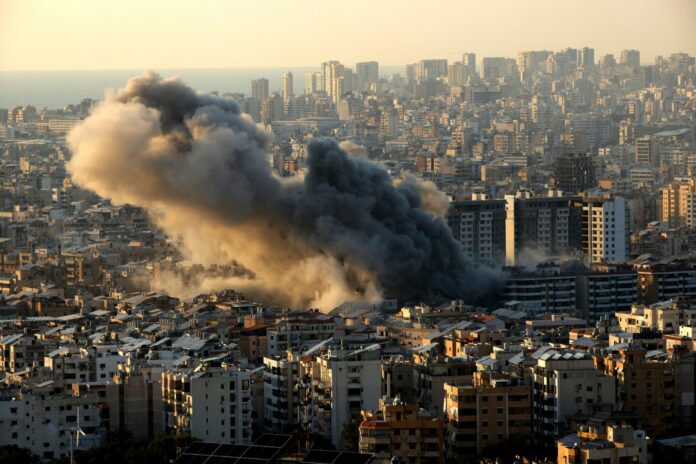
A new report issued by the United Nations Office of the High Commissioner for Human Rights (OHCHR) paints a devastating picture of the escalating conflict in Lebanon, documenting widespread civilian casualties, mass displacement, destruction of civilian infrastructure, and conduct by the Israeli forces that may amount to serious violations of international humanitarian law. The report covers the period from 2 to 22 March 2026, during which Lebanon experienced its most severe escalation since the ceasefire agreement of November 2024.
More Than One Million Displaced in Three Weeks
According to the report, renewed hostilities between parties to the conflict erupted on 2 March 2026, prompting Israel to expand its military operation known as “Roaring Lion” into Lebanon. What followed was a wave of intensive airstrikes, shelling, and ground incursions affecting southern Lebanon, the Bekaa Valley, Baalbek-Hermel, Nabatieh, and Beirut’s southern suburbs.
The scale of displacement has been unprecedented. More than one million people were forced to flee their homes within less than three weeks. The Ministry of Social Affairs registered over one million displaced persons, while approximately 134,377 individuals sought refuge in 644 collective shelters across the country. An additional 82,000 people crossed into Syria during the first half of March alone.
OHCHR expressed concern that Israeli military warnings and evacuation orders covered at least 189 towns and villages, affecting roughly 14 percent of Lebanese territory. Many orders were reportedly issued with insufficient notice, without identifying safe evacuation routes or safe destinations, raising concerns that such measures may amount to prohibited forced displacement under international humanitarian law.
Civilian Death Toll Surpasses One Thousand
The human cost of the escalation has been staggering. By 22 March, Lebanon’s Ministry of Public Health reported at least 1,029 people killed and 2,786 injured. Among those killed were at least 118 children, while 372 children were reported injured. Hundreds of thousands of children were displaced from their homes and communities.
Health workers have been among the victims. The report documents the deaths of at least 40 healthcare personnel and injuries to 119 others during the reporting period. OHCHR verified incidents where Israeli strikes killed at least 25 health workers operating with the Islamic Health Association and Al-Risala Association for Health Care.
The report also notes that Hezbollah rocket attacks into Israel resulted in civilian injuries, displacement, and damage to residential buildings and infrastructure. OHCHR warned that the use of unguided rockets against populated areas may constitute indiscriminate attacks prohibited under international humanitarian law.
Entire Families Wiped Out
One of the most alarming findings concerns repeated strikes on residential buildings. OHCHR documented several incidents in which multi-story residential structures were destroyed, killing entire families.
Among the incidents verified by OHCHR:
- On 4 March in Baalbek, nine civilians were killed, including four women and two children.
- On 8 March in Sir el Gharbiyeh (Nabatieh), at least 13 civilians were killed inside a residential building.
- On 12 March in Arkey near Saida, nine civilians, seven from the same family, were killed.
- On 18 March near Yunin in Baalbek-Hermel, six members of a single family, including four children, died when their home was struck.
- Separate attacks targeted health facilities in Tyre and Sawana, killing paramedics and healthcare workers.
OHCHR stated that it was unaware of any specific advance warnings issued before these attacks and noted that no public information had been provided regarding the military objectives allegedly targeted. Preliminary findings indicate that Israeli military forces may have failed to comply with the principles of distinction, proportionality, and precautions in attack.
Hospitals, Schools, and Places of Worship Under Pressure
The conflict has severely damaged Lebanon’s civilian infrastructure. According to the report, tens of thousands of buildings have been destroyed or damaged since the beginning of hostilities in October 2023, while hospitals, schools, religious sites, and public services continue to suffer significant destruction.
The March 2026 escalation alone forced the closure of 49 primary healthcare centers and five hospitals. Schools have suspended operations, with many educational facilities converted into shelters for displaced families. The disruption has severely affected access to healthcare, education, and other essential services.
Growing Concerns Over Human Rights Violations
OHCHR identified several patterns that may amount to serious violations of international humanitarian law. These include:
- Attacks on civilians and civilian residential buildings.
- Strikes affecting humanitarian organizations and medical personnel.
- Attacks on healthcare facilities.
- Large-scale displacement orders affecting hundreds of thousands of civilians.
- Indiscriminate rocket attacks against populated areas in Israel.
- Potential failures to distinguish between military objectives and civilian objects.
The report stresses that civilians and civilian infrastructure remain protected under international law unless they are directly participating in hostilities or constitute legitimate military objectives. All parties to the conflict are bound by the principles of distinction, proportionality, and precaution.
Economic Hardship and Discrimination Against the Displaced
Beyond the immediate violence, the report highlights worsening socio-economic conditions for displaced communities. Rising rental prices, overcrowded shelters, and barriers to housing have left many families without adequate shelter.
OHCHR documented reports of discrimination against displaced persons in the housing market, including refusals to rent based on names, appearance, or religious affiliation, as well as demands for excessive advance payments. In some areas, municipalities reportedly introduced measures restricting housing access for displaced populations. Some families were left with no alternative but to sleep in their vehicles or in public spaces.
Women, children, refugees, migrants, persons with disabilities, and older persons face heightened protection risks, particularly in overcrowded shelters and informal accommodation settings.
Environmental and Agricultural Devastation
The conflict is also leaving long-term environmental consequences. OHCHR reports that bombardments, land clearing, and the use of incendiary munitions have damaged forests, farmland, water systems, and soil, particularly in southern Lebanon. The report references allegations regarding the use of white phosphorus munitions, which have contributed to environmental degradation and agricultural losses.
UN Human Rights Chief Calls for Accountability
In its concluding recommendations, the United Nations High Commissioner for Human Rights calls on all parties to immediately comply with international humanitarian law, ensure the protection of civilians, and secure an effective ceasefire. The High Commissioner also urges independent investigations into all alleged violations and calls for accountability for those responsible.
The report further calls upon the Government of Lebanon to investigate violations within its jurisdiction, facilitate humanitarian assistance, and ensure the voluntary, safe, and dignified return of displaced persons when conditions permit. Member States are urged to use their influence to promote respect for international law and to refrain from arms transfers where there is a clear risk that such weapons could facilitate serious violations.
A Nation Under Strain
The OHCHR assessment presents a stark warning that the March 2026 escalation has severely undermined the enjoyment of fundamental human rights in Lebanon, including the rights to life, health, education, housing, food, work, freedom of movement, and freedom of religion. The cumulative impact of repeated conflict, economic crisis, displacement, and infrastructure destruction threatens to deepen Lebanon’s humanitarian emergency and leave lasting scars on its social fabric.
As the international community considers its response, the report serves as a reminder that civilians continue to bear the overwhelming burden of a conflict whose consequences extend far beyond the battlefield.
هذه المقالة متاحة أيضًا بـ:

