

Across Lebanon, a deepening humanitarian crisis is unfolding as ongoing Israeli military attacks continue to drive displacement, disrupt livelihoods, and push thousands of families closer to hunger. Humanitarian agencies warn that food insecurity is rapidly worsening, particularly in the country’s south, where insecurity, damaged infrastructure, disrupted markets, and limited humanitarian access have left many households struggling to secure enough food. According to the Integrated Food Security Phase Classification (IPC), the global standard for measuring hunger, South Lebanon and Nabatieh are expected to remain in Crisis (IPC Phase 3) through September 2026, a level at which families can no longer adequately meet their food needs and are forced to resort to desperate coping mechanisms such as skipping meals, selling productive assets, borrowing money, or sacrificing healthcare and education expenses to survive. Meanwhile, other regions, including Akkar, Baalbek-Hermel, Beirut, and parts of Mount Lebanon, the Bekaa, and North Lebanon, risk sliding from Stressed (IPC Phase 2) conditions into Crisis as displacement pressures mount, job opportunities shrink, and humanitarian food assistance declines. Aid agencies warn that unless hostilities subside, humanitarian access improves, and additional funding is secured, a growing number of Lebanese households will face impossible choices between food, rent, medicine, and other basic necessities.
A Crisis Beyond the Frontlines
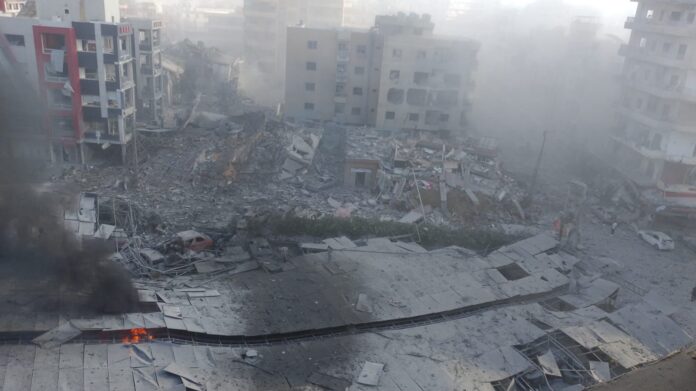
Despite the announcement of a 45-day ceasefire extension in mid-May, military attacks has continued to intensify across southern Lebanon. Air and drone strikes have repeatedly targeted areas in South Lebanon and increasingly the Bekaa Valley, damaging roads, water systems, health facilities, and other critical infrastructure.
For civilians, the impact extends far beyond the immediate threat of bombardment. Damaged transportation routes have disrupted supply chains, making it harder for food and essential goods to reach vulnerable communities. Humanitarian organizations also face significant challenges in delivering aid to those most in need.
In villages across Tyre, Nabatieh, Bint Jbeil, and Marjayoun, many residents remain unable to return home. Houses lie damaged or destroyed, services remain interrupted, and insecurity continues to prevent normal life from resuming.
Displacement on a Massive Scale
The continuing violence has triggered one of Lebanon’s largest displacement crises in recent years. Nearly 130,000 people are currently living in collective shelters, while the majority of an estimated 1.3 million displaced persons are staying with relatives, renting temporary accommodation, or finding refuge in communities across Beirut, Mount Lebanon, and northern governorates.
The influx of displaced families is placing enormous pressure on host communities already struggling with Lebanon’s long-running economic crisis. Schools, public services, housing markets, and local infrastructure are facing unprecedented demand. In some areas, overcrowding and competition for limited resources are beginning to fuel social tensions.
For many displaced families, the uncertainty is overwhelming. Each day away from home means another day without stable employment, another day of mounting expenses, and another day of wondering when, or whether, they will be able to return.
The Growing Cost of Survival
Food and fuel prices remain key constraints on household food access amid Lebanon’s heavy reliance on imports and ongoing insecurity-related disruptions. Below-average 2025 wheat production, intermittent trade disruptions, and localized access constraints, particularly in the south and the Bekaa-Baalbek-Hermel corridor, are placing upward pressure on prices, with bread prices rising 12 percent from mid-February to mid-April and remaining elevated despite national wheat availability that is supported by sustained imports, especially in areas affected by insecurity and transport disruptions. Sharp increases in fuel prices — rising by approximately 84 percent between mid-February and mid-May — due to domestic price adjustments and regional fuel market pressures following the escalation are raising transportation and production costs. These price increases are further eroding household purchasing power, particularly for poor and displaced households.
Lebanon remains heavily dependent on imported food and fuel, making the country particularly vulnerable to disruptions caused by conflict. Combined with lower-than-average wheat production and transportation challenges, the result has been rising prices across basic commodities.
For displaced families who have lost their primary sources of income, the impact is devastating.
Parents report reducing meal portions, purchasing cheaper foods, and relying increasingly on humanitarian assistance to meet basic needs. Poor Lebanese families, Syrian refugees, and Palestinian refugees alike are feeling the strain as purchasing power continues to erode.
Markets Struggle as Livelihoods Disappear
The economic consequences of the conflict are becoming visible across the country.
In southern governorates, markets remain severely disrupted. Supply chains have broken down, traders face difficulties accessing goods, and physical access restrictions continue to limit commercial activity. Meanwhile, areas receiving large numbers of displaced people are experiencing growing pressure on local markets, with increased demand driving further shortages and inflation.
Employment opportunities are also shrinking
Lebanon’s tourism sector, traditionally a key source of seasonal income, has reportedly suffered an 80 percent decline compared to the same period last year. Construction, transport, and service sectors are similarly struggling. At the same time, the arrival of large numbers of displaced workers has increased competition for scarce jobs, pushing wages downward and making it harder for families to earn enough to survive.
In agricultural regions such as South Lebanon, Nabatieh, and Baalbek-Hermel, the wheat and barley harvest season would normally provide important employment opportunities. This year, displacement, damaged infrastructure, and restricted access to farmland have significantly reduced those opportunities.
Aid Efforts Under Pressure
Humanitarian organizations continue to provide critical support, delivering millions of meals, bread distributions, ready-to-eat food rations, and cash assistance to hundreds of thousands of affected people.
Yet aid agencies acknowledge that current assistance remains insufficient compared to the scale of growing needs. Funding shortages threaten to reduce humanitarian operations just as food insecurity is expected to worsen across several governorates in the coming months.
While a revised humanitarian appeal aims to support up to one million people through August, its success depends heavily on securing additional international funding. In conflict-affected areas, operational challenges including movement restrictions, damaged infrastructure, and security risks continue to hamper aid delivery.
هذه المقالة متاحة أيضًا بـ:
 العربية (Arabic)
  Français (French)

