

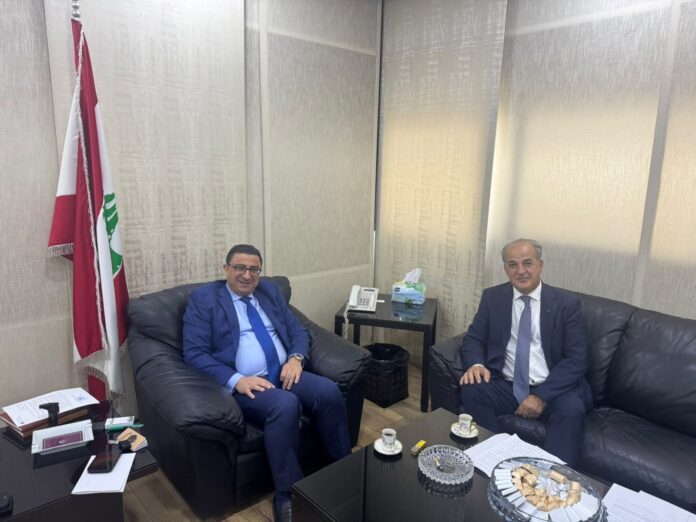
As part of efforts to strengthen institutional cooperation between the National Human Rights Commission of Lebanon, including the National Preventive Mechanism against Torture (NHRC-NPM), and the judicial authorities, and to reinforce the rule of law and the protection of the rights of persons deprived of their liberty, the President of the National Human Rights Commission, Dr. Fadi Gerges, met today with the Public Prosecutor before the Court of Cassation, Judge Ahmad Rami El Hajj, at his office in the Palace of Justice in Beirut.
The meeting focused on the current situation in prisons and places of detention, as well as practical and legal measures to address a number of challenges affecting the proper administration of justice and the fundamental safeguards afforded to detainees.
During the meeting, Dr. Gerges briefed Judge El Hajj on the preliminary results of the NHRC’s initiative to reduce prison overcrowding by submitting applications for the release of detainees who meet the legal conditions set out in Article 108 of the Code of Criminal Procedure. The initiative is being implemented in cooperation with a team of lawyers contracted by the Commission. He explained that the initiative aims not only to alleviate overcrowding but also to safeguard the right to trial within a reasonable time and to prevent the continued pretrial detention of individuals where there is no longer any legal justification.
Dr. Gerges also outlined the Commission’s efforts to ensure the full and effective implementation of Article 47 of the Code of Criminal Procedure, which constitutes one of the most important safeguards of a fair trial. Article 47 guarantees the right of detainees to be assisted by a lawyer from the very first moments of detention, to have legal counsel present during initial interrogations, and to enjoy all procedural guarantees provided under Lebanese law and international human rights standards.
The President of the Commission further noted that the NHRC’s monitoring and fieldwork had revealed a number of structural and procedural shortcomings requiring urgent attention. Among the most significant are cases in which detainees’ files have remained inactive for extended periods, despite judicial decisions ordering their release, particularly where detainees lack legal representation. Such situations have resulted in the unlawful continuation of detention.
Dr. Gerges also highlighted difficulties encountered in determining the whereabouts of certain detainees, as well as the lack of cooperation by some police stations, security units, and law enforcement bodies in responding to requests concerning places of detention or informing court registries and public prosecution offices of detainees’ locations. These shortcomings negatively affect judicial proceedings and delay the execution of judicial decisions.
He further explained that the Commission had documented cases in which the case file remained before one judicial authority while the detainee was being held, on a custodial basis, at another detention facility. This disconnect hampers case management, delays the implementation of judicial decisions, and further complicates criminal proceedings.
In the same context, Dr. Gerges raised concerns regarding the conduct of preliminary investigations involving children in conflict with the law. He noted the continued occurrence of cases in which juvenile protection officers do not physically attend interrogation sessions, despite the legal requirement to do so, and instead participate remotely. He stressed the need to adopt the necessary measures to ensure that children receive the full legal protections guaranteed under Lebanese legislation and the Convention on the Rights of the Child.
In light of these challenges, the President of the Commission requested that the Public Prosecutor’s Office adopt a number of practical and administrative measures, including:
- Issuing a circular to all security agencies, particularly the Information Branch of the Internal Security Forces, instructing them to facilitate lawyers’ access to places of detention and ensure their presence during preliminary interrogations, in accordance with Article 47 of the Code of Criminal Procedure.
- Circulating instructions to public prosecution registries to facilitate the work of lawyers contracted by the National Human Rights Commission by granting them access to investigation registers and judicial files necessary for locating and following up on detainees’ cases.
- Issuing instructions to the registries of criminal courts to facilitate the processing of release applications submitted by lawyers cooperating with the Commission, ensuring that such applications are handled promptly and are not delayed by administrative procedures.
- Authorizing lawyers contracted by the Commission to access all detention facilities operated by the various security agencies, including detention facilities under the Information Branch, the Lebanese Armed Forces Directorate of Intelligence, and the General Directorate of General Security, enabling them to provide legal assistance and monitor detainees’ conditions in accordance with the law.
For his part, Judge Ahmad Rami El Hajj affirmed the Public Prosecutor’s Office’s interest in the issues raised by the Commission and stressed the importance of strengthening cooperation with the National Human Rights Commission.
Judge El Hajj expressed his readiness to take the necessary measures to address the identified challenges, including through the issuance of appropriate circulars and directives to security agencies, public prosecution offices, and court registries. These measures, he noted, would facilitate the work of the National Human Rights Commission and its cooperating lawyers, experts, and volunteers, while strengthening respect for detainees’ legal safeguards and promoting the proper administration of justice.
Judge El Hajj also announced his intention to designate Judge Rahif Ramadan as the permanent liaison between the Public Prosecutor’s Office before the Court of Cassation and the National Human Rights Commission. This coordination mechanism will serve to enhance communication, ensure effective follow-up on matters of mutual concern, and remove obstacles that may impede the Commission in the exercise of its legal mandate.
Concluding the meeting, Judge El Hajj confirmed that he would personally oversee sensitive cases referred to him by the National Human Rights Commission whenever warranted by their nature, in order to ensure their prompt examination and the adoption of appropriate legal measures.
هذه المقالة متاحة أيضًا بـ:
 العربية (Arabic)
  Français (French)

