

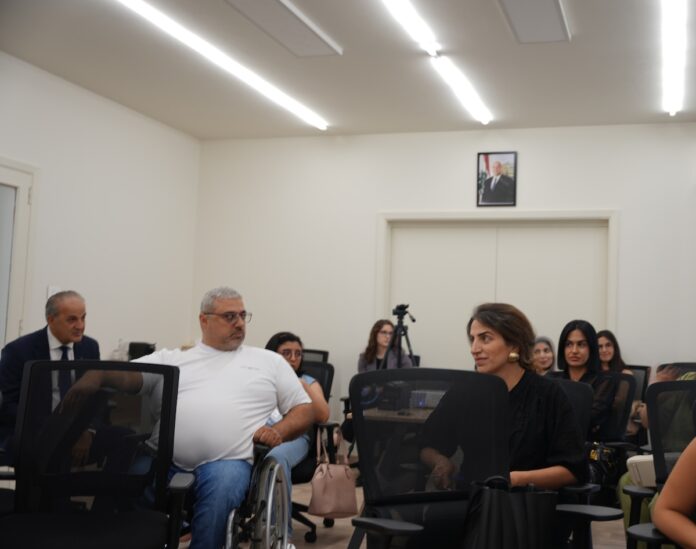
The National Human Rights Commission, including the Committee for the Prevention of Torture, convened the second session of its monthly dialogue series, “Connecting for Rights,” dedicated to the theme “Advancing the Rights of Persons with Disabilities in Lebanon.”
The meeting brought together Sabine Saad of the National Commission for Lebanese Women; Fadia Farah of the Lebanese Association for Self-Advocacy (LASA); Taghrid Awad of the United Nations Relief and Works Agency for Palestine Refugees in the Near East (UNRWA); Fadi Halabi of the Ecumenical Disability Advocates Network (EDAN); Qusai Abboushi and Randa Abdo of the Forum for the Rights of Persons with Disabilities; Tawfiq Rizkallah and Dolly Bassil of Partners for Development; Dana Charafeddine of the Friends of Disabled Association; as well as representatives of the Coalition of Organizations of Persons with Disabilities in Lebanon, civil society organizations, and other stakeholders and experts working in the field of human rights. The meeting was held at the Commission’s headquarters in Beirut.

The meeting was opened by Dr. Fadi Gerges, President of the National Human Rights Commission, who emphasized that the “Connecting for Rights” series serves as a permanent national platform for dialogue, consultation, and cooperation between the Commission and its partners. He stressed that the initiative is grounded in the firm belief that the protection of human rights is a shared responsibility requiring genuine partnerships among national institutions, civil society organizations, and rights holders. Dr. Gerges also reaffirmed the Commission’s commitment, in accordance with its mandate under Law No. 62/2016 and the Paris Principles, to promoting participation, openness, and strengthening its role as Lebanon’s independent national institution for the promotion and protection of human rights.
Dr. Gerges noted that dedicating the meeting to the rights of persons with disabilities reflects the Commission’s conviction that respect for their rights is a fundamental indicator of the State’s commitment to equality, non-discrimination, and human dignity. He stressed that the current priority is to move beyond the formal recognition of rights toward ensuring their effective realization, enabling persons with disabilities to participate fully and effectively in all aspects of public life. He further underscored that the Commission recognizes persons with disabilities as rights holders and partners in decision-making—not as passive recipients of care or services—and reaffirmed its commitment to the principle of “Nothing About Us Without Us” in all matters concerning disability rights.
During the meeting, Dr. Gerges officially announced the launch of the Committee on the Rights of Persons with Disabilities within the National Human Rights Commission. The Committee will serve as a permanent institutional framework for strengthening cooperation with organizations of persons with disabilities, supporting the independent monitoring of the implementation of the Convention on the Rights of Persons with Disabilities (CRPD), and promoting the protection of rights and freedoms in accordance with the Convention and Lebanon’s national legal framework.
The Commission’s Commissioner for International Relations and Information, Bassam Al Kantar, then delivered a presentation outlining the legal framework for independent monitoring under Article 33(2) of the CRPD, highlighting the Commission’s role as Lebanon’s independent national mechanism for promoting, protecting, and monitoring the Convention’s implementation in accordance with the Paris Principles. He also presented the mandate and priorities of the newly established Committee on the Rights of Persons with Disabilities for the period 2026–2030, including aligning national legislation with the Convention, monitoring the implementation of the National Strategy for the Rights and Inclusion of Persons with Disabilities, strengthening the meaningful participation of persons with disabilities and their representative organizations in decision-making, improving accessibility, enhancing protection against violence and abuse, promoting inclusive education and decent work, and developing national disability-related data collection systems.
The meeting also reviewed the Commission’s contributions to strengthening the national legal and policy framework for the rights of persons with disabilities. These included its legal opinion on the terminology relating to persons with disabilities, its advocacy for adopting a human rights-based approach consistent with the Convention, and its contribution to the development and launch of the Arab Guide to Human Rights Education in Schools, prepared in partnership with the Arab Network of National Human Rights Institutions (ANNHRI) and the Office of the United Nations High Commissioner for Human Rights (OHCHR), with the aim of integrating the principles of the Convention into educational curricula.
Participants emphasized the importance of strengthening institutional cooperation between the National Human Rights Commission and organizations of persons with disabilities, recognizing them as essential partners in independent monitoring and decision-making in accordance with Article 33(3) of the Convention, while reinforcing the Commission’s independence and its national mandate to promote and protect human rights.
The meeting concluded with a set of key priorities and recommendations. Participants called for strengthening the role of the National Human Rights Commission as Lebanon’s independent mechanism for promoting, protecting, and monitoring the implementation of the Convention on the Rights of Persons with Disabilities; enhancing institutional cooperation with organizations of persons with disabilities in line with the principle of “Nothing About Us Without Us”; accelerating the alignment of national legislation and public policies with the Convention and its Optional Protocol; and supporting the implementation of the National Strategy for the Rights and Inclusion of Persons with Disabilities (2026–2030). They also stressed the importance of ensuring the effective participation of persons with disabilities and their representative organizations in legislative processes, public policymaking, and monitoring mechanisms; improving accessibility to public services and facilities; advancing inclusive education, decent work, and protection from all forms of discrimination and violence; and strengthening national data collection systems and indicators to measure progress in the realization of the rights of persons with disabilities in accordance with international human rights standards.
In closing, Dr. Gerges announced that the third session of the “Connecting for Rights” series will take place on Thursday, 13 August 2026, under the theme “Towards a National Drug Policy: From Criminalization and Punishment to a Public Health and Human Rights-Based Approach.” The meeting will discuss the preparation of the first national draft Charter on the Rights of People Affected by Drug Use, as well as mechanisms for implementing the International Guidelines on Human Rights and Drug Policy at the national level, with the objective of promoting a more effective and humane drug policy centered on public health, human dignity, and respect for human rights.
The National Human Rights Commission concluded by reaffirming its commitment to keeping its doors open to all partners and rights holders, strengthening dialogue and consultation with all relevant stakeholders, promoting a culture of human rights, advancing the principles of equality and non-discrimination, and contributing to the building of a more inclusive, just, and rights-respecting Lebanon.
هذه المقالة متاحة أيضًا بـ:
 العربية (Arabic)
  Français (French)

