
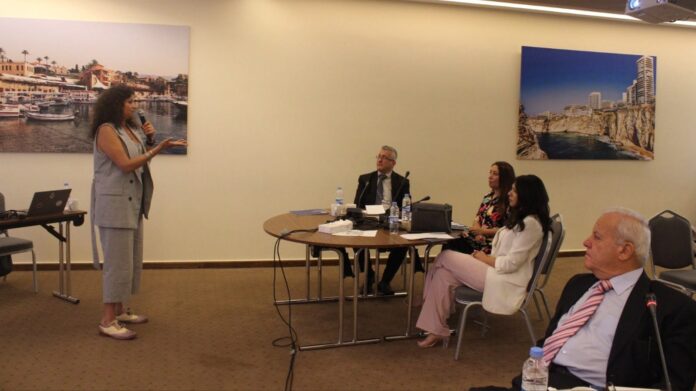
The Lebanese Center for Human Rights (CLDH), in partnership with the Danish Refugee Council (DRC) and with the financial support of the European Union’s Directorate-General for European Civil Protection and Humanitarian Aid Operations (DG ECHO) in Lebanon, organized a high-level roundtable discussion entitled “Bridging the Justice Gap: Strengthening Legal Aid and Access to Justice Frameworks.”
The event brought together representatives of national institutions, judicial authorities, the legal profession, international organizations, and civil society organizations to discuss the challenges affecting legal aid and access to justice in Lebanon, particularly for persons deprived of their liberty.
The National Human Rights Commission of Lebanon, including the Committee for the Prevention of Torture (NHRC-CPT), participated in the roundtable through Committee members Dr. Josiane Maroun Madi Skaff and Mr. Raymond Medlej.
The discussions focused on the current state of legal aid and access to justice for persons deprived of their liberty in Lebanon, particularly in the context of the ongoing conflict and its impact on detention conditions, judicial proceedings, and the functioning of justice institutions. Participants examined the structural and operational challenges limiting detainees’ access to legal representation and fair trial guarantees, while identifying both immediate and long-term solutions to strengthen legal aid services and improve access to justice.
The roundtable also explored opportunities to reinforce coordination and cooperation among judicial authorities, bar associations, legal aid providers, national human rights institutions, and civil society organizations to ensure that persons deprived of their liberty, as well as victims of human rights violations, have effective access to legal assistance and judicial protection.
During the discussion, Executive Director of the Lebanese Center for Human Rights (CLDH), stressed the broader significance of legal aid, stating:
“This crisis should be understood as a protection crisis, as well as a justice issue. Legal aid is an investment in trust.”
Participants agreed that accessible and effective legal aid is a cornerstone of the rule of law and one of the most important safeguards against arbitrary detention, torture, and other forms of ill-treatment. They emphasized that timely access to qualified legal representation from the earliest stages of detention is essential for protecting fundamental rights, ensuring fair trial guarantees, and preventing human rights violations.
The NHRC-CPT reaffirmed its commitment to promoting equal access to justice and strengthening safeguards for persons deprived of their liberty. The Commission emphasized that legal aid is an integral component of torture prevention and an essential guarantee for protecting the rights of detainees, ensuring accountability, and reinforcing public confidence in the justice system.
Marking the International Day in Support of Victims of Torture, the NHRC-CPT reiterated the importance of strengthening Lebanon’s legal aid framework through sustained cooperation between State institutions, judicial authorities, bar associations, civil society organizations, and international partners. It called for continued efforts to remove barriers to justice, improve legal protection for vulnerable groups, and uphold the principles of fairness, equality before the law, and respect for human dignity in accordance with Lebanon’s national and international human rights obligations.
هذه المقالة متاحة أيضًا بـ:

