


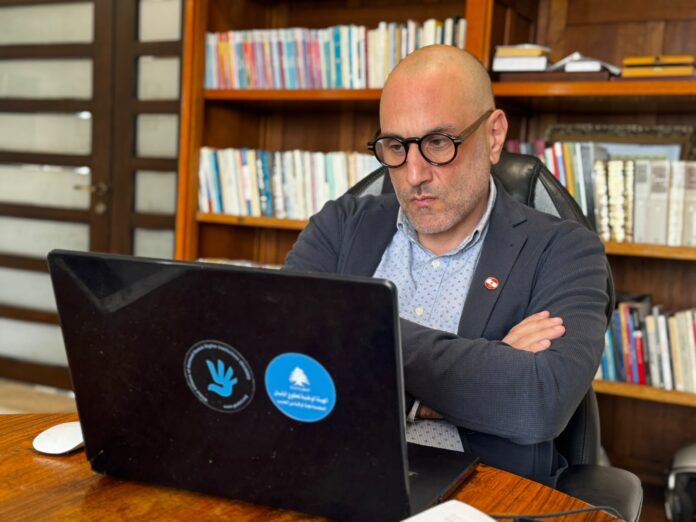
Beirut, 17 November 2026 — Lebanon’s National Human Rights Commission, including the Committee for the Prevention of Torture (NHRC-CPT), participated in the regional consultation for the Middle East and North Africa on “Children’s Rights and Safety in the Digital Environment”, organised online by the Office of the United Nations High Commissioner for Human Rights (OHCHR) on Tuesday, 17 November 2026, pursuant to Human Rights Council resolution 56/6.
The Commission was represented by its Commissioner of International Relations and Information, Bassam Al Kantar, who delivered an oral statement on its behalf. The Commission also submitted a written contribution assessing digital risks, legislative developments and protection gaps, with recommendations to strengthen the responsibilities of States and businesses and safeguard children’s rights.
The consultation forms part of a global process to gather evidence, expertise and good practices from different regions to inform OHCHR’s report to the Human Rights Council at its sixty-fourth session, scheduled for early 2027. Moderated by Wafa Ben Hassine, Chief of OHCHR’s Digital Technology and Human Rights Section, the event brought together representatives of government institutions, regional and international organisations, and child protection experts, alongside a child representative from the Arab Parliament for the Child.
Protection encompassing all children’s rights
In his statement, Al Kantar stressed that protection in the digital environment must enable children to exercise all their rights, including privacy, education, freedom of expression, access to information and participation. He emphasised the need to address risks arising from platform operations and business models, including exploitative data practices, manipulative design, harmful recommendation systems, grooming and emerging forms of abuse involving artificial intelligence.
“Protection should not require excessive disclosure of children’s identities or exclude them from essential information and support,” Al Kantar said, stressing that children must play a central role in determining whether protective measures make their digital lives safer.
The oral statement identified three interconnected priorities: establishing enforceable duties for platforms, including risk assessments, protective default settings, accessible reporting mechanisms and effective remedies; ensuring that age restrictions and age-assurance mechanisms are lawful, necessary and proportionate; and securing sustained funding for digital literacy, psychosocial services, specialist investigations and independent oversight, with children meaningfully involved in designing and evaluating these measures.
Clear legislation and enforceable responsibilities
The written contribution drew on the Commission’s study on protecting children in the digital environment, its contribution published on 7 October 2026, and its advisory opinions on relevant Lebanese legislative proposals.
The Commission explained that regulation must account for the different functions and risks of digital services and address specific features, such as public accounts, unsolicited contact, geolocation and algorithmic recommendations. It also called for explicit safeguards governing age assurance, including data minimisation, limits on retention and reuse, accessible alternatives and human review of automated decisions that adversely affect children.
Al Kantar referred to the Commission’s advisory opinion published on 15 November 2026, which welcomed a Lebanese legislative proposal’s attention to service-provider responsibilities while recommending substantive amendments to clarify definitions, strengthen safeguards and establish clear institutional responsibilities, oversight and implementation mechanisms.
The written contribution also highlighted the importance of enabling children to report without prior parental authorisation, rejecting general monitoring of communications and ensuring that proposed provisions do not expose children to inappropriate prosecution.
Assessing protection through children’s experiences
The Commission stressed the need to address gaps in evidence and capacity and establish indicators that measure actual outcomes, including access to assistance, response times, recurring harm, privacy breaches and unjustified exclusion. It emphasised that content-removal figures alone cannot demonstrate the effectiveness of protective measures.
It also called for an assessment of how such measures affect children facing barriers related to disability, language, economic circumstances or migration status, while ensuring that children receive understandable explanations of decisions affecting them and can challenge those decisions.
The Commission concluded by calling for practical regional cooperation that delivers effective protection in Arabic and strengthens lawful preservation of digital evidence, urgent referrals and cross-border remedies, while respecting privacy and due process. It affirmed that national human rights institutions can contribute, within their mandates, through legislative scrutiny, monitoring and complaints handling, with progress assessed against children’s safety, rights and actual experiences.
هذه المقالة متاحة أيضًا بـ:
 العربية (Arabic)
 Français (French)

