

Care depends on people who can work safely: nurses attending to patients, doctors performing emergency surgery, ambulance crews reaching the wounded, and rescue teams searching beneath collapsed buildings.
For Lebanon, the International Day of Care and Support, observed on 29 October, must place the protection of these workers at the centre of public attention. Israeli military attacks during 2024 and the renewed escalation in 2026 have killed health workers, damaged medical infrastructure and disrupted emergency services. Public investigations have documented unlawful attacks and identified incidents requiring investigation as war crimes.
Recognizing care workers must therefore mean protecting their lives, preserving the services they provide and pursuing accountability for violations.
Care is a human rights issue
The United Nations established the International Day of Care and Support through General Assembly resolution 77/317. The observance recognizes paid and unpaid care and calls for resilient, inclusive care systems, decent working conditions and greater equality.
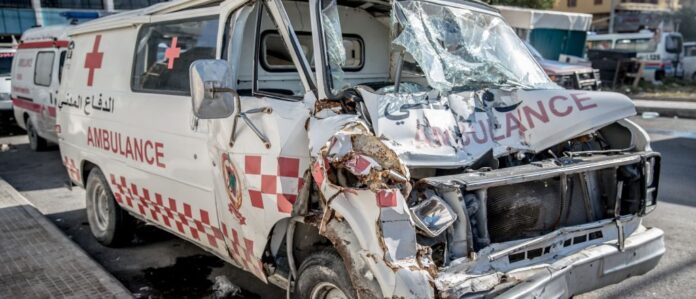
In Lebanon, these objectives are inseparable from the protection of health care during armed conflict. A hospital cannot provide reliable care when its staff face attack. A rescue service cannot reach injured civilians when its ambulances are destroyed or its crews fear being struck while responding.
Protecting those who provide care is essential to protecting everyone who needs it.
2024: documented attacks on medical workers and facilities
In its investigation published on 30 October 2024, Human Rights Watch documented three Israeli attacks involving apparent war crimes:
- A 3 October strike on a civil defence centre in Bashoura, Beirut, which killed seven paramedics.
- A 4 October strike on an ambulance near Marjayoun Hospital, which killed seven paramedics and forced the hospital to close.
- An attack that same day on Salah Ghandour Hospital in Bint Jbeil.
Human Rights Watch reported that it found no evidence of military use that would justify removing the protected status of the medical personnel, transports and facilities concerned. These were investigative findings of apparent war crimes, rather than judicial convictions. The wider impact was severe. WHO reported 226 health workers and patients killed and 199 injured in attacks on health care between 7 October 2023 and 18 November 2024. These figures include patients and cover a period beginning in 2023; they should not be presented as a count of medical workers killed during 2024 alone. WHO also reported that 15 of Lebanon’s 153 hospitals had ceased operating or were functioning only partially.
2025–2026: continuing insecurity and renewed attacks
The period following the November 2024 cessation-of-hostilities arrangement did not bring an end to civilian harm. An OHCHR report published in April 2026 stated that Israeli military operations continued almost daily thereafter, with 139 civilian deaths verified up to 1 March 2026. This is a civilian casualty figure, not a count of health workers.
Following the renewed escalation on 2 March 2026, attacks on health care again became a major concern. A WHO health brief dated 28 April 2026 reported 150 attacks on health care since 2 March, resulting in 103 deaths and 234 injuries. These are dated monitoring figures, not totals for the whole of 2026 or a determination of criminal responsibility for every incident.
On 19 March 2026, Amnesty International called on Israel to halt attacks on health workers, medical facilities and first responders. It warned that the renewed attacks echoed violations documented in 2024 and challenged unsupported allegations that ambulances and medical sites were being used for military purposes.
The documented recurrence strengthens the need for independent investigations, immediate protective measures and effective remedies for victims.
What international humanitarian law requires
Medical personnel, hospitals, medical units and ambulances performing their medical functions must be respected and protected. This protection applies to doctors, nurses, paramedics and other medical workers. Civilian rescue workers also benefit from civilian protection, alongside any applicable specific protection for their functions.
The ICRC’s guidance for Lebanon explains that parties must protect medical services and must not obstruct their work. Attacking forces must verify targets, take all feasible precautions and comply with the prohibition on disproportionate attacks. These obligations apply to every party to the conflict.
Three principles are particularly relevant to Lebanon:
Treating wounded fighters does not remove protection. Providing medical care to wounded or sick combatants who are no longer participating in hostilities is a protected humanitarian activity. Medical decisions must follow patients’ needs.
Political affiliation alone does not make a medic a lawful target. Amnesty International emphasized that working for an institution associated with Hezbollah does not, by itself, remove civilian protection or justify directly attacking personnel performing humanitarian duties.
An evacuation warning does not automatically make an attack lawful. Loss of a hospital’s special protection requires specific legal conditions, including harmful acts outside its humanitarian function and the applicable warning requirements. Even then, proportionality and precautions remain binding, and patients and uninvolved medical personnel remain protected.
Attacks on rescuers require particular scrutiny
Emergency teams often arrive immediately after a strike, when wounded people urgently need evacuation. A subsequent attack can kill rescuers and prevent assistance from reaching survivors.
Reports of repeated strikes at rescue scenes require careful investigation into timing, visibility, target identification and what the attacking forces knew. Deliberately attacking protected medics performing humanitarian duties can constitute a war crime. Establishing responsibility requires evidence concerning each incident and the relevant criminal intent.
Nurses and patients bear consequences beyond the initial strike
The damage extends beyond those killed or injured at the moment of an attack. WHO has highlighted consequences including interrupted treatment, reduced vaccination and barriers to maternal, sexual and reproductive health services. Losing skilled workers also weakens the health system’s ability to recover.
For Lebanon, supporting care should therefore include nurses’ safety, reliable salaries, adequate staffing, protective equipment, transport and psychological support. Families caring for injured or disabled relatives also need accessible rehabilitation and social assistance.
Hospitals must be rebuilt as functioning services, with staff, equipment, medicines and dependable utilities.
Priorities for Lebanon and its international partners
The International Day of Care and Support should encourage concrete action:
- Prevent unlawful attacks: Protect medical workers, civilian rescuers, patients, hospitals and medical transport.
- Enable rescue and treatment: Ensure timely access to wounded people and safe medical evacuation.
- Investigate alleged violations: Preserve evidence and examine individual incidents and possible patterns of unlawful conduct.
- Support victims and families: Provide rehabilitation, psychological care, compensation and other appropriate reparations.
- Restore care services: Finance functioning hospitals, emergency services and accessible community care.
- Support the workforce: Include nurses, ambulance crews and rescue workers in decisions about safety and recovery.
Lebanon’s care workers have continued serving communities under extraordinary danger. Honouring them requires protection and accountability, alongside sustained investment in the services on which people’s lives depend.
Care workers must be able to save lives without becoming targets themselves.
Public references
- United Nations — International Day of Care and Support
- General Assembly — Resolution 77/317
- WHO — Lebanon: A conflict particularly destructive to health care, 22 November 2024
- Human Rights Watch — Lebanon: Israeli Attacks on Medics Apparent War Crimes, 30 October 2024
- Amnesty International — Israel must halt attacks on healthcare workers, medical facilities and first responders, 19 March 2026
- OHCHR — Update on the Human Rights Situation in Lebanon, April 2026
- WHO — Lebanon Health Brief, 18 March–28 April 2026
- ICRC — Lebanon: Frequently asked questions about international humanitarian law
- ICRC — The protection of hospitals during armed conflicts: What the law says
هذه المقالة متاحة أيضًا بـ:
 العربية (Arabic)
 Français (French)

