


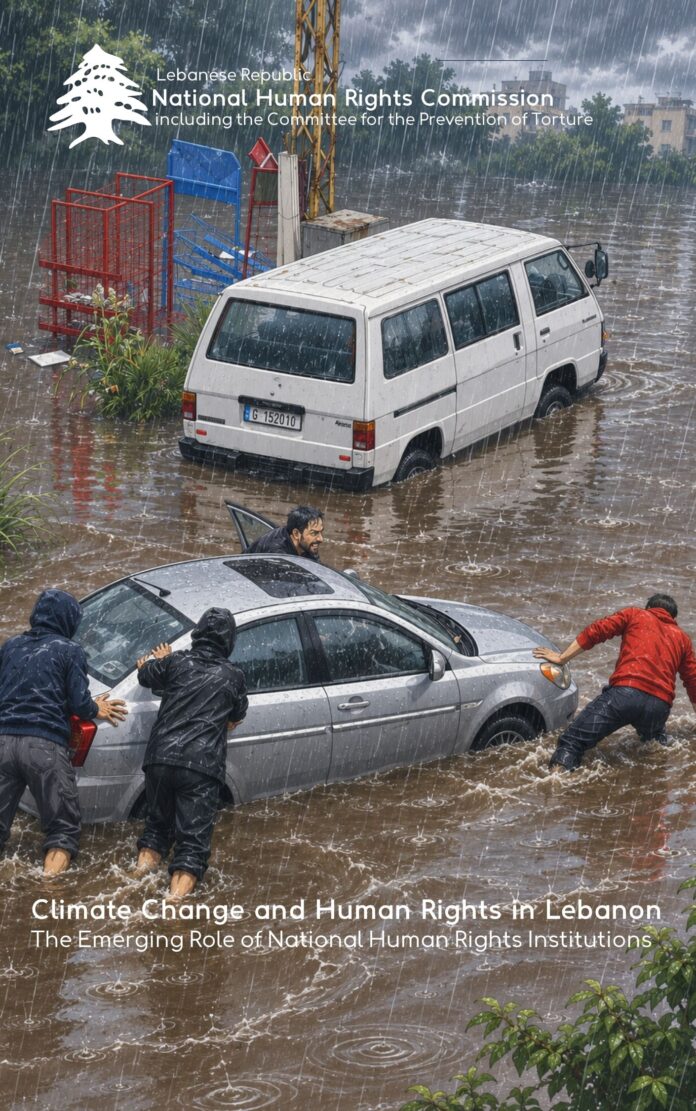
Climate Change and Human Rights in Lebanon: The Emerging Role of National Human Rights Institutions
Publisher: Lebanese Republic | National Human Rights Commission, including the Committee for the Prevention of Torture (NHRC-CPT)
Author: Bassam Al Kantar — Commissioner of International Relations and Media, National Human Rights Commission
Key Abbreviations
| Meaning | Abbreviation |
| Nationally Determined Contribution | NDC |
| Third Nationally Determined Contribution | NDC 3.0 |
| Biennial Transparency Report | BTR |
| First report | BTR1 |
| National Adaptation Plan | NAP |
| Business-as-usual scenario | BAU |
| Greenhouse gases | GHG |
| Carbon dioxide equivalent | CO₂eq |
| Gigagram, equivalent to one thousand tonnes | Gg |
| Global Alliance of National Human Rights Institutions | GANHRI |
| National human rights institution | NHRI |
| National Human Rights Commission, including the Committee for the Prevention of Torture | NHRC-CPT |
| Rapid Damage and Needs Assessment | RDNA |
| Lebanon Emergency Assistance Project | LEAP |
Executive Summary
This study examines the effects of climate change and responses to it on human rights in Lebanon, in a context of fragile services, economic crisis and the consequences of conflict. National evidence shows that the decline in emissions recorded after 2019 was substantially associated with declining electricity production and economic activity; it cannot, on its own, demonstrate a just transition. Water and reconstruction data also show that service continuity and affordability are decisive in translating climate targets into effective protection.
Comparing human rights rules with national documents yields three findings: an existing legal basis for monitoring, information and environmental assessment; climate plans that are more recent than the data measuring their implementation; and a need to connect inventories and finance with outcomes distributed across regions and groups. This documentary review neither establishes violations in individual cases nor attributes conflict losses to climate change. It identifies available facts and questions requiring field verification.
The study proposes an initial one-year work cycle for the Commission on water and extreme heat, starting with three purposively selected sites. It includes establishing a baseline, documenting barriers to services, addressing urgent reports within the Commission’s mandate, and issuing a report and follow-up register. Part Five sets out minimum resources, an expansion option, indicators and verification dates. The recommendations remain proposals made by the study, subject to institutional deliberation.
On standards, the study finds that existing human rights rules provide a basis for assessing climate action, although their legal force and avenues for invoking them differ. On evidence, Lebanese documents establish inventories, commitments, certain service activities and recovery needs, but do not independently establish equitable implementation or adequate prevention at every site.
The institutional comparison identifies monitoring, advice, complaints and cooperation as adaptable tools, subject to the limits of the mandate and the independence of preventive work. A feasible programme begins with a limited cycle on water and heat, transparent resources, a baseline and follow-up. The study’s practical value ultimately depends on producing local evidence that affected people and authorities can use to determine what has changed and who is responsible for completing the work.
Introduction and Methodology
How can climate commitments become verifiable protection in Lebanon? The study addresses four interconnected questions: Which human rights standards apply to mitigation and adaptation decisions? What do Lebanese documents establish about risks, services and implementation, and what remains unknown? Which tools of national institutions are available in Lebanon? And how can a Commission programme balance priorities and resources while producing measurable results?
The study uses documentary legal analysis and a selective functional comparison. The review covers the Fourth National Communication, the First Biennial Transparency Report and its technical review, the Third Nationally Determined Contribution, the National Adaptation Plan, and the study on derisking renewable energy investment. These documents were selected because they establish, respectively, the information base, targets, implementation options and financing. They were supplemented by UNICEF programme data and World Bank damage and reconstruction assessments.[1]
Comparative practice was selected for its different functions: judicial precedents to interpret obligations, standing and remedies; national inquiries to understand evidence gathering and hearings; and the European survey to analyse patterns of institutional engagement. This is a selective analytical sample, not a comprehensive systematic literature review, and it cannot rank institutions by performance. Priority is given to original legal texts, judgments and documents; secondary studies are used for interpretation and comparison.
The study includes no original interviews or field visits, nor independent measurements of water quality, heat burden or financial disbursement. Its sources are affected by differences in coverage, currency and definitions, and possible underreporting. Information is presented as published information, interpretation as analytical inference, and future action as a recommendation. Hypothetical examples are identified and are not attributed to real people or towns.
‘Mitigation’ means reducing emissions or enhancing their removal; ‘adaptation’ means adjusting systems and policies to address current or expected impacts; and ‘maladaptation’ means a measure that increases vulnerability or transfers risk. ‘Loss and damage’ refers to impacts that cannot be wholly avoided through available mitigation and adaptation. Risk varies with the climate hazard, exposure and vulnerability; event severity is therefore not equated with the severity of human rights harm. ‘Grievance’ refers to a request to review a decision or address a complaint; ‘remedy’ to effective avenues and responses; and ‘reparation’ to addressing harm for which the conditions of responsibility have been established.[2]
The study’s original contribution is a Lebanese framework connecting the standard governing a right, the national document, the responsible body and evidence of implementation. It applies this framework to emissions accounting, water continuity, energy financing and reconstruction, then translates it into a limited Commission programme. It claims neither to invent international standards nor to provide a new national measurement. Its value lies in adapting existing tools to a specific institutional and service context.
The study assigns distinct functions to five parts: the first sets out human rights rules and their legal force; the second examines institutional tools and comparative practice; the third presents a method for assessing harm and intervention safeguards; the fourth analyses Lebanese facts and documents; and the fifth addresses implementation and recommendations. Information and participation safeguards are explained once in their methodological context, with applications referring back to that discussion rather than repeating the entire framework.
Part One The Human Rights Basis for Climate Action
Chapter One From Climate Risk to Impacts on Rights
Heatwaves affect the rights to life, health, work and housing through income and service conditions. A day labourer may be unable to stop working, a household may be unable to afford safe cooling, and an older person may lack transport to a cooler place. These are explanatory examples of exposure pathways, not individual cases documented by this study in Lebanon. Hospital data help measure severe outcomes but may exclude people unable to access care; they should therefore be read alongside data on work, housing and access to services.[3]
Water disruption also affects health, education and work. As supply hours decline, the ability to buy and safely store water becomes decisive. Collection, household management and care may fall disproportionately on particular family members, while a school may be unable to keep its toilets usable. The right to water is examined through availability, safety, physical accessibility and affordability. This requires monitoring the total cost to households of public services, private alternatives, transport and storage, and whether they must cut other essential needs to pay for water.[4]
Small farmers face risks extending beyond the loss of one season’s harvest. Repeated drought can raise irrigation and feed costs, accumulate debt or force sales of productive assets, affecting seasonal workers and local vendors. Responses concern the rights to food, work and social security, and access to extension services, credit and insurance for tenants and small producers. Compensation limited to registered owners may favour those holding documents, leaving workers’, tenants’ and herders’ losses uncounted. Prevention therefore requires eligibility criteria that reflect actual harm and its connection to livelihoods, allowing proof through reasonable means.
In housing, floods and fires combine immediate danger with long-term consequences. Evacuating an at-risk building may save lives, yet displacement may persist because affordable alternative accommodation is unavailable or schooling and employment are disrupted. Responses must examine shelter safety and accessibility, privacy and family unity, continued treatment and education, and procedures for replacing documents. When considering permanent relocation, attention must be paid to residents’ options, transport costs and the ability to preserve community ties and income sources, with participation, grievance procedures and compensation where applicable.[5]
Risks are greater in places people cannot freely leave. In detention, avoiding heat and obtaining water and care depend on management measures. Within its mandate, the preventive body can examine ventilation, drinking water access, power outage plans, medical responses and evacuation arrangements. This differs from monitoring municipal performance or considering individual compensation claims. The example shows how climate indicators can be integrated into existing oversight tools according to each mandate, while protecting confidential testimony and addressing retaliation risks.[6]
Assessing harm requires distinguishing attribution science from what a legal case file establishes. A scientific study may show that warming increased the probability or intensity of a heatwave, within a range of uncertainty. This can support risk foreseeability and the need for preparedness. In an individual case, an investigator may need further evidence on the location and duration of exposure, the person’s condition, available measures, and whether a service failure contributed to harm. Confusing these levels can overstate evidence or exclude useful information. In preventive monitoring, the severity and foreseeability of risk may justify requesting reasonable measures before a particular loss can be attributed.
The effect of uncertainty on decisions can be tested by asking whether a measure works under several scenarios. Repairing major leaks, protecting facilities against power cuts and improving access to warnings may yield benefits despite differing estimates of drought severity or heat frequency. When a measure is costly or may transfer risk elsewhere, alternatives analysis and periodic review become more important. A review trigger linked to a known indicator, such as a change in average outage duration or a facility exceeding its response capacity, enables officials to adjust policy as risks change or previously unidentified costs emerge.
Chapter Two State Duties and Procedural Rights
Article 6 of the International Covenant on Civil and Political Rights provides a basis for protecting life; Articles 11 and 12 of the International Covenant on Economic, Social and Cultural Rights address an adequate standard of living and health. These obligations are read alongside equality and non-discrimination and the right to an effective remedy under applicable provisions. The duty to respect requires examining the effects of authorities’ own decisions; the duty to protect requires regulating third parties; and the duty to fulfil requires practical measures and resource allocation. For economic and social rights, it is useful to distinguish progressive realization within maximum available resources from immediate duties, including non-discrimination and taking concrete, deliberate steps.[7]
Different Levels of Legal Authority
Treaties in force for Lebanon, applicable customary rules, national laws and regulations are used according to their scope and rules of effect. Treaty bodies’ general comments provide expert interpretations of obligations; they do not constitute separate treaties. General Assembly resolutions, the Paris Principles, guiding principles and practical manuals provide interpretive and institutional standards, without becoming equivalent to binding provisions simply because they appear in a footnote.
Judgments bind their parties according to the relevant legal system; foreign judgments do not automatically have binding authority in Lebanon. They are useful through comparison of provisions, jurisdiction, standing, facts and the relief sought. The International Court of Justice’s advisory opinion does not itself have the authority of a judgment between parties to a dispute, while the international obligations it explains retain their original legal force. Every local application requires identifying the applicable rule and competent avenue.
Due diligence can be examined through the foreseeability and seriousness of risk, authorities’ knowledge and the reasonable means available to reduce it. Where maps identify flood-prone areas, questions arise about whether licensing bodies received and used them in setting building, warning and evacuation requirements. Assessing adequacy requires verifying implementation and testing preparedness, then comparing what was known when the decision was made with later findings. Claims for compensation for specific harm require examining causation, evidence and jurisdiction under the applicable rule and available procedure.
The procedural dimension includes early, usable information: draft projects and alternatives, risk data, assessment methods, affected groups, financing sources and monitoring results. Technical texts and accessible summaries should be published together, with oral or written submissions and times and locations accommodating work, care and disability. A response register shows what consultation changed and why alternatives were rejected. Participation is more valuable when residents can discuss project location or conditions before contracts are signed and can raise objections during operation.[8]
Children have a right to have their best interests considered and to be heard in decisions affecting them. In schools, this means assessing how closures or shorter hours affect education, nutrition and transport, and hearing children in age-appropriate ways that protect their information. The Convention on the Rights of Persons with Disabilities requires necessary protective measures in situations of risk and emergency, alongside accessibility and participation. Monitoring tests whether sirens, written messages, evacuation routes and transport accommodate diverse needs, and whether persons with disabilities and their organizations helped test them.[9]
Chapter Three The International Climate Regime Equity and Remedy
The Paris Agreement establishes a collective temperature goal and a process for nationally determined contributions, successive progression and transparency, addressing adaptation, finance, and loss and damage. Its preamble recalls human rights when taking action on climate change. States’ responsibilities are read in light of equity and common but differentiated responsibilities and respective capabilities, in the context of differing national circumstances. This requires Lebanon to develop implementable measures within its capabilities and identify support needs, while relevant international actors consider their obligations and roles in finance, cooperation and technology transfer.[10]
The International Court of Justice issued its advisory opinion on States’ climate change obligations on 23 July 2025. It is neither a judgment in a Lebanese dispute nor an order to compensate particular individuals, but it clarifies applicable international law. The Court rejected reducing obligations to climate treaties alone: those treaties are read together with rules on preventing significant environmental harm, cooperation and human rights. Its value here is to establish a legal benchmark for examining policies, while leaving proof of responsibility in each case to the competent process.[11]
Due diligence examines whether a State took reasonable measures proportionate to risk severity, scientific knowledge and its capabilities. It encompasses prevention, assessment, monitoring and regulation of relevant private activities, and is not satisfied merely by announcing a plan. A State’s small share of global emissions does not render its regulatory role irrelevant; differing capabilities remain relevant to assessing required measures and cooperation.[12]
Human rights analysis also extends to protection against harmful impacts. In Lebanon, one can examine whether risk information informed facility licensing or reconstruction, and whether measures protected essential services and groups lacking alternatives. These are applications proposed by the study, not findings made by the Court about Lebanon.
Establishing a breach is separate from determining reparation for particular harm. Attribution of an act or omission to the State is examined first, followed by the required causal link between breach and injury when reparation is claimed. The opinion explains that multiple contributors to the phenomenon do not predetermine these questions, which depend on the facts of each case. It assigns neither an amount nor a compensation provider to every affected person.[13]
For the Commission, the opinion’s value runs from reviewing decision-making and policy standards to improving evidence and referral files and monitoring measures. Individual litigation or international claims still require jurisdiction, standing, appropriate relief and evidence. General references to climate justice or environmental harm cannot replace these conditions.
United Nations General Assembly resolution 76/300 affirmed the right to a clean, healthy and sustainable environment. It supports interpretation of the relationship between environmental quality and enjoyment of rights, while enforceable obligations in each procedure derive from applicable legal provisions. Lebanon’s Environmental Protection Law supplies a national framework for environmental principles, participation and impact assessment, whose mechanisms can complement human rights safeguards. Reviewing a licence or spending plan requires examining the relevant procedural and substantive rules and maintaining a record of who decided, on what information, and what was accomplished.[14]
Intergenerational justice concerns the distribution of present risks and future costs. If an emissions reduction plan postpones most measures until its final years, the feasibility of implementation and the cost of delay to people facing tighter future constraints must be examined. Similar reasoning applies to infrastructure. Rebuilding a facility in a flood-prone location to specifications designed for an earlier climate may reduce current construction costs while increasing future outages and repair expenses. Multi-year budgeting can reveal these costs, compare preventive spending with disruption losses, and identify who will bear each share.
Part Two National Institutions and the Accountability System
Chapter One Mandate Independence and Working Tools
National institutions derive their general functions from their founding laws; the Paris Principles provide a benchmark for a broad mandate, independence, pluralism and adequate resources. This framework supports opinions and reports, monitoring legislation and practice, and cooperation with national bodies and international mechanisms. Investigative and complaint-handling powers vary by law. In Lebanon, Law No. 62/2016 defines the Commission’s tools and roles and, separately, the competence of the Committee for the Prevention of Torture. Each proposed climate activity must therefore be linked to an identified statutory task, and the limits of recommendations and referrals explained before accepting a request.[15]
An institution’s practical value emerges when it translates scientific knowledge and affected people’s experience into a factual record that can be put to the administration and followed up. This differs from operating services or awarding compensation. In a water case, the institution gathers evidence of outages, distribution rules and alternative costs, while laboratory testing and water resource assessments remain with competent technical bodies. A report identifies established and uncorroborated facts, linking each conclusion to the body able to correct the problem.
Monitoring tools operate at three levels: the existence of a protective rule or policy, its actual implementation, and its effect on rights holders. This prevents equating training or visit counts with improved services. Published findings explain definitions, missing data and comparison limits. Operational indicators and a model recommendation register appear in Chapter Two of Part Five.[16]
Interview data are subject to a defined purpose, collection minimization, restricted access and retention limits. Identity, exact address or legal status are not collected simply because collection is possible. Participants are told how testimony will be used, the limits of confidentiality and referral, and whether consent may be withdrawn before publication where feasible. Aggregated reporting suppresses combinations that could identify individuals. This design relates to Law No. 81/2018 and the Commission’s specific confidentiality duties, with regard to the legal basis for each processing activity.[17]
Legislative and budgetary advice tests proposed rules against rights and distributional effects. It distinguishes appropriations, commitments and verified disbursement, and construction costs from operation and maintenance. Fully funding equipment does not establish service sustainability. The Commission’s advice is more precise when it identifies the provision or budget item, affected right, requested amendment and expected effect.[18]
Cooperation with universities and experts is valuable when the institution retains responsibility for its opinions and discloses methods, funding and potential conflicts of interest. A meteorologist may review climate trends, a health specialist interpret case data, and a social researcher assess sampling bias. Reports should include an annex explaining excluded data and reasons, and how conclusions change under different assumptions. Where expert estimates differ, the range and its implications for preventive decisions should be explained rather than reduced to one number.
Difficulty accessing information in Lebanon raises a distinct procedural issue. Requests can identify the document, period and producing authority and seek searchable, analysable data. Where a document contains personal or legitimately restricted information, separable portions or statistical aggregates may be disclosed. Recording request and response dates, refusal grounds and available legal review is useful. Proactive disclosure of frequently requested information, such as risk maps and plan implementation indicators, reduces individual requests and enables municipalities, researchers and residents to verify decisions affecting them.[19]
Chapter Two Complaints Public Inquiries and Business
Complaint handling begins by identifying immediate danger, the respondent’s status, the potentially affected right, information needed for verification, and available deadlines or preventive measures. Responses vary: suspected unsafe water may require urgent referral for testing and preventive information for residents; repeated supply complaints may require examination of distribution patterns and budgets. Complainants need to know what the Commission will do, what may require their consent and how to follow results. Records should distinguish referral alone from restored services, an administrative investigation or another measure.
A public inquiry can bring scattered complaints together to reveal a pattern. Its mandate and questions are defined, a call for information published, public and confidential hearings offered as needed, and relevant persons and bodies given an opportunity to respond. Verified facts are distinguished from uncorroborated statements, identifying whether barriers arise from conflicting powers, inadequate oversight, missing data or discriminatory practice. Setting dates for publishing responses and reviewing implementation enables affected communities to test whether the inquiry changed policy or improved access to remedies.
The Philippine Commission on Human Rights illustrates how a national inquiry can gather testimony and expertise on the relationship between fossil fuel activities and rights. Bermudez and Damary also discuss a separate inquiry into internal displacement. Each has its own scope and evidence; they should neither be merged nor treated as binding judicial judgments. Comparison illuminates hearing, analysis and follow-up tools, while their transfer to Lebanon remains subject to the Commission’s law, resources and safeguards for parties.[20]
The UN Guiding Principles on Business and Human Rights provide three pillars: the State duty to protect, the corporate responsibility to respect rights, and access to remedy. Due diligence includes identifying actual and potential impacts, integrating findings into decisions, tracking responses and communicating them. Requirements vary depending on whether a company caused or contributed to an impact or is directly linked to it through its operations or services by a business relationship. Review considers what it can do to reduce harm and what it must do to contribute to remediation where it caused or contributed to harm.[21]
Reviewing corporate climate claims requires disclosed accounting boundaries, data sources and a distinction between emissions reductions and purchased offsets. Effects on land, labour and water are assessed on their own evidence. Chapter Three of Part Three explains how these responsibilities become project-cycle safeguards, without equating carbon disclosure with respect for rights.
Protection of environmental defenders affects the quality of information reaching oversight bodies. If workers fear losing wages or residents fear losing services when reporting, complaint records may remain weak despite rising risks. Multiple channels, clear confidentiality limits, retaliation assessments and follow-up after publication or referral can help. Responses to threats include safe referral, informed consent and clear information on procedures and outcomes. Hearings are more effective when people can check the accuracy of attributed statements and understand when their testimony will be used anonymously or publicly.
Chapter Three Courts and Comparative Practice
In Urgenda, the Dutch Supreme Court in 2019 upheld the obligation to reduce greenhouse gas emissions by at least 25% by the end of 2020 compared with 1990, in light of Articles 2 and 8 of the European Convention on Human Rights. In Leghari, the Lahore High Court addressed delayed implementation of Pakistan’s climate policy and prompted a multi-stakeholder monitoring mechanism. Comparison highlights the difference between examining minimum mitigation ambition and administrative inaction in implementing an existing policy. Transferring arguments depends on local provisions, jurisdiction, standing and the form of relief sought.[22]
Germany’s Federal Constitutional Court in 2021 connected future freedom to the temporal distribution of mitigation effort, finding inadequate specification of the post-2030 pathway. In Verein KlimaSeniorinnen Schweiz v. Switzerland in 2024, the European Court found violations of Article 8 and, for the association’s access to court, Article 6(1). It distinguished the association’s standing from individual applicants’ victim-status requirements. These distinctions help frame litigation or human rights interventions by identifying the evidence needed on policy impacts, standing and access to review.[23]
In Lebanon, disputes may concern specific action: an administrative decision contrary to assessment requirements, refusal to disclose information or failure to implement an adopted measure. Work begins by identifying the decision and decision-maker, documenting notice dates, and determining interest, standing, deadlines and the competent forum. The Commission can help develop facts and clarify human rights standards, considering opinions or interventions where procedural rules permit. Following a judgment, it can monitor implementation, hear affected people and publish an assessment distinguishing administrative action from outcomes still requiring follow-up.
Jan Lhotský’s 2026 survey describes practice among some European institutions. A questionnaire went to 38 institutions and 13 responded, about 34%. Respondents reported awareness raising, reports and judicial interventions, with limited domestic court intervention in the sample. Results are subject to voluntary-response bias and may reflect engaged institutions more than others; some impact estimates rely on respondents’ own assessments. The study is therefore used to select tools for testing, such as thematic reports and policy reviews, with their Lebanese impact measured through documented follow-up.[24]
Petersen’s study, published by the French Development Agency, brings together applications of an analytical framework by national institutions in Colombia, the Gambia, Honduras, Kenya, Namibia and Sierra Leone. It helps select common substantive and procedural rights questions for local adaptation; the six countries’ findings are not estimates for Lebanon. This study uses the March 2026 edition’s data, section titles and pages, distinguishing the publisher from the author’s affiliation with the Danish Institute.[25]
International cooperation includes submissions to treaty bodies and the Universal Periodic Review, exchanges with regional networks and GANHRI, and participation in climate processes under their rules. Contributions gain value through precise demands that can be followed up locally, such as disclosing flood maps or ensuring accessible warnings. International recommendations can return to a domestic workplan identifying responsibility and deadlines, with implementation data requested in the next monitoring cycle. Field testimony thus remains connected to local decisions after presentation abroad.
Part Three Human Rights Safeguards in Climate Responses
Chapter One Human Rights Impact Assessment and Evidence Building
Human rights impact assessment starts with a right and an assessable standard, then identifies how a climate hazard or response decision may affect it. Petersen’s framework helps integrate substantive and procedural rights in one tool, adapting questions to local services and jurisdiction. Policy soundness is not measured solely by emissions reductions: a policy may reduce emissions while increasing the cost of an essential resource or restricting access for a group.[26]
Work begins with a decision or programme and a clear geographical and temporal scope. An explanatory chain connects hazard, exposure, vulnerability, human rights outcomes and the competent body’s response. In a hypothetical irrigation-water decline, comparing two harvests is insufficient to establish a breach of the right to food. Rainfall, water resources, input prices, allocation rules and access to support must be examined. Questions address known risks, available measures and choices. Reasonable precautions need not await resolution of every element of scientific attribution; attributing particular harm to a specific act nevertheless requires evidence appropriate to the conclusion and reviewing body.
A baseline enables before-and-after comparison, separating data from stakeholders’ estimates. Sources may include service and budget records, residents’ interviews, technical tests and exposure maps. Each source’s period, update frequency and limits are recorded; gaps are disclosed rather than filled with unstated assumptions. Where disaggregated data are absent, qualitative samples can identify access barriers without becoming population-wide percentages. Differences between areas remain connected to housing, income and service conditions, not merely a shared hazard. Rights holders participate from the formulation of assessment questions and alternatives through review of findings. Participants are told why information is collected and how its use is limited, with safe channels for non-public testimony. Draft findings may be returned to affected communities to verify descriptions while preserving independent assessment and confidentiality. Authorities receive specific questions requiring answers; each recommendation addresses a documented deficiency, identifies the responsible body and specifies expected evidence of improvement. Assessment thus supports implementation monitoring and review rather than merely preceding approval.
Chapter Two Climate Displacement Unequal Exposure and Protection
Population movements are examined through reasons for departure, possibilities of remaining or returning, displacement duration and available alternatives. The Philippine internal displacement inquiry helps connect protection to housing, land and livelihoods while remaining separate from the climate inquiry discussed in Part Two. This comparison does not create a uniform legal category of ‘climate refugee’.[27]
In Lebanon, displacement risk can be examined through housing, service and livelihood continuity, distinguishing climate factors from conflict, destruction and poverty. Movement is not attributed to climate simply because it follows a flood or heatwave: reasons for departure, alternatives and duration must be documented. Hazards may overlap when water-scarce areas receive people displaced for other reasons or temporary shelters suffer storm damage. This analysis identifies necessary measures and responsibility without creating a new legal classification or presuming refugee-status conditions are met.
Prevention requires examining warnings, evacuation and safe remaining options before relocation. Proposed planned relocation requires reviewing necessity, alternatives, procedures, participation and appeal. Assessment covers tenure security at the new site, transport costs, school, work and care access, and the effects of losing land or social ties. Consultations must include tenants, non-owner occupants and those economically dependent on the site. Building compensation may not remedy livelihood loss, and housing may remain inadequate if essential services cannot be reached.
Disaggregated data reveal unequal exposure when linked to concrete barriers. A person with a disability may need accessible warnings and suitable evacuation; an outdoor worker needs water, rest and organized hours; a woman-headed household may face higher water purchasing costs and collection time. Children, older persons and people deprived of liberty require measures reflecting dependence on others. Groups are not homogeneous: age, income, disability, location and legal status intersect. The Commission can document barriers and propose eligibility and referral corrections while respecting the Committee for the Prevention of Torture’s distinct mandate.
Chapter Three Climate Project Safeguards and Business Responsibility
Human rights protection includes harm from responses themselves, as Eisen and Eschke’s handbook explains. Projects are tested for effects on workers, residents, land and water through design, construction, operation and closure. Alternatives must be examined before location and contracts are fixed: waiting until financial commitment can make participation tokenistic and narrow opportunities to correct harm.[28]
Due diligence becomes practical questions about a company’s relationship to impacts and its ability to prevent, mitigate and remedy them. Supply chains, contractors, material sources, working conditions and land acquisition effects are described proportionately to project risks. Review asks whether assessment actually changed decisions, such as location, contracting or water arrangements. Written policies or a consultation alone do not establish respect for rights. Where public financiers or operators participate, each party’s duties and verification are identified; outsourcing implementation does not end authorities’ regulatory and oversight responsibilities.
Carbon offset and forest protection projects require verification of existing use rights and restrictions’ effects on land-using communities. Questions may address restriction duration, access rights, revenue distribution, livelihood alternatives and objections to land-use changes. Carbon claims are examined for measurement boundaries, assumptions, storage permanence and leakage. Carbon estimates should not be presented as evidence of socially sound impacts. Environmental-claim credibility and respect for affected people’s rights are reviewed separately, even where they share documents.
In Lebanon, the Commission can apply these questions to a defined project sample according to its mandate and information access. It requests impact assessments, contracts or disclosable portions, beneficiary criteria, maintenance plans and grievance mechanisms, comparing commitments with observations and residents’ accounts. Grievance mechanisms should be understandable and accessible and preserve administrative and judicial avenues. Follow-up depends on harm, such as restoring resource access, correcting eligibility or addressing occupational risks. Binding decisions and judicial compensation remain with competent bodies; the Commission focuses on verification, recommendations, referrals and results.
Chapter Four Complementary Accountability Pathways and Institutional Capacity
Accountability is shared among the national institution, administration, parliament, financial oversight, courts and international mechanisms. Successful foreign practice or an international recommendation does not confer powers. Monitoring and advice differ from binding dispute resolution, while service continuity and budget execution remain executive responsibilities. This chapter selects suitable avenues without repeating Part Two’s comparative precedents.
A pathway is chosen after identifying the desired outcome, urgency and evidence. Imminent danger may require urgent referral to a body able to act, while correcting allocation rules may require regulatory or legislative review. Time and deadlines affect remedies; complainants must understand the Commission’s follow-up limits and whether independent legal advice is needed. Where local rules allow court opinions, these can focus on relevant facts and standards without claiming unestablished procedural powers. Follow-up continues after decisions to verify changes to the service or procedure complained of.[29]
Complementarity requires sustainable expertise in climate and financial data, interviews, legal analysis and information protection. Independent technical review supplements human rights expertise where needed, with funding and conflicts disclosed. Programme size reflects staff time and capacity to follow recommendations; Part Five sets out resource options and expansion limits.
The result is a single verification framework: identify the decision, risk and right; gather evidence and its limits; hear affected people and the authority’s response; then choose correction and follow-up pathways. This allows Lebanese documents to be read without assuming policy announcements prove implementation or weak services alone prove specific climate responsibility.
Part Four An Assessment of Lebanese Climate Policies
This part applies the preceding standards to Lebanese facts and documents. Each chapter separates published evidence, human rights interpretation and verification gaps. Proposed actions are collected in Part Five. Documentary cases cover emissions and electricity, water-system repairs and financing post-conflict service restoration; they are not presented as Commission field investigations.
Analysis proceeds from inventories, commitments and finance to adaptation, energy and governance. A legal map and timeline connect documents to provisions and bodies. Historical data establish starting points or vulnerability patterns, whereas judging service conditions in November 2026 requires newer measurements than many available sources.
The National Legal Framework
Lebanon has usable rules without awaiting comprehensive climate legislation. The table collects provisions most relevant to this analysis; it is a thematic map, not an exhaustive list of sectoral rules. A legal text’s existence does not establish full implementation or available resources.[30][31][32]
| Area and provision | Standard or procedure | Relevant bodies |
| Environmental protection — Law 444/2002, Articles 4, 17 and 21–23 | Environmental principles, information and impact assessment | Ministry of Environment and licensing authorities |
| Environmental assessment — Decrees 8213 and 8633/2012; amendment 1958/2025 | Distinguish policy assessment from project assessment and apply the amended text | Ministry of Environment and policy or project proponent |
| Water — Law 192/2020, Articles 1–3 | Water as a national resource, the right to basic needs and sustainable management | Ministry of Energy and Water and water establishments |
| Distributed energy — Law 318/2023, Articles 1–6 | Net metering, exchange and oversight under statutory conditions | Ministry of Energy and Water, Electricité du Liban and the regulator |
| Information — Law 28/2017, amended by 233/2021 | Publication, information requests, responses and review | Information-holding administration and National Anti-Corruption Commission |
| Personal data — Law 81/2018, Part Five | Processing purpose, access, correction and confidentiality | Data controller and competent bodies under the law |
| Labour — 1946 Code, Articles 7, 8, 61 and 62; Decree 11802/2004 | Prevention, health and safety; examine coverage and exclusions | Ministry of Labour, employers and health authorities |
| Municipalities — Legislative Decree 118/1977, Articles 47–55 and 126–129 | Local and joint powers within mandate and resources | Municipal councils, unions and oversight authorities |
| Commission — Law 62/2016, Articles 15–20 and 22–27 | Monitoring, advice and complaints | National Human Rights Commission, including the Committee for the Prevention of Torture |
Articles 61 and 62 of the Labour Code establish prevention, health and safety duties, subject to the scope and exclusions in Articles 7 and 8; coverage of all agricultural, domestic or day workers under the same regime cannot be assumed. The Municipalities Law identifies local and union responsibilities without displacing water establishments’ or ministries’ powers or presuming unavailable resources.[33][34]
Information requests rely on amended Law 28/2017, covering publication, requests, deadlines and review. Refusal or non-compliance with publication is distinguished from the absence of an original duty to produce a new indicator. Regulatory amendments must also be considered, including the 2025 amendment to Article 16(1) of the environmental impact assessment decree; the 2012 version alone cannot determine current fees.[35]
Chapter One National Inventories Commitments and Climate Finance
First The Functions and Evidentiary Limits of National Documents
Lebanon’s Fourth National Communication provides a basis for understanding national circumstances, emissions trends, climate risks and response needs. It includes a greenhouse gas inventory for 1994–2019 and knowledge and institutional gaps and technical and financial needs. This helps identify sectors requiring intervention or further research, taking account of data periods and estimation assumptions.[36]
Lebanon’s Climate Risk Profile
The Fourth Communication shows rising mean annual temperatures over 1950–2020, more pronounced in recent decades. It also presents downscaled projections under the high-emissions SSP5-8.5 scenario: average increases of approximately 1.2°C for 2021–2040 and 2°C for 2041–2060 compared with 1995–2014, with spatial variation. These model results depend on a scenario and reference period; they are neither measurements of 2026 temperatures nor deterministic forecasts for every town.[37]
These findings justify prioritizing heat and water continuity for verification, but cannot independently attribute particular outages, illnesses or displacement to climate change. Human rights conclusions require linking hazards to housing, work, services and available measures, following Part Three’s method.
The First Biennial Transparency Report, submitted on 31 December 2024, has a different function: updating information and tracking progress under the Paris Agreement’s enhanced transparency framework. It was followed by the Third Nationally Determined Contribution, submitted on 30 September 2025, with targets through 2035.[38][39]
Analysis must separate these functions and dates. Inventories describe estimated past emissions, NDCs set future targets, and implementation plans identify necessary measures and resources. Earlier emissions declines cannot prove implementation of later targets; project announcements cannot establish expected reductions have occurred.
Timeline of Documents and Policies
The timeline brings together knowledge production, commitments, publication and review. Close dates do not mean each document measures implementation of its predecessor, and launching a policy package does not prove all measures have begun.
| Date | Document or event | Significance and limits |
| Submitted 29 December 2022 / UNDP publication 3 January 2023 | Fourth National Communication | Historical baseline; 1994–2019 inventory |
| 31 December 2024 / registry 2 January 2025 | First Biennial Transparency Report submission and publication | Core inventory data for 2020–2022 |
| 23 September 2025 | Climate package launch | Plans launched; implementation not established |
| 30 September 2025 | Third NDC submission | 2035 targets against a reference scenario |
| 30 December 2025 | Adaptation plan published on UNDP website | 2025–2035 framework; eight sectors |
| 26 January 2026 | Investment derisking study published with 2025 in its title | Distinguish title year from publication date |
| 9–13 March / 8 July 2026 | Technical review, then publication of report and addendum | Facilitative technical process; not a comprehensive human rights assessment |
Second Reading Emissions alongside Services and Rights
The First Transparency Report’s executive summary records total 2022 emissions of 20,519 Gg CO₂eq, about 20.52 million tonnes, approximately 32% below 2019. Energy, including transport, accounted for 77%. Table 1 gives more detailed totals of 20,519.78 Gg gross and 17,274.22 Gg net. Values are attributed to their location in the report, not recalculated by this study.[40]
The report explains declining emissions through reduced electricity production, economic activity and fuel availability, noting an 85% fall in Electricité du Liban output between 2019 and 2022. This documented Lebanese case shows that an improved carbon indicator can coincide with deteriorating essential services. It does not establish that the crisis caused the entire decline or negate renewable energy and efficiency effects.
Interpreting the decline therefore requires reading electricity reliability, cost and alternatives alongside the inventory. Figures for 2022 cannot describe 2026 supply, nor national aggregates establish household distributional effects. Identifying who bore outage costs requires service records and household data tied to periods and areas.
Gross and net figures differ through inclusion of removals and relevant sectors. Tables 1 and 10 also differ slightly, particularly on net figures; values must remain tied to their tables rather than combined into one series without methodological review. Comparison with NDCs also requires matching gases, sectors and reference scenarios, preventing scope differences from appearing as success or failure.
Third Interpreting the Third Nationally Determined Contribution
The Third NDC sets an unconditional emissions reduction target of 22% by 2035, rising to 33% conditional on international support, against business as usual. It also targets renewable sources meeting 25% of electricity demand unconditionally and 30% conditionally.[41]
These percentages do not themselves represent absolute reductions against a historical year. Interpretation depends on projected reference-scenario emissions and assumptions about economic activity, population and energy demand. Comparing successive NDCs therefore requires the target year, covered sectors, assumptions and estimated tonnes alongside percentages.
Targets are read according to their deadline, gas and sector coverage and reference scenario. Earlier declines cannot establish later target attainment, and programmes sharing the same reductions cannot have their effects added. The document establishes trackable commitments; each policy’s separate effect requires estimation methods and implementation data.
Fourth Finance Budgets and Equitable Resource Allocation
The national climate package combines the Third NDC, adaptation plan and long-term low-emission development strategy. This integration enables testing current decisions against development through 2050, especially investments creating long-lived assets.[42]
Estimated costs differ from announced, approved, contracted and disbursed finance. Grants, loans, guarantees and investments also have different financial consequences. Strategic documents alone cannot establish disbursement or completed facilities, so this study derives no national climate-finance implementation rate from them.
Finance access must reflect unequal project-preparation capacity. Resources may concentrate in municipalities better able to submit proposals despite greater deprivation elsewhere. This distributional hypothesis requires application, approval and location data; approved project lists alone cannot establish equitable selection.
Budget review reveals two separate questions: traceability of climate appropriations and links between spending and service outcomes. Buying a pump’s solar system does not prove sustained pumping without maintenance and replacement funding. Verification requires project records identifying finance and partners to avoid duplication, alongside operating data.
Investment portfolios have broader effects than individual projects. Pressures on a watershed or farmland can accumulate through separately licensed projects. This directly connects policy-level strategic environmental assessment with project-level environmental assessment, as the legal map below explains.
Chapter Two Adaptation and Rights Protection in Priority Sectors
First Translating the Adaptation Plan into Monitorable Outcomes
The National Adaptation Plan for 2025–2035 identifies eight priority sectors: agriculture, forestry, water resources, biodiversity, urban infrastructure, public health, disaster risk reduction and tourism. It also addresses implementation conditions concerning governance, finance, data, monitoring and stakeholder engagement.[43]
The plan provides a framework for priorities, coordination and monitoring; its publication page alone does not establish completed sectoral interventions. The difference between activities and protection is measured through service reliability, reduced exposure and improved response capacity. Sectoral links must be read together: health facility readiness depends on water, electricity, transport and communications.
Second Water Service Continuity and Affordability
Water is a documented Lebanese case of intersecting energy, maintenance and financial capacity. UNICEF warned in July 2022 about fragile supply systems and the operational crisis’s effects on continuity. This identifies a historical vulnerability; its figures and estimates are not presented as current measurements.[44]
UNICEF’s 2024 programme data report more than 500 water-system repairs, helping sustain public supply for over four million users. These document the scale of service support, but do not alone establish sufficient quantities, quality or reliability for each user, or isolate repairs’ climate effects from other operational support.[45]
Two Documented Cases in Northern Lebanon
On 13 June 2025, UNICEF announced the inauguration of the rehabilitated Chekka pumping station and the Dar Baashtar solar installation. According to the statement, Dar Baashtar has 336 panels powering a station serving about 4,000 residents, potentially supplying up to seven hours daily when combined with grid electricity or backup generation. Chekka’s rehabilitation included four pumps and control and monitoring systems. These are two location-specific examples linking energy to water continuity.[46]
This information documents works and announced capacity at inauguration; it does not establish continued supply hours, water quality or equitable distribution in 2026. Analysis identifies verification questions: did operation and maintenance continue, and did benefits reach network extremities, facilities and poorer households? The study attributes no unverified failure or violation to either site.
A specific verification gap follows: linking repairs to service areas, supply hours, quality tests and household spending on alternatives. Restored facility-level pumping may conceal continued deprivation at network extremities. Availability, safety and affordability standards are discussed in Chapter One of Part One, and monitoring design in Part Five.
Third Health and Protection from Extreme Heat
The adaptation plan gives public health a sectoral role, but this review does not provide a complete national series on heat stress cases by occupation, age and area. This limits burden estimates and comparisons of prevention effectiveness. Missing data neither imply absent risk nor justify unsubstantiated figures.
Health facility preparedness is assessed through energy, water, cooling and referral continuity, rather than written plans alone. This is especially important in areas with weak services or displaced populations. Warning thresholds and medical procedures remain technical matters set with competent bodies, not inferred from this documentary study.
For outdoor work, heat prevention intersects with pay, breaks, water access and fear of job loss. Legal and actual coverage differ between formal and informal workers. Inspecting registered establishments cannot be assumed to reveal all agricultural or temporary workers’ conditions; proposed monitoring appears in the Ministry of Labour recommendations.
Fourth Agriculture Forestry and Biodiversity
Agriculture combines exposure to rainfall and heat variability with input, water and land costs. The national plan prioritizes the sector, but assessing more efficient irrigation requires basin-level abstraction data: efficiency gains may accompany expansion of irrigated areas. This is an analytical conclusion about required evidence, not a local abstraction measurement made by this study.
Forestry and biodiversity connect to fire prevention, soil stability and livelihoods. Reforested area alone does not establish successful restoration: outcomes depend on suitable species, survival, maintenance and restrictions’ effects on land users. Part Three, Chapter Three’s project assessment safeguards apply.
Fifth Cities the Coast and Tourism
The plan links adaptation to urban infrastructure and tourism, while human rights assessment asks a distributional question: whom do drainage and shade protect, and to whom might risks or higher housing costs be transferred? Strategic documents alone cannot answer; location, project and beneficiary data are needed before generalizing about cities and the coast.
Housing rights and access to public space are particularly important in coastal protection and neighbourhood rehabilitation. Relocation is assessed through alternatives, consultation, tenure security, services and livelihoods under Part Three, Chapter Two’s safeguards, without repeating them here.
In mountain tourism, changing seasons affect income, water and energy use and local employment. Including tourism among adaptation priorities enables testing activity diversification; community benefits cannot be inferred solely from increased investment, but require examining income distribution, resource sustainability and working conditions.
Sixth Disaster Risk Displacement and Avoiding Maladaptation
Displacement may coincide with storms or water scarcity, but chronology alone does not establish causation. In Lebanon, analysis must separate hostilities, destruction of homes and services, changing climate exposure and economic obstacles to return. Climate may increase shelter or host-area vulnerability without being the original cause of departure.
Loss of housing, work and services affects the capacity to avoid heat, afford water and rebuild. Describing these links requires reasons for displacement, dates, locations and return options. War losses are not relabelled climate losses, and protection is not reduced to proving one causal classification.
Measures transferring risk to residents or increasing reliance on depleted resources are tested against avoiding maladaptation. This matters especially where weak services, displacement and physical damage combine: restoring an asset to its previous condition may reproduce the same exposure.[47]
Conflict and Reconstruction as a Context for Compound Risks
In March 2025, the World Bank estimated recovery and reconstruction needs at US$11 billion, based on an assessment covering 8 October 2023–20 December 2024. This does not automatically include later damage, and represents estimated needs rather than disbursed finance. The case documents burdens competing with preventive investment without classifying conflict damage as climate damage.[48]
The Lebanon Emergency Assistance Project (LEAP) is a second documentary case. The World Bank’s February 2026 account describes a scalable US$1 billion framework, with initial financing of US$250 million approved in June 2025, implemented by the Council for Development and Reconstruction in coordination with ministries. Framework size is not equivalent to available finance, disbursement or actual service restoration.[49]
The climate question arises in choosing reconstruction locations, specifications and operating lifespans. Rebuilding a water or health facility without considering floods, power cuts or heat stress may restore physical assets while leaving services highly vulnerable. This design risk requires hazard and alternatives assessment; the study does not establish that it occurred in any particular project.
Eligibility assessment distinguishes property loss from loss of tenancy, use or work and reviews obstacles facing people who lost documents. Debris management, treatment-site selection and transport also require safety, environmental and participation standards. Accountability claims for harm from hostilities retain their own avenues; reconstruction finance and climate resilience do not replace investigation or reparation where conditions are met.
These cases show a practical need to compare construction, operation and service access after intervention, tracking who benefits from reconstruction and who remains excluded. Restored asset values alone cannot establish equitable recovery or safe return.
Chapter Three Energy Investment and a Just Transition
First Investment Derisking and the Limits of Modelling
Derisking Renewable Energy Investment in Lebanon 2025, published on UNDP’s website in January 2026, analyses relationships between investment risks, financing costs and renewable energy expansion.[50]
Risks include licensing, the grid, electricity purchasers, finance, currency and the political environment. Its methodology highlights public measures addressing risk sources, while warning that results inform decisions rather than provide final estimates of all system costs or guarantees of expected outcomes.[51]
The investment study distinguishes risks caused by administrative procedures from those requiring financial instruments. Human rights analysis concludes that suitability depends not only on financing costs but also on who bears residual risks and how public guarantees affect budgets and tariffs. These distributional criteria are not attributed to the financial model’s own findings.
Second Financial Risk Allocation and Land Rights
Public guarantees transfer some risks to the budget when their conditions are triggered. Assessment requires commitment ceilings, triggering probabilities and conditions, and beneficiaries; announced investment values cannot establish public costs. Absence from a strategy does not prove contracting bodies lack this information, but identifies documents needed for verification.
Land rights are read according to owners’, occupants’, farmers’, herders’ and seasonal users’ situations and applicable law and facts. Early assessment reveals location and alternatives’ effects on water, biodiversity and livelihoods. Compensation eligibility and scope depend on established rights and legal avenues, without equating all forms of use.
Full project costs include maintenance, decommissioning, equipment treatment and site restoration. Ignoring these obligations may defer burdens to users or the State. Verification remains a matter of contracts, licences and budgets, applying Part Three’s project-cycle safeguards.
Third Decentralized Energy and Equitable Access
Distributed solar benefits vary with roof ownership, capital, occupancy status and financing access. Law No. 318/2023 adds a national framework for net metering, exchange and oversight, but its existence does not prove equal actual opportunities for tenants or residents of shared buildings.[52]
Distributional assessment requires data on beneficiaries, subscriptions, contracts, tariffs and connections. Shared models and public-facility investment are options for testing in Part Five, not programmes presented here as implemented.
System sustainability remains tied to maintenance, replacement and safe battery disposal. Continued benefits are inferred from documented operation and users’ ability to fund later costs, rather than installation counts.
Fourth Work Transport and Social Protection
A just transition extends to jobs, skills, wages and social protection. Change has different costs for formal workers, day labourers and those outside coverage. Training counts cannot establish successful reskilling; suitable employment and sustained income must be tracked.
Transport reform’s effects depend on when existing modes are restricted relative to the availability and cost of public alternatives. Higher travel costs before viable alternatives exist may restrict work, education and care. Assessment requires trip, spending and coverage data rather than assuming universal benefits from the same measure.
Comparing fares, journey times, coverage, safety and accessibility reveals regional and group differences. Shared follow-up indicators appear in Part Five, avoiding unnecessary separate sectoral measurement systems.
Fifth Consumer Protection and Project Cycle Safeguards
Consumer protection depends on clear tariffs, service quality, contract terms and opportunities to object. Property or account ownership and required documents influence support access; beneficiary account counts may conceal exclusion of actual users, including tenants.
The analysis identifies three energy verification gaps: beneficiary distribution, public and private financial commitments, and sustainable operation. Investment modelling cannot independently resolve these human rights questions; contracts, household data and operating records are needed.
This finding complements Part Three’s impact assessment, information, participation and remedy safeguards. Actions for regulators, financiers and companies are collected in implementation recommendations, distinguishing existing legal obligations from proposed improvements.[53]
Chapter Four Climate Policy Implementation Governance Transparency and Accountability
First Responsibilities and Institutional Coordination
Naming a plan does not identify who implements or finances each action. Governance is examined through the decision establishing a task, allocation of responsibility, appropriations, deadlines and follow-up evidence. Strategic documents reveal coordination levels, but assessing effectiveness requires minutes, decisions and implementation reports rather than partner lists.
Institutional stability remains distinct from externally funded project success. Staff transfers or funding expiry may interrupt records and monitoring; system sustainability depends on updating and retrieving data and assigning responsibility after projects end.
The project supporting the Third NDC includes stronger governance, a finance and investment strategy and climate change legislation among its objectives. Including a law’s preparation in project objectives differs from enactment and entry into force. Future legislation could organize planning, disclosure, review and participation duties and national–local relationships.[54]
Second International Technical Review and Better Reporting
The technical review of Lebanon’s First Transparency Report took place in Bonn on 9–13 March 2026; the report and addendum were published on 8 July 2026. Distinguishing these dates clarifies the sequence of submission, review and access to findings.[55]
The review addresses consistency with enhanced transparency framework requirements, progress tracking and capacity-building needs. It is facilitative and non-punitive, neither a judicial ruling nor a comprehensive human rights assessment.[56]
Technical review identifies reporting improvement needs; it does not automatically establish those improvements occurred. Follow-up requires matching each technical recommendation with action, responsibility, deadlines, resources and evidence. Part Five proposes a monitoring model.
Inventory quality alone cannot assess equity. Geographical service distribution, costs and participation require additional indicators and privacy safeguards. Climate reporting and human rights assessment are complementary processes with different scopes.
Third Public Participation and Access to Information
The Paris Agreement recognizes education, awareness, public participation and information access as important to climate action; OHCHR emphasizes inclusion of affected and most at-risk groups.[57]
Early participation distinguishes informing residents of an adopted decision from allowing discussion of alternatives. Attendance lists do not prove influence; drafts, comments, responses and changes must be examined.
Reviewed documents cannot support a comprehensive estimate of participation quality across all policies and projects. This requires tracking specific files and interviewing people unable to attend, distinguishing general consultation from consultation with directly affected people.
Fourth Oversight Grievance Mechanisms and Remedies
Oversight bodies vary with decisions, finance and harm. Distinguishing their roles prevents assuming reports or complaint receipt alone provide binding review. Pathways depend on the act, body, requested relief and legal deadlines.
Project complaint mechanisms, administrative grievances, financial oversight and judicial review must be distinguished. Project mechanisms may address harm early, but their jurisdiction, deadlines and escalation options must be clear, and use must not imply waiver of legally available remedies.
Aggregated complaints can reveal patterns but cannot measure harm prevalence without understanding reporting access and coverage. More complaints may indicate greater trust; fewer may conceal fear or access barriers.
Fifth The National Human Rights Commission’s Role
Law No. 62/2016 provides a basis for the Commission to monitor respect for rights, advise on legislation and policies, prepare reports and recommendations, and receive and contribute to resolving human rights complaints within its competence.[58]
The Commission adds value by assessing policies’ effects on people, documenting differences and addressing recommendations to authorities within its mandate. The Committee for the Prevention of Torture retains a distinct preventive pathway in places of deprivation of liberty. Climate-related work does not merge the two pathways or permit transfers of protected information without a basis.
The governance review finds that plans and international transparency mechanisms provide a monitoring basis, but do not establish spending, effective participation or better services. The study therefore identifies a limited pilot connecting documents to outcomes, rather than making unsupported judgments about overall national performance.
The review answers the evidence question within four limits: inventories describe the past within specified boundaries; plans set directions without proving implementation; programme data establish activities rather than all human rights outcomes; and conflict assessments establish time-bound needs rather than climate harm. Research should prioritize connecting these levels through a verifiable local service file.
Part Five A Proposed Work Programme for the Commission
Chapter One From Priorities to a Thematic Inquiry
The proposed programme uses a one-year cycle beginning with approval of scope, team, confidentiality rules and resources. A focal point coordinates, inventories sources and follows requests; decisions and sensitive case management remain subject to Commission rules. Testimony collection, analysis and approval of conclusions have separate responsibilities, with independent technical review of climate, health and water matters.[59]
The programme tests the right to water and heat protection in three purposively selected sites: a dense urban area, a town with variable water service, and a rural location with significant outdoor work. These are proposed selection types, not sites visited by the study. Selection reflects exposure, deprivation, lack of alternatives and safe access, without claiming statistical representation of Lebanon.
Months 1–3 map data holders, request service records, pilot forms and approve consent and referral procedures. Each source’s date, scope, definitions and discrepancies are retained. An initial list of 30 qualitative interviews, indicatively ten per site, is adjustable for diversity, saturation and participant safety, without becoming population percentages.
Months 4–6 cover interviews with residents, workers, municipalities, water establishments and health facilities, with at least six verification visits where safety and access permit. Statements are compared with available operation, maintenance and test records, with interviews separate from employers or local officials. Urgent risks are referred immediately to competent bodies without waiting for the report.
Months 7–9 cover evidence analysis and technical review, factual checks and responses from relevant bodies, followed by a thematic report and accessible summary. Months 10–12 cover follow-up visits, an implementation register and public review of aggregate results. The right of reply does not confer a veto over independent reporting, and participant-identifying data are withheld.
UNICEF’s published water-repair case illustrates required verification: select a service area with known repairs, seek evidence of operation before and after, and compare water access for households, schools and health centres. This remains a proposed research pathway; the study assumes neither specific complaints nor human rights success or failure of repairs.
A rights-holder and duty-bearer map covers operators, financiers, regulators, users and technical bodies. Participation methods accommodate time, mobility, language and disability under Part Three, Chapter One. Records show how testimony changed monitoring questions or interpretation, without repeating consultation procedures in every file.
Sites are ranked by threat severity to life and essential services, lack of alternatives, extent of harm, marginalization and preventability, rather than property values or population alone. An indicative 0–2 scale per defined criterion may be tested, while threats to life override numerical rankings. Selection reasons and scale limits are published without claiming a previously validated scientific tool.
Urgent assistance is separated from lengthy research interviews. Non-essential questions are postponed, referrals recorded and responses followed, with patterns examined after stabilization. Assistance is not conditional on proving climate responsibility or agreeing to research participation.
Expansion is reviewed at year-end against completed follow-up, data quality and team capacity. If files or reports cannot be addressed, activities are reduced or new sites deferred. This protects quality, independence and continuity while explaining remaining coverage gaps.
Minimum Resources and an Expansion Option
The proposed planning minimum is neither an accounting estimate nor an approved appropriation: a focal point equivalent to one working day weekly for a year; a monitoring and interview officer equivalent to two days weekly for six months; about 12 working days of legal review; about 12 combined working days of water, health and climate expertise; six verification visits and 30 initial qualitative interviews. Assumptions are adjusted after piloting tools and estimating travel, translation, accessibility and safety.
Costs are calculated locally by multiplying working days by approved rates and adding transport, independent tests, accessibility support, data management and production. No dollar figure is included without quotations or a calculation basis. Existing staff time may be used where available, without assuming it is free or transferable from other protection tasks.
Expansion adds two sites, a second seasonal round and risk-based technical tests, conditional on available finance and follow-up capacity. Funding tied to changing findings or suppressing publication is rejected. The operational matrix shows the minimum for testing the first cycle’s feasibility.
| Phase | Work and resources | Verifiable output |
| Months 1–3 | Focal point; legal and technical review; select 3 sites | Scope decision, data and referral procedures, baseline or documented gaps |
| Months 4–6 | Monitoring team; 30 initial qualitative interviews; 6 targeted visits | Documented site files and recorded urgent referrals |
| Months 7–9 | Analysis, technical and legal review, and right of reply | Thematic report, accessible summary and evidence-based recommendations |
| Months 10–12 | Follow-up round and review with rights holders | Implementation register, baseline comparison and reasoned expansion decision |
Chapter Two Monitoring Indicators and Recommendation Register
Measurement units vary with the decision assessed. Water monitoring may track outage days by service area, the proportion of facilities with safe reserves and monthly household spending. Early warning can measure the share receiving understandable messages in time to act and facilities testing plans. Complaints monitoring can track time to first response, confirmed referrals and recorded outcomes. Each field requires clear definitions, collection methods and stable denominators, with missing data disclosed and update responsibility assigned.[60]
A recommendation register tracks responsibility across bodies. Each entry specifies the recommendation, lead and supporting bodies, due date and verification source. Statuses may include ‘awaiting response’, ‘in progress’, ‘partially implemented’ and ‘implemented according to available evidence’. An administrative letter does not establish implementation. Promised emergency plans require proof of publication and accessibility, then testing through an exercise or subsequent event. Delays require explanations and assessment of financial, legislative, technical or jurisdictional obstacles.
Time comparisons are meaningful when data are interpretable. Response rates may improve after reporting channels expand; complaints may rise as residents learn the competent authority. Counts should therefore be read with population, service scope, response speed and outcome type. Aggregate data accompany anonymized examples of practical effects. Monitoring remains separate from final assessment so conclusions can be updated with new evidence, retaining a record of what changed, when and why.
Financial oversight requires indicators of allocations, spending and beneficiaries. Project records can be linked to local budgets and field outcomes, examining finance directed to the most exposed communities under disclosed criteria. Investment and operating costs, financing conditions and future commitments should be separated. Comparisons consider population, hazard and access costs. Costs per beneficiary may be higher in an isolated town while protecting people with no alternatives more effectively. Data enable scrutiny of choices and their reasons.
The programme can be assessed at three achievement levels. The first measures process regularity, such as information requests and visits completed against the sample. The second examines institutional changes, such as revised service protocols, published data or clarified responsibility for complaints previously passed between offices. The third tracks rights-holder outcomes, such as reliable supply, shorter delays and improved warning access. This may require another monitoring cycle and baseline comparison. Other possible explanations are recorded before attributing improvement to one intervention.
Annual review should involve rights holders, experts and addressed bodies. A published brief can explain verified findings, referrals and why some recommendations could not be completed or measured. The annual session considers whether expansion improves evidence or disperses capacity, and whether local institutions can repeat data collection after the study. Sustainable monitoring avoids costly, unrepeatable surveys, using simple measures supported by periodic observation to keep figures connected to residents’ experience.
Indicator Definitions and Baselines
The table provides pilot definitions, not established national values. Baselines are established in the first three months or their absence explained; missing data do not justify invented zeroes. No health threshold or water quality standard is set without the competent technical reference.
| Indicator and definition | Source and frequency | Limits of inference |
| Monthly water outage days per service area | Operator records and user accounts; monthly | Define outage and coverage; no extrapolation beyond sample |
| Water and alternative costs as a share of household income | Qualitative interviews and available bills; start and end of cycle | Describe missing or fluctuating income; no national average |
| Facilities testing operational continuity ÷ facilities examined | Test minutes and observation; twice yearly | Tests do not replace actual-event outcomes |
| Time from urgent report registration to first response | Dated register; monthly review | Distinguish acknowledgment from preventive action |
| Recommendations with verified implementation ÷ recommendations due | Evidence and response register; quarterly | Partial implementation is separate; letters alone are not completion |
| Participants describing understandable and timely warnings | Interviews and warning information; after events | Count within qualitative sample; not population-representative percentage |
Chapter Three Recommendations for Authorities the Commission and Partners
The following recommendations translate preceding findings into measures with identifiable responsibility and verifiable effects. They are study proposals submitted to competent bodies and the Commission for deliberation within mandates and resources; they do not constitute an adopted official programme or financial commitments created by the study. Proposed periods run from each body’s approval of its implementation plan: urgent action in the first three months, short-term action in 3–12 months, and medium-term action in one to three years. Protecting life, sustaining essential services and addressing discrimination take priority over expanding activities.
First Recommendations to the Council of Ministers Ministries and Administrations
To the Council of Ministers, with the Ministry of Environment, sectoral ministries and Ministry of Finance: approve an NDC and adaptation-plan priority register within three months of adopting the implementation plan, naming a lead body, resources and deadline for every measure. Update finance and completion status periodically, separating commitments from disbursement.
To the Ministry of Energy and Water, water establishments and Ministry of Public Health: prioritize water and health facilities in the first-year service continuity plan, including backup power, safe storage, maintenance and emergency supply. Test implementation through outage duration, water safety and continued care at selected sites.
To the Ministry of Labour, with the Ministry of Public Health, unions and employer representatives: prepare heat-stress prevention arrangements covering water, shade, rest, work schedules and health referral, assessing changed hours’ effects on wages. Provide safe channels for temporary and informal workers under applicable rules.
To the Ministry of Environment and licensing and contracting bodies: apply project environmental impact assessment and strategic environmental assessment where applicable, integrating early rights and alternatives review in higher-risk projects. Explain how affected people’s objections were addressed before contracts are finalized or designs substantially changed.
To the Ministry of Finance and sectoral ministries: include operation, maintenance, guarantees and future commitments in budget analysis, assessing tariff or subsidy changes’ effects on low-income households before imposing costs. Verify protection reaches actual users, including tenants.
Second Recommendations to Parliament and Oversight Bodies
To parliamentary committees concerned with environment, finance, budgets, rights and sectors: periodically review targets, finance, implementation and human rights outcomes, hearing municipalities, rights holders and the Commission. Publish requested corrections and follow-up dates, without equating appropriations approval with service delivery.
To Parliament and competent oversight bodies: distinguish necessary legislative amendments from implementing existing rules or issuing executive measures. Consider comprehensive climate legislation against these gaps. The Court of Audit, Central Inspection and National Anti-Corruption Commission should each examine expenditure, administration and duly referred suspicions within their competence.
Third Recommendations to Municipalities Their Unions and Service Operators
To municipalities and their unions: in the first year, prepare operational maps of critical facilities, shelters, evacuation and contacts at selected sites, testing them with residents, persons with disabilities and older people. Additional tasks must identify resources, technical support and responsibility for operating plans.
To water establishments, municipalities and operators within their competence: announce emergency supply rules and warning and reporting channels before scarcity seasons or anticipated events, with non-digital alternatives. Review responses after events and publish privacy-protecting aggregates.
Fourth Protecting the Most Exposed Groups and Ensuring Remedies
To ministries, municipalities and assistance providers: connect each prevention or recovery barrier to a specific measure, including accessible warnings, evacuation, continued care and livelihood support. Review documentation and registration requirements to prevent exclusion and discrimination, considering refugees and displaced people and protecting data.[61]
To administrative bodies and project operators: announce complaint procedures, deadlines, jurisdiction limits and objections, urgently triaging threats to life and health. Urgent responses must not require proof of climate responsibility; reparation claims remain subject to their facts, rules and competent avenues.[62]
To adaptation, reconstruction and housing bodies: protect against arbitrary relocation and examine remaining and moving alternatives, tenure security, services and employment. Review tenants’, workers’ and use-right holders’ losses according to established rights, with accessible grievances and independent legal review.
Fifth Recommendations to the National Human Rights Commission
To the Commission: submit the water and heat cycle for approval of scope, team and resources within the first three months, under this part’s Chapter One. Initial arrangements include confidentiality, consent, referral, conflicts of interest and technical-opinion limits.
Issue the water and extreme heat thematic report defined in Part Five, Chapter One during months 7–9 after programme approval, stating sample limits and authorities’ responses. Assign each recommendation a responsible body, deadline and implementation evidence, publishing the follow-up register at year-end. International contributions remain grounded in locally verified findings.[63]
To the Commission: operate a safe referral pathway proportionate to its mandate, telling complainants what it can follow and documenting responses. Repeated deprivation or discrimination may warrant a thematic study within its powers, without promising judgments or compensation beyond legal authority.
To the Committee for the Prevention of Torture: integrate heat, water and energy risks into preventive visits and emergency plans under its independent mandate and procedures. Preserve confidentiality and the distinction between visits and complaints, publishing aggregates where lawful without exposing people to reprisals.
To the Commission: publish a follow-up register and annual results review, defining expansion conditions through evidence quality, resources and sustainability. Funding and partnerships must preserve independent conclusions and publication.
Sixth Recommendations to Financiers Companies and Developers
To financiers, contracting bodies and developers: include rights safeguards and participation and maintenance costs in finance and contracts, publishing essential location, risk and obligation information. Review terms transferring disproportionate burdens to the State or users, with corrections preserving essential services.
To companies: conduct risk-proportionate due diligence concerning workers, residents, land, water and supply relationships, explaining how findings affected decisions. Provide trustworthy, accessible grievance mechanisms without requiring waiver of courts, addressing impacts according to causation, contribution or direct linkage.[64]
Seventh Recommendations to International Partners Universities and Civil Society
To universities, civil society and international partners: support data and budget analysis, technical review and access to hard-to-reach groups, agreeing in advance on data use, tool handover and ongoing costs. Disclose finance and conflicts, preserving Commission and participant independence.
To the Commission and partners: use verified local findings in international reports, mechanisms and practice exchanges, returning recommendations to local implementation registers. Prioritize sustainable capacity and accessible Arabic materials, explaining mandate and resource differences when transferring experience.
Eighth Implementation Sequencing and Outcome Verification
Use the matrix below to sequence interventions, with periods running from each body’s approval of its implementation plan. Statutory request and review deadlines remain applicable and are not replaced by planning periods. Distinguish process indicators, such as plan publication, from outcomes, such as service continuity when tested.
Review the plan after one year against life protection, water and health continuity, distributional effects and remedy access. Present partial results, failures and missing data, distinguishing changes attributable to the team from other explanations. Adjust scope and resources on this basis rather than expanding automatically.
| Priority and lead body | Period and resources | Implementation and outcome evidence |
| Ministry of Environment with sectoral ministries and Finance — priority register | 1–3 months; administrative assignment and plan and budget data | Responsibility, finance and status per measure; quarterly updates |
| Energy and Water, water establishments and Health — facility continuity | 3–12 months; locally assessed maintenance, energy and tests | Tested plan; changed outage duration and water quality |
| Labour and Health ministries — worker heat protection | Before next hot season; inspection and technical expertise | Documented measures and coverage; referral outcomes and wage review |
| Municipalities and unions — evacuation and warnings | Within a year; maps, communications, accessibility and transport | Resident-participatory exercise and correction of identified barriers |
| Ministry of Environment and licensing bodies — early project assessment | Before licensing or substantial modification; within the applicable process | Assessment, alternatives and responses; correction of established risks |
| Council for Development and Reconstruction and sectoral ministries — resilient recovery | During reconstruction project selection and design; approved funding | Specifications, climate risk and complaints; sustainably restored services |
| Commission — water and heat file and follow-up register | One year; Chapter One’s minimum resources | Report in months 7–9; follow-up by year-end |
| Parliamentary committees and oversight bodies — implementation review | Annual; existing records and reports | Hearing, observations and corrective follow-up within competence |
References and Sources
International Treaties Resolutions and Standards
United Nations, International Covenant on Civil and Political Rights, 1966, Articles 2 and 6.
United Nations, International Covenant on Economic, Social and Cultural Rights, 1966, Articles 2, 11 and 12.
Committee on Economic, Social and Cultural Rights, General Comment No. 15, The Right to Water.
International Covenant on Civil and Political Rights, Articles 2 and 6; International Covenant on Economic, Social and Cultural Rights, Articles 2, 11 and 12; Human Rights Committee, General Comment No. 36, CCPR/C/GC/36, para. 62.
Convention on the Rights of the Child, Articles 3, 12 and 24; Committee on the Rights of the Child, General Comment No. 26 on children’s rights and the environment, with a special focus on climate change, CRC/C/GC/26, 2023; Convention on the Rights of Persons with Disabilities, Articles 4, 9 and 11.
Paris Agreement, 2015, preamble and Articles 2, 4, 7, 8, 9 and 13.
United Nations General Assembly, resolution 76/300, The human right to a clean, healthy and sustainable environment, 28 July 2022.
United Nations General Assembly, Paris Principles, annex to resolution 48/134, 20 December 1993, sections on competence and responsibilities and on composition and guarantees of independence and pluralism.
OHCHR, Guiding Principles on Business and Human Rights, 2011.
Intergovernmental Panel on Climate Change, Climate Change 2023: Synthesis Report, Summary for Policymakers, sections A, B and C, on interactions between hazard, exposure and vulnerability, adaptation limits and maladaptation.
Lebanese Legal Texts
Lebanon, Law No. 62 of 27 October 2016 establishing the National Human Rights Commission, including the Committee for the Prevention of Torture, as amended.
Lebanon, Decree No. 8633 of 7 August 2012 on Environmental Impact Assessment Procedures, Articles 1 and 4–12 and annexes.
Decree No. 8213 of 24 May 2012 on Strategic Environmental Assessment of Draft Public Sector Policies, Plans and Programmes; Presidency of the Council of Ministers, Circular 28 of 16 November 2012.
Decree No. 1958 of 26 November 2025 amending Article 16(1) of Decree 8633, Official Gazette, No. 51, 4 December 2025.
Lebanon, Water Code as set out in Law No. 192 of 16 October 2020 amending Law 77/2018, particularly Articles 1–3 on water, the right to water and management objectives.
Lebanon, Law No. 318 of 22 December 2023 on Distributed Renewable Energy Production, Articles 1–6 on definitions, net metering, exchange and oversight.
Lebanon, Right of Access to Information Law No. 28 of 10 February 2017, amended by Law No. 233 of 16 July 2021, Articles 1, 2, 7 and 15–19 on beneficiaries, publication, requests, deadlines and review.
Lebanon, Law No. 81 of 10 October 2018 on Electronic Transactions and Personal Data, Part Five, particularly processing purposes and rights of access and correction.
Lebanon, Labour Code of 23 September 1946, as amended, Articles 7, 8, 61 and 62 on scope, exclusions and worker protection.
Decree No. 11802 of 30 January 2004 regulating occupational prevention, safety and health in all establishments subject to the Labour Code.
Lebanon, Legislative Decree No. 118 of 30 June 1977, as amended, Municipalities Law, Articles 47–55 on council powers and 126–129 on union council powers.
Lebanon, Environmental Protection Law No. 444 of 29 July 2002, Official Gazette, No. 44, 8 August 2002, pp. 5369 ff.
National Documents and Service and Recovery Data
Lebanese Ministry of Environment and UNDP, Fourth National Communication on Climate Change, publication page dated 3 January 2023, on the 1994–2019 inventory and national gaps and needs.
Lebanese Ministry of Environment and UNDP, Lebanon’s 4th National Communication to the UNFCCC, 2022, section 4.1, pp. 80–81, and Figure 51, p. 96, on historical climate and downscaled SSP5-8.5 projections relative to 1995–2014.
Lebanese Republic, Lebanon’s First Biennial Transparency Report on Climate Change, 2024.
Lebanese Republic, Lebanon’s Nationally Determined Contribution, NDC 3.0, 2025, submitted 30 September 2025.
Lebanese Ministry of Environment and UNDP, Lebanon’s National Adaptation Plan: Strategy and Roadmap (2025), covering 2025–2035, publication page dated 30 December 2025.
UNDP, Lebanon launches climate policy package to advance Paris Agreement goals and accelerate low-carbon transition, September 2025; Lebanese Ministry of Environment, Lebanon’s Long-Term Low-Emission Development Strategy, August 2025.
UNDP, Lebanon Derisking Renewable Energy Investment 2025, publication page dated 26 January 2026. The study’s title year is distinguished from its website publication date.
UNDP, Lebanon Derisking Renewable Energy Investment 2025, conclusions, p. 100, on risk categories and limits in interpreting modelling results. The chapter’s proposed risk-distribution criteria and human rights safeguards are supplementary analytical interpretation.
UNDP, Support to the development of Lebanon’s Nationally Determined Contribution (NDC 3.0), 2025–2028 project, particularly stronger climate governance, a finance and investment strategy and climate change legislation.
UNFCCC secretariat, Report on the technical expert review of Lebanon’s First Biennial Transparency Report, FCCC/ETF/TERR.1/2024/LBN, and addendum FCCC/ETF/TERR.1/2024/LBN/Add.1, published 8 July 2026, on the review held in Bonn on 9–13 March 2026.
UNICEF, Water, Sanitation and Hygiene (WASH) Programme, 2024 results: more than 500 water-system repairs and continued public supply access for over four million users. Published programme data, not an independent service-quality survey. Accessed 12 November 2026.
UNICEF, Lebanon’s water infrastructure struggles on, but remains on the brink, 21 July 2022, on the energy crisis and operating costs’ effects on water continuity. This documents 2022 conditions and is not presented as a current 2026 estimate.
UNICEF, The European Union, France and UNICEF strengthen sustainable and cost-effective solutions for water access in the North of Lebanon, 13 June 2025, on Chekka station and Dar Baashtar’s solar installation. Figures are the implementing body’s inauguration data, not independent measurements of continued service.
World Bank, Lebanon’s Recovery and Reconstruction Needs Estimated at US$11 Billion, 7 March 2025, based on the Rapid Damage and Needs Assessment covering 8 October 2023–20 December 2024.
World Bank, Lebanon Emergency Assistance Project: Frequently Asked Questions, 17 February 2026, questions 1 and 2 on scope, finance and implementation, and questions on selection, transparency and complaints.
Judgments and Advisory Opinions
International Court of Justice, Obligations of States in respect of Climate Change, Advisory Opinion, 23 July 2025.
Supreme Court of the Netherlands, State of the Netherlands v. Urgenda Foundation, 20 December 2019, ECLI:NL:HR:2019:2007, paras. 5.2–5.8 and operative clause.
Lahore High Court, Asghar Leghari v. Federation of Pakistan, W.P. No. 25501/2015, orders of 4 and 14 September 2015.
German Federal Constitutional Court, order of 24 March 2021, 1 BvR 2656/18 and others, paras. 182–195.
European Court of Human Rights, Verein KlimaSeniorinnen Schweiz and Others v. Switzerland, application 53600/20, Grand Chamber, 9 April 2024, paras. 487–502 and 544–574 and operative clause.
Studies and Institutional Guidance
Maria Ploug Petersen, Human Rights and Climate Policies: The Human Rights Impacts of Climate Change and Mitigating Measures, French Development Agency, Research Papers No. 399, March 2026.
Nathaniel Eisen and Nina Eschke, Climate Change and Human Rights: The Contributions of National Human Rights Institutions. A Handbook, German Institute for Human Rights, in cooperation with the Center for International Environmental Law, December 2020.
Peter Splinter, Practical Guidance for NHRIs on Addressing Human Rights and Climate Change, Global Alliance of National Human Rights Institutions, with support from the United Nations Environment Programme, 2022.
Jan Lhotský, Climate change and human rights: the emerging role of NHRIs in law and practice, Journal of Human Rights Practice, Vol. 18, No. 2, 2026, article huag020, published online 7 August 2026.
Reinna S. Bermudez and Tamara Ligaya J. Damary, Climate change as a human rights issue: the role of National Inquiries in the Philippines, Forced Migration Review, No. 69, February 2022, pp. 67–69.
Vanishree R and Mohd. Saleem, Role of National Courts and Human Rights Institutions in Climate Change Accountability, Indian Journal of Law and Legal Research, Vol. 8, No. 1, 2026, pp. 6250–6260.
OHCHR, Environment and climate change, on links between environmental protection and rights to health, food and water, and the need to protect those most at risk.
OHCHR, Human rights and climate change, summary of obligations concerning impact assessment, information access, public participation, access to justice and remedies.
UNFCCC secretariat, Technical expert review, on the scope and facilitative, non-punitive nature of review under Paris Agreement Article 13 and decision 18/CMA.1.
OHCHR, submission on integrating human rights into nationally determined contributions, particularly Paris Agreement Article 12 and inclusive public participation by affected and most at-risk groups.
OHCHR, Key Messages on Human Rights and Climate Change, sections on prevention, participation and equality.
Ministry of Environment and United Nations Development Programme, Lebanon’s 4th National Communication on Climate Change, 2022; publication page dated 3 January 2023.[1]
https://www.undp.org/lebanon/publications/lebanons-4th-national-communication-climate-change
Lebanese Republic, Lebanon’s First Biennial Transparency Report on Climate Change, 2024.
https://unfccc.int/sites/default/files/resource/CC%20Lebanon%20BTR%20-%20Final.pdf
Intergovernmental Panel on Climate Change, Climate Change 2023: Synthesis Report, Summary for Policymakers, sections A, B and C, on interactions between hazard, exposure and vulnerability, adaptation limits and maladaptation.[2]
https://www.ipcc.ch/report/ar6/syr/downloads/report/IPCC_AR6_SYR_SPM.pdf
Maria Ploug Petersen, Human Rights and Climate Policies: The Human Rights Impacts of Climate Change and Mitigating Measures, French Development Agency, Research Papers No. 399, March 2026, section 2.2, pp. 16–31.[3]
https://www.afd.fr/sites/default/files/2026-03/pr399-va-web.pdf
Committee on Economic, Social and Cultural Rights, General Comment No. 15, The Right to Water, E/C.12/2002/11, paras. 10–16 and 37. https://docs.un.org/E/C.12/2002/11[4]
Reinna S. Bermudez and Tamara Ligaya J. Damary, Climate change as a human rights issue: the role of National Inquiries in the Philippines, Forced Migration Review, No. 69, February 2022, pp. 67–69.[5]
https://www.fmreview.org/climate-crisis/bermudez-damary/
Lebanon, Law No. 62 of 27 October 2016 establishing the National Human Rights Commission, including the Committee for the Prevention of Torture, as amended. Articles 22–27 on the Committee, its visits and access to information and places.[6]
International Covenant on Civil and Political Rights, Articles 2 and 6; International Covenant on Economic, Social and Cultural Rights, Articles 2, 11 and 12; Human Rights Committee, General Comment No. 36, CCPR/C/GC/36, para. 62. https://docs.un.org/CCPR/C/GC/36[7]
Nathaniel Eisen and Nina Eschke, Climate Change and Human Rights: The Contributions of National Human Rights Institutions. A Handbook, German Institute for Human Rights, in cooperation with the Center for International Environmental Law, December 2020, section 3.2, pp. 18–19.[8]
https://www.ciel.org/wp-content/uploads/2020/12/Climate-Change-and-Human-Rights_final.pdf
Convention on the Rights of the Child, Articles 3, 12 and 24; Committee on the Rights of the Child, General Comment No. 26 on children’s rights and the environment, with a special focus on climate change, CRC/C/GC/26, 2023; Convention on the Rights of Persons with Disabilities, Articles 4, 9 and 11. https://docs.un.org/CRC/C/GC/26[9]
Paris Agreement, 2015, preamble and Articles 2, 4, 7, 8, 9 and 13. https://unfccc.int/sites/default/files/english_paris_agreement.pdf[10]
International Court of Justice, Obligations of States in respect of Climate Change, Advisory Opinion, 23 July 2025, paras. 162–171, 280–308, 369–404 and 421–455; operative clause at para. 457. Detailed references below are organized by legal issue.[11]
https://www.icj-cij.org/sites/default/files/case-related/187/187-20250723-adv-01-00-en.pdf
International Court of Justice, Obligations of States in respect of Climate Change, Advisory Opinion, 23 July 2025, paras. 162–171 on the integration of treaties and other rules, 280–300 on due diligence, and 301–308 on cooperation.[12]
https://www.icj-cij.org/sites/default/files/case-related/187/187-20250723-adv-01-00-en.pdf
International Court of Justice, Obligations of States in respect of Climate Change, Advisory Opinion, 23 July 2025, paras. 369–404 on human rights, 425–438 on attribution and causation, and 444–455 on legal consequences and reparation.[13]
https://www.icj-cij.org/sites/default/files/case-related/187/187-20250723-adv-01-00-en.pdf
United Nations General Assembly, resolution 76/300, The human right to a clean, healthy and sustainable environment, 28 July 2022.[14]
https://docs.un.org/A/RES/76/300
Lebanon, Environmental Protection Law No. 444 of 29 July 2002, published in the Official Gazette on 8 August 2002, Articles 4, 17 and 21–23.
https://legallaw.ul.edu.lb/Law.aspx?lawId=244662
United Nations General Assembly, Paris Principles, annex to resolution 48/134, 20 December 1993, sections on competence and responsibilities and on composition and guarantees of independence and pluralism.[15]
https://docs.un.org/A/RES/48/134
Lebanon, Law No. 62 of 27 October 2016 establishing the National Human Rights Commission, including the Committee for the Prevention of Torture, as amended.
Peter Splinter, Practical Guidance for NHRIs on Addressing Human Rights and Climate Change, Global Alliance of National Human Rights Institutions, with support from the United Nations Environment Programme, 2022, sections 3.4, 5.3 and 5.4, pp. 48 and 88–93.[16]
Lebanon, Law No. 81 of 10 October 2018 on Electronic Transactions and Personal Data, Part Five, particularly processing purposes and rights of access and correction.[17]
https://legallaw.ul.edu.lb/OriginalLawPage.aspx?lawId=278573
Nathaniel Eisen and Nina Eschke, Climate Change and Human Rights: The Contributions of National Human Rights Institutions. A Handbook, German Institute for Human Rights, in cooperation with the Center for International Environmental Law, December 2020, Chapter 5, pp. 27–43.[18]
https://www.ciel.org/wp-content/uploads/2020/12/Climate-Change-and-Human-Rights_final.pdf
Lebanon, Right of Access to Information Law No. 28 of 10 February 2017, amended by Law No. 233 of 16 July 2021, Articles 1, 2, 7 and 15–19 on beneficiaries, publication, requests, deadlines and review.[19]
https://legallaw.ul.edu.lb/LawView.aspx?LawID=269965&opt=view
Reinna S. Bermudez and Tamara Ligaya J. Damary, Climate change as a human rights issue: the role of National Inquiries in the Philippines, Forced Migration Review, No. 69, February 2022, pp. 67–69, on the two national inquiries and their distinct scopes. For the climate inquiry, see also Nathaniel Eisen and Nina Eschke, Climate Change and Human Rights: The Contributions of National Human Rights Institutions. A Handbook, German Institute for Human Rights, in cooperation with the Center for International Environmental Law, December 2020, section 5.1.[20]
https://www.fmreview.org/climate-crisis/bermudez-damary/
https://www.ciel.org/wp-content/uploads/2020/12/Climate-Change-and-Human-Rights_final.pdf
Office of the United Nations High Commissioner for Human Rights, Guiding Principles on Business and Human Rights, 2011, Principles 11–24 and 25–31.[21]
https://www.ohchr.org/sites/default/files/documents/publications/guidingprinciplesbusinesshr_en.pdf
Supreme Court of the Netherlands, State of the Netherlands v. Urgenda Foundation, 20 December 2019, ECLI:NL:HR:2019:2007, paras. 5.2–5.8 and operative clause.[22]
https://uitspraken.rechtspraak.nl/details?id=ECLI:NL:HR:2019:2007
Lahore High Court, Asghar Leghari v. Federation of Pakistan, W.P. No. 25501/2015, orders of 4 and 14 September 2015. For comparison: Vanishree R and Mohd. Saleem, Role of National Courts and Human Rights Institutions in Climate Change Accountability, Indian Journal of Law and Legal Research, Vol. 8, No. 1, 2026, pp. 6250–6260, particularly pp. 6252 and 6256–6257.
German Federal Constitutional Court, order of 24 March 2021, 1 BvR 2656/18 and others, paras. 182–195.[23]
European Court of Human Rights, Verein KlimaSeniorinnen Schweiz and Others v. Switzerland, application 53600/20, Grand Chamber, 9 April 2024, paras. 487–502 and 544–574 and operative clause.
https://hudoc.echr.coe.int/eng?i=001-233206
Jan Lhotský, Climate change and human rights: the emerging role of NHRIs in law and practice, Journal of Human Rights Practice, Vol. 18, No. 2, 2026, article huag020, published online 7 August 2026, section 5 on the survey and sample limitations.[24]
https://doi.org/10.1093/jhuman/huag020
Maria Ploug Petersen, Human Rights and Climate Policies: The Human Rights Impacts of Climate Change and Mitigating Measures, French Development Agency, Research Papers No. 399, March 2026, sections 1.2–1.5, pp. 8–13, and Chapter 3, pp. 37–39.[25]
https://www.afd.fr/sites/default/files/2026-03/pr399-va-web.pdf
Maria Ploug Petersen, Human Rights and Climate Policies: The Human Rights Impacts of Climate Change and Mitigating Measures, French Development Agency, Research Papers No. 399, March 2026, section 1.3 on the analytical framework and Chapter 2 on substantive and procedural rights, pp. 8–9 and 14–36.[26]
https://www.afd.fr/sites/default/files/2026-03/pr399-va-web.pdf
Reinna S. Bermudez and Tamara Ligaya J. Damary, Climate change as a human rights issue: the role of National Inquiries in the Philippines, Forced Migration Review, No. 69, February 2022, pp. 67–69.[27]
https://www.fmreview.org/climate-crisis/bermudez-damary/
Nathaniel Eisen and Nina Eschke, Climate Change and Human Rights: The Contributions of National Human Rights Institutions. A Handbook, German Institute for Human Rights, in cooperation with the Center for International Environmental Law, December 2020, sections 2.2 and 3.3, pp. 16 and 19–20.[28]
https://www.ciel.org/wp-content/uploads/2020/12/Climate-Change-and-Human-Rights_final.pdf
Vanishree R and Mohd. Saleem, Role of National Courts and Human Rights Institutions in Climate Change Accountability, Indian Journal of Law and Legal Research, Vol. 8, No. 1, 2026, pp. 6250–6260, section 6, pp. 6255–6258. See also Jan Lhotský, Climate change and human rights: the emerging role of NHRIs in law and practice, Journal of Human Rights Practice, Vol. 18, No. 2, 2026, article huag020, published online 7 August 2026, sections 4 and 6.[29]
https://doi.org/10.1093/jhuman/huag020
Lebanon, Decree No. 8633 of 7 August 2012 on Environmental Impact Assessment Procedures, Articles 1 and 4–12 and annexes.[30]
https://www.dgu.gov.lb/8633_2012.pdf
Decree No. 8213 of 24 May 2012 on Strategic Environmental Assessment of Draft Public Sector Policies, Plans and Programmes; Presidency of the Council of Ministers, Circular 28 of 16 November 2012.
https://pcm.gov.lb/arabic/subpg.aspx?pageid=3356
Decree No. 1958 of 26 November 2025 amending Article 16(1) of Decree 8633, Official Gazette, No. 51, 4 December 2025.
https://www.pcm.gov.lb/arabic/subpg.aspx?pageid=26650
Lebanon, Water Code as set out in Law No. 192 of 16 October 2020 amending Law 77/2018, particularly Articles 1–3 on water, the right to water and management objectives.[31]
https://faolex.fao.org/docs/pdf/leb203251.pdf
Lebanon, Law No. 318 of 22 December 2023 on Distributed Renewable Energy Production, Articles 1–6 on definitions, net metering, exchange and oversight.[32]
https://legallaw.ul.edu.lb/Law.aspx?language=ar&lawId=329310
Lebanese Center for Energy Conservation, Decentralized RE Law, introductory page providing the legal text.
https://lcec.org.lb/our-work/partners/RELaw
Lebanon, Labour Code of 23 September 1946, as amended, Articles 7, 8, 61 and 62 on scope, exclusions and worker protection.[33]
https://legallaw.ul.edu.lb/LawView.aspx?LawID=190374&opt=view
Decree No. 11802 of 30 January 2004 regulating occupational prevention, safety and health in all establishments subject to the Labour Code.
https://legiliban.ul.edu.lb/LawView.aspx?LawID=245612&opt=view
Lebanon, Legislative Decree No. 118 of 30 June 1977, as amended, Municipalities Law, Articles 47–55 on council powers and 126–129 on union council powers.[34]
https://legallaw.ul.edu.lb/Law.aspx?lawId=244078
Lebanon, Right of Access to Information Law No. 28 of 10 February 2017, amended by Law No. 233 of 16 July 2021, Articles 1, 2, 7 and 15–19 on beneficiaries, publication, requests, deadlines and review.[35]
https://legallaw.ul.edu.lb/LawView.aspx?LawID=269965&opt=view
Lebanese Ministry of Environment and UNDP, Fourth National Communication on Climate Change, publication page dated 3 January 2023, on the 1994–2019 inventory and national gaps and needs.[36]
https://www.undp.org/lebanon/publications/lebanons-4th-national-communication-climate-change
Lebanese Ministry of Environment and UNDP, Lebanon’s 4th National Communication to the UNFCCC, 2022, section 4.1, pp. 80–81, and Figure 51, p. 96, on historical climate and downscaled SSP5-8.5 projections relative to 1995–2014.[37]
https://unfccc.int/sites/default/files/resource/Lebanon-Fourth%20National%20Communication.pdf
UNFCCC secretariat, Lebanon’s First Biennial Transparency Report for 2024 (BTR1), submitted 31 December 2024 and published in the registry 2 January 2025.[38]
https://unfccc.int/documents/645245
UNFCCC secretariat, Lebanon’s Third Nationally Determined Contribution (NDC 3.0), submitted 30 September 2025.[39]
https://unfccc.int/node/650168
Lebanese Republic, Lebanon’s First Biennial Transparency Report on Climate Change, 2024, executive summary, pp. 19–20; Chapter 1, pp. 25–27; Table 1, pp. 27–28; and Table 10, pp. 55–56. Gross and net figures differ slightly between the tables; values should not be mixed or net totals recalculated from rounded figures.[40]
https://unfccc.int/sites/default/files/resource/CC%20Lebanon%20BTR%20-%20Final.pdf
Lebanese Republic, Lebanon’s Nationally Determined Contribution, NDC 3.0, 2025, submitted 30 September 2025, pp. 22–23, on 2035 targets against business as usual.[41]
https://unfccc.int/sites/default/files/2025-09/LBN%20NDC%203.0%2030.09.2025%20Final.pdf
UNDP, Lebanon launches climate policy package to advance Paris Agreement goals and accelerate low-carbon transition, September 2025; Lebanese Ministry of Environment, Lebanon’s Long-Term Low-Emission Development Strategy, August 2025.[42]
https://climatechange.moe.gov.lb/lebanons-long-term-low-emission-development-strategy/
Lebanese Ministry of Environment and UNDP, Lebanon’s National Adaptation Plan: Strategy and Roadmap (2025), covering 2025–2035, publication page dated 30 December 2025, table of eight sectors and implementation and monitoring framework. Detailed human rights applications in this chapter are the study’s analysis.[43]
https://www.undp.org/lebanon/publications/lebanon-national-adaptation-plan-nap
https://unfccc.int/documents/655302
UNICEF, Lebanon’s water infrastructure struggles on, but remains on the brink, 21 July 2022, on the energy crisis and operating costs’ effects on water continuity. This documents 2022 conditions and is not presented as a current 2026 estimate.[44]
UNICEF, Water, Sanitation and Hygiene (WASH) Programme, 2024 results: more than 500 water-system repairs and continued public supply access for over four million users. Published programme data, not an independent service-quality survey. Accessed 12 November 2026.[45]
https://www.unicef.org/lebanon/water-sanitation-and-hygiene-wash-programme
UNICEF, The European Union, France and UNICEF strengthen sustainable and cost-effective solutions for water access in the North of Lebanon, 13 June 2025, on Chekka station and Dar Baashtar’s solar installation. Figures are the implementing body’s inauguration data, not independent measurements of continued service.[46]
OHCHR, Environment and climate change, on links between environmental protection and rights to health, food and water, and the need to protect those most at risk.[47]
https://europe.ohchr.org/areas-of-work/environment
World Bank, Lebanon’s Recovery and Reconstruction Needs Estimated at US$11 Billion, 7 March 2025, based on the Rapid Damage and Needs Assessment covering 8 October 2023–20 December 2024.[48]
World Bank, Lebanon Emergency Assistance Project: Frequently Asked Questions, 17 February 2026, questions 1 and 2 on scope, finance and implementation, and questions on selection, transparency and complaints.[49]
UNDP, Lebanon Derisking Renewable Energy Investment 2025, publication page dated 26 January 2026. The study’s title year is distinguished from its website publication date.[50]
https://www.undp.org/lebanon/publications/lebanon-derisking-renewable-energy-investment-2025
UNDP, Lebanon Derisking Renewable Energy Investment 2025, conclusions, p. 100, on risk categories and limits in interpreting modelling results. The chapter’s proposed risk-distribution criteria and human rights safeguards are supplementary analytical interpretation.[51]
Lebanon, Law No. 318 of 22 December 2023 on Distributed Renewable Energy Production, Articles 1–6 on definitions, net metering, exchange and oversight.[52]
https://legallaw.ul.edu.lb/Law.aspx?language=ar&lawId=329310
Lebanese Center for Energy Conservation, Decentralized RE Law, introductory page providing the legal text.
https://lcec.org.lb/our-work/partners/RELaw
OHCHR, Human rights and climate change, summary of obligations concerning impact assessment, information access, public participation, access to justice and remedies.[53]
https://www.ohchr.org/sites/default/files/2022-02/ClimateChangeSummary.pdf
UNDP, Support to the development of Lebanon’s Nationally Determined Contribution (NDC 3.0), 2025–2028 project, particularly stronger climate governance, a finance and investment strategy and climate change legislation.[54]
UNFCCC secretariat, Report on the technical expert review of Lebanon’s First Biennial Transparency Report, FCCC/ETF/TERR.1/2024/LBN, and addendum FCCC/ETF/TERR.1/2024/LBN/Add.1, published 8 July 2026, on the review held in Bonn on 9–13 March 2026.[55]
https://unfccc.int/documents/659618
https://unfccc.int/documents/659604
UNFCCC secretariat, Technical expert review, on the scope and facilitative, non-punitive nature of review under Paris Agreement Article 13 and decision 18/CMA.1.[56]
https://unfccc.int/technical-expert-review
OHCHR, submission on integrating human rights into nationally determined contributions, particularly Paris Agreement Article 12 and inclusive public participation by affected and most at-risk groups.[57]
https://unfccc.int/sites/default/files/722.pdf
Lebanon, Law No. 62 of 27 October 2016 establishing the National Human Rights Commission, including the Committee for the Prevention of Torture, as amended, Articles 15–16 on functions, monitoring, assessment and reports, and 17–20 on complaints and inquiries.[58]
Peter Splinter, Practical Guidance for NHRIs on Addressing Human Rights and Climate Change, GANHRI, with UNEP support, 2022, section 3.4, p. 48, and sections 5.3 and 5.8, pp. 88–90 and 100.[59]
Maria Ploug Petersen, Human Rights and Climate Policies: The Human Rights Impacts of Climate Change and Mitigating Measures, French Development Agency, Research Papers No. 399, March 2026, sections 1.3, 3.1 and 4.1, pp. 8–9, 37 and 40; Lebanese Ministry of Environment and UNDP, Lebanon’s National Adaptation Plan: Strategy and Roadmap (2025), covering 2025–2035, publication page dated 30 December 2025, monitoring and evaluation framework.[60]
https://www.afd.fr/sites/default/files/2026-03/pr399-va-web.pdf
https://www.undp.org/lebanon/publications/lebanon-national-adaptation-plan-nap
OHCHR, Key Messages on Human Rights and Climate Change, sections on prevention, participation and equality. https://www.ohchr.org/Documents/Issues/ClimateChange/KeyMessages_on_HR_CC.pdf[61]
OHCHR, Guiding Principles on Business and Human Rights, 2011, Principles 25–31 on access to remedy and effectiveness criteria for grievance mechanisms. https://www.ohchr.org/documents/publications/guidingprinciplesbusinesshr_en.pdf[62]
Peter Splinter, Practical Guidance for NHRIs on Addressing Human Rights and Climate Change, GANHRI, with UNEP support, 2022, sections 5.4 and 5.8 on assessment and follow-up, pp. 91–93 and 100.[63]
OHCHR, Guiding Principles on Business and Human Rights, 2011, Principles 13, 17–22, 29 and 31.[64]
https://www.ohchr.org/sites/default/files/documents/publications/guidingprinciplesbusinesshr_en.pdf
First edition: November 2026
Address: Serhal Building, first floor, Sami El Solh Boulevard, Beirut, Lebanon
Email: info@nhrclb.org
Website: https://nhrclb.org
Hotline: 03923456
Facebook: https://www.facebook.com/nhrclb
X: https://x.com/nhrclb
Instagram: https://www.instagram.com/nhrc_lb
YouTube: http://yt.nhrclb.org
Flickr: https://www.flickr.com/photos/145354751@N08
Bluesky: https://bsky.app/profile/nhrclb.bsky.social
Tumblr: https://www.tumblr.com/nhrclb
Mastodon: https://mastodon.social/@nhrclb
LinkedIn: https://www.linkedin.com/company/nhrclb/
Threads: https://www.threads.com/@nhrc_lb
Some rights reserved (CC), National Human Rights Commission, including the Committee for the Prevention of Torture — Lebanon, 2026.
The opinions expressed in this report represent the views of the National Human Rights Commission, including the Committee for the Prevention of Torture, and do not necessarily reflect those of any entity mentioned in the report or any past or present partner.
This document is available under the Creative Commons Attribution–NonCommercial–NoDerivatives 4.0 International licence (CC BY-NC-ND 4.0). Reproducing this book, storing it in any information retrieval system or transmitting it in any form or by any means, whether electronic, mechanical, photocopying, recording or otherwise, for commercial purposes is strictly prohibited without prior written permission from the publisher. For further information, please visit the Commission’s copyright page: https://nhrclb.org/copyright. Licensing: Requests for commercial use, additional rights or licences should be addressed to info@nhrclb.org.
The National Human Rights Commission, including the Committee for the Prevention of Torture, works to protect and promote human rights in Lebanon in accordance with the standards set out in the Lebanese Constitution, the Universal Declaration of Human Rights, relevant international conventions and treaties, and national laws consistent with those standards.
The Commission is an independent national institution established under Law No. 62/2016, drawing on the United Nations General Assembly resolution on the Paris Principles governing the establishment and functioning of national human rights institutions.
The Commission also serves as the national preventive mechanism against torture, in accordance with the Optional Protocol to the Convention against Torture and Other Cruel, Inhuman or Degrading Treatment or Punishment, to which Lebanon acceded under Law No. 12/2008.
هذه المقالة متاحة أيضًا بـ:
 العربية (Arabic)
 Français (French)

