


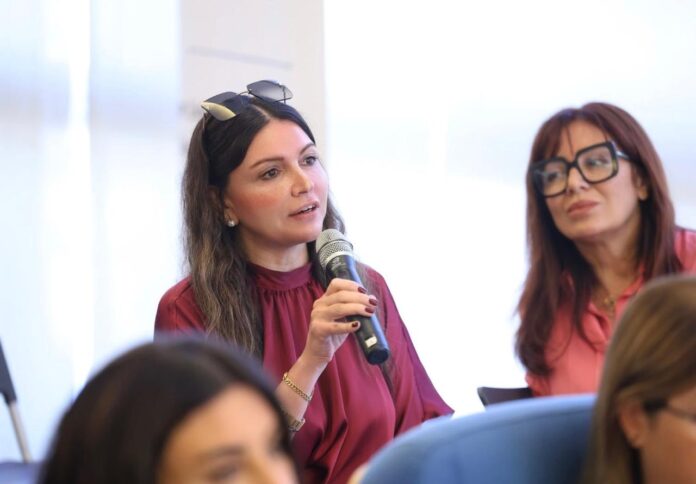
The National Human Rights Commission, including the Committee for the Prevention of Torture (NHRC-CPT), represented by its Secretary, lawyer Dr. Rana Al Jamal, participated in the meetings of the two coordination committees responsible for the first and fifth priorities of Lebanon’s Second National Action Plan to implement United Nations Security Council Resolution 1325 on Women, Peace and Security for 2026–2030.
Dr. Al Jamal made several interventions addressing women’s participation in leadership and the development of institutional capacity. She stressed the importance of strengthening women’s role in decision-making and improving coordination and cooperation among relevant stakeholders to ensure the effective implementation of the Plan and the achievement of its objectives.
The meetings formed part of the implementation follow-up process led by the National Commission for Lebanese Women. They aimed to coordinate interventions, exchange expertise, assess challenges and progress, and identify next steps, bringing together representatives of public institutions, civil society, international organizations, trade unions and political parties.
The first priority focuses on advancing women’s participation in leadership and decision-making, including in political, administrative, security, military and diplomatic institutions, the judiciary and trade unions, at both national and local levels. The fifth priority addresses institutional capacity, coordination and effective implementation. This includes supporting gender equality units and gender focal points, strengthening monitoring, evaluation and data collection, and addressing barriers to women’s participation within institutions.
Background to the National Action Plan
Lebanon’s Council of Ministers approved the Second National Action Plan on 30 April 2026, following a consultative process involving public institutions, security and military bodies, civil society organizations, academic institutions, trade unions, media representatives and international partners. The Plan responds to the challenges that economic, social and security crises and armed conflict have created for women and girls in Lebanon.
Alongside women’s leadership and institutional capacity, the Plan prioritizes protecting women and girls from violence during conflicts and crises, promoting a culture of peace and conflict prevention, and ensuring gender-responsive relief and reconstruction. It provides a framework for cooperation among public institutions, civil society and international organizations to advance women’s participation and protection throughout 2026–2030.
These efforts build on Security Council Resolution 1325, adopted on 31 October 2000, which recognizes women’s role in conflict prevention, conflict resolution and peacebuilding, and calls for their equal participation in efforts to maintain peace and security and their increased representation in decision-making.
هذه المقالة متاحة أيضًا بـ:
 العربية (Arabic)
 Français (French)

