


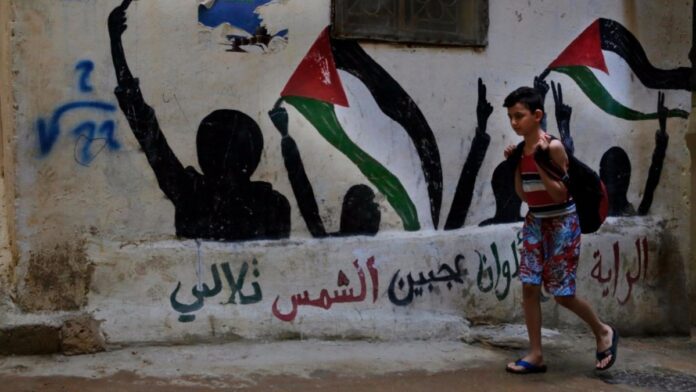
On the International Day of Solidarity with the Palestinian People, observed annually on 29 November, the National Human Rights Commission of Lebanon reaffirms its solidarity with the Palestinian people and its commitment to their inalienable rights, foremost among them the rights to self-determination, independence and return. The Commission calls for the protection of civilians, an end to Israel’s unlawful presence in the Occupied Palestinian Territory, accountability for violations and reparation for victims.
Solidarity requires action to protect lives, prevent displacement and ensure access to aid and essential services. It also requires removing restrictions that prevent Palestinian refugees in Lebanon from enjoying their civil, economic and social rights. These rights must be upheld without prejudice to the right of return, and guaranteeing them must not be treated as permanent resettlement in Lebanon.
Renewing the Commitment to Rights and Justice
In resolution 32/40 B of 2 December 1977, the United Nations General Assembly called for 29 November to be observed annually as the International Day of Solidarity with the Palestinian People. The date marks the adoption of General Assembly resolution 181 (II) on 29 November 1947, concerning the partition of Palestine.
The Commission calls for the observance to be accompanied by action to realise the rights of the Palestinian people and protect the population of the Gaza Strip and the West Bank, including East Jerusalem. This requires ending attacks on civilians and civilian objects, preventing forced displacement and collective punishment, ensuring safe and sustained access to humanitarian aid, and protecting health workers, humanitarian personnel and journalists.
Any arrangements for a ceasefire, recovery or reconstruction must safeguard Palestinian rights. They must not be used to impose permanent displacement, alter the demographic composition of the territory or deny people the right to return to their homes and lands.
Ending the Occupation and Ensuring Accountability
The Commission recalls the International Court of Justice’s advisory opinion of 19 July 2024 on the legal consequences arising from Israel’s policies and practices in the Occupied Palestinian Territory, including East Jerusalem. The Court concluded that Israel’s continued presence in the territory is unlawful and affirmed that the Palestinian people’s right to self-determination had been violated and that the settlements in the West Bank and East Jerusalem are unlawful. The advisory opinion is distinct from other judicial proceedings concerning the Gaza Strip.
The Commission calls for compliance with relevant international obligations, support for the independence of international courts and competent mechanisms, preservation of evidence and cooperation with investigations. Political settlements must safeguard victims’ rights to truth, justice and remedy.
All parties have a duty to protect civilians. Attacks on civilians, hostage-taking, torture, sexual violence and other violations must be investigated and those responsible held to account, regardless of who committed them.
Upholding Palestinian Refugees’ Rights in Lebanon
Lebanon’s rejection of permanent resettlement is compatible with its duty to uphold the fundamental rights of Palestinian refugees throughout their stay in the country. Improving access to work, education, health care, housing and social protection does not confer Lebanese citizenship, extinguish the right of return or alter the political and legal status of the Palestinian question.
This position builds on the fourth meeting in the Commission’s “Connecting for Rights” series, organised in cooperation with the Lebanese–Palestinian Dialogue Committee under the title “The Rights of Palestinian Refugees in Lebanon: Towards a Rights-Based Approach and Fairer Policies”. The Commission published its account of the meeting on 11 September 2026. The account gives the publication date and does not specify a separate date for the meeting. At the meeting, the Commission stressed the need to clarify legislation and administrative procedures, remove discriminatory restrictions and give refugees a greater role in decisions affecting their lives.
The Commission calls for a coherent national approach grounded in the Constitution, Lebanon’s international obligations and dialogue with refugees and the institutions concerned. This calls for clearly defined reforms, assigned responsibilities and publicly announced implementation deadlines.
Refugee Registration, Residence and Socioeconomic Indicators
According to UNRWA figures updated in September 2026, around 490,000 Palestine refugees are registered with the Agency in Lebanon. As of that update, UNRWA had verified that around 229,000 resided in the country, including approximately 19,000 Palestine refugees from Syria. The registration total and the verified resident population measure different things.
UNRWA reports that more than 83% live below the national poverty line and that unemployment exceeds 32%. Both figures come from the 2023 socioeconomic survey of Palestine refugees in Lebanon. They should be updated to assess the effects of subsequent developments.
Effective policymaking requires up-to-date data and published methods that distinguish registration, residence and use of services, and specify both when the data were published and what period they cover.
Supporting UNRWA and Upholding the State’s Responsibilities
The Commission stresses the importance of the United Nations Relief and Works Agency for Palestine Refugees in the Near East (UNRWA) in providing education, health care, relief and protection, and improving infrastructure in the camps.
The Commission calls for sustainable and predictable funding, protection of UNRWA staff, facilities and service users, and transparency and independent, fair investigations into any allegations. Responses to allegations must safeguard refugees from collective punishment and maintain essential services.
UNRWA provides humanitarian assistance and services in the camps. Camp administration falls outside that role. The Lebanese authorities retain their legal responsibilities towards people residing in Lebanon.
Recommendations of the Commission
- Protect civilians and prevent displacement. Respect international humanitarian law, protect health and education facilities and sources of water and food, ensure humanitarian assistance reaches those in need, prevent forced displacement and safeguard voluntary and safe return.
- Support accountability and victims’ rights. Cooperate with competent judicial and investigative mechanisms, preserve evidence, protect witnesses and human rights defenders, and ensure victims have access to remedies and reparation.
- Adopt a comprehensive legal framework for the rights of Palestinian refugees in Lebanon. The Government and Parliament should address legislative and administrative gaps and clarify rights, obligations and procedures while safeguarding the right of return and respecting the Constitution and Lebanon’s international obligations.
- Remove discriminatory restrictions on employment and social protection. Review laws and procedures that restrict access to employment, professions and social security. Simplify administrative processes, ensure decent working conditions and protect workers from exploitation.
- Protect housing rights and improve conditions in the camps. Review legal restrictions affecting housing, property ownership and inheritance. Improve water supply, sanitation, electricity, waste management and safety. Prevent arbitrary evictions and homelessness.
- Facilitate access to identity documents and civil registration. Simplify procedures for proving identity and registering births and other civil status events. Ensure that children have access to education, health care and protection regardless of their documentation status.
- Maintain services and ensure specialised protection. Support the continuity of UNRWA services and coordination with Lebanese institutions. Address the needs of children, women, persons with disabilities, older people and survivors of violence and torture.
- Involve refugees and monitor reforms transparently. Establish a consultation mechanism that includes the Lebanese–Palestinian Dialogue Committee, relevant public authorities, UNRWA, refugee representatives and civil society. Adopt a phased reform programme with published responsibilities, deadlines and indicators. Public reporting should distinguish proposed plans, adopted decisions and measures already implemented.
The Commission reaffirms that solidarity with the Palestinian people means defending their national rights and protecting the rights of refugees in their daily lives, wherever they reside. Upholding the right of return, ensuring safe and dignified living conditions and providing equitable access to services are complementary commitments. Each must be honoured in its own right.
Resources and Reference Documents
- United Nations — International Day of Solidarity with the Palestinian People
- United Nations General Assembly resolution 32/40, particularly part B, 2 December 1977
- United Nations General Assembly resolution 181 (II), 29 November 1947
- United Nations General Assembly resolution 194 (III), 11 December 1948, particularly paragraph 11
- International Court of Justice — Official press release on the advisory opinion of 19 July 2024
- National Human Rights Commission of Lebanon — Account of the fourth meeting on the rights of Palestinian refugees, published on 11 September 2026.
- UNRWA — Lebanon country page, updated in September 2026, including the source of the poverty and unemployment figures
- Lebanese–Palestinian Dialogue Committee — Living Conditions
- United Nations Office for the Coordination of Humanitarian Affairs — Occupied Palestinian Territory
هذه المقالة متاحة أيضًا بـ:
 العربية (Arabic)
 Français (French)

