
Bassam Al Kantar, Commissioner for International Relations and Media at the National Human Rights Commission, including the Committee for the Prevention of Torture, participated in “Bread&Net 2026” in Beirut, in a session entitled “Towards Lebanon’s Ratification of ILO Convention No. 193 on Decent Work in the Platform Economy.” His intervention focused on the advocacy campaign launched by the Commission to encourage Lebanon to ratify the Convention and translate its provisions into legal and practical safeguards for people working through apps and platforms.
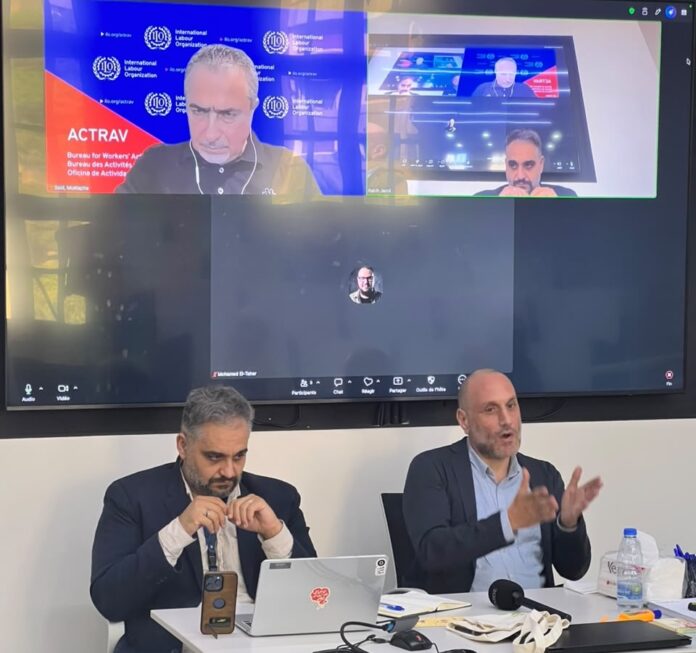
Held at ESA Business School, the session brought together academic Rabih Jamil, ILO Regional Workers’ Specialist Mustafa Said, researcher and technologist Mohamed El-Taher, and Al Kantar to discuss the intersection of labour rights and digital rights.
Al Kantar outlined the advocacy process, which began with the reference paper published by the Commission in May 2026 and continued with the consultative meeting held at its headquarters on 6 August 2026, in cooperation with Legal Agenda, SMEX, the website “Sifr,” the Lebanese Observatory for Workers’ and Employees’ Rights, and the National Federation of Worker and Employee Trade Unions in Lebanon (FENASOL). He explained that this process seeks to build support for ratification among human rights organisations, trade unions and the wider community, alongside legislative reform and the regulation of platforms’ responsibilities.
The campaign follows the International Labour Conference’s adoption, on 12 June 2026, of Convention No. 193 on Decent Work in the Platform Economy, the first international labour standard dedicated to this sector. Its approach covers platform workers regardless of their employment status classification, extending fundamental protections beyond contractual labels. This does not remove the need to ensure that employment relationships are correctly classified or to prevent the use of the “independent contractor” designation to deny rights arising from the actual working relationship.
Al Kantar stressed that the Commission’s campaign links ratification to clear implementation measures, including reviewing labour and social security laws and related legislation, developing a participatory national plan, and strengthening oversight, complaints mechanisms and access to remedies. Its central demands also include fair pay that accounts for work-related expenses and waiting time, occupational safety, freedom of association and collective bargaining, and protection against retaliation.
On digital rights, he emphasised that decisions determining workers’ income, allocating tasks, assessing performance and controlling whether their accounts remain active directly affect their rights and livelihoods. The Commission therefore calls for transparency in algorithmic systems, understandable explanations of decisions affecting work, effective human review and opportunities to challenge decisions, alongside personal data protection and safeguards against using data for discrimination or monitoring trade union activity. These demands are central to the reference paper prepared by Al Kantar and published by the Commission.
Participation in Bread&Net forms part of efforts to broaden the debate on the future of digital work and engage technology, human rights and research communities in advocating for workers’ rights. Understanding how data and algorithms are used to manage work is essential to establishing responsibilities and developing enforceable protections.
Organised by SMEX, Bread&Net has brought together human rights defenders, journalists, technologists, researchers, artists, policymakers and civil society organisations from West Asia and North Africa over the past eight years. The 2026 edition takes place in Beirut under the theme “Spaces We Imagine,” calling for a more just digital future grounded in solidarity, participation and respect for rights.
هذه المقالة متاحة أيضًا بـ:

