
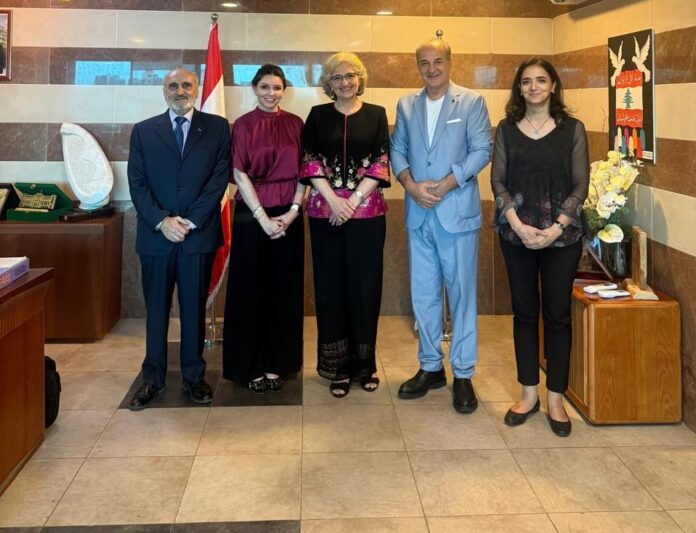
The National Human Rights Commission, including the Committee for the Prevention of Torture, led by its President, Dr Fadi Gerges, met with the Minister of Education and Higher Education, Dr Rima Karami. The meeting was attended by the Commission’s Secretary, lawyer Dr Rana Al Jamal; the Minister’s Education Adviser, Dr Wadia Khoury; and the Commission’s Commissioner for Studies, Education and Development, Professor Fadl Daher.
The meeting explored ways to launch a national human rights education project covering public and private primary and secondary schools. Discussions also addressed the Commission’s recommendations on education, rehabilitation, and the protection of displaced people’s and students’ rights. The project aims to build a culture of human rights through educational programmes that strengthen awareness of fundamental rights and freedoms and respect for human dignity.
Vocational Education in Places of Detention
Participants discussed the recommendations in the Commission’s report on its visit to the Warwar juvenile centre, particularly those concerning the right to education and vocational training. They also addressed the implementation of vocational programmes that the Ministry of Education and Higher Education is expected to provide, within its responsibilities and in coordination with the relevant authorities, in prisons and correctional and rehabilitation centres.
The Commission stressed the importance of developing regular programmes that can be implemented and monitored, tailored to participants’ ages, needs and abilities. These programmes should offer meaningful opportunities to acquire skills, continue studying and obtain recognised qualifications. It also emphasised the need to ensure continuity in education and training when detainees are transferred between facilities, and to connect rehabilitation programmes with opportunities for further education and social and professional reintegration after release, with particular attention to children and their educational needs.
Protecting the Rights of Displaced People and Students
The Commission also presented the recommendations of its study on displacement shelters during the conflict. The study highlighted the need to protect displaced people’s dignity and ensure adequate living conditions while safeguarding students’ right to education and the continuity of schooling.
In this context, the Commission called for adequate and safe alternative accommodation for displaced people staying in schools and educational facilities. Such arrangements should be coordinated, address their needs, and avoid exposing them to further vulnerability or relocating them to unsuitable premises. The Commission also stressed the need to provide appropriate alternative learning arrangements for students whose schools are being used as shelters, and to ensure displaced children’s access to education without discrimination, taking account of their best interests and reducing the risks of interrupted schooling and dropout.
Integrating Human Rights Education into Schools
The meeting included a presentation of the 2026 Guide to Best Practices and Experiences in Human Rights Education in Schools in the Arab Region, which the Commission helped prepare, and explored how it could support the development of human rights education in Lebanon.
Participants discussed ways to integrate the guide’s content and approaches into curricula, learning activities and extracurricular activities at every stage of school education, in ways suited to learners’ ages and needs. This includes promoting equality, non-discrimination, participation, respect for diversity and human dignity, and translating these principles into everyday practices in classrooms and schools.
Discussions also addressed the importance of helping teachers and school leaders use the guide and develop practical, participatory activities through which students can understand and exercise their rights while respecting the rights of others. This approach connects human rights education with the school environment, teaching methods and relationships across the school community.
This initiative forms part of the Commission’s educational, awareness-raising and preventive role under Law No. 62/2016. It seeks to build a lasting human rights culture across society, with education and awareness serving as essential foundations for protecting and promoting human rights.
The Minister welcomed the initiative and expressed her willingness to cooperate, paving the way for joint working arrangements and practical steps to develop the project and follow up on the recommendations in coordination with the relevant authorities and stakeholders.
هذه المقالة متاحة أيضًا بـ:

