
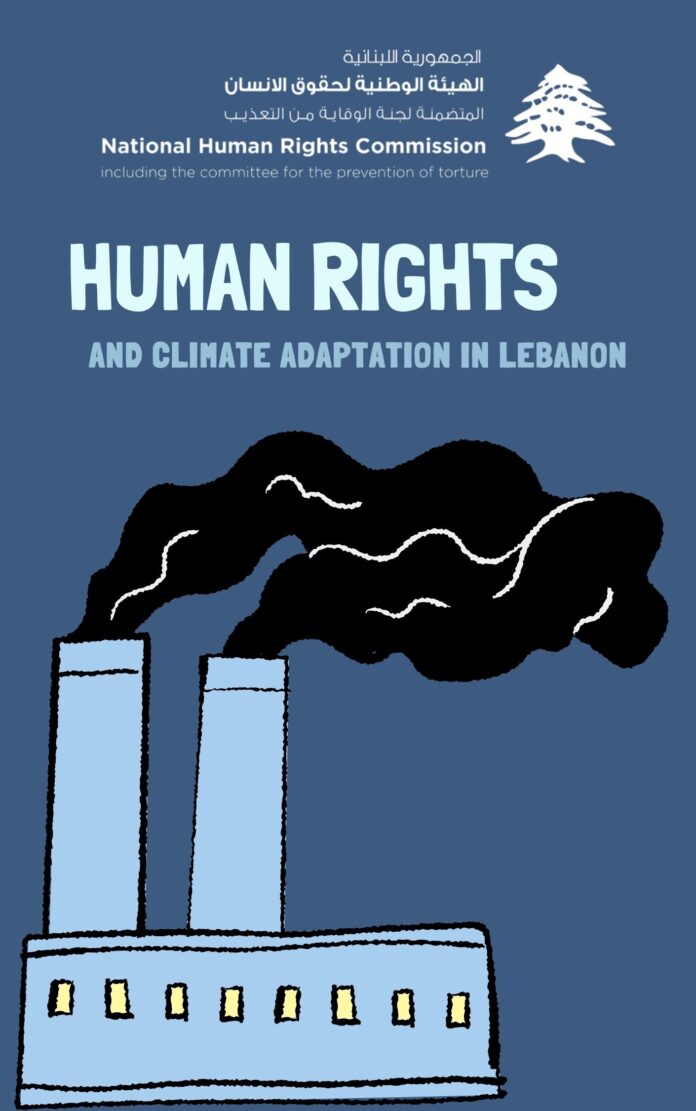
Human rights and climate adaptation in Lebanon
Contribution of the National Human Rights Commission of Lebanon, including the Committee for the Prevention of Torture – Lebanese Republic
Submitted for the Secretary-General’s analytical study pursuant to Human Rights Council resolution 62/14
Scope and principal recommendation
The NHRC-CPT recommends assessing Lebanon’s adaptation efforts by its protection of life, health, water, food, adequate housing, education, and livelihoods, and by equitable access to information, participation, and remedy. Lebanon’s 2025 National Adaptation Plan (NAP) and NDC 3.0 provide a promising policy foundation. Their commitments must be translated into funded services, accountable institutions, and measurable improvements for people facing the greatest risks. [1–3]
This contribution draws on Lebanon’s national reports. It distinguishes reported activities, prospective policy commitments and the Commission’s recommendations. It does not constitute an independent evaluation of project outcomes or confirm that every institution or measure envisaged in the NAP is operational. The analysis also addresses people deprived of liberty, whose dependence on public authorities requires explicit protection in adaptation planning.
1 Measures and promising practices
Lebanon’s First Biennial Transparency Report (BTR) maps 293 adaptation projects undertaken by non-State actors during 2020–2022. It reports interventions involving irrigation efficiency, sustainable farming, water supply, and community-based water and forest management. These activities have plausible pathways to protecting food, water, health, and livelihoods; the mapping alone does not demonstrate their human rights outcomes. The BTR also identifies substantially fewer interventions in health, disaster risk reduction and resilient cities, highlighting priorities for future investment. [3, sections 3.3–3.5 and 4.2]
Promising NAP measures include reducing water losses, strengthening climate-resilient health services, improving flood and wildfire preparedness, restoring ecosystems, and advancing climate-resilient urban planning. Lessons from the BTR are that isolated projects require sustained maintenance, coordination, and outcome monitoring. Project counts and infrastructure outputs should be accompanied by evidence that services remain safe, affordable, and accessible, including during extreme events. [1, chapters 3 and 7; 3]
2 Design science and community knowledge
The NAP describes risk and vulnerability assessments, stakeholder engagement and policy analysis as inputs to priority setting. The Fourth National Communication and BTR provide scientific assessments of changing heat, rainfall, water availability and sectoral exposure. They should inform regularly updated local risk assessments, with climate scenarios and uncertainties clearly explained rather than presented as certain forecasts. [1, section 1.2; 3; 4]
The Commission recommends combining scientific evidence with farmers’, fishers’ and communities’ knowledge of seasonal changes, water use and local hazards. Participation should begin before options are selected, use accessible formats, cover reasonable participation costs and document how community proposals affect decisions. The attached Lebanon reports do not establish a specific Indigenous Peoples’ adaptation practice; local knowledge should not be relabelled as Indigenous knowledge. Where Indigenous Peoples are affected, their distinct rights and knowledge systems must be respected.
3 Policies, institutions and human rights integration
The principal instruments are Lebanon’s NAP Strategy and Roadmap (2025), NDC 3.0 with a 2035 target year, the First BTR (2024), and the Fourth National Communication (2022). The NAP and NDC cover agriculture, forestry, water, biodiversity, urban infrastructure, public health, disaster risk reduction, and tourism. NDC 3.0 integrates adaptation with recovery, nature-based solutions, public health, and protection of vulnerable groups; its guiding principles include gender responsiveness and participation of marginalized groups. [1, chapters 1–3; 2, pp. 29–30]
The NAP sets out an institutional architecture involving the Ministry of Environment, NDC Committee, an Adaptation Technical Working Group, sectoral task forces and Local Authority Climate Change Committees. It proposes participatory, gender-responsive monitoring and engagement through local platforms, workshops and community initiatives. These are policy arrangements and commitments; their effective operation should be verified through staffing, budgets, published decisions and reporting. [1, chapters 5–7]
The Commission recommends giving equality, non-discrimination, accessibility, participation and accountability an operational role in project selection, procurement and monitoring. Each adaptation program should publish a human rights impact assessment, responsible authority, funding source, consultation record and grievance route. The NHRC-CPT should be enabled to provide independent advice and scrutiny within its mandate, without becoming responsible for implementing or certifying government projects. GANHRI guidance and NHRI research support this role through policy advice, thematic reporting, complaints and cooperation.
4 Protection of groups facing compounded risks
The NAP expressly addresses gender equality, disability inclusion and displaced communities. NDC 3.0 identifies women, children, older persons, persons with disabilities, internally displaced Lebanese persons and low-income communities in its public health principles. The Commission recommends applying protection without discrimination to everyone within Lebanon’s jurisdiction, including refugees, migrant workers and people in informal settlements. Nationality, residence status, inability to pay or lack of formal tenure should not prevent access to life-saving warnings, drinking water, emergency health care or shelter. [1, chapters 2 and 6; 2, p. 29]
For women and girls, adaptation should address unequal care burdens, access to land and finance, safe sanitation and gender-based violence risks during emergencies. For children and youth, priorities include safe schools, continuity of learning, nutrition and meaningful age-appropriate participation. Older persons and persons with disabilities require accessible warning systems, evacuation transport, shelters, water points and continuity of medication, assistive devices and support. Outdoor workers require heat protection, drinking water, rest and safeguards against lost income.
People deprived of liberty require particular attention: they cannot freely seek shade, safe water, cooling or evacuation. The Commission recommends facility-specific heat and flood assessments, adequate ventilation and drinking water, continuity of health care and power, and emergency plans that protect dignity and prohibit abusive responses. These are proposed safeguards, not findings that existing climate plans cover detention facilities. Adaptation audits should include prisons, juvenile facilities and other places of deprivation of liberty, with independent preventive monitoring.
Monitoring should examine intersecting disadvantages rather than treat each group as homogeneous. Indicators should be disaggregated where safe and feasible by sex, age, disability, location and relevant socioeconomic characteristics. Data collection must protect privacy and avoid exposing individuals to retaliation, stigma or exclusion.
5 Coordination resilience and maladaptation
NDC 3.0 provides a common framework for adaptation and mitigation, with the NAP operationalizing adaptation priorities. Nature-based solutions, resilient water services and sustainable agriculture can deliver benefits across both objectives. Lebanon’s renewable energy investment study examines policy and financial instruments to reduce investment risks; it models investment, not adaptation or equitable service outcomes. [1–2; 5–6]
Renewable electricity can strengthen resilience by supporting reliable water pumping, health facilities, schools, warning systems, and cooling. Its benefits depend on affordability, maintenance, resilient siting, and adequate backup or storage. Solar-powered pumping without abstraction controls can accelerate groundwater depletion; private energy access can leave poorer households behind. Restoration should conserve biodiversity and local livelihoods, with land rights and community participation protected.
The Commission identifies the following risks for preventive assessment: flood barriers that transfer risk downstream; water projects that raise unaffordable charges; relocation without secure tenure, adequate housing and livelihood protection; urban greening that displaces low-income residents; and adaptation infrastructure that damages ecosystems or locks in exposure to future hazards. These are risks to assess, not verified violations attributable to the projects in the attachments. Decisions should compare alternatives, cumulative impacts, and the distribution of benefits, and revise permits where harm emerges.
Resilience should mean the continued enjoyment of rights during and after shocks. Recovery investments should therefore combine climate risk assessment with service continuity, social protection, ecosystem safeguards and community oversight. Adaptation cannot substitute for emissions reductions, and climate policy should not obscure responsibility for conflict-related damage or other non-climatic causes of deprivation.
6 Challenges and enabling conditions
The BTR and NAP identify fragmented governance, limited financial and technical resources, weak local capacity and gaps in data and coordination. The BTR acknowledges that measuring adaptation progress remains difficult. The NAP proposes a results-based monitoring framework, clearer coordination, financial instruments and knowledge systems; NDC 3.0 describes MISCAL as a national reporting platform. These developments provide opportunities, but require implementation and public verification. [1, chapters 4–8; 2, chapter V; 3, sections 3.4–3.5]
The Commission recommends predictable public funding for essential adaptation services, with grants and concessional support prioritized where projects have limited commercial returns. Funding criteria should reflect exposure, poverty, disability, service deficits and recovery needs. International partners should simplify access for capable local actors, fund maintenance and capacity alongside construction, and avoid imposing unsustainable debt burdens.
Budget allocations, disbursements, procurement and geographic distribution of benefits should be public. Climate finance reporting should distinguish commitments from funds received and outcomes achieved. All public and private projects need proportionate rights safeguards and accessible complaints mechanisms. Independent oversight should review exclusion, corruption risks, adverse impacts, and corrective action, while preserving access to judicial remedies. [1, chapters 4 and 6]
7 Actionable pathways and recommendations
The following pathways build on measures proposed in Lebanon’s NAP. They should be implemented as accountable programs with baselines, timelines, budgets, and community-defined outcomes; the Commission does not present them as independently verified successes. [1, chapters 3 and 6]
Local adaptation and essential services. Support municipalities and community organizations to identify priority risks and prepare funded local plans. Give affected residents a documented role in selecting and reviewing projects. Prioritize leakage reduction, safe water storage and treatment, drainage, accessible shelters, and continuity of health and education services. Measure household access, affordability, and outage duration during extreme events, not just installed infrastructure.
Heat health and detention protection. Develop coordinated heat preparedness protocols linking public health authorities, schools, employers, social services and detention administrations. Establish locally appropriate alert thresholds, outreach to isolated individuals, accessible cooling options and uninterrupted medicines. Publish results on heat-related illness, service failures and protection of people unable to relocate independently.
Early warning and early action. Operationalize the NAP’s proposed integrated multi-hazard warning system, linking scientific monitoring to clear institutional duties and funded responses. Use multiple channels, including accessible audio and visual alerts and non-digital communication. Test warnings with persons with disabilities, older persons, informal settlements and rural communities. Measure whether warnings reach people in time and whether safe action is possible, not only the number of alerts issued.
Food, water and ecosystem resilience. Support small farmers and cooperatives through advisory services, water-efficient practices, livelihood protection and access to finance. Link renewable pumping to metering and sustainable water allocation. Expand locally informed watershed, forest and coastal restoration with safeguards for tenure, access to resources and biodiversity. Evaluate effects on food security, water availability, and livelihood distribution.
Accountability and remedy. Require a rights assessment before approval and periodic review afterward. Provide complaint channels that are free, accessible, confidential where needed, and protected against retaliation. Publish responses and corrective measures. Ensure that complaint mechanisms supplement independent NHRI oversight and judicial protection. Business participation should include human rights due diligence, consultation, and remediation of adverse impacts.
National authorities should designate accountable institutions and fund these pathways through coordinated sectoral and local budgets. Municipalities should lead accessible local planning and reporting. Businesses and donors should apply safeguards throughout project lifecycles. Regional and international partners should strengthen climate data sharing, accessible technology transfer and sustained finance, while supporting local decision-making and independent evaluation.
8 Intergenerational equity and further information
Future generations’ interests should be addressed through long-term climate scenarios, protecting water sources and ecosystems, and avoiding infrastructure that locks communities into foreseeable risk. Children and young people should participate in planning and review, with decisions explaining how they weighed longer-term consequences. Adaptation must also secure immediate minimum levels of essential services for today’s population.
The Commission recommends an annual public review of adaptation and human rights, drawing on community testimony, complaints, budget data and disaggregated service indicators. Independent NHRI reporting can connect national climate reporting with scrutiny of rights outcomes, identify overlooked settings such as detention, and recommend corrections. Sustainable capacity and resources for this scrutiny should accompany investment in adaptation delivery.
Sources
[1] MoE/UNDP/GCF (2025). Lebanon’s National Adaptation Plan Strategy and Roadmap. Especially sections 1.2 and 2.3, chapters 3–8, and the implementation roadmap. Source of proposed sectoral measures, inclusion principles, institutional architecture, and monitoring arrangements.
[2] Government of Lebanon (2025). Lebanon’s Nationally Determined Contribution NDC 3.0 Target year 2035. Especially adaptation priorities and guiding principles, pp. 23–67, and chapter V on institutional arrangements and monitoring. Source of policy commitments, rather than evidence of completed delivery.
[3] MoE/UNDP/GEF (2024). Lebanon’s First Biennial Transparency Report on Climate Change. Especially sections 3.3–3.5, pp. 73–78, and section 4.2, pp. 80–81. The database of 293 non-State actor adaptation projects concerns 2020–2022; monitoring gaps are described in section 3.4.
[4] MoE/UNDP/GEF (2022). Lebanon’s Fourth National Communication to the UNFCCC. Climate impacts, vulnerability and adaptation assessments. Climate projections depend on the scenarios and time horizons specified in the report.
[5] Lebanon’s Climate Commitment NDC 3.0 A Roadmap for Recovery and Sustainability. Used as a summary of sectoral priorities; read alongside the full NDC.
[6] Government of Lebanon (2025). Lebanon Derisking Renewable Energy Investment 2025. Analysis of policy and financial derisking instruments for renewable electricity investment. Used to inform discussion of enabling finance and energy resilience; modeled results are not treated as observed rights outcomes.
Title: Human rights and climate adaptation in Lebanon: Contribution of the National Human Rights Commission of Lebanon, including the Committee for the Prevention of Torture – Lebanese Republic. Submitted for the Secretary-General’s analytical study pursuant to Human Rights Council resolution 62/14
Publisher: The Lebanese Republic | The National Human Rights Commission, which includes the Committee for the Prevention of Torture (NHRC-CPT)
First Edition: October 2026
📍 Address: Serhal Building, First Floor, Sami El Solh Boulevard, Beirut, Lebanon.
📧 Email: info@nhrclb.org
🌐Website: https://nhrclb.org
☎️Hotline: +961 3 923 456
Facebook: http://fb.nhrclb.org
Instagram: http://insta.nhrclb.org
YouTube: http://yt.nhrclb.org
Flickr: https://www.flickr.com/photos/145354751@N08/
Bluesky: https://bsky.app/profile/nhrclb.bsky.social
Tumblr: https://www.tumblr.com/nhrclb
Mastodon: https://mastodon.social/@nhrclb
LinkedIn: https://www.linkedin.com/company/nhrclb/
Threads: https://www.threads.com/@nhrc_lb
Some Rights Reserved (CC), National Human Rights Commission, including the Committee for the Prevention of Torture – Lebanon, 2026.
The views expressed in this report are those of the National Human Rights Commission, including the Committee for the Prevention of Torture, and do not necessarily reflect the views of any parties mentioned in the report or of any past or current partners.
This document is available under the Creative Commons Attribution-NonCommercial-NoDerivatives 4.0 International License (CC BY-NC-ND 4.0).
Reproduction, storage in a retrieval system, or transmission of this book in any form or by any means—electronic, mechanical, photocopying, recording, or otherwise—for commercial purposes is strictly prohibited without prior written permission from the publisher.
For more information, please visit the copyright page on the Commission’s website:
Permissions: Requests for commercial use, additional rights, or licensing should be directed to: info@nhrclb.org
هذه المقالة متاحة أيضًا بـ:

