
The Legal Status of Lebanese Prisoners, Detainees, Victims of Enforced Disappearance, and Missing Persons Held by Israel
Publisher: The Lebanese Republic | The National Human Rights Commission, which includs the Committee for the Prevention of Torture (NHRC-CPT)
Author: Bassam Alkantar │Commissioner for International Relations at Lebanon’s National Human Rights Commission, which includes the Committee for the Prevention of Torture. He previously served as an investigator with the United Nations Independent Fact-Finding Mission on Libya and as a researcher with Amnesty International.
Executive Summary
This report examines the legal status of Lebanese prisoners, detainees, victims of enforced disappearance, and missing persons whose cases are linked to Israeli military or security operations in or against Lebanon. It focuses on cases in which detention remained ongoing, or the person’s fate remained unresolved as of 15 September 2026. Its purpose is to determine each person’s legal status on the basis of the individual facts of the case, rather than the designations applied by the detaining authority; to set out the protections guaranteed under international humanitarian law and international human rights law; and to identify the obligations incumbent upon Israel, Lebanon, and the international community with respect to determining individuals’ fate, ensuring protection, conducting investigations, ensuring accountability, and providing reparation.
The report documents 39 cases divided into five legal and factual categories: 14 persons who fell into the hands of Israeli forces in the context of military operations; two persons who were performing medical duties; 17 civilians detained in the context of military operations or the Israeli presence and control over parts of Lebanese territory; two cases linked to cross-border special or intelligence operations; and three longstanding cases of missing persons whose fate remains unresolved, as well as one new case of a person who went missing during the 2024 invasion. These classifications do not mean that all cases are supported by the same degree of evidence. Some are documented through Israeli acknowledgments or recordings; others are based on testimony from released prisoners, direct witnesses, family statements, or evidence gathered in the field. Israel, meanwhile, has not formally acknowledged a number of the detention cases or disclosed the individuals’ whereabouts or their medical and legal status.
The number cited in the report does not constitute an exhaustive count of all potential cases. Forty-two persons reported missing during the 2024 invasion, including 36 Lebanese and six Palestinians, were excluded from the principal published count because consent had not been obtained from their families to disclose their names and prepare publicly available individual case files. We also did not include other cases associated with the 2026 invasion because verifiable information was unavailable or family consent had not been obtained. Where possible, these cases remain recorded in a confidential register or reflected in anonymized aggregate data. Their exclusion does not amount to a denial that they occurred, nor does it extinguish the rights of the individuals concerned and their families to search for them, protect them, and clarify their fate.
The report’s methodology requires the family’s free, prior, and informed consent to document and publish an individual by name when the person’s own consent cannot be obtained because they are detained, missing, or out of contact. The methodology also seeks to minimize the amount of data made public, protect medical, family, and security-related information, and indicate the degree and basis of verification as well as the most recent proof of life in each case. Inclusion of a person’s name does not constitute a judicial determination or automatically prove that the person is currently being held in an Israeli prison, just as the absence of information does not establish that the person has died. The database likewise excludes persons whose release has been confirmed, although their testimonies may be used or their names may appear in the factual narrative.
The report proceeds from the principle that legal status is not determined by labels such as “security detainee” or “unlawful combatant,” but rather by the nature of the conflict, the status and actual function of the individual, the place where the person was apprehended, and the circumstances of their capture. In the Lebanese context, the rules governing the international armed conflict arising from the use of force between Israel and Lebanon may overlap with the rules governing a non-international armed conflict between Israel and Hezbollah where the requisite thresholds of organization and intensity of violence are met. Such overlap, however, cannot leave any person outside the protection of the law. At a minimum, all persons who fall into the hands of an adverse party are entitled to humane treatment and protection from killing, torture, coercion, humiliation, arbitrary detention, and disappearance.
With respect to the 14 persons who fell into the hands of Israeli forces during military operations, the report concludes that the status of each individual must be determined in accordance with the Third Geneva Convention and the relevant rules. If they are members of the armed forces or fall into other categories that satisfy the Convention’s requirements, they are entitled to prisoner-of-war status and combatant immunity for the mere fact of lawful participation in hostilities. Where doubt exists as to entitlement to such status, they must be treated in accordance with the Convention’s protections until a competent and independent tribunal determines their status. The matter may not be conclusively determined by a unilateral security or intelligence decision.
If certain situations are treated exclusively within the framework of a non-international armed conflict, prisoner-of-war status does not arise automatically under treaty law. Detainees nevertheless remain protected by Common Article 3 of the Geneva Conventions, customary rules, and fundamental human rights guarantees. They may not be tortured, disappeared, exposed to public curiosity, or sentenced without a trial that meets essential judicial guarantees. Nor may information or statements extracted from them through coercion be used.
The second category comprises two individuals who worked in nursing and, according to available information, remained in Aita al-Shaab to provide first aid and care to the wounded before they were captured. The report emphasizes that medical personnel enjoy special protection because of their humanitarian function and do not lose that protection merely because they treat wounded persons belonging to one of the parties to the conflict. They may not be targeted, detained, or punished solely for carrying out medical duties, nor may their detention be used to obstruct care or to pressure them or the entity for which they work.
The third category comprises 17 civilians, including fishermen, shepherds, farmers, workers, a municipal employee, a student, and persons suffering from injuries or illnesses, as well as civilians apprehended in their homes or while working after the cessation of hostilities. The report concludes that a civilian occupation, residence in a border area, or returning to one’s home or agricultural land does not constitute direct participation in hostilities and does not, in itself, provide a lawful basis for detention. Such persons remain protected civilians unless individual and reliable evidence establishes that they were members of an armed force or directly participated in hostilities during the relevant period.
A ceasefire does not terminate the application of international humanitarian law rules concerning detainees, wounded persons, and missing persons, nor does it grant Israeli forces general policing powers within Lebanese territory. The apprehension of civilians after the cessation of hostilities requires the identification of an individual legal basis for each operation and an assessment of the nature of Israeli control over the area concerned. If such control reaches the threshold of occupation, the law of belligerent occupation applies, including strict limitations on administrative detention, the requirement of imperative security reasons and periodic review, the prohibition on transferring protected civilians into Israel, the prohibition of collective punishment, and the prohibition of destruction of property not rendered absolutely necessary by military operations.
The report places particular emphasis on protecting the wounded and sick. Preventing an injured person from receiving first aid, delaying treatment without medical justification, or using pain, medication, or deprivation of medical care as a means of punishment, pressure, or extracting information may constitute cruel or inhuman treatment and, depending on the intent, severity of suffering, and surrounding circumstances, may amount to torture. Independent medical examinations must be conducted, treatment must be prioritized solely according to medical need, and any death or deterioration in health occurring during apprehension, transfer, or detention must be investigated.
The fourth category concerns Imad Fadel Amhaz and Ahmad Ali Shukr, both associated with cross-border special or intelligence operations. These cases differ from battlefield capture because they involve targeting a specific individual through a raid on the person’s residence or by luring the person into a trap, followed by their removal from Lebanon. If it is established that the operation was carried out directly by Israeli agencies, their acts are attributable to Israel. If, however, local individuals or networks carried it out, attribution requires proof that they acted on the instructions of the Israeli state or under its direction or control. In either case, responsibility may arise for violations of Lebanese sovereignty, arbitrary deprivation of liberty, and disappearance, in addition to the individual criminal responsibility of those who planned, lured, detained, transferred, or concealed evidence or information concerning the person’s fate.
The report adopts a graduated characterization of the two cases. Israel acknowledged the operation in which Imad Amhaz was apprehended and transferred to Israel, but it has not adequately disclosed his current place of detention or the legal safeguards afforded to him. It also published selected excerpts from his interrogation that do not, in themselves, establish the truthfulness or voluntariness of the statements made. In the case of Ahmad Shukr, Lebanese investigations point to an operation in which he was lured and abducted by a network working on behalf of the Mossad. However, his whereabouts, the route by which he was transferred, and his current presence in Israeli detention have not been publicly established through independent evidence or an individual acknowledgment by Israel. His case therefore raises strong indications of enforced disappearance, while final attribution to Israel remains dependent on establishing the operational link between the perpetrators and Israeli agencies.
The fifth category comprises Abdullah Khalil Alyan, Mohammad Adel al-Farran, Yahya Mohammad Skaff, and Alaa Fares. The report classifies them as missing persons whose fate remains unresolved, while recognizing differences in the facts and degree of evidence from one case to another.
The report distinguishes between a missing person and a victim of enforced disappearance. A missing person is an individual whose fate remains unknown without sufficient evidence establishing that they fell into the hands of a particular actor. Enforced disappearance, by contrast, requires proof that the state, or persons acting with its authorization, support, or acquiescence, deprived the person of liberty, followed by a refusal to acknowledge the deprivation or concealment of the person’s fate or whereabouts, thereby placing the person outside the protection of the law. An initial classification does not preclude recharacterization if new records, testimony, or forensic evidence subsequently emerges.
The report emphasizes that the duty to search for missing persons and clarify their fate is an independent and continuing obligation that does not expire with the passage of time or through the repetition of an unsupported account that the person has died. This obligation encompasses reviewing records relating to military operations, apprehension, interrogation, transfers, prisons, hospitals, morgues, and burials; verifying declared and undeclared places of detention and burial; collecting reference DNA samples from families; and comparing them with unidentified human remains in accordance with independent scientific standards. The absence of a person’s name from prison lists or prisoner-exchange records does not establish that the person was never captured or that their remains are not located elsewhere.
Analysis of the Israeli Prison Service report for the fourth quarter of 2025 reveals an additional information gap. As of 31 December 2025, the Service listed 38 persons as being affiliated with Hezbollah, including 32 classified as “unlawful combatants-security,” one of whom was a minor, and six as “security prisoners serving sentences.” On the same date, Lebanese authorities said 21 persons had been arrested, captured, or detained, leaving a numerical discrepancy of 17 persons.
This discrepancy cannot be interpreted as proof that 17 additional Lebanese nationals are being held in Israeli prisons. The Israeli classification may include Syrians, Palestinians, Israelis, or persons of other nationalities, while the increase may also reflect transfers or administrative reclassification. A review of the chronological data shows that the “Hezbollah” category predates the wave of arrests in Lebanon and that some persons listed under it had their place of residence recorded as Israel. Nevertheless, the figures constitute a statistical acknowledgment of a group of detainees whose identities, nationalities, and circumstances of apprehension Israel has not disclosed. This warrants a demand that Israel provide complete individual-level data for cross-referencing against missing-person case files.
The appearance of a minor in the Israeli statistics further underscores the need for such disclosure, since, according to the available information, the known Lebanese cases do not include anyone who was under the age of 18 at the time they were deprived of their liberty. It cannot be assumed that the minor is Lebanese; the individual may be unidentified in existing documentation, may hold another nationality, or may have been listed due to a discrepancy or error in age-related data. This cannot be determined from aggregate statistical tables without disclosing individual data in a manner consistent with child-protection safeguards.
The report devotes a chapter to Israel’s 2026 death penalty law and the extent to which it may be applied by civilian courts to Lebanese detainees. It concludes that the law does not apply automatically on the basis of capture, nationality, or presumed affiliation with an armed group, and that it may not be applied retroactively to an act committed before its entry into force on 5 April 2026. The relevant date is the date of the alleged act, not the date of apprehension or trial. Nor may the law be used to circumvent combatant immunity for lawful acts of warfare or rely on confessions obtained through torture or coercion. Any potential application remains contingent on establishing jurisdiction, individual responsibility, and specific intent, as well as on an independent and fair trial. The report also reiterates the Commission’s opposition to the death penalty and its call for a moratorium on executions.
The cases examined reveal a recurring pattern of failure to acknowledge detention individually, withholding information about the place and legal basis of detention, denying families contact with detainees, failing to document access by the International Committee of the Red Cross, and relying on testimony from released prisoners to obtain proof of life. The case files also contain allegations of beatings, torture, isolation, threats, denial of medical treatment, and the filming of detainees or publication of excerpts from their interrogations under undisclosed circumstances. Propaganda material or statements attributed to detainees may not be relied upon as judicial evidence without independent verification that they were made voluntarily and that the procedures by which they were obtained were lawful and proper.
The report concludes that the most urgent priority is to require Israel to provide a complete list, by name, of all persons it has apprehended, received into custody, or transferred from Lebanese territory, including the date and place of apprehension, the route of transfer, the current place of detention, the individual’s medical and legal status, and the authority responsible for detention. Detainees must also be able to communicate with their families and lawyers; the International Committee of the Red Cross must be allowed to visit them; every detention must be subject to effective judicial review; and civilians detained without an individual and lawful legal basis must be released.
The report calls on Israel to treat all persons entitled to prisoner-of-war status in accordance with the Third Geneva Convention; protect the wounded, sick, and medical personnel; cease torture, coercion, prolonged isolation, public humiliation, and exposure to public curiosity; and independently investigate secret detention, enforced disappearance, denial of medical treatment, unlawful killing, transfer from occupied territory, and destruction of property. It also calls on Israel to disclose records concerning missing persons and burial sites, including the “cemeteries of numbers”; conduct DNA testing; return remains to families once identities have been established; and provide effective remedies and reparation.
At the Lebanese level, the report recommends treating the issue as a unifying national cause and establishing a permanent mechanism and a unified central register that distinguish between established facts, circumstantial evidence, and allegations, while consolidating information held by ministries, judicial and security authorities, the National Human Rights Commission, the National Commission for the Missing and Forcibly Disappeared, and families. It also calls for the designation of a single national focal point; completion of investigations into abductions and cross-border transfers; preservation of digital and forensic evidence and its chain of custody; collection of DNA samples; activation of United Nations special procedures; provision of legal, psychological, and social support to families; and regular communication with families concerning the progress of follow-up efforts.
The report recommends that the United Nations establish a structured mechanism for exchanging information and documentation, regularly include the issue in its reporting on Lebanon, ensure independent access to detainees, and support Lebanon in documentation, forensic work, and the identification of human remains. It also calls upon the Human Rights Council to adopt a dedicated resolution keeping the issue under consideration, mandate the Office of the United Nations High Commissioner for Human Rights to conduct public monitoring and verification, activate the special procedures, and consider establishing an independent international mechanism, or expanding the mandate of an existing mechanism, to collect, preserve, and analyze evidence.
The report requests that the assessment mission dispatched to Lebanon by the United Nations High Commissioner for Human Rights devote a distinct workstream to these cases and conduct individual assessments distinguishing between confirmed and probable detention; the capture of combatants and detention of civilians; medical personnel; cross-border abductions; potential enforced disappearances; and unresolved cases of missing persons. It further calls upon the mission to conduct confidential interviews with families, witnesses, and released prisoners; request specific official information from Israel; investigate allegations of torture, denial of medical treatment, and apprehensions carried out after the cessation of hostilities; and issue a public report setting out its findings, the obstacles encountered, and the parties that declined to cooperate.
The report’s central conclusion is that the existing uncertainty is not merely a statistical information gap, but an urgent matter of protection and legal accountability. Every person has an individual legal status and independent rights that should not be made contingent on political negotiations or obscured by collective security classifications. Fulfilment of those rights begins with acknowledging and registering every case; disclosing each person’s fate, whereabouts, medical condition, and the legal basis for their detention; ensuring family, legal, and humanitarian access; and subsequently ensuring independent investigation, accountability, and reparation.
Report Methodology
I. Purpose and Nature of the Report
The National Human Rights Commission, which includes the Committee for the Prevention of Torture, prepared this report pursuant to its statutory mandate to monitor the human rights and international humanitarian law situation, receive complaints, investigate violations, and follow up on them.[1] The report aims to document and analyze the legal status of persons who were captured, arrested, detained, or went missing in circumstances linked to Israeli military or security operations in or against Lebanon.
The report does not constitute a judicial investigation or a final determination of individual criminal responsibility or state responsibility. Rather, it is a human rights and legal assessment based on information that could be collected and verified as of 15 September 2026. In preparing the report, due regard was given to the principles of independence, impartiality, objectivity, transparency, methodological consistency, and the protection of victims and witnesses.[2] Its findings remain subject to updating or revision should new and more reliable information, records, or testimony emerge.
II. Temporal and Thematic Scope of the Report
The report covers both longstanding and recent cases in which detention remained ongoing, or the person’s fate or whereabouts remained unresolved as of the date of its preparation. Its temporal scope extends from cases of missing persons linked to hostilities and the Israeli occupation in previous decades to captures, arrests, and abductions that occurred during the 2024 and 2026 invasions and in the intervening periods.
The report focuses on cases in which there is a verifiable link to Israeli forces or agencies, or to forces or individuals suspected of having acted with their authorization or support, on their instructions, or under their direction or control. The mere fact that a person went missing in a border area, or that an unsubstantiated media allegation circulated, is insufficient to establish such a link; rather, specific information or evidence connecting the incident to the relevant actor is required.
The principal case database does not include persons whose release has been confirmed, although their names may appear in the factual narrative or their testimony may be used to document the circumstances of other detainees. Nor does it include persons whose deaths have been confirmed and whose remains have been returned and reliably identified, except to the extent necessary to understand the context of the operations or patterns of violations.
III. Sources of Information
The report relied on a diverse range of primary and secondary sources, including:
- The database and individual case documentation compiled by The Legal Agenda, including published and unpublished information made available to the Commission subject to confidentiality and consent requirements.
- Statements from family members, witnesses, and persons who were with the detainees at the time of their apprehension or prior to their disappearance.
- Testimonies of released prisoners and detainees, including individuals who reported seeing or identifying Lebanese detainees inside detention facilities.
- Statements and positions issued by the Lebanese authorities, the Lebanese Armed Forces, municipalities, Civil Defense, and associations concerned with prisoners and missing persons.
- Official statements issued by the Israeli military and authorities, recordings and images published by them, and reports of the Israel Prison Service.
- Lebanese, Arab, Hebrew-language, and international media coverage, distinguishing between independent journalistic reporting and material that merely relays a military or security account.
- CCTV footage, photographs, video recordings, and other available digital material, where sources and context can be verified.
- Correspondence, complaints, and memoranda submitted to the Lebanese or Israeli authorities, the United Nations, or the International Committee of the Red Cross.
- International and domestic legal instruments; judgments and decisions of courts and international bodies; commentaries of the International Committee of the Red Cross; and general comments issued by United Nations treaty bodies.
No single source was treated as conclusive merely because of its official or media status. Statements issued by the detaining authority establish that the authority put forward a particular account, but do not necessarily establish the accuracy of the facts or allegations contained therein. Likewise, statements from family members are an essential source of information, but the report distinguished between matters they witnessed directly and information conveyed to them by others.
IV. Inclusion and Exclusion Criteria
A case was included in the report when a minimum amount of information was available sufficient to establish the person’s identity; the date or period of capture, arrest, or disappearance; the location of the incident or the person’s last known location; and a reasonable basis for linking the case to Israeli forces or agencies, or to an entity suspected of being associated with them.
Inclusion does not require proof that the person is currently being held in an Israeli prison. A case may be included as a confirmed detention, probable detention, potential enforced disappearance, or unresolved missing-person case, provided that the report clearly indicates the degree of verification and the limitations of the available information.
The following cases were excluded from the principal published count:
- Cases for which sufficient and verifiable information was unavailable.
- Cases in which the individual could not be identified or distinguished from other cases.
- Cases in which the individual’s release had been confirmed, although their testimony may be used to document other incidents.
- Cases in which the family did not consent to preparing or publishing an individually identified case file.
- Cases in which the individual’s death had been confirmed and their remains identified and returned, unless analytical considerations required the incident to be included within a broader context.
Exclusion does not mean that the incident did not occur, that the individual does not possess legal rights, or that the duty to search for them has ended. It is a methodological decision relating to the evidentiary and publication thresholds applied in the current version of the report.
V. Scope of the Count and Unpublished Cases
The principal count comprises 39 individual cases distributed across five legal and factual categories. This figure does not include 42 persons reported missing during the 2024 invasion, including 36 Lebanese and six Palestinians, whose families did not consent to the disclosure of their names or the preparation of publicly available individual case files. It also does not include persons reported missing during the 2026 invasion for whom verifiable information was unavailable or whose families did not consent to public documentation.
Where possible, we retain information relating to these cases confidentially or incorporate it into anonymized statistics until the verification process is complete and we receive the necessary consent. Accordingly, the figures presented in the report represent cases that met the applicable documentation and publication criteria and do not constitute an exhaustive count of all persons who may have been captured, detained, or gone missing.
VI. Degrees of Verification and Last Proof of Life
The report assessed each element of a case separately rather than assigning a single evidentiary classification to the case as a whole. For example, the fact of apprehension may be confirmed while the current place of detention remains unknown, or the person may have been confirmed alive on an earlier date without more recent information on their condition.
Depending on the individual case, the assessment of the degree of verification was based on one or more of the following elements:
- An official Israeli acknowledgment of apprehension or detention.
- A reliable photograph or recording showing the person alive in the custody of Israeli forces.
- Direct testimony from a person who was present at the time of apprehension or was detained with the individual concerned.
- Testimony from a released prisoner or detainee containing identifying information that can be corroborated.
- Findings of an official Lebanese investigation supported by physical or digital evidence or by statements or admissions subject to investigation.
- Statements from family members corroborated by independent sources or field evidence.
- The discovery of a vehicle, boat, or personal belongings in circumstances supporting the occurrence of apprehension or disappearance.
- A verifiable medical, judicial, prison, or official record or correspondence.
The report uses the concept of “last proof of life” to refer to the most recent date on which it was possible to verify that the person was alive, whether at the time of apprehension or through a subsequent communication, recording, or eyewitness account. This date does not mean that the person died thereafter; it merely identifies the latest point in time for which verified information confirming that the person was alive is available.
A specific place of detention was recorded only when a source could be assessed and verified. Where indirect information referred to a particular prison or detention facility, the source and date were indicated, and the information was not necessarily treated as evidence of the person’s current place of detention.
VII. Assessment of Testimony and Open-Source Evidence
Testimony was assessed based on the witness’s proximity to the incident, ability to identify the person concerned, the internal consistency of the account, and its correspondence with available chronological, geographical, medical, and family information. Direct testimony was accorded greater weight than second-hand information, without disregarding indirect accounts where they contained identifying details unlikely to have been known to an uninformed source. The collection and use of testimony were guided by professional principles relating to the “do no harm” approach, protection of sources, risk assessment, and preservation of confidentiality.[3]
When relying on the testimony of a released prisoner, consideration was given to the date and location of the sighting, the length of time the witness spent with the person concerned, the circumstances that enabled the witness to identify that person, and any details regarding the person’s medical condition or the section or room in which they were held. Where a source declined to disclose information that could reveal their identity or place them at risk, this was recorded in the case file without publishing the protected details.
Digital material and open-source information were analyzed for their source, date, location, publication history, and the possibility of manipulation or selective editing. Recordings published by the detaining authority, particularly interrogation footage, were not treated as judicial confessions or as evidence establishing the truth of their content in the absence of independent information concerning the circumstances of the recording, the voluntariness of the statements, and access to legal counsel. [4]
VIII. Treatment of Israeli Accounts
The report distinguishes between four types of information attributed to Israel:
- An official statement acknowledging the apprehension or detention and identifying the person by name.
- An official statement acknowledging the operation without identifying the person by name.
- A Hebrew-language media report citing the Israeli military or an Israeli official.
- A Hebrew-language report citing Lebanese or Arab reports without an independent Israeli acknowledgment.
An allegation appearing in a Hebrew-language media outlet does not become an official Israeli position. Likewise, an official statement does not, by itself, establish the accuracy of allegations about a detainee’s membership, role, or activities; it only establishes that the authority issued that account. Accordingly, allegations concerning military affiliation, security-related duties, or possession of weapons are claims made by the apprehending or detaining authority until an independent body examines them and the person concerned is afforded access to the evidence and an opportunity to challenge it.
IX. Analysis of Israeli Statistical Data
The statistical analysis was kept separate from individual case documentation. The Israel Prison Service report for the fourth quarter of 2025 listed 38 persons whom the Service identified as being affiliated with Hezbollah, compared with 21 persons whose arrest, capture, or detention had been established by Lebanese authorities as of 31 December 2025.
The numerical discrepancy of 17 persons was not treated as evidence that 17 additional Lebanese nationals were being held in Israeli prisons, since the classification may include persons of other nationalities, residents of Israel, or cases that were administratively reclassified. Account was also taken of the fact that the “Hezbollah” category appeared in the records before the wave of arrests associated with the 2024 invasion, and that subsequent numerical increases did not always correspond to the number of documented Lebanese cases.
The report used these data to establish an information gap requiring disclosure of individual-level information, rather than to attribute a particular identity or fate to any specific person. Aggregate statistical tables do not permit the identification of detainees’ names, nationalities, places of apprehension, or places of detention, and cannot, on their own, establish that a specific missing person is being held in an Israeli prison.
X. Methodology for Legal Characterization
The legal characterization of each case was based on an interconnected set of factors, principally:
- The nature of the armed conflict existing at the time of the incident.
- The status and actual function of the person at the time of apprehension.
- The place of apprehension and the extent to which it was under effective Israeli control.
- The circumstances in which the person fell into the hands of Israeli forces.
- Whether the person was a civilian, a member of an armed force, or medical personnel.
- Whether the person directly participated in hostilities, and the duration of such participation.
- The stated legal basis for detention and the nature of the judicial review available.
- The route of transfer, particularly whether the person was transferred from occupied territory into Israel.
- The conditions of treatment, interrogation, medical care, and contact with the outside world.
- Whether the detention was acknowledged or the person’s fate or whereabouts were concealed.
- Whether hostilities were ongoing or had ceased, and the implications thereof for the duration of detention, release, and repatriation.
The analysis was based on the four Geneva Conventions of 1949, customary international humanitarian law, the rules governing belligerent occupation, the International Covenant on Civil and Political Rights, the Convention against Torture, and other relevant instruments. Where appropriate, the report used provisions of treaties to which Israel is not a party as interpretive references or as expressions of customary rules, expressly noting this distinction rather than presenting such provisions as automatically binding treaty obligations.
The legal characterization was not based on political, regional, or family affiliation, occupation, or labels applied by the detaining authority. Nor did the report presume that every person apprehended during a military operation was a prisoner of war, or that every missing person was a victim of enforced disappearance. The report adopted a conditional legal characterization where the conclusion depended on an unresolved factual issue, such as the place of apprehension, the nature of control over the area, or whether the person had been taken alive into custody.
XI. Distinction Between Legal Categories
The report adopts five analytical categories, while recognizing that certain protections applicable to them may overlap:
- Combatants who fell into the hands of Israeli forces.
- Medical personnel.
- Civilians detained in the context of military operations or occupation.
- Victims of cross-border special or intelligence operations.
- Missing persons and detainees whose fate or whereabouts are unknown.
These categories are analytical tools rather than rigid or final determinations. A case may move from one category to another if new information emerges. A missing person may be reclassified as a detainee if an arrest record or proof of life emerges; a case involving detention at an unknown location may give rise to a suspicion of enforced disappearance if the requisite elements are established; and a person’s characterization may change from civilian to member of an armed force if reliable individualized evidence establishing such status is produced.
XII. Methodology for Characterizing Enforced Disappearance
The term “enforced disappearance” was not used merely because a person was absent or their whereabouts were unknown. The report applied three interrelated elements:
- An arrest, detention, or abduction occurred.
- State agents or persons acting with the state’s authorization, support, or acquiescence carried out the deprivation of liberty.
- There was a refusal to acknowledge the deprivation of liberty or concealment of the person’s fate or whereabouts, thereby placing the person outside the protection of the law.
Where it was established that a person had been taken alive by an Israeli force and this was followed by an absence of individual acknowledgment or concealment of the person’s whereabouts, the report used formulations such as “serious grounds to suspect enforced disappearance” or “the elements of enforced disappearance may be present,” depending on the strength of the evidence. Where it was not established that the person had fallen alive into Israeli custody, the designation “missing person” was retained pending the emergence of additional evidence.
XIII. Informed Consent and Protection of Sources and Data
The Commission requires free, prior, and informed consent for the preparation and publication of an individually identified case file whenever it is not possible to obtain the consent of the person concerned. This includes explaining the purpose of the documentation, the information to be collected, how it will be used, the entities that may have access to it, the potential risks involved, and the family’s right to decline to provide certain information or to request that information be withheld, corrected, or that consent subsequently be withdrawn.
Where multiple family members are involved or they disagree, due regard is given to the missing person’s interests, safety, and privacy, and the narrowest scope of publication is adopted. Refusal to consent to publication does not preclude the receipt and confidential retention of information or, with the family’s consent, referral of the case to humanitarian or judicial authorities or United Nations mechanisms.
Information that could reveal the identity of a source at risk, or identify a date of sighting or place of detention that the source requested not be disclosed, was withheld. The “do no harm” principle was applied to decisions concerning the collection, retention, use, and publication of information, with particular attention to health, family, and security-related data and to information concerning children. Procedures for retaining and using information were based on the principles of purpose limitation, data minimization, confidentiality, information security, restricted access, and respect for the rights of data subjects. [5]
XIV. Complaints and Institutional Follow-up
Complaints and information are received, screened, assessed, and followed up in accordance with the National Human Rights Commission’s procedural manual for receiving and processing complaints, which includes the Committee for the Prevention of Torture. The process encompasses receipt and registration, preliminary assessment, determination of jurisdiction, investigation or requests for information, and subsequent follow-up or referral to the competent authority, where appropriate. [6]
A case’s failure to meet the criteria for public inclusion does not extinguish the family’s right to submit a complaint or report an alleged violation. Likewise, inclusion of a case in the report does not preclude continuing an investigation, updating information, or referring the case to the judiciary or competent humanitarian and international mechanisms.
XV. Limitations and Challenges
The preparation of the report faced significant limitations, most notably the absence of Israeli nominal lists; the lack of independent access to a number of detainees; the inability to review Israeli military, intelligence, prison, and medical records; reliance in some cases on indirect testimony; difficulties in determining precise coordinates or the nature of control over areas where apprehensions occurred; and the considerable passage of time in some missing-person cases.
In a number of cases, independent medical or forensic examinations were also unavailable to document injuries or causes of death, analyze biological traces, or identify human remains. Accordingly, where relevant, the report was guided by international standards concerning the investigation of potentially unlawful deaths and the documentation of torture and ill-treatment. [7]
These limitations were addressed by identifying the source of each piece of information and its degree of verification, using cautious language, distinguishing between established facts, circumstantial evidence, and allegations, and refraining from making definitive determinations regarding a place of detention, death, or legal status where the evidence did not permit such a conclusion.
XVI. Updating the Report and Correcting Information
The case database is maintained as an updatable record rather than a closed list. It is amended when new proof of life, an official acknowledgment, verifiable testimony, a judicial decision, or the results of a medical, forensic, or genetic examination become available. Personal information, including date of birth, occupation, and family status, is likewise corrected when an official document or a more reliable source is presented.
The person concerned or their family has the right to request that information be corrected or supplemented, or that its publication be restricted. A missing-person case is not closed, nor is the person declared deceased, except on the basis of reliable evidence and appropriate legal and scientific procedures, with the family informed and involved in the verification process.
Nature of the Conflict and Its Impact on the Legal Characterization of Prisoners, Detainees, Victims of Enforced Disappearance, and Missing Persons
Determining the legal status of each person who fell into the hands of Israeli forces, or who went missing in circumstances suspected of being linked to them, requires consideration of the nature of the conflict at the time of the incident, the status of the person concerned, the place of apprehension, and the circumstances surrounding the deprivation of liberty. Israel may not deprive any person of legal protection merely by refusing to acknowledge their detention or by failing to accord them a specific status.
The Impact of the Complex Nature of the Conflict
The National Human Rights Commission, which includes the Committee for the Prevention of Torture, considers that hostilities relating to Lebanon may encompass both:
- An international armed conflict between Israel and Lebanon, arising whenever Israeli forces use armed force within Lebanese territory without the consent of the Lebanese state;
- A cross-border non-international armed conflict between Israel and Hezbollah, as an organized armed group, whenever the hostilities reach the legally required threshold of intensity.
This characterization directly affects how captured or detained persons are classified. In an international armed conflict, a combatant may be entitled to prisoner-of-war status, while a civilian is protected under the Fourth Geneva Convention. In a non-international armed conflict, prisoner-of-war status does not arise automatically under treaty law, but detainees remain protected by the fundamental guarantees of Common Article 3, customary international humanitarian law, and human rights law.
Where there is doubt as to the legal status of a person who participated in hostilities and fell into the hands of Israeli forces, that status may not be determined by a unilateral security decision. In an international armed conflict, the person must be treated as a prisoner of war until a competent tribunal determines their status, in accordance with Article 5 of the Third Geneva Convention.
Persons Apprehended from Lebanese Territory
The apprehension of a person within Lebanese territory by Israeli forces does not, in principle, constitute an ordinary law-enforcement measure, but rather an incident connected with an international armed conflict and the use of force within the territory of another state. The person’s status must therefore be determined under the Geneva Conventions before resorting to any Israeli domestic classification, such as “security detainee” or “unlawful combatant.”
Persons apprehended fall, in principle, into two categories:
- Combatants or persons participating in hostilities: They may be entitled to prisoner-of-war status if they satisfy the requirements of the Third Geneva Convention. Where doubt arises, they are provisionally entitled to its protections until a competent tribunal determines their status.
- Civilians not directly participating in hostilities: They are protected under the Fourth Geneva Convention. They may not be arrested or detained except on a clear legal basis, for imperative security reasons, and under procedures that provide periodic review and the ability to challenge the lawfulness of detention.
A person may not be presumed to be a combatant merely because of their political or family affiliation or because they reside in an area where hostilities are taking place. Nor does a civilian lose protection except for such time as they directly participate in hostilities; such participation does not strip them of protection once they have been captured or are no longer participating in the fighting.
Prisoners of War
In an international armed conflict, prisoner-of-war status applies to members of the armed forces of a party to the conflict and to the other categories specified in Article 4 of the Third Geneva Convention where the applicable legal requirements are satisfied.
Captivity does not constitute punishment. Rather, it is a preventive measure that a detaining power may take to prevent a prisoner from returning to combat. A prisoner of war may therefore not be prosecuted merely for lawful participation in hostilities, although they may be investigated and prosecuted for specific war crimes where evidence exists and the right to a fair trial is guaranteed.
Israel’s obligations toward prisoners of war include, among other things:
- Registering them immediately upon capture;
- Notifying the International Committee of the Red Cross and the competent Information Bureau of their detention;
- Enabling them to inform their families of their capture and whereabouts;
- Allowing the International Committee of the Red Cross to visit them;
- Protecting them from torture, coercion, threats, humiliation, and public disparagement;
- Providing adequate food, shelter, and medical care; and
- Refraining from transferring them to conditions that would endanger their lives or safety.
Prisoners of war must be released and repatriated without delay after the cessation of active hostilities, unless they are subject to lawful criminal proceedings concerning specific offenses unrelated to their mere participation in the fighting.
Civilian Internees and Detainees
Civilians apprehended by Israeli forces within Lebanese territory may not automatically be classified as prisoners of war, nor may they be left outside the scope of legal protection. They are protected persons under the Fourth Geneva Convention and enjoy the protections afforded by human rights law.
Detaining a civilian is not lawful merely on the basis of general suspicion, political affiliation, family ties, or residence in a particular area. It must be based on specific and individualized grounds, be necessary and proportionate, and be subject to independent and periodic review.
A civilian detainee must be afforded safeguards including:
- Being informed of the reasons for arrest and detention;
- Having their name and whereabouts recorded from the outset;
- Having their family informed of their detention;
- Being able to communicate with a lawyer;
- Being brought before an independent judicial authority;
- Being able to challenge the lawfulness of their detention;
- Receiving healthcare;
- Being protected from torture, ill-treatment, and prolonged isolation; and
- Not being held in a secret or unacknowledged place of detention.
Where a civilian is apprehended in Lebanese territory under occupation, their forcible transfer into Israel, whether individually or collectively, is prohibited. Depending on the circumstances, unlawful transfer, unlawful confinement, and torture may constitute grave breaches of the Fourth Geneva Convention and war crimes.
Persons Detained After a Ceasefire
A ceasefire does not render the apprehension of civilians lawful, nor does it grant Israeli forces general policing authority within Lebanese territory. Where persons are apprehended from their homes or villages after the cessation of hostilities has begun, it is necessary to determine:
- Whether Israeli forces were physically present in the area;
- The extent to which they exercised authority or control over the location;
- The individualized legal basis for the apprehension;
- The status of the person apprehended; and
- Whether the person was transferred into Israel or to an undisclosed location.
Where Israeli forces exercise effective control over the area, the law of occupation applies. Where apprehension occurs during a military incursion without establishing a stable occupation, the incident remains governed by the rules of international armed conflict and the rules concerning the treatment of persons who fall into the hands of an adverse party.
In either situation, civilians may not be held as hostages, used to obtain information or as bargaining chips, or punished for the acts of their relatives or because of their presumed affiliation with a particular political or social milieu.
Persons Detained Whose Detention Israel Refuses to Acknowledge
Where it is established that a person fell into the hands of Israeli forces, or of an entity acting with their authorization, support, or acquiescence, and the authorities subsequently refuse to acknowledge the person’s detention or conceal their fate or whereabouts, the situation may constitute an enforced disappearance.
This characterization consists of three interrelated elements:
- Arrest, detention, or abduction by state agents or by persons acting with the state’s authorization, support, or acquiescence;
- Refusal to acknowledge the deprivation of liberty, or concealment of the person’s fate or whereabouts; and
- As a consequence, placing the person outside the protection of the law.
Establishing serious grounds to suspect enforced disappearance does not require locating the person inside an official prison. The essence of the violation lies precisely in the concealment of the detention or the person’s fate. Accordingly, a denial that the person is being held in officially recognized prisons does not resolve their fate, particularly where evidence or indications exist that they fell into the hands of Israeli forces.
Enforced disappearance constitutes a continuing violation until the person’s fate and whereabouts are reliably established. The violation does not end merely because it is alleged that the person died, unless the circumstances of the death are established, the location of the remains is disclosed, the remains are reliably identified, and they are returned to the family.
Where enforced disappearance is practiced on a widespread or systematic basis against a civilian population, it may amount to a crime against humanity, irrespective of the fact that Israel is not a party to the International Convention for the Protection of All Persons from Enforced Disappearance.
Missing Persons
A distinction must be drawn between a missing person and a victim of enforced disappearance. A missing person is any person whose family does not know their whereabouts or fate as a result of conflict, occupation, capture, or an incident connected with them, without sufficient evidence at the present stage to establish that the person fell into the hands of a particular actor.
Accordingly, the absence of a person’s name from Israeli prison records, or the failure to locate their remains among bodies or burial sites that have been discovered, does not by itself establish that the person was never captured, nor does it establish that the person is dead. Their fate remains open to several possibilities, including:
- Capture without registration or disclosure;
- Detention in a secret location or under an incorrect identity;
- Transfer to another entity;
- Death during apprehension, transfer, or detention;
- Retention of the person’s remains or burial without identification; or
- Death in the circumstances that led to the person’s disappearance without recovery of their remains.
Accordingly, in the absence of conclusive evidence, the most accurate characterization is that of a person missing in circumstances linked, or suspected of being linked, to Israel or to entities that were operating with it, where it remains unresolved whether the person was captured, died during the events associated with their disappearance, had their remains retained, or was transferred to an unknown location.
This initial characterization does not preclude subsequently reclassifying the case as an enforced disappearance if serious evidence later emerges establishing that the person fell into the hands of Israeli forces or an entity associated with them, followed by denial of their detention or concealment of their fate.
Duty to Search and Clarify Fate
Israel is under an obligation to search for persons who went missing in the context of its military operations or who came under its authority, and to disclose the information in its possession concerning their fate. This includes reviewing:
- Records of apprehension, detention, interrogation, and transfer;
- Records of the military units that carried out the operations;
- Records of prisons, interrogation facilities, and medical facilities;
- Death, morgue, and burial records;
- Information relating to burial sites known as the “cemeteries of numbers”;
- Photographs, recordings, documents, and materials seized during operations; and
- Records of persons transferred to other authorities or agencies.
The International Committee of the Red Cross and competent independent mechanisms must also be granted access to relevant information and places of detention; families must be informed of the findings; and exhumation and identification processes must be conducted in accordance with scientific standards, including DNA testing, followed by the dignified return of remains to the families.
The Khiam Rehabilitation Center for Victims of Torture reports that the Israeli authorities are holding the remains of dozens of persons killed, including the remains of a prisoner that have been withheld for more than thirty years on the grounds that the term of his sentence had not been completed. The Center considers the withholding of remains and the denial of families’ ability to receive and bury them for many years to constitute a grave violation of humanitarian, ethical, and religious values, and has denounced the silence of the international community and the limited attention given to this issue.[8]
Minimum Common Standard of Protection
Irrespective of any disagreement concerning the classification of the conflict or the status of the person concerned, no prisoner, detainee, or missing person may be placed outside the protection of the law. At a minimum, all persons who have come under the authority of Israeli forces are entitled to the following rights:
- Humane treatment at all times;
- Protection from killing, torture, disappearance, humiliation, and sexual violence;
- Immediate and accurate registration;
- Detention in a recognized place of detention;
- Notification of the detainee’s family regarding their whereabouts;
- Communication with a lawyer and family members;
- Access to medical care;
- Independent judicial oversight;
- Visits by the International Committee of the Red Cross; and
- Investigation of any allegation of death, torture, or disappearance.
Accordingly, designations such as “unlawful combatant” or “security detainee” may not be used to deny prisoner-of-war status where the person is entitled to it, circumvent protections afforded to civilians, conceal a place of detention, or deprive a detainee of fundamental judicial and humanitarian safeguards. A classification adopted by a state under its domestic law does not take precedence over the objective legal status established under the Geneva Conventions and customary international law.
Applicability of the Israeli Death Penalty Law to Lebanese Detainees
The Israeli Knesset enacted the “Death Penalty for Terrorists Law, 2026” on 30 March 2026, and it entered into force after publication in the Israeli statute book on 5 April 2026. Assessing its potential impact on Lebanese detainees requires distinguishing between the political and media discourse that accompanied its enactment and its actual legal scope. Although it is commonly referred to as the “law for the execution of prisoners,” the law does not make the status of being a prisoner or detainee, in itself, a ground for imposing the death penalty. Rather, it links the penalty to a person’s conviction for a specific offense that satisfies aggravated statutory elements.
Among the cases covered by this report, eight persons were apprehended after the law entered into force on 5 April 2026. This does not, however, automatically bring them within its scope. Its application to any of them could be considered only if the prosecution alleges an act committed on or after that date and all elements of the offense, as well as the requirements relating to jurisdiction, individual responsibility, and specific intent, are satisfied. If the alleged act predates the law’s entry into force, the newly introduced penalty may not be applied retroactively, irrespective of the date of apprehension, indictment, or trial.
The law establishes two separate tracks. The first concerns Israeli military courts in the West Bank and applies to “residents of the Area,” as defined by specific territorial and population criteria. Accordingly, this track does not, in principle, apply to Lebanese persons captured, arrested, or abducted from Lebanese territory, unless the person concerned is registered as, or actually resides as, a resident of the West Bank. The track potentially relevant to Lebanese detainees is the amendment to the Israeli Penal Law, which may be applied before Israeli civilian courts where the authorities assert that the requirements of jurisdiction and the statutory elements of the offense are satisfied.
Scope of the Law Before Israeli Civilian Courts
The law amended the provisions governing aggravated murder under the Israeli Penal Law, permitting the imposition of either the death penalty or life imprisonment on a person who intentionally causes the death of another person in circumstances connected with an act of terrorism and with the specific intent to deny the existence of the State of Israel. In its general formulation, the provision is not restricted to any particular nationality and does not require the accused to be Palestinian or Israeli. In theory, therefore, the Israeli prosecution could seek to rely on it in proceedings against a Lebanese person before an Israeli civilian court.
Lebanese nationality, presumed affiliation with Hezbollah, or membership in any armed group is not, however, sufficient to trigger the penalty. The provision requires proof of a combination of elements: that a death occurred; that there was a causal connection between the accused’s conduct and the death; that the death was caused intentionally; that the act occurred in the statutory circumstances rendering it an act of terrorism; and that the accused possessed the specific intent to deny the existence of the State of Israel.
Accordingly, liability carrying the death penalty may not be inferred merely from organizational membership, presence at a military site, possession of a weapon, or general participation in the conflict. Nor may the requisite specific intent be presumed on the basis of the positions of the group with which the person is alleged to be affiliated. The prosecution must establish that intent in relation to the individual accused and the specific act forming the subject of the proceedings, based on individualized evidence that the defense can access and challenge.
In the event of conviction before a civilian court, the law does not make the death penalty the sole mandatory punishment in absolute terms, but instead provides the court with the alternatives of death or life imprisonment. Nevertheless, the law expands the court’s authority to impose the death penalty even where the prosecution has not requested that sentence, raising additional concerns regarding foreseeability of punishment and the ability of the defense to prepare its case accordingly. Israeli legal and human rights organizations have criticized this arrangement on the grounds that it infringes the rights to life, dignity, and equality and carries a risk of discriminatory application.
Jurisdiction over Acts Committed in Lebanon
The mere presence of a Lebanese detainee inside Israel is not sufficient to establish the jurisdiction of Israeli courts over every act allegedly committed by that person in Lebanon. The accused’s physical presence before the court is distinct from the existence of a legal basis permitting Israeli criminal law to be applied to conduct committed outside Israeli territory.
The Israeli Penal Law nevertheless contains provisions granting Israeli courts jurisdiction over certain “foreign offences,” particularly offences directed against the life, body, health, or liberty of an Israeli citizen or resident. Accordingly, the prosecution may claim that Israeli civilian courts have jurisdiction where a Lebanese person is alleged to have caused the death of an Israeli citizen or resident outside Israel, including within Lebanese territory.
Jurisdiction, however, does not establish that the offense has been proved or that the death penalty applies. Four separate issues must be distinguished:
- The jurisdiction of the Israeli court to adjudicate the alleged act;
- The legal status of the accused, particularly whether the person is entitled to prisoner-of-war status;
- Whether the act constituted lawful conduct in hostilities or a punishable offence; and
- Whether the specific requirements introduced by the 2026 law are satisfied.
Not every death of an Israeli soldier or civilian in the context of the conflict may automatically be characterized as “terrorist murder.” The legal characterization depends on the victim’s status at the time of the attack, the nature of the target, the circumstances of the act, the status of the accused, and compliance with the rules of distinction, proportionality, precautions, and other applicable rules of international humanitarian law.
Non-Retroactivity of the Death Penalty
The temporal rule is one of the most important limitations on applying the law to Lebanese detainees. The law entered into force on 5 April 2026, while the Israeli Penal Law provides that provisions creating new offenses or increasing penalties may not apply to acts committed before their publication or entry into force.
Accordingly, the newly introduced death penalty may not be imposed for an act committed before 5 April 2026, even where the person was apprehended, indicted, or brought to trial after that date. The relevant date is the date of the act attributed to the accused, not the date of their capture, arrest, or trial.
Consequently, the new law may not be applied to acts attributed to Lebanese persons who fell into the hands of Israeli forces during the 2024 military operations. Nor may it be applied to acts connected with the fighting in March 2026, including incidents occurring before 5 April, even if the persons concerned remained in detention or their trials commenced after the law entered into force.
For persons apprehended after that date, the date of apprehension alone is insufficient to establish the law’s applicability. If the act for which they are to be prosecuted occurred before 5 April 2026, the law remains inapplicable. Its application may be considered only where acts allegedly committed after its entry into force are attributed to them and all of its elements are satisfied.
Effect of Prisoner-of-War Status
Where a Lebanese detainee fell into the hands of Israeli forces while participating in an international armed conflict and satisfies the requirements for prisoner-of-war status, the person may not be prosecuted merely for lawful participation in hostilities. This immunity extends to acts of hostilities directed against members of the Israeli armed forces and military objectives, provided that they were carried out in accordance with international humanitarian law.
Israeli legal scholarship likewise recognizes that a prisoner of war may not be prosecuted merely for participation in the conflict, although the person may be investigated and prosecuted for individual acts constituting war crimes or other independent offences not covered by combatant immunity.
Accordingly, Israeli authorities may not circumvent prisoner-of-war immunity merely by recharacterizing lawful conduct in hostilities as an “act of terrorism.” Where the act consisted of attacking Israeli soldiers during an armed engagement, was directed against a military objective, and was carried out in accordance with the laws of war, the prisoner may not be prosecuted for that act as ordinary or terrorist murder, nor may the death penalty be imposed on that basis.
If, however, a detainee is alleged to have intentionally killed a civilian, killed a person who was hors de combat, tortured detainees, taken hostages, or committed another act constituting a war crime, that individual act may, in principle, be investigated and prosecuted. Any trial must nevertheless comply with all the guarantees of the Third Geneva Convention, including the rights of the defense, trial before an independent and impartial court, and the prohibition on imposing a penalty more severe than that which could be imposed on members of the armed forces of the Detaining Power for the same act.
Israel may not dispense with these safeguards merely by designating the person an “unlawful combatant,” “security detainee,” or “terrorist.” Where there is doubt as to whether the person is entitled to prisoner-of-war status, a competent and independent tribunal must determine their status, and they must be treated in accordance with the protections of the Third Geneva Convention pending that determination.
Status of Lebanese Civilians
Combatant immunity does not extend to civilians. This does not, however, make them subject to the death penalty law merely because of suspected affiliation, political support, or presence in an area where hostilities took place. For an Israeli civilian court to apply the law to a Lebanese civilian, the prosecution must establish that the person committed, or individually participated in, an intentional killing satisfying all of the aggravated elements, including the specific intent required by the provision.
Accordingly, the law does not apply to a fisherman, shepherd, farmer, or civilian worker merely because that person was apprehended near the border. Nor does it apply to a person taken from their home after a ceasefire or abducted in an intelligence operation unless their individual responsibility is established for a specific act of killing committed after the law entered into force.
Where a civilian was apprehended in Lebanese territory under the effective control of Israeli forces and subsequently transferred into Israel, their prosecution does not extinguish the separate violation arising from their forcible transfer from occupied territory. The Fourth Geneva Convention imposes strict limitations on the legislation and penalties that an Occupying Power may apply to protected persons, particularly the death penalty. The published Hebrew text of the Convention confirms that this penalty may be imposed on a protected person only within narrow limits and subject to conditions relating, among other things, to the law that was in force in the territory before the occupation.
Fair-Trial Guarantees and Risks Relating to Evidence Obtained During Detention
Even in cases where Israel asserts that the law may be applied, a death sentence remains impermissible unless the proceedings satisfy the highest standards of fairness and due process. These safeguards assume heightened importance because the penalty is irreversible and the consequences of a miscarriage of justice cannot be remedied once the sentence has been carried out.
In particular, any statements or confessions obtained through torture, threats, denial of medical treatment, prolonged isolation, or incommunicado detention must be excluded. The accused must also be afforded access to a lawyer from the beginning of the investigation, access to the evidence, the ability to examine witnesses, interpretation and consular assistance, the ability to challenge the lawfulness of detention, and full judicial review of both conviction and sentence.
A conviction may not be based on secret intelligence that the defense cannot challenge, recordings produced by the detaining authority without verification of the circumstances in which they were made, or generalized inferences drawn from organizational affiliation. Particular caution is also required for confessions made by a person whose detention was not officially registered or who was denied access to a lawyer or the International Committee of the Red Cross.
Israeli legal bodies have warned that the law restricts judicial discretion and increases the risk of irreversible errors. Israeli human rights organizations have also challenged its constitutionality before the Supreme Court, invoking the rights to life, dignity, and equality and the prohibition of cruel and discriminatory punishment. Filing such challenges does not, by itself, suspend the law unless the Court issues an order staying or invalidating it.
Israeli Statistical Record of the Number of Lebanese Prisoners and Detainees
A review of the Israel Prison Service report for the fourth quarter of 2025 shows that, as of 31 December 2025, the number of persons whom the Service classified as affiliated with Hezbollah totaled 38. Of these, 32 persons, including one minor, were classified as “unlawful combatants—security,” [9]while another six were classified as “security prisoners serving sentences.” [10] By contrast, as of 31 December 2025, the number of persons whose arrest, detention, or capture had been confirmed by Lebanese authorities did not exceed 21, leaving an unexplained discrepancy of 17 persons. It cannot be established that all of these individuals are Lebanese, as the Israeli classification may include Syrians, Palestinians, Israelis, or persons of other nationalities accused of working with Hezbollah. Nevertheless, this discrepancy raises the possibility that some Lebanese or Palestinian missing persons may be among detainees whose names, nationalities, or places of detention Israel has not disclosed. The Israeli authorities’ failure to publish nominal lists and individualized information constitutes a deliberate obstacle to verifying the fate of missing persons and may, in cases where detention is denied or the person’s fate or whereabouts are concealed, contribute to the continuation of a situation of enforced disappearance.
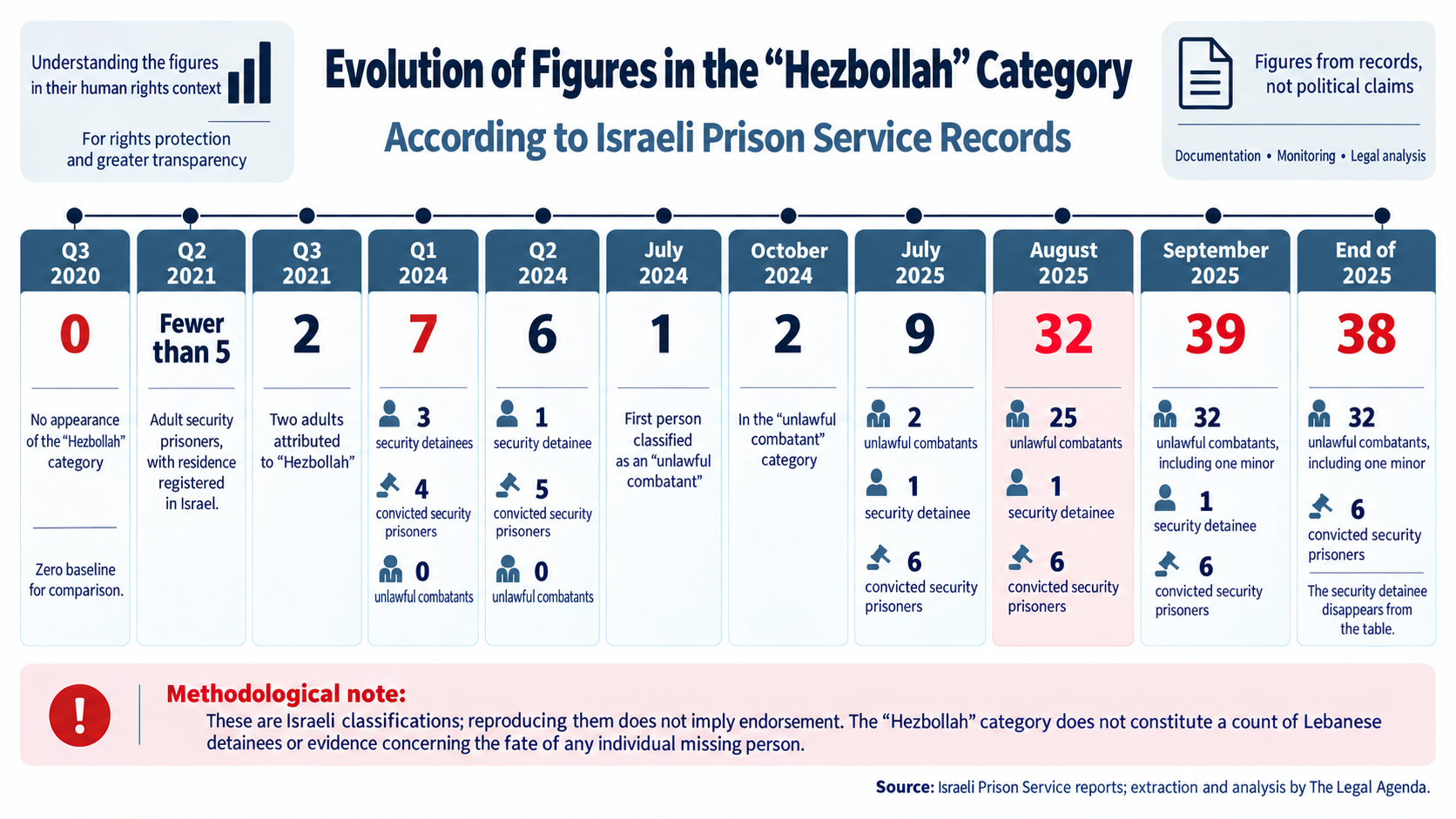
An investigation prepared by The Legal Agenda and shared with the Commission prior to publication found that the figures listed under the “Hezbollah” category do not constitute a reliable count of Lebanese detainees and cannot establish the fate of any particular missing person. “Hezbollah” did not appear in the organizational-affiliation table for the third quarter of 2020. The earliest appearance identified in the review was in the second quarter of 2021, under the intersection “sentenced/security/adults/Israel,” with the figure withheld and reported as “fewer than five,” before an explicit figure of two adults appeared in the third quarter of the same year. The investigation concludes that the longstanding existence of this category and its inclusion of persons registered as residents of Israel, together with the possibility that it includes detainees from other Arab countries, particularly southern Syria, preclude treating it as a count limited to persons taken from Lebanon. Moreover, the increase from two persons in July 2025 to 25 in August and then 32 in September did not coincide with a comparable increase in the number of documented Lebanese cases, which may reflect the transfer or reclassification of detainees or other administrative factors not disclosed in the records. Accordingly, these data constitute a numerical acknowledgment that Israel holds detainees whom it attributes an affiliation with “Hezbollah,” but they do not disclose their identities, nationalities, places of apprehension, or places of detention, nor do they resolve the fate of Lebanese missing persons. This underscores the need to require the Israeli authorities to provide complete individualized information and to cross-check it against the case files of prisoners, abducted persons, and missing persons.
The appearance of a minor in the Israeli records further underscores the need to require the Israeli authorities to disclose the minor’s identity, nationality, date of birth, place and date of detention, and current legal status. According to the available information, none of the known Lebanese cases involves a person who was under the age of eighteen at the time of deprivation of liberty, as the youngest known detainee had turned eighteen approximately three months before being detained. Accordingly, it cannot be presumed that the minor listed in the records is Lebanese. The individual may be a person not identified in Lebanese documentation, may be of another nationality, or may have been classified as a minor because of discrepancies or errors in the age-related data used by the Israeli authorities. In all circumstances, neither the minor’s identity nor legal status can be conclusively determined on the basis of aggregate statistical records alone. This requires the disclosure of accurate individualized information, with due regard for the safeguards under international law applicable to children deprived of their liberty.[11]
Classification of Cases and Determination of the Legal Status of Persons Covered by the Report
Legal Characterization I: Combatants Who Fell into the Hands of Israeli Forces
1. Waddah Kamel Younes
Waddah Kamel Younes, a Lebanese national born on 11 March 1971, is from the town of Blida in the Marjayoun District and was 53 years old at the time of his capture. He is married, has four children and two granddaughters, and was the primary provider for his family prior to his detention. He works as a plumbing technician, contrary to the impression some reports may convey by focusing exclusively on the military affiliation attributed to him. [12]
Younes was captured alive in the town of Blida, Marjayoun District, between 11 and 13 October 2024, during Israeli ground operations in southern Lebanon. Israel first announced his capture without identifying him by name on 13 October 2024, then disclosed his identity on 15 October and published visual material documenting his presence in the custody of Israeli forces and his interrogation. [13] Younes thus became the first Lebanese detainee whom Israel publicly acknowledged as having fallen into its custody since the beginning of its ground operations that year.
According to the official account published in Hebrew by the Israeli military on 15 October 2024, Israeli forces discovered an opening inside a building leading to an underground space. They surrounded the site and entered it, where they found Younes sheltering inside. The military stated that he surrendered to the forces and underwent an initial field interrogation before being transferred to a detention facility inside Israel for further interrogation by investigators from Unit 504 of Israeli Military Intelligence. Although the statement did not specify the precise location of the operation, documentation compiled by The Legal Agenda identifies the place of capture as the town of Blida.[14]
The Israeli military described Younes as a Hezbollah operative, while Hebrew-language press reports, relying on the military’s account, attributed him to the Radwan Force. These reports alleged that the underground space in which he was found was approximately seven metres deep and contained weapons and equipment enabling a person to remain there for an extended period. These claims remain allegations made by, or reported from, the detaining authority and may not be treated as established judicial facts unless they are subjected to an independent investigation and legal proceedings that allow Younes to examine the evidence against him, challenge it, and exercise his right to a defense.
The Israeli military also published excerpts from Younes’s interrogation in which statements concerning field commanders, members of the Radwan Force, and plans to advance toward the Galilee were attributed to him. The published recording, however, does not show the interrogation in its entirety and does not disclose the circumstances in which the statements were made, whether he had access to legal assistance, or whether he was subjected to coercion, threats, or ill-treatment. Accordingly, the statements attributed to him may not be treated as a judicial confession or as independent evidence of his status or criminal responsibility until the voluntariness and lawfulness of the circumstances in which they were obtained have been verified. If Younes is a prisoner of war, he may not be subjected to physical or mental coercion to obtain information from him and, when questioned, is required to provide only his surname, first names, rank, date of birth, and army, regimental, personal, or serial number, or equivalent information.[15]
Publishing his photographs and excerpts from his interrogation also raises concerns about respect for his dignity and protection from humiliation and public curiosity. The prohibition is not limited to images that are inherently degrading; it also extends to the publication of images of prisoners and detainees where doing so reveals their identity, exposes them to public disparagement, or exploits them for propaganda purposes, unless an imperative public interest justifies publication and appropriate measures are taken to protect the person’s dignity and identity.[16]
Information verified by the Commission, based on the testimony of a released Palestinian prisoner, indicates that Younes was seen alive in Nafha Prison on 10 October 2025. This constitutes “proof of life” more than a year after his capture, but it does not replace Israel’s obligation to provide official and up-to-date information regarding his whereabouts and his legal and medical status. Since his capture, Younes has been unable to communicate with his family, and no verified information is available concerning access to him by the International Committee of the Red Cross, his ability to communicate with a lawyer, his appearance before a judicial authority, or his referral for trial.
The need for independent medical access is heightened by his health condition. According to his family, Younes suffers from a chronic rheumatic condition and has only one kidney, requiring monitoring of kidney function and careful management of his medication. He also previously sustained a pelvic fracture and underwent internal fixation with a metal device. He therefore requires regular renal and orthopedic follow-up and conditions of detention appropriate to his medical condition. Any arbitrary interruption of his medication, or use of his health condition as a means of pressure during interrogation, must be prohibited. [17]
Legal Characterization
Based on the available information concerning his alleged participation in confronting Israeli forces and his capture alive during ground operations, the National Human Rights Commission, which includes the Committee for the Prevention of Torture, provisionally classifies Waddah Kamel Younes among persons who participated in resisting the invasion and who claim entitlement to treatment as prisoners of war. This characterization does not constitute acceptance of all Israeli allegations concerning his affiliation or role; rather, it identifies the minimum level of protection to which he is entitled from the moment he fell into the hands of Israeli forces. [18]
If Israel contends that Younes does not satisfy the requirements for prisoner-of-war status, it may not determine the matter unilaterally and deprive him of protection. Article 5 of the Third Geneva Convention requires that he be treated as a prisoner of war until a competent tribunal determines his legal status. Criminal responsibility cannot be inferred merely from his alleged membership in an armed group or participation in hostilities. Rather, it is necessary to establish that he committed a specific act constituting a war crime or another offence under applicable law through independent and fair judicial proceedings.[19]
From the moment he surrendered and was captured, Younes became hors de combat. It is prohibited to kill, torture, coerce, humiliate, subject him to reprisals, or otherwise treat him cruelly. He must be treated humanely, provided with the medical care required by his condition, and his capture and place of detention must be recorded. He must also be permitted to communicate with his family and lawyer, and the International Committee of the Red Cross must be allowed to visit and interview him without witnesses.
The Commission calls upon the Israeli authorities to immediately and officially disclose Waddah Younes’s place of detention, legal status, medical condition, and the legal basis for his continued detention; provide the International Committee of the Red Cross, an independent physician, and an independent lawyer with access to him; ensure regular communication with his family; investigate the circumstances of his interrogation and the publication of the recorded material; and release and repatriate him in accordance with the rules governing prisoners of war, unless he faces a specific criminal charge in proceedings that fully comply with the guarantees of a fair trial.
2. Youssef Moussa Abdallah
Youssef Moussa Abdallah, a Lebanese national born on 5 January 1986, is from the town of Al-Babiliyeh in the Sidon District and was 38 years old when he was captured. He is married and was the primary provider for his family prior to his detention. No verified information is available concerning his occupation or health condition.[20]
Abdallah was captured alive in the town of Aita al-Shaab, Bint Jbeil District, on 15 October 2024, during Israeli ground operations in southern Lebanon. The Israeli military also published visual material showing him at the time of his capture, further corroborating that he was alive in the custody of Israeli forces.[21] The updated list prepared by the Lebanese Association for Prisoners and Liberated Prisoners states that he was captured after running out of ammunition during the fighting. This latter detail remains attributed to the Association unless corroborated by additional independent evidence.
On 30 January 2025, the Hebrew-language website Nziv published a report naming Youssef Moussa Abdallah among a list of seven detainees said to have fallen into Israeli custody during the war and identifying Aita al-Shaab as the place of his capture. The report, however, did not rely on an independent official Israeli announcement identifying him. Rather, it republished a list that it said had previously been published by LBCI after Hezbollah provided it to the Lebanese authorities.[22]
Unlike in the case of Waddah Kamel Younes, no statement in the available official Israeli material clearly names Youssef Moussa Abdallah, specifies the date and place of his capture and his legal status, or verifiably links his name to the published visual material. The absence of an official announcement identifying him by name, however, does not negate the fact of his capture, which was verified by The Legal Agenda, nor does it relieve Israel, as the detaining authority, of its obligations toward him.
According to subsequent information verified by The Legal Agenda, Abdallah was seen alive in Section 11, Room 5, of Nafha Prison on 25 June 2026.[23] This constitutes the most recent documented “proof of life” concerning him, but it does not replace the Israeli authorities’ obligation to formally acknowledge his detention and continuously disclose his whereabouts and legal and medical status.
Since his capture, Abdallah has been unable to communicate with his family, and no verified information is available about access to him by the International Committee of the Red Cross, his ability to communicate with a lawyer, his appearance before a judicial authority, or his referral for trial. His continued detention in isolation from the outside world, coupled with the withholding of official information concerning his whereabouts and the legal basis for his detention, raises serious concerns regarding secret detention and deprivation of the fundamental safeguards guaranteed under international humanitarian law and international human rights law.[24]
Legal Characterization
Based on the information concerning his participation in confronting Israeli forces and his capture alive after he had ceased fighting, the National Human Rights Commission, which includes the Committee for the Prevention of Torture, provisionally classifies Youssef Moussa Abdallah among persons who participated in resisting the invasion and who claim entitlement to treatment as prisoners of war. This characterization does not signify acceptance of all accounts concerning his affiliation or the circumstances of his capture; rather, it identifies the applicable protection regime in light of the nature of the conflict and the existing uncertainty regarding his legal status.[25]
If Israel considers that Abdallah does not satisfy the requirements for prisoner-of-war status, it may not deprive him of the protection of the Third Geneva Convention on the basis of a unilateral security or administrative classification. Rather, he must be treated as a prisoner of war until a competent tribunal determines his legal status. Nor may he be punished merely for participating in hostilities if he is established to possess combatant status. He may instead be held accountable only for specific offences proven to have been committed by him in proceedings that satisfy the guarantees of independence, impartiality, and the rights of the defense.[26]
From the moment of his capture, Abdallah became hors de combat and is absolutely protected from killing, torture, coercion, reprisals, humiliation, and cruel treatment. His detention must also be officially registered; information concerning his capture and whereabouts must be communicated; he must be permitted to correspond with his family and communicate with his lawyer, and the International Committee of the Red Cross must be allowed to visit and interview him without witnesses. A deliberate refusal to acknowledge his detention or concealment of his whereabouts, if established, may satisfy the elements of enforced disappearance, particularly in light of his continued complete lack of contact with his family and the absence of independent humanitarian access.[27]
Accordingly, the Commission calls upon the Israeli authorities to immediately and officially disclose Youssef Moussa Abdallah’s place of detention and his legal and medical status, as well as the date of his capture and the route of his transfer; grant the International Committee of the Red Cross and an independent lawyer access to him; ensure regular communication with his family; and release and repatriate him in accordance with the rules governing prisoners of war, unless he faces a specific criminal charge in judicial proceedings that comply with all guarantees of a fair trial.
3. Ibrahim Mounif Al-Khalil
Ibrahim Mounif Al-Khalil, a Lebanese national born on 12 January 1990, is from the town of Aita al-Shaab in the Bint Jbeil District and was 34 years old when he was captured. He is married and the father of two minor children, aged nine and six, and was the primary provider for his family prior to his detention. He works in the preparation of desserts and cocktails.[28]
Al-Khalil was captured in Aita al-Shaab on 15 October 2024, during Israeli ground operations in southern Lebanon. According to the list prepared by the Lebanese Association for Prisoners and Liberated Prisoners, he remained with a group of combatants until they ran out of ammunition and were then captured. His capture coincided with a series of apprehension operations described in Israeli material concerning Aita al-Shaab during the same period. That material, however, does not identify Al-Khalil by name and does not permit the specific operation during which he was captured, or its sequence of events, to be reconstructed with certainty.[29]
Al-Khalil’s name was subsequently included in lists of persons believed to be detained by Israel that were submitted to the Lebanese authorities and published by Lebanese media outlets in January 2025. Some press sources also subsequently listed him among the Lebanese detainees whose families and concerned bodies have called for clarification of their fate and their return. This coverage does not, in itself, constitute an official Israeli acknowledgment of his detention, but it is consistent with the documentation compiled by The Legal Agenda and the Lebanese Association for Prisoners and Liberated Prisoners.
The Legal Agenda classifies Al-Khalil’s detention as confirmed. According to information it verified, Al-Khalil was seen alive in Nafha Prison on 10 October 2025, based on the testimony of a released Palestinian prisoner.[30] This constitutes “proof of life” after his capture, but it does not replace the need for official acknowledgment of his detention or independent verification of his current whereabouts, health, and conditions of detention.
No statement was identified in the available official Israeli sources that clearly names Al-Khalil or specifies the date of his capture, his current place of detention, or the legal basis for his continued deprivation of liberty. No information is available about his health condition, appearance before a judicial authority, or referral for trial. Since his capture, he has been unable to communicate with his family; there is no documented access to him by the International Committee of the Red Cross, and no information is available concerning his receipt of official Lebanese legal assistance or official social support for his family.[31]
The absence of an Israeli announcement identifying him by name does not diminish the established fact of his detention or Israel’s obligations as the detaining authority. Israel is required to officially register him, continuously disclose his whereabouts and his legal and medical status, transmit information concerning him to the competent body, enable him to communicate with his family and lawyer, and allow the International Committee of the Red Cross to visit and interview him without witnesses.[32]
Legal Characterization
Based on the available information concerning his participation in confronting Israeli forces and his having fallen alive into their hands after he had ceased fighting, the National Human Rights Commission, which includes the Committee for the Prevention of Torture, provisionally classifies Ibrahim Mounif Al-Khalil among persons who participated in resisting the invasion and who claim entitlement to treatment as prisoners of war. This characterization does not constitute a definitive determination of his organizational affiliation or acceptance of all accounts concerning his role; rather, it identifies the legal protection to which he is entitled in light of the nature of the conflict and the existing uncertainty regarding his status.[33]
If Israel contends that Al-Khalil does not satisfy the requirements for prisoner-of-war status, it may not deprive him of the protection of the Third Geneva Convention on the basis of a unilateral security classification. Where doubt exists as to whether he belongs to one of the categories covered by the Convention, he must benefit from its protection until a competent tribunal determines his legal status. Nor may he be prosecuted merely for participating in hostilities if he is established to possess combatant status. He may be held accountable only for a specific act constituting an offence under international law or other applicable law, following an independent and fair trial that fully guarantees his rights of defense.[34]
From the moment of his capture, Al-Khalil became hors de combat. It is prohibited to kill, torture, coerce, humiliate, subject him to reprisals, or otherwise subject him to cruel or degrading treatment. Detention in isolation from the outside world may not be used to pressure him or his family. He must be provided with necessary medical care, family contact, legal assistance, and independent humanitarian visits. [35]
His detention may amount to enforced disappearance if it is established that the Israeli authorities refuse to acknowledge his deprivation of liberty or deliberately conceal his fate or whereabouts, thereby placing him outside the protection of the law. The absence of a public statement identifying him by name is not, by itself, sufficient to establish this characterization. However, his continued complete lack of contact with his family, the absence of documented access by the International Committee of the Red Cross, and the failure to disclose his whereabouts or the basis for his detention constitute serious indicators warranting urgent investigation.[36]
Accordingly, the Commission calls upon the Israeli authorities to immediately and officially disclose Ibrahim Mounif Al-Khalil’s place of detention, legal and medical status, date of capture, and route of transfer; grant the International Committee of the Red Cross and an independent lawyer access to him; ensure his immediate and regular communication with his family; and release and repatriate him in accordance with the rules governing prisoners of war, unless he faces a specific criminal charge in judicial proceedings that comply with all guarantees of a fair trial.
4. Hassan Aqil Jawad
Hassan Aqil Jawad, a Lebanese national born on 15 December 1987, is from the town of Aita al-Shaab in the Bint Jbeil District and was 36 years old at the time of his capture, not 37, as he was captured before his thirty-seventh birthday. He is married and the father of two minor children, aged seven and three, and was the primary provider for his family prior to his detention. He works as a curtain installer. [37]
Jawad was captured alive in Aita al-Shaab on 15 October 2024, during Israeli ground operations in southern Lebanon. He is the only known Lebanese detainee from Aita al-Shaab whom the Israeli military explicitly identified by name in its material concerning capture operations in the town. The Israeli military also published visual material showing him at the time of his capture. [38]
On 29 October 2024, the Israeli military announced that forces from the Golani Brigade had apprehended Jawad approximately two weeks earlier, together with several other persons. According to the Israeli account, acting on intelligence, the force discovered an opening inside what the military described as a “military headquarters” that led to an underground space. The forces then surrounded the site, after which the persons inside surrendered and were captured. The statement added that they underwent field interrogation by investigators from Unit 504 of Israeli Military Intelligence before being transferred to a detention facility inside Israel for further interrogation.[39] The announcement, including the identification, photographs, and visual material it contained, constitutes public evidence originating from Israeli forces that Jawad fell alive into their custody.
A review of the published Israeli material, however, indicates that there were accounts of a series of capture operations in Aita al-Shaab during that period, including at least two operations, each reportedly involving several persons. According to this material, Jawad was among the group captured in the second operation. Nevertheless, the published information does not permit the sequence of these operations or the relationship between them to be reconstructed with certainty.[40]
The Israeli military described Jawad as the “Hezbollah commander of the Aita al-Shaab area” and attributed the other persons captured with him to the Radwan Force. It further alleged that information obtained during their interrogation assisted its forces in locating and destroying military sites and infrastructure. Hebrew-language media outlets, including Ynet, republished this account based on information from the Israeli military.[41] These descriptions and allegations remain claims made by the forces that captured him and the authority responsible for his interrogation. According to available information, they have not been independently verified or examined in public judicial proceedings that would afford Jawad access to the evidence and an opportunity to challenge it. His alleged command role and information attributed to his interrogation therefore may not be presented as established judicial facts.
The list prepared by the Lebanese Association for Prisoners and Liberated Prisoners states that Jawad was captured after running out of ammunition. According to information verified by The Legal Agenda, he was seen alive in Nafha Prison on 10 October 2025.[42] This constitutes “proof of life” after his capture, but it does not relieve the Israeli authorities of their obligation to provide official, up-to-date information on his current whereabouts and his legal and medical status.
Since the moment of his capture, Jawad has been unable to communicate with his family, and there is no documented access to him by the International Committee of the Red Cross. Nor is information available concerning his health condition, his ability to communicate with a lawyer, his appearance before a judicial authority, his referral for trial, or the provision of official Lebanese legal or social support to him or his family.[43]
His field interrogation and subsequent transfer to a facility operated by Unit 504 raise serious questions concerning compliance with interrogation safeguards. If Jawad is a prisoner of war, when questioned he is required to provide only his surname, first names, rank, date of birth, and army, regimental, personal, or serial number, or equivalent information, and he may not be subjected to physical or mental torture or any other form of coercion to obtain information from him. Nor may statements established to have been obtained through torture be invoked in any proceedings.[44]
The publication of his photographs and visual material relating to his capture also raises the issue of his protection from humiliation and public curiosity. The obligation to safeguard dignity is not limited to prohibiting images that are inherently degrading; it also encompasses protection against disclosure of a prisoner’s identity and exploitation of their image for propaganda purposes or to publicly portray them as guilty prior to trial, except in exceptional circumstances justified by an imperative public interest and subject to the necessary measures to protect their dignity.[45]
Legal Characterization
Based on the information concerning his participation in confronting Israeli forces and his having fallen alive into their hands after surrendering and ceasing to fight, the National Human Rights Commission, which includes the Committee for the Prevention of Torture, provisionally classifies Hassan Aqil Jawad among persons who participated in resisting the invasion and who claim entitlement to treatment as prisoners of war. This characterization does not signify the Commission’s acceptance of the command role attributed to him by the Israeli military; rather, it identifies the protection regime that must be applied in light of the nature of the conflict and the publicly available facts concerning his capture.[46]
If Israel disputes Jawad’s entitlement to prisoner-of-war status, it may not deprive him of the protection of the Third Geneva Convention on the basis of a unilateral security classification. Rather, he must be treated as a prisoner of war until a competent tribunal determines his legal status. If he is established to possess combatant status, he may not be prosecuted merely for his lawful participation in hostilities; he may be held accountable only for a specific act constituting an offence under international law or other applicable law, following an independent and fair trial that fully guarantees his rights of defense.[47]
From the moment he surrendered and was captured, Jawad became hors de combat and is absolutely protected from killing, torture, coercion, reprisals, humiliation, and cruel or degrading treatment. His detention must be officially registered, information concerning his capture and place of detention must be communicated, he must be permitted to communicate with his family and lawyer, and the International Committee of the Red Cross must be allowed to visit and interview him without witnesses.[48]
The initial acknowledgment of his capture is not, by itself, sufficient to discharge these obligations if it is followed by withholding his whereabouts and legal and medical status and severing contact with his family. The continuation of such a situation may amount to enforced disappearance if accompanied by a refusal to acknowledge his deprivation of liberty or deliberate concealment of his fate or whereabouts, thereby placing him outside the protection of the law.[49]
Accordingly, the Commission calls upon the Israeli authorities to immediately and officially disclose Hassan Aqil Jawad’s place of detention, legal and medical status, and route of transfer; grant the International Committee of the Red Cross and an independent lawyer access to him; ensure his immediate and regular communication with his family; investigate the circumstances of his interrogation and the publication of his photographs; and release and repatriate him in accordance with the rules governing prisoners of war, unless he faces a specific criminal charge in proceedings that comply with all guarantees of a fair trial.
5. Hadi Mustafa Assaf
Hadi Mustafa Assaf, a Lebanese national born on 12 December 1990, is from the town of Al-Diyabiyeh in the Bekaa and was 33 years old at the time of his capture, not 34, as he was captured before his thirty-fourth birthday. He is married and the father of a five-year-old minor daughter, and was the primary provider for his family prior to his detention. He works as a specialist in civic education.[50]
According to documentation compiled by The Legal Agenda, Assaf was captured in the town of Aita al-Shaab, Bint Jbeil District, between 15 and 16 October 2024, during Israeli ground operations in southern Lebanon. His personal belongings were also found in a school located in the Abu Tawil neighborhood of Aita al-Shaab, providing additional circumstantial evidence concerning his whereabouts prior to his capture.[51]
Information collected by Lebanese bodies concerned with the prisoners’ file indicates that he was a volunteer with a group that participated in the ground fighting in Aita al-Shaab and that he was captured after the group ran out of ammunition. His name was subsequently included in Lebanese lists of persons detained by Israel. These details should nevertheless remain attributed to their respective sources, as the Israeli authorities have not published any document individually identifying Assaf or specifying the circumstances of his capture.
The Israeli military, by contrast, announced that forces from the Golani Brigade had captured several persons at an underground site in the Aita al-Shaab area after surrounding the site and the persons inside surrendered. It stated that they underwent field interrogation by investigators from Unit 504 before being transferred to a detention facility inside Israel.[52] The statement does not identify Hadi Assaf by name and therefore cannot, by itself, establish that he was among the group to which it refers. It does, however, provide Israeli documentation of group capture operations in Aita al-Shaab during the same period and suggests that his capture may have occurred within the series of operations described in the published Israeli material, without making it possible to conclusively identify the specific operation concerned.
The Legal Agenda classifies Assaf’s detention as confirmed. It documented the testimony of a former detainee who was held with him during October 2024 and who stated that the circumstances of his capture were extremely harsh.[53] This testimony is particularly significant because it comes from a person who was detained with him. Nevertheless, further verification is required regarding the details of the treatment to which Assaf was subjected, including the circumstances of his apprehension, transfer, and interrogation, as well as any possible injuries or assaults.
Earlier unofficial information, relayed by released Palestinian prisoners, had indicated that Assaf was being held in Nafha Prison. However, The Legal Agenda documentation identifies Ramla Prison as his last known place of detention, with his presence there confirmed on 25 September 2025, while the most recent documented proof that he remained alive dates to 18 October 2025.[54] This information does not replace the Israeli authorities’ obligation to officially disclose his current whereabouts and his legal and medical status.
Since the moment of his capture, Assaf has been unable to communicate with his family, and there is no documented access to him by the International Committee of the Red Cross. Nor is sufficient information available concerning his health condition, the circumstances of his transfer and interrogation, his appearance before a judicial authority, his referral for trial, or his ability to communicate with a lawyer. According to the case record, there is also no information concerning official Lebanese legal or social support provided to him or his family.[55]
Legal Characterization
Based on the information concerning Assaf’s participation in confronting Israeli forces and his having fallen alive into their hands after he had ceased fighting, the National Human Rights Commission, which includes the Committee for the Prevention of Torture, provisionally classifies Hadi Mustafa Assaf among persons who participated in resisting the invasion and who claim entitlement to treatment as prisoners of war. This characterization does not constitute a definitive determination of his organizational affiliation or acceptance of all accounts concerning his role; rather, it identifies the protection regime that must be applied in light of the nature of the conflict and the existing uncertainty regarding his legal status.[56]
If Israel disputes Assaf’s entitlement to prisoner-of-war status, it may not deprive him of the protection of the Third Geneva Convention on the basis of a unilateral security classification. Where doubt exists as to whether he belongs to one of the categories covered by the Convention, he must benefit from its protection until his status has been determined by a competent tribunal. If he is established to possess combatant status, he may not be prosecuted merely for participating in hostilities; he may be held accountable only for a specific act constituting an offence, and only following an independent and fair trial that fully guarantees his rights of defense.[57]
From the moment of his capture, Assaf became hors de combat and is absolutely protected from killing, torture, coercion, reprisals, humiliation, and cruel or degrading treatment. If the information concerning the extremely harsh circumstances of his capture is substantiated, an independent and effective investigation must be conducted to determine whether the treatment amounted to torture or other cruel, inhuman, or degrading treatment, and those responsible must be held accountable.[58]
Israel is also required to officially register him, continuously disclose his whereabouts and legal and medical status, enable him to communicate with his family and lawyer, and allow the International Committee of the Red Cross to visit and interview him without witnesses. Continued concealment of his whereabouts may amount to enforced disappearance if accompanied by a refusal to acknowledge his detention or deliberate concealment of his fate or whereabouts, thereby placing him outside the protection of the law.[59]
Accordingly, the Commission calls upon the Israeli authorities to immediately and officially disclose Hadi Mustafa Assaf’s place of detention, legal and medical status, and route of transfer; grant the International Committee of the Red Cross, an independent lawyer, and an independent physician access to him; ensure his immediate and regular communication with his family; investigate the circumstances of his capture and interrogation and the treatment to which he was subjected; and release and repatriate him in accordance with the rules governing prisoners of war, unless he faces a specific criminal charge in judicial proceedings that comply with all guarantees of a fair trial.
6. Hussein Ali Sharif
Hussein Ali Sharif, a Lebanese national born on 20 February 1990, is from the town of Yammouneh in the Baalbek–Hermel Governorate and was 34 years old at the time of his capture. He is married and the father of four minor children, aged 13, 11, 11, and one and a half years, and was the primary provider for his family prior to his detention. He works as a taxi driver.[60]
Sharif was captured in the town of Aita al-Shaab, Bint Jbeil District, between 15 and 16 October 2024, during Israeli ground operations in southern Lebanon. Information collected by Lebanese bodies concerned with the prisoners’ file indicates that he remained with a group of combatants until they ran out of ammunition, after which he fell into the hands of Israeli forces. His name was subsequently included in Lebanese lists of persons detained by Israel.[61]
The Israeli military announced, without individually identifying Sharif by name, that forces from the Golani Brigade had captured several persons at an underground site in the Aita al-Shaab area after surrounding the site and the persons inside surrendered. It added that they underwent field interrogation by investigators from Unit 504 of Israeli Military Intelligence before being transferred to a detention facility inside Israel.[62] This statement cannot, by itself, establish that Sharif was among the group to which it refers. It does, however, officially document that group capture operations, interrogation, and transfers from Aita al-Shaab into Israel occurred in the same location and during the same period. Documentation compiled by The Legal Agenda indicates that Sharif was likely captured within the series of operations described in the published Israeli material, although the specific operation concerned cannot be conclusively identified.
The Legal Agenda classifies Sharif’s detention as confirmed. It documented the testimony of a former detainee who was held with him during October 2024 and who indicated that the circumstances of his capture were extremely harsh.[63] This testimony constitutes direct evidence that he was alive in the custody of Israeli forces during that period and also warrants an independent investigation into the circumstances of his apprehension, transfer, and interrogation and the treatment to which he was subjected.
Earlier unofficial information, relayed by released Palestinian prisoners, had indicated that Sharif was being held in Nafha Prison. However, The Legal Agenda documentation identifies Ramla Prison as his last known place of detention, with his presence there confirmed on 25 September 2025, while the most recent documented proof that he remained alive dates to 18 October 2025.[64] This information does not replace the Israeli authorities’ obligation to officially disclose his current place of detention and his legal and medical status.
His health condition raises serious concerns requiring urgent and independent medical access. According to the available information, Sharif suffers from severe gastric ulceration accompanied by intermittent episodes of gastrointestinal bleeding. He also previously underwent surgery on the cruciate ligament and meniscus, with internal fixation using a screw, and suffers from knee instability and ear pain.[65] He therefore requires regular gastrointestinal examinations and treatment, orthopedic follow-up for his knee condition, a specialist examination of his ear, and appropriate food, medication, and detention conditions consistent with his medical needs.
Since his capture, Sharif has been unable to communicate with his family, and the International Committee of the Red Cross has not documented any access to him. Nor is information available concerning his ability to communicate with a lawyer, his appearance before a judicial authority, his referral for trial, or the provision of official Lebanese legal or social support to him or his family.[66] His continued detention in isolation from his family and independent humanitarian bodies, coupled with the withholding of official information concerning his whereabouts and his legal and medical status, creates an additional risk to his safety.
Legal Characterization
Based on the information concerning Sharif’s participation in confronting Israeli forces and his having fallen alive into their hands after he had ceased fighting, the National Human Rights Commission, which includes the Committee for the Prevention of Torture, provisionally classifies Hussein Ali Sharif among persons who participated in resisting the invasion and who claim entitlement to treatment as prisoners of war. This characterization does not constitute a definitive determination of his organizational affiliation or acceptance of all accounts concerning his role; rather, it identifies the protection regime that must be applied in light of the nature of the conflict and the existing uncertainty regarding his legal status.[67]
If Israel disputes Sharif’s entitlement to prisoner-of-war status, it may not deprive him of the protection of the Third Geneva Convention on the basis of a unilateral security classification. Rather, he must benefit from the Convention’s protections until a competent tribunal determines his status. If he is established to possess combatant status, he may not be prosecuted merely for participating in hostilities; he may be held accountable only for a specific act constituting an offence, and only following an independent and fair trial that fully guarantees his rights of defense.[68]
From the moment of his capture, Sharif became hors de combat and is absolutely protected from killing, torture, coercion, reprisals, humiliation, and cruel or degrading treatment. If the information concerning the harsh circumstances of his capture is substantiated, a prompt, independent, and effective investigation must be conducted to determine whether the treatment amounted to torture or other forms of ill-treatment, and those responsible must be held accountable.[69]
Israel bears full responsibility for providing the medical care required by his condition, particularly the diagnosis and treatment of his gastrointestinal bleeding, and for ensuring that he receives the necessary medication, appropriate nutrition, orthopedic follow-up, and specialist care for his ear condition. Deliberately denying him medical treatment, or using his health condition as a means of exerting pressure on him, may constitute cruel or inhuman treatment and, depending on the intent, severity of suffering, and surrounding circumstances, may amount to torture.[70]
Sharif must also be officially registered; his whereabouts and legal and medical status must be continuously disclosed; he must be permitted to communicate with his family and lawyer; and the International Committee of the Red Cross must be allowed to visit and interview him without witnesses. Continued concealment of his whereabouts may amount to enforced disappearance if accompanied by a refusal to acknowledge his detention or deliberate concealment of his fate or whereabouts, thereby placing him outside the protection of the law.[71]
Accordingly, the Commission calls upon the Israeli authorities to immediately and officially disclose Hussein Ali Sharif’s place of detention, legal and medical status, and route of transfer; grant the International Committee of the Red Cross, an independent lawyer, and an independent physician access to him; provide the specialized medical treatment required by his condition; ensure his immediate and regular communication with his family; investigate the circumstances of his capture and the treatment to which he was subjected; and release and repatriate him in accordance with the rules governing prisoners of war, unless he faces a specific criminal charge in judicial proceedings that comply with all guarantees of a fair trial.
7. Abdullah Khodr Fahda
Abdullah Khodr Fahda, a Lebanese national born on 14 January 2002, is from the town of Al-Qasr in the Hermel District and was 22 years old at the time of his capture, making him one of the youngest known Lebanese detainees captured during the ground fighting in October 2024. He had entered into a marriage contract and was a provider for his family. According to the available information, he worked in Hezbollah’s military media.[72]
Fahda was captured in the town of Aita al-Shaab, Bint Jbeil District, between 15 and 16 October 2024, during Israeli ground operations in southern Lebanon. Information collected by Lebanese bodies concerned with the prisoners’ file indicates that he remained with a group participating in the fighting until it ran out of ammunition, after which he fell into the hands of Israeli forces. His personal belongings were also found in a school in the Abu Tawil neighborhood of Aita al-Shaab, providing additional circumstantial evidence concerning his whereabouts prior to his capture.[73]
No official statement was identified in publicly available Israeli material that individually names Abdullah Fahda or permits his capture to be linked to one of the capture operations that Israeli forces said they carried out in Aita al-Shaab. However, on 29 October 2024, the Israeli military announced that forces from the Golani Brigade had captured several persons at an underground site in the area after surrounding the site and the persons inside surrendered, and that they underwent field interrogation by Unit 504 before being transferred to a detention facility inside Israel.[74] The absence of Fahda’s name from the statement does not allow a conclusion that he was among the group it refers to. The statement does, however, officially document that group capture operations, interrogation, and transfers into Israel occurred in the same location and during the same period.
The Legal Agenda classifies Fahda’s detention as confirmed, based on its documentation cross-checked against that of the Lebanese Association for Prisoners and Liberated Prisoners. According to the most recent information it verified, he was seen alive in Nafha Prison, Section 11, Room 5, on 25 June 2026.[75] This constitutes important and specific evidence that he remained alive and establishes his place of detention on that date, but it does not replace Israel’s obligation to officially acknowledge his detention and continuously disclose his whereabouts and legal and medical status.
Since the moment of his capture, Fahda has been unable to communicate with his family, and there is no documented access to him by the International Committee of the Red Cross. No information is available about his health condition, the circumstances of his interrogation and transfer, his ability to communicate with a lawyer, his appearance before a judicial authority, or his referral for trial. According to the case record, there is also no information concerning official Lebanese legal or social support provided to him or his family.[76]
Fahda’s work in “military media” raises a legal issue requiring a distinction between media activity and participation in combat. The mere act of filming, documenting, or preparing media or propaganda material does not make a person a combatant and does not, in itself, constitute direct participation in hostilities. Journalists engaged in dangerous professional missions in areas of armed conflict are treated as civilians unless and for such time as they take a direct part in hostilities.[77] If, however, it is established that Fahda was a member of the military wing and was participating in combat at the time of his capture, his status must be determined under the rules governing combatants and prisoners of war, regardless of any parallel media role.
Legal Characterization
Based on the available information indicating that Fahda was part of a group that participated in confronting Israeli forces and that he fell alive into their hands after he had ceased fighting, the National Human Rights Commission, which includes the Committee for the Prevention of Torture, provisionally classifies Abdullah Khodr Fahda among persons who participated in resisting the invasion and who claim entitlement to treatment as prisoners of war. This does not constitute a definitive determination of the nature of his membership or his combat role; rather, it identifies the protection regime that must be applied until his legal status is determined by a competent and independent body.[78]
If Israel disputes his entitlement to prisoner-of-war status, it may not deprive him of the protection of the Third Geneva Convention on the basis of a unilateral security classification. Where doubt exists as to whether he belongs to one of the categories covered by the Convention, he must be treated as a prisoner of war until a competent tribunal determines his status. If he is established to possess combatant status, he may not be prosecuted merely for participating in hostilities; he may be held accountable only for a specific act constituting an offence, and only following an independent and fair trial that fully guarantees his rights of defense.[79]
If, on the other hand, it is established that his role was limited to media work and that he was neither a member of the fighting force nor directly participating in hostilities, he must be classified as a civilian protected under the Fourth Geneva Convention and customary international humanitarian law. In that case, he may not be detained or prosecuted for engaging in lawful media activity, and security detention may be imposed only for imperative and individually determined security reasons, subject to effective and periodic review.[80]
Irrespective of his ultimate legal characterization, from the moment of his capture, Fahda became hors de combat and is absolutely protected from killing, torture, coercion, reprisals, humiliation, and cruel or degrading treatment. His detention must be officially registered, his whereabouts and legal and medical status must be disclosed, he must be permitted to communicate with his family and lawyer, and the International Committee of the Red Cross must be allowed to visit and interview him without witnesses.[81]
Continued concealment of his whereabouts may amount to enforced disappearance if accompanied by a refusal by the Israeli authorities to acknowledge his detention or deliberate concealment of his fate or whereabouts, thereby placing him outside the protection of the law. The absence of a public statement identifying him by name is not, by itself, sufficient to establish such a characterization. However, his complete lack of contact with his family, the absence of independent humanitarian access, and the failure to disclose his legal status constitute serious indicators warranting urgent investigation.[82]
Accordingly, the Commission calls upon the Israeli authorities to immediately and officially disclose Abdullah Khodr Fahda’s place of detention, legal and medical status, date of capture, and route of transfer; grant the International Committee of the Red Cross and an independent lawyer access to him; ensure his immediate and regular communication with his family; and release and repatriate him in accordance with the rules governing prisoners of war, unless he faces a specific criminal charge in judicial proceedings that comply with all guarantees of a fair trial.
8. Ali Qassem Assaf
Ali Qassem Assaf, a Lebanese national born on 31 December 1999, is from the city of Hermel and was 24 years old at the time of his capture, not 25, as he was captured before his twenty-fifth birthday. He was unmarried and a provider for his family, and worked in various occupations.[83]
Assaf was captured in the town of Aita al-Shaab, Bint Jbeil District, between 15 and 16 October 2024, during Israeli ground operations in southern Lebanon. Information collected by Lebanese bodies concerned with the prisoners’ file indicates that he remained with the group of which he was a part until it ran out of ammunition, after which he fell into the hands of Israeli forces. His personal belongings were also found in a school in the Abu Tawil neighborhood of Aita al-Shaab, providing additional circumstantial evidence concerning his whereabouts prior to his capture.[84]
No official statement was identified in publicly available Israeli sources that individually names Ali Qassem Assaf or permits his capture to be linked to one of the operations that Israeli forces announced they had carried out in Aita al-Shaab. However, on 29 October 2024, the Israeli military announced that forces from the Golani Brigade had captured several persons at an underground site in the area after surrounding the site and the persons inside surrendered, and that they underwent field interrogation by Unit 504 before being transferred to a detention facility inside Israel.[85] The absence of Assaf’s name from the statement does not permit a conclusion that he was among the group concerned. The statement does, however, officially document that group capture operations, interrogation, and transfers from Aita al-Shaab into Israel occurred during the same period.
The Legal Agenda classifies Assaf’s detention as confirmed. It documented the testimony of a former detainee who was held with him during October 2024 and who indicated that the circumstances of his capture were extremely harsh.[86] This testimony constitutes direct evidence that he was alive in the custody of Israeli forces and also warrants an independent investigation into the circumstances of his apprehension, transfer, and interrogation and the treatment to which he was subjected.
According to the most recent information verified by The Legal Agenda, Assaf was seen alive in Nafha Prison, Section 11, Room 5, on 25 June 2026.[87] This constitutes specific evidence that he remained alive and establishes his place of detention on that date, but it does not replace Israel’s obligation to officially acknowledge his detention and provide continuous and up-to-date information concerning his whereabouts and his legal and medical status.
Since the moment of his capture, Assaf has been unable to communicate with his family, and there is no documented access to him by the International Committee of the Red Cross. Nor is information available concerning his health condition, the circumstances of his interrogation and transfer, his ability to communicate with a lawyer, his appearance before a judicial authority, or his referral for trial. According to the case record, there is also no information concerning official Lebanese legal or social support provided to him or his family.[88]
Legal Characterization
Based on the information concerning Assaf’s participation in confronting Israeli forces and his having fallen alive into their hands after he had ceased fighting, the National Human Rights Commission, which includes the Committee for the Prevention of Torture, provisionally classifies Ali Qassem Assaf among persons who participated in resisting the invasion and who claim entitlement to treatment as prisoners of war. This characterization does not constitute a definitive determination of his organizational affiliation or acceptance of all accounts concerning his role; rather, it identifies the protection regime that must be applied in light of the nature of the conflict and the existing uncertainty regarding his legal status.[89]
If Israel disputes his entitlement to prisoner-of-war status, it may not deprive him of the protection of the Third Geneva Convention on the basis of a unilateral security classification. Rather, he must benefit from its protections until his status has been determined by a competent tribunal. If he is established to possess combatant status, he may not be prosecuted merely for participating in hostilities; he may be held accountable only for a specific act constituting an offence, and only following an independent and fair trial that fully guarantees his rights of defense.[90]
From the moment of his capture, Assaf became hors de combat and is absolutely protected from killing, torture, coercion, reprisals, humiliation, and cruel or degrading treatment. If the information concerning the harsh circumstances of his capture is substantiated, a prompt, independent, and effective investigation must be conducted to determine the nature of the treatment to which he was subjected and whether it amounted to torture or other forms of ill-treatment, and those responsible must be held accountable.[91]
Israel is also required to officially register him, continuously disclose his whereabouts and legal and medical status, enable him to communicate with his family and lawyer, and allow the International Committee of the Red Cross to visit and interview him without witnesses. Continued concealment of his whereabouts may amount to enforced disappearance if accompanied by a refusal to acknowledge his detention or deliberate concealment of his fate or whereabouts, thereby placing him outside the protection of the law.[92]
Accordingly, the Commission calls upon the Israeli authorities to immediately and officially disclose Ali Qassem Assaf’s place of detention, legal and medical status, date of capture, and route of transfer; grant the International Committee of the Red Cross, an independent lawyer, and an independent physician access to him; ensure his immediate and regular communication with his family; investigate the circumstances of his capture and the treatment to which he was subjected; and release and repatriate him in accordance with the rules governing prisoners of war, unless he faces a specific criminal charge in judicial proceedings that comply with all guarantees of a fair trial.
9. Abbas Ali Al-Deirani
Abbas Ali Al-Deirani, a Lebanese national born in 1989, is from the town of Qasarnaba in the Bekaa and was approximately 37 years old at the time of his capture. He works as an automobile mechanic. The available case record does not contain verified information concerning his family or health status.[93]
Al-Deirani was captured alive, together with Ahmad Hussein Al-Aitawi, in the town of Khiam, Marjayoun District, on 23 March 2026, during renewed Israeli ground operations in southern Lebanon. The Israeli military published photographs and video footage of two persons whom it said its forces had captured during the fighting. The Legal Agenda subsequently verified that Al-Deirani was one of the two persons shown in that material.[94] His identification therefore no longer rests merely on an assessment of likelihood or family recognition of his voice, but on a subsequent verification process conducted by The Legal Agenda.
On the same day, the Israeli military announced that forces from the Givati Brigade, under the command of the 91st Division, had apprehended armed persons in southern Lebanon whom it described as members of Hezbollah’s “Radwan Force.” It alleged that they had been preparing a position from which to launch an anti-tank missile at Israeli forces and that they surrendered after being surrounded, before undergoing preliminary interrogation by investigators from Unit 504. It further stated, on the basis of that interrogation, that they had come from the Bekaa region to southern Lebanon at the beginning of the Israeli military operation known as “Roar of the Lion.”[95]
The statement did not identify the two persons apprehended by name, nor did it expressly identify the town of Khiam. The descriptions concerning their alleged affiliation with the Radwan Force, the nature of the mission attributed to them, and the information reportedly obtained during their interrogation remain allegations made by the military authority that captured and interrogated them. According to the available information, these allegations have not been independently verified or examined in public judicial proceedings in which the two men were afforded access to the evidence and an opportunity to challenge it.
Contemporary Hebrew-language media coverage reported that the operation resulted in the capture of two persons and their transfer to Unit 504 for interrogation, and published photographs attributed to the Israeli military spokesperson. It also reported that the two men were armed and surrendered after being surrounded, repeating the Israeli account that they had been preparing to launch an anti-tank missile and had come from the Bekaa region.[96] The correspondence between the number of persons apprehended, the date of the operation, their geographical origin, and the visual material provides corroborating context; however, the identification of Al-Deirani rests primarily on the subsequent verification conducted by The Legal Agenda.
No subsequent proof of life concerning Al-Deirani is available after the material documenting that he was captured alive on 23 March 2026, and his current place of detention is unknown.[97] Since the moment of his capture, he has been unable to communicate with his family, and there is no documented access to him by the International Committee of the Red Cross. Nor is information available concerning his health condition, the circumstances of his transfer and interrogation, his ability to communicate with a lawyer, his appearance before a judicial authority, his referral for trial, or the provision of official Lebanese legal or social support.[98]
The field interrogation to which he was subjected, together with the publication of images of his capture, raises separate legal issues. If Al-Deirani is a prisoner of war, when questioned he is required to provide only his surname, first names, rank, date of birth, and army, regimental, personal, or serial number, or equivalent information, and he may not be subjected to physical or mental torture or any other form of coercion in order to obtain information from him. He must also be protected at all times from insults and public curiosity, including against the use of images of him for purposes of public condemnation or propaganda.[99]
Legal Characterization
Based on the available information concerning his participation in confronting Israeli forces and his having fallen alive into their hands after surrendering and ceasing to fight, the National Human Rights Commission, which includes the Committee for the Prevention of Torture, provisionally classifies Abbas Ali Al-Deirani among persons who participated in resisting the invasion and who claim entitlement to treatment as prisoners of war. This characterization does not signify the Commission’s acceptance of the organizational affiliation or combat mission attributed to him by the Israeli military; rather, it identifies the protection regime that must be applied until his legal status is determined by a competent and independent body.[100]
If Israel disputes Al-Deirani’s entitlement to prisoner-of-war status, it may not deprive him of the protection of the Third Geneva Convention on the basis of a unilateral security classification. Rather, he must benefit from its protections until his status has been determined by a competent tribunal. If he is established to possess combatant status, he may not be prosecuted merely for participating in hostilities; he may be held accountable only for a specific act constituting an offence, and only following an independent and fair trial that fully guarantees his rights of defense.[101]
From the moment of his surrender and capture, Al-Deirani became hors de combat and is absolutely protected from killing, torture, coercion, reprisals, humiliation, and cruel or degrading treatment. His detention must be officially registered, his whereabouts and legal and medical status must be continuously disclosed, he must be permitted to communicate with his family and lawyer, and the International Committee of the Red Cross must be allowed to visit and interview him without witnesses.[102]
Continued concealment of his whereabouts may amount to enforced disappearance if accompanied by a refusal by the Israeli authorities to acknowledge his detention or deliberate concealment of his fate or whereabouts, thereby placing him outside the protection of the law. These concerns carry particular weight because the Israeli authorities published evidence showing that he had been captured alive without disclosing his identity or place of detention, and because no subsequent proof of life has emerged and he has had no documented contact with the outside world.[103]
Accordingly, the Commission calls upon the Israeli authorities to immediately and officially disclose Abbas Ali Al-Deirani’s place of detention, legal and medical status, and route of transfer; grant the International Committee of the Red Cross, an independent lawyer, and an independent physician access to him; ensure his immediate and regular communication with his family; investigate the circumstances of his interrogation and the publication of images of him; and release and repatriate him in accordance with the rules governing prisoners of war, unless he faces a specific criminal charge in judicial proceedings that comply with all guarantees of a fair trial.
10. Ahmad Hussein Al-Aitawi
Ahmad Hussein Al-Aitawi, a Lebanese national born in 1999, is from the town of Labweh in the Baalbek–Hermel Governorate. He is married and a provider for his family, and works as a photographer and bodybuilding trainer. His precise age at the time of his capture cannot be determined because his full date of birth is unavailable; he was either 26 or 27 years old on 23 March 2026.[104]
Al-Aitawi was captured alive, together with Abbas Ali Al-Deirani, in the town of Khiam, Marjayoun District, on 23 March 2026, during Israeli ground operations in southern Lebanon. The Israeli military published photographs and video footage of two persons whom it said its forces had captured during the fighting. The Legal Agenda subsequently verified that Al-Aitawi was one of the two persons shown in that material.[105] His identification therefore no longer rests merely on his family’s recognition of his voice in the recording, but is also supported by a subsequent verification process conducted by The Legal Agenda.
On the same day, the Israeli military announced that forces from the Givati Brigade, under the command of the 91st Division, had apprehended armed persons in southern Lebanon whom it described as members of Hezbollah’s “Radwan Force.” It alleged that they had been preparing a position from which to launch an anti-tank missile at Israeli forces and communities in northern Israel and that they surrendered after being surrounded, before undergoing preliminary interrogation by investigators from Unit 504. It further stated, on the basis of that interrogation, that they had come from the Bekaa region to southern Lebanon at the beginning of the Israeli military operation known as “Roar of the Lion.”[106]
The statement did not identify the two persons apprehended by name, nor did it expressly identify the town of Khiam. The descriptions concerning their alleged affiliation with the Radwan Force, the nature of the combat mission attributed to them, and the information reportedly obtained during their interrogation remain allegations made by the military authority that captured and interrogated them. According to the available information, these allegations have not been independently verified or examined in public judicial proceedings in which the two men were afforded access to the evidence and an opportunity to challenge it.
Initial information provided by the families indicated that the families of Al-Aitawi and Al-Deirani had recognized their voices in the Israeli recording, despite their faces not being clearly visible. The Legal Agenda, however, subsequently confirmed their identities through its sources and included them among the persons confirmed to have fallen alive into the hands of Israeli forces.[107] Images of the two men were published in circumstances that The Legal Agenda described as violating their human dignity, raising the issue of the protection of prisoners from insults, public curiosity, and exploitation for propaganda purposes.
According to the most recent information verified by The Legal Agenda, Al-Aitawi was seen alive in Ramon Prison, Section 4, Room 9, on 11 August 2026.[108] This constitutes recent and specific evidence that he remained alive and establishes his place of detention on that date, but it does not replace Israel’s obligation to officially acknowledge his detention and continuously disclose his whereabouts and legal and medical status.
Since the moment of his capture, Al-Aitawi has been unable to communicate with his family, and there is no documented access to him by the International Committee of the Red Cross. Nor is information available concerning his health condition, the circumstances of his transfer and interrogation, his ability to communicate with a lawyer, his appearance before a judicial authority, or his referral for trial. According to the case record, there is also no information concerning official Lebanese legal or social support provided to him or his family.[109]
His field interrogation and the publication of images of him raise separate legal issues. If Al-Aitawi is a prisoner of war, when questioned he is required to provide only his surname, first names, rank, date of birth, and army, regimental, personal, or serial number, or equivalent information, and he may not be subjected to physical or mental torture or any other form of coercion in order to obtain information from him. He must also be protected at all times from insults and public curiosity, including against the use of images of him for purposes of public condemnation or propaganda.[110]
Legal Characterization
Based on the available information concerning his participation in confronting Israeli forces and his having fallen alive into their hands after surrendering and ceasing to fight, the National Human Rights Commission, which includes the Committee for the Prevention of Torture, provisionally classifies Ahmad Hussein Al-Aitawi among persons who participated in resisting the invasion and who claim entitlement to treatment as prisoners of war. This characterization does not signify the Commission’s acceptance of the organizational affiliation or combat mission attributed to him by the Israeli military; rather, it identifies the protection regime that must be applied until his legal status is determined by an independent body.[111]
If Israel disputes Al-Aitawi’s entitlement to prisoner-of-war status, it may not deprive him of the protection of the Third Geneva Convention on the basis of a unilateral security classification. Rather, he must benefit from its protections until his status has been determined by a competent tribunal. If he is established to possess combatant status, he may not be prosecuted merely for participating in hostilities; he may be held accountable only for a specific act constituting an offence, and only following an independent and fair trial that fully guarantees his rights of defense.[112]
From the moment of his surrender and capture, Al-Aitawi became hors de combat and is absolutely protected from killing, torture, coercion, reprisals, humiliation, and cruel or degrading treatment. His detention must be officially registered, his whereabouts and legal and medical status must be continuously disclosed, he must be permitted to communicate with his family and lawyer, and the International Committee of the Red Cross must be allowed to visit and interview him without witnesses.[113]
The availability of unofficial information or the publication of images documenting his capture is not sufficient to discharge these obligations. Continued concealment of his whereabouts may amount to enforced disappearance if accompanied by a refusal to acknowledge his detention or deliberate concealment of his fate or whereabouts, thereby placing him outside the protection of the law, particularly given his complete lack of contact with his family and the absence of independent humanitarian access. [114]
Accordingly, the Commission calls upon the Israeli authorities to immediately and officially disclose Ahmad Hussein Al-Aitawi’s place of detention, legal and medical status, and route of transfer; grant the International Committee of the Red Cross, an independent lawyer, and an independent physician access to him; ensure his immediate and regular communication with his family; investigate the circumstances of his interrogation and the publication of images of him; and release and repatriate him in accordance with the rules governing prisoners of war, unless he faces a specific criminal charge in judicial proceedings that comply with all guarantees of a fair trial.
11. Abdullah Ahmad Al-Obaid
Abdullah Ahmad Al-Obaid, a Syrian national born to a Lebanese mother, was born in 1992 and was approximately 33 years old at the time of his detention. He is a resident of the town of Rayak in the Bekaa and works as a baker. Lebanese records indicate that he is married and a provider for his family, while the available case record does not contain additional details concerning his family status.[115]
Al-Obaid participated in confronting the Israeli invasion in southern Lebanon. After the fighting ended, he withdrew from Bint Jbeil on foot and reached Ain Ebel while wounded and in need of medical treatment, before Israeli forces detained him in the town of Debel, Bint Jbeil District, on 22 April 2026, following the ceasefire of 17 April 2026.[116]
The Legal Agenda classifies his detention as confirmed, based on information it verified and cross-checked with documentation by the Lebanese Association for Prisoners and Liberated Prisoners. However, no official statement was identified in publicly available Israeli sources that names Al-Obaid, acknowledges his detention, or explains the reasons for his apprehension or the specific acts attributed to him. Nor is there any subsequent proof of life beyond the information establishing that he was taken alive on 22 April 2026, and his place of detention remains unknown.[117]
The circumstances of his apprehension raise additional concerns because he was wounded and visibly in need of medical treatment. From the moment he ceased participating in hostilities because of his injury and fell into the hands of Israeli forces, he became hors de combat and was required to be respected and protected, collected, and provided with the medical care required by his condition without delay or adverse distinction.[118] The nature of his injury, the treatment he received following his apprehension, and whether his transfer and interrogation were conducted in a manner compatible with his medical condition must therefore be urgently verified.
Since the moment of his detention, Al-Obaid has been unable to communicate with his family, and there is no documented access to him by the International Committee of the Red Cross. Nor is information available concerning his ability to communicate with a lawyer, his appearance before a judicial authority, his referral for trial, or the provision of official legal or social support to him or his family.[119] Concealment of the whereabouts and medical condition of a wounded detainee exposes him to heightened risks of medical neglect, torture, ill-treatment, and incommunicado detention.
Al-Obaid’s Syrian nationality does not alter the legal nature of his capture on Lebanese territory in the context of an international armed conflict. Entitlement to prisoner-of-war status is determined by his status, role, and the circumstances in which he was captured, rather than by whether he possesses Lebanese or Syrian nationality. His nationality likewise does not permit deprivation of fundamental guarantees or his transfer to a place where he would face a risk of torture, persecution, or other serious violations.[120]
Legal Characterization
Based on the available information concerning his participation in confronting Israeli forces, his subsequent withdrawal while wounded, and his having fallen alive into their hands after the fighting had ended, the National Human Rights Commission, which includes the Committee for the Prevention of Torture, provisionally classifies Abdullah Ahmad Al-Obaid among persons who participated in resisting the invasion and who claim entitlement to treatment as prisoners of war, while at the same time benefiting from the special protection afforded to wounded persons and persons hors de combat.[121]
The fact that he was captured after the ceasefire of 17 April 2026 does not automatically extinguish the protections arising from the conflict or transform his status into that of a security or criminal detainee. The Geneva Conventions continue to apply to persons who fell into the hands of an adverse party as a result of the conflict until their final release and repatriation. Moreover, his apprehension after withdrawing from the area of fighting while wounded reinforces his entitlement to the protections afforded to persons hors de combat.[122]
If Israel disputes Al-Obaid’s entitlement to prisoner-of-war status, it may not deprive him of the protection of the Third Geneva Convention through a unilateral determination. Rather, he must benefit from its protections until his status has been determined by a competent tribunal. If he is established to possess combatant status, he may not be prosecuted merely for participating in hostilities; he may be held accountable only for a specific act constituting an offence, and only following an independent and fair trial that fully guarantees his rights of defense.[123]
Regardless of his ultimate legal characterization, Al-Obaid was wounded and hors de combat at the time of his detention, thereby placing Israel under an obligation to search for and collect him, protect him from pillage and ill-treatment, and provide the medical treatment required by his condition. Deliberately depriving him of necessary medical care may constitute cruel or inhuman treatment and, where the requisite elements are present, may amount to torture or to a grave breach of the Geneva Conventions, depending on the consequences, intent, and circumstances.[124]
Israel is also required to officially register him, acknowledge his detention, continuously disclose his whereabouts and legal and medical status, enable him to communicate with his family and lawyer, and allow the International Committee of the Red Cross to visit him. Continued concealment of his whereabouts may amount to enforced disappearance if accompanied by a refusal to acknowledge the deprivation of his liberty or deliberate concealment of his fate or whereabouts, thereby placing him outside the protection of the law.[125]
Accordingly, the Commission calls upon the Israeli authorities to immediately disclose Abdullah Ahmad Al-Obaid’s place of detention, route of transfer, and legal and medical status; provide a complete record of the medical treatment he has received since his capture; grant the International Committee of the Red Cross, an independent lawyer, and an independent physician access to him; ensure his immediate communication with his family; and release and repatriate him in accordance with the rules governing prisoners of war, unless he faces a specific criminal charge in proceedings that comply with all guarantees of a fair trial.
12. Ali Al-Akbar Haitham Al-Hattab
Ali Al-Akbar Haitham Al-Hattab, a Lebanese national born on 11 November 2002, was a resident of the town of Qasarnaba in the Bekaa, according to The Legal Agenda documentation database, and not of the Chiyah area as stated in the previous version. He was 23 years old at the time of his capture, not 24, as the incident occurred before his twenty-fourth birthday. He was unmarried and worked in an administrative position in the restaurant sector.[126]
Al-Hattab was captured alive in the town of Qantara, Marjayoun District, on 26 March 2026, during renewed Israeli ground operations in southern Lebanon, and not on 21 March as indicated in the initial information.[127] His detention is classified as confirmed, although the circumstances of his capture and the nature of his role during the operations remain unclear.
No official statement was identified in publicly available Israeli Arabic-language sources that names Al-Hattab, explains the circumstances of his apprehension or his status, or identifies the specific acts attributed to him. Nor, according to the available information, have any photographs or recordings been published that can be individually linked to him. His reported participation in the confrontations should therefore be presented as information based on Lebanese monitoring and documentation that requires further verification, rather than as a judicially established fact proven through independent and public proceedings.
No subsequent proof of life is available beyond the information establishing that he was taken alive on 26 March 2026, and his place of detention remains unknown.[128] Since the moment of his capture, Al-Hattab has been unable to communicate with his family, and there is no documented access to him by the International Committee of the Red Cross. Nor is information available concerning his health condition, the circumstances of his transfer and interrogation, his ability to communicate with a lawyer, his appearance before a judicial authority, his referral for trial, or the provision of official Lebanese legal or social support.[129]
The absence of information concerning him since he was taken alive gives rise to serious concerns regarding his incommunicado detention and his physical and psychological safety. The absence of an Israeli announcement identifying him by name does not relieve the detaining authority of its obligation to register him, acknowledge his detention, disclose his whereabouts, route of transfer, and legal and medical status, and provide his family and the competent authorities with information concerning him.
Legal Characterization
Based on the available information concerning his capture in the area of military operations, the National Human Rights Commission, which includes the Committee for the Prevention of Torture, provisionally classifies Ali Al-Akbar Haitham Al-Hattab among persons who participated in resisting the invasion and who claim entitlement to treatment as prisoners of war. This characterization does not constitute a definitive determination that he was a member of an armed force or establish the nature of his role; rather, it identifies the protection regime that must be applied until his legal status is determined by a competent and independent body.[130]
If it is established that he was a member of an armed force or armed group belonging to a party to the conflict and that the relevant legal requirements were satisfied, he is entitled to treatment as a prisoner of war. Where doubt exists as to whether he belongs to one of the categories covered by the Third Geneva Convention, he must benefit from its protections until his status has been determined by a competent tribunal, and Israel may not determine his status through a unilateral security or administrative classification.[131]
If he is established to possess combatant status, he may not be prosecuted merely for participating in hostilities; he may be held accountable only for a specific act constituting an offence under international law or other applicable law, and only following an independent and fair trial that fully guarantees his rights of defense. If, however, his military status is not established and he is classified as a civilian, he is entitled to the protections afforded to civilians and may be detained only on individualized and specific lawful grounds subject to review.[132]
Regardless of his ultimate legal characterization, from the moment Al-Hattab fell into the hands of Israeli forces he became hors de combat. It is therefore prohibited to kill him, attack his life or physical integrity, torture or coerce him, subject him to cruel or degrading treatment, or expose him to reprisals. He must also be provided with the medical care required by his condition, notwithstanding the absence of current information concerning his health status.[133]
If he is treated as a prisoner of war, when questioned he is required to provide only his surname, first names, rank, date of birth, and army, regimental, personal, or serial number, or equivalent information, and he may not be subjected to physical or mental torture or any other form of coercion in order to obtain information from him. If, however, he is classified as a civilian, the rule concerning these four identifying particulars in its prisoner-of-war formulation does not apply to him; nevertheless, the absolute prohibition of torture, threats, coercion, and the extraction of confessions remains fully applicable.[134]
Israel is required to officially register Al-Hattab, continuously disclose his whereabouts and legal and medical status, enable him to communicate with his family and lawyer, and allow the International Committee of the Red Cross to visit him. Continued concealment of his whereabouts may amount to enforced disappearance if accompanied by a refusal to acknowledge his detention or deliberate concealment of his fate or whereabouts, thereby placing him outside the protection of the law.
Accordingly, the Commission calls upon the Israeli authorities to immediately and officially disclose Ali Al-Akbar Haitham Al-Hattab’s place of detention, legal and medical status, date of apprehension, and route of transfer; grant the International Committee of the Red Cross, an independent lawyer, and an independent physician access to him; ensure his immediate and regular communication with his family; and release and repatriate him in accordance with the rules governing prisoners of war, unless he faces a specific criminal charge in judicial proceedings that comply with all guarantees of a fair trial.
13. Hassan Youssef Berri
Hassan Youssef Berri, a Lebanese national whose mother is Fatima Berri, was born on 15 December 1987 and is from the town of Al-Hmayri in Tyre District. He was 38 years old at the time of his capture. No verified information is available concerning his occupation, health condition, or details of his family status, although The Legal Agenda documentation indicates that he was a provider for his family. His family consented to the publication of his name but did not consent to the publication of his photograph, a restriction that must be respected in any public release.[135]
According to monitoring by The Legal Agenda and documentation by the Lebanese Association for Prisoners and Liberated Prisoners, Berri was captured alive by Israeli forces in the city of Bint Jbeil, Bint Jbeil District, on 17 April 2026, following the announcement of the ceasefire on the same day. Both sources classify his detention as confirmed, although the detailed circumstances of his apprehension and the nature of his activities at the time remain unclear.[136]
His civilian or combatant status cannot be inferred solely from the place or timing of his capture. Likewise, the classification of his case in the documentation record under the category of “participation in resisting the invasion” does not dispense with the need for an individualized assessment of the nature of his role, proof of membership in an armed force, or evidence of direct participation in hostilities. This classification must therefore be treated as a preliminary characterization requiring additional evidence, rather than as an established judicial fact.
No official announcement was identified in publicly available Israeli sources that names Hassan Berri or explains the circumstances of his apprehension or the specific acts attributed to him. Nor are there published visual materials that can reliably be linked to him. No subsequent proof of life is available beyond the information establishing that he was taken alive on 17 April 2026, and his place of detention remains unknown.[137]
Since the moment of his capture, Berri has been unable to communicate with his family, and there is no documented access to him by the International Committee of the Red Cross. Nor is information available concerning his health condition, the circumstances of his transfer and interrogation, his ability to communicate with a lawyer, his appearance before a judicial authority, or his referral for trial. According to the documentation record, no information is available concerning whether he or his family have received official Lebanese legal or social support.[138]
Verification by Lebanese entities that he was taken alive does not substitute for official Israeli acknowledgment of his detention, although it provides serious grounds for requiring Israel to provide specific information concerning him. Nor does the fact that he was captured on the day the ceasefire was announced remove him from the protection of international humanitarian law. The Geneva Conventions continue to protect persons who fell into the hands of a party to the conflict as a result of military operations until their final release and repatriation.
Legal Characterization
In light of the lack of information concerning the nature of Berri’s activities at the time of his capture, the National Human Rights Commission, which includes the Committee for the Prevention of Torture, considers that his civilian or combatant status cannot be definitively determined at the present stage. In the absence of reliable evidence establishing his membership in an armed force or his direct participation in hostilities, he benefits from the presumption of civilian protection and must be treated as a protected civilian.[139]
If, however, Israel alleges that Berri was a combatant or directly participated in hostilities, thereby raising the question of his entitlement to prisoner-of-war status, Israel may not determine his status through a unilateral security classification. Rather, he must benefit from the protection of the Third Geneva Convention until his status has been determined by a competent tribunal. This does not affect the fundamental guarantees enjoyed by every person deprived of liberty, regardless of their ultimate legal characterization. [140]
If he is classified as a civilian, he may be detained only on individualized and specific lawful grounds. Security detention may be imposed only where required by imperative security reasons, with the decision subject to effective review at the earliest possible time and thereafter to periodic review. He may be prosecuted only for a specific criminalized act, with full respect for the principle of legality and all guarantees of a fair trial.[141]
Regardless of his ultimate status, from the moment Berri fell into the hands of Israeli forces he became hors de combat and is absolutely protected against killing, torture, coercion, reprisals, humiliation, and cruel or degrading treatment. He must be registered; his whereabouts, health condition, and the legal basis for his detention must be disclosed; records of his transfers must be maintained; he must be enabled to communicate with his family and lawyer; and the International Committee of the Red Cross must be permitted to visit him.[142]
If the Israeli authorities are holding Berri without registration, refuse to acknowledge the deprivation of his liberty, or deliberately conceal his fate or whereabouts, thereby placing him outside the protection of the law, his detention may amount to enforced disappearance. If, by contrast, his detention is internally registered and acknowledged but his whereabouts are withheld from his family and independent bodies, it may, depending on the facts, constitute secret or incommunicado detention, sharply increasing the risks of torture, ill-treatment, and deprivation of judicial safeguards.[143]
Accordingly, the Commission calls upon the Israeli authorities to immediately and officially disclose Hassan Youssef Berri’s place of detention, legal and medical status, date of apprehension, and route of transfer; grant the International Committee of the Red Cross, an independent lawyer, and an independent physician access to him; ensure his immediate and regular communication with his family; and release him unless a lawful, specific, and reviewable legal basis for his continued detention is provided.
14. Ali Abdullah Osseili
Ali Abdullah Osseili, a Lebanese national whose mother is Diba Osseili, was born on 12 April 1988 and is from the town of Sharaf in Bint Jbeil District. He was 38 years old at the time of his detention and is a provider for his family. No verified information is available concerning his occupation or health condition.[144]
Osseili was captured alive by Israeli forces in the Bint Jbeil area on 7 July 2026, while the Israeli occupation of the city was ongoing. His detention is classified as confirmed, although the immediate circumstances of his apprehension and the nature of his activities at the time remain unclear. [145]
This information corresponds with an announcement published by the Israeli military on 8 July 2026, stating that forces of the “Yiftah Formation 679,” under the command of the 91st Division, had apprehended a person in the Bint Jbeil area on the previous day and transferred him into Israel for further interrogation by Unit 504. The Israeli military described the apprehended person as a Hezbollah operative affiliated with the “Radwan Force,” without disclosing his name. [146] The precise correspondence between the date and location of the incident and the manner of transfer constitutes a strong indication that the announcement concerns Osseili, but it does not dispense with the obligation of the Israeli authorities to officially disclose his identity.
The announcement does not indicate whether Osseili was armed or participating in combat at the time of his apprehension, but rather links the operation to an area that had witnessed military confrontation several days earlier. Accordingly, the description of him as a member of the “Radwan Force” and the assumption that he participated in combat cannot be treated as established facts. They are allegations made by the military authority that apprehended and detains him and have not been subjected to an independent investigation or public judicial examination in which he could review and challenge the evidence.
No subsequent proof of life is available beyond the information establishing that he was taken alive on 7 July 2026, and his place of detention inside Israel remains unknown.[147] Since the moment of his capture, Osseili has been unable to communicate with his family, and there is no documented access to him by the International Committee of the Red Cross. Nor is information available concerning his health condition, the circumstances of his interrogation and transfer, his ability to communicate with a lawyer, his appearance before a judicial authority, his referral for trial, or the provision of official Lebanese legal or social support to him or his family. [148]
Legal Characterization
In light of the lack of clarity concerning the circumstances of Osseili’s apprehension and the nature of his activities at the time, the National Human Rights Commission, which includes the Committee for the Prevention of Torture, considers that his civilian or combatant status cannot be definitively determined on the basis of the Israeli allegation alone. Although he has been provisionally included among persons who participated in resisting the invasion and who claim entitlement to treatment as prisoners of war, this classification remains subject to independent individualized verification.[149]
If Israel alleges that he committed a belligerent act and the question arises whether he belongs to one of the categories covered by Article 4 of the Third Geneva Convention, he must benefit from the protection of the Convention until his status has been determined by a competent tribunal. His status may not be determined through a unilateral military or security classification. If he is established to possess combatant status, he may not be prosecuted merely for lawful participation in hostilities, but only for specific offences established through a fair trial.[150]
If, however, sufficient evidence establishing his combatant status is not produced, he must be treated as a protected civilian under the Fourth Geneva Convention. In that event, he may be detained only on individualized and specific lawful grounds, and security detention may be imposed only where required by imperative security reasons, with the decision subject to prompt and thereafter periodic review.[151]
If it is established that Osseili was a protected civilian taken from occupied territory in Bint Jbeil and transferred into Israel, that transfer raises concerns regarding a possible violation of Article 49 of the Fourth Geneva Convention, which prohibits individual or mass forcible transfers of protected persons from occupied territory to the territory of the Occupying Power, regardless of the motive for such transfer. The applicability of this provision remains dependent on establishing his civilian status and the nature of effective Israeli control over the area at the time of his apprehension. [152]
Regardless of his ultimate status, from the moment Osseili fell into the hands of Israeli forces he became hors de combat and is absolutely protected against killing, torture, coercion, reprisals, humiliation, and ill-treatment. Israel is also required to register his personal information, the date of his apprehension, his places of detention, and his transfers; disclose his legal and medical status; enable him to communicate with his family and lawyer; and allow the International Committee of the Red Cross access to him.[153]
Continued concealment of his whereabouts from his family and humanitarian bodies may constitute secret or incommunicado detention. It may amount to enforced disappearance if accompanied by a refusal to acknowledge the deprivation of his liberty or deliberate concealment of his fate or whereabouts, thereby placing him outside the protection of the law. [154]
Accordingly, the Commission calls upon the Israeli authorities to immediately disclose the identity of the person apprehended in Bint Jbeil on 7 July 2026 and to disclose Ali Abdullah Osseili’s place of detention, legal and medical status, and route of transfer; grant the International Committee of the Red Cross and an independent lawyer access to him; ensure his communication with his family; and release him unless a lawful, specific, and reviewable legal basis for his continued detention is provided.
Summary of the Legal Characterization of Detained Combatants Who Fell into the Hands of Israeli Forces
Based on the nature of the international armed conflict between Lebanon and Israel, and on the available information concerning these persons’ participation in confronting Israeli forces and their capture alive during military operations or in their immediate context, the National Human Rights Commission, which includes the Committee for the Prevention of Torture, provisionally classifies their cases within the category of combatants who claim entitlement to treatment as prisoners of war.[155]
This characterization encompasses, according to the varying degrees of evidence available in each case, persons who were captured during confrontations, after exhausting their ammunition or surrendering, following injury and withdrawal from the battlefield, as well as cases in which capture occurred after the announcement of a truce or cessation of hostilities, provided that the incident was connected to the armed conflict. The Israeli authorities’ characterization of such persons as “security detainees,” “terrorist operatives,” or “hostages” does not alter their legal status; status is determined by the facts and the rules of international humanitarian law and is not governed by a unilateral characterization issued by the detaining authority.[156]
Nevertheless, the Commission distinguishes between the documentation-based classification of a case within the category of participation in resisting the invasion and a final judicial determination of entitlement to prisoner-of-war status. Some cases are supported by audiovisual materials, Israeli announcements, or testimony from former detainees, while in other cases the nature of the person’s participation or organizational affiliation remains unclear. Where a person falls into the hands of the adverse party after committing a belligerent act and doubt arises as to whether that person belongs to one of the categories covered by Article 4 of the Third Geneva Convention, that person must be treated as a prisoner of war until a competent and independent tribunal determines their status. This protection may not be withdrawn by an administrative, security, or intelligence decision.[157]
If the competent determination concludes that a detainee is not entitled to prisoner-of-war status, that person does not thereby fall outside the protection of the law. If it is not established that the person is a member of an armed force or directly participated in hostilities, they benefit from the protections afforded to civilians under the Fourth Geneva Convention. In all cases, the fundamental guarantees of humane treatment and protection against torture, killing, enforced disappearance, and unfair trial remain applicable, irrespective of the detainee’s ultimate status.[158]
Protection from the Moment of Capture
A combatant becomes hors de combat when they surrender, fall into the hands of the adverse party, or become incapable of defending themselves because of injury, illness, or exhaustion of the means of combat, provided that they abstain from any hostile act and do not attempt to escape. From that moment, it is prohibited to kill or injure them or subject them to violence, reprisals, or humiliation. The wounded and sick must be collected and protected and provided, without delay or adverse distinction, with the medical care required by their condition.[159]
This protection is not affected by the fact that the person participated in hostilities before capture or belonged to a non-state armed force. Nor does apprehension after a truce or cessation of fighting automatically remove the person from the scope of international humanitarian law where the detention is connected to the conflict. The protection of the Geneva Conventions continues until final release and repatriation, and not merely for the duration of active combat.
Prohibition of Torture and Coercive Interrogation
A prisoner of war may not be subjected to physical or mental torture, threats, or coercion in order to obtain information. When questioned, a prisoner of war is required to provide only their surname, first names, rank, date of birth, and army, regimental, personal, or serial number, or equivalent information. They may not be threatened, insulted, or deprived of their rights because they refuse to answer other questions.[160]
If prisoner-of-war status is not established and the person is classified as a civilian, the “four identifying particulars” rule in its prisoner-of-war formulation does not apply. Nevertheless, the absolute prohibition of torture, physical or psychological coercion, and the extraction of confessions remains applicable. Statements established to have been obtained through torture may not be invoked in any proceedings, except against a person accused of torture as evidence that the statements were made.[161]
Field interrogations conducted by Unit 504, and the subsequent publication of video excerpts or allegations concerning information provided during interrogation, give rise to a duty to independently verify the circumstances of the interrogation and the voluntariness of the statements. Edited materials may not be presented as judicial confessions or as conclusive evidence of organizational affiliation or criminal responsibility.
Protection of Prisoners from Public Curiosity
Prisoners must at all times be protected against insults and public curiosity. This includes prohibiting the photographing or publication of their images and recordings in a manner that reveals their identities, exposes them to defamation, humiliation, or danger, or uses them for military propaganda or psychological pressure against them or their families. This protection does not cease merely because the visual material contains no apparent violence; a violation may arise from the context in which the images were taken, from depicting the person in a position of submission and helplessness, or from associating their image with allegations that have not been judicially examined.[162]
The Commission notes that, in certain cases, the Israeli authorities published photographs or recordings of captures and interrogations while neither naming the persons concerned nor disclosing their places of detention. A propaganda announcement concerning a capture cannot substitute for official legal registration or for notifying the detainee’s family and humanitarian bodies of their whereabouts and status.
Registration, Disclosure of Fate, and Family Communication
Israel is required to register every person who falls into its hands from the moment of capture, retain their personal information and the date, place, and circumstances of their capture, and document all transfers between detention facilities. This information must also be transmitted without delay to the competent Information Bureau and the Central Tracing Agency, thereby enabling the person’s family and state to be informed of their fate and whereabouts. [163]
The detainee must be enabled to correspond with their family and inform them of their capture, address, and health condition, and must be permitted to send and receive letters and cards. They may not be held in a secret location or repeatedly transferred for the purpose of frustrating efforts to trace them or severing contact with their family and lawyer.
For these obligations to be fulfilled, it is insufficient for the fact of detention to be known to internal Israeli agencies or for an image of the detainee to appear in military material. The applicable protections require official and continuous acknowledgment of the detention and the provision of accurate and updated information concerning the person’s whereabouts and legal and medical status.
Access by the International Committee of the Red Cross
The International Committee of the Red Cross has the right to visit all places where prisoners of war are held, examine the conditions of their detention, and interview them without witnesses. Such visits may be restricted only exceptionally and temporarily for reasons of imperative military necessity. The absence of any documented access by the International Committee of the Red Cross to Lebanese detainees, combined with their complete loss of contact with their families, constitutes a particularly serious indicator of incommunicado detention.[164]
Indirect communication through released prisoners does not substitute for an independent humanitarian visit, even where it provides “proof of life” or information concerning a specific prison, section, or cell.
Conditions of Detention and Health Care
The detaining authority is responsible for maintaining prisoners of war free of charge and for providing them with adequate food, water, clothing, shelter, and health care. They must undergo periodic medical examinations and be provided with necessary specialized treatment and medication, with due regard to pre-existing and chronic injuries and illnesses.[165]
These obligations assume particular importance in cases involving persons who were captured while wounded or who suffer from kidney, cardiac, gastrointestinal, or orthopedic conditions. Deliberate deprivation of medical treatment or medication, or the use of pain and illness as a means of pressure during interrogation, may constitute cruel or inhuman treatment and, depending on the intent, consequences, and circumstances, may amount to torture or a grave breach of the Geneva Conventions.
Secret Detention and Enforced Disappearance
The fact that a detainee’s name is not published in an Israeli statement is not, by itself, sufficient to establish enforced disappearance, particularly where the detention has been officially registered and the information is available to the competent authorities. However, the following elements, when present in combination, raise serious indicators:
- it is established that the person fell alive into the hands of Israeli forces;
- all communication with the person’s family has ceased;
- the person’s place of detention or records of transfer have not been disclosed;
- the International Committee of the Red Cross has not been granted access; and
- the legal basis for the person’s detention has not been disclosed, or the person has not been brought before a competent authority.
Where these circumstances are accompanied by a refusal by the authorities to acknowledge the deprivation of liberty, or by deliberate concealment of the person’s fate or whereabouts in a manner that places them outside the protection of the law, the elements of enforced disappearance are present. Where detention is internally acknowledged but the location is withheld from the family and humanitarian bodies, it may constitute secret or incommunicado detention, a situation that substantially increases the risk of torture and ill-treatment.[166]
Transfer into Israel
Where prisoner-of-war status is established, the person may be detained in the territory of the Detaining Power in accordance with the Third Geneva Convention, subject to all the safeguards contained therein. If, however, the competent determination concludes that the detainee is a protected civilian who was taken from occupied Lebanese territory and subsequently transferred into Israel, such transfer may constitute a violation of Article 49 of the Fourth Geneva Convention, which prohibits the individual or mass forcible transfer of protected persons from occupied territory to the territory of the Occupying Power.[167]
Accordingly, the assessment of the lawfulness of transfer in certain cases, including that of Ali Abdullah Osseili, who was captured in Bint Jbeil while the Israeli occupation of the city was ongoing, depends on determining his legal status and the nature of effective Israeli control over the area at the time of his apprehension.
Criminal Responsibility and Fair Trial
A prisoner of war may not be prosecuted merely for lawful participation in hostilities prior to capture. Prisoner-of-war status does not, however, confer immunity from accountability for war crimes or ordinary crimes separate from mere participation in combat. Any prosecution must be based on a specific individual act and lawfully obtained evidence, rather than merely on organizational affiliation or edited and recorded confessions.[168]
Where charges are brought, the prisoner must be tried before an independent and impartial tribunal established by law; be promptly and fully informed of the charges; be afforded adequate time and facilities to prepare a defense; have the assistance of counsel; be able to examine witnesses; and benefit from the presumption of innocence and the right of appeal. Collective penalties, sham trials, and punishment based on collective responsibility are prohibited.
Release and Repatriation
Prisoners of war must be released and repatriated without delay after the cessation of active hostilities, except for those subject to lawful criminal proceedings for a specific offence or serving a sentence imposed following a trial that complied with the applicable guarantees.[169] They may not be retained as hostages or bargaining chips, nor may their fate be made conditional upon obtaining a political or military concession from a third party; depending on the facts and intent, such conduct may amount to the crime of hostage-taking. [170]
Legal Characterization II: Medical Personnel
15. Mohammad Abdel Karim Jawad
Mohammad Abdel Karim Jawad, a Lebanese national born on 23 May 1994, is from the town of Aita al-Shaab in Bint Jbeil District and was 30 years old at the time of his detention. He is unmarried, a provider for his family, and works as a nurse at Jwaya Hospital. According to The Legal Agenda documentation, Jawad decided to remain in his village during the Israeli invasion in his capacity as a medical worker and volunteer assisting others, before Israeli forces detained him in Aita al-Shaab between 15 and 16 October 2024.[171]
On 29 October 2024, the Israeli military announced that forces of the Golani Brigade had captured Hassan Aqil Jawad, whom it described as the commander of the Aita al-Shaab area, together with other persons after surrounding an underground site, and that those apprehended underwent field interrogation by Unit 504 before being transferred to a detention facility inside Israel.[172] The statement did not name Mohammad Abdel Karim Jawad, and no verified information establishes that he was among the group referred to. It therefore cannot be relied upon as direct evidence of his detention. It does, however, provide contextual evidence confirming that Israeli forces carried out apprehension, interrogation, and transfer operations from Aita al-Shaab into Israel during the same period.
The Legal Agenda classifies Jawad’s detention as confirmed, based on documentation it verified and cross-checked with documentation by the Lebanese Association for Prisoners and Liberated Prisoners. At a later stage, Jawad was seen alive in Nafha Prison, according to the testimony of a released Palestinian prisoner who conveyed assurances to his family that he was alive. The documentation record identifies 10 October 2025 as the date of this “proof of life.”[173] His case is therefore no longer merely that of a missing person, but one of confirmed Israeli detention based on direct testimony verified by The Legal Agenda, although it remains unaccompanied by a public and individualized Israeli acknowledgment naming him.
Since the moment of his detention, Jawad has been unable to communicate with his family. No verified information is available concerning whether he has been permitted to communicate with a lawyer, appeared before a judicial authority, or been referred for trial. Nor is there documented access to him by the International Committee of the Red Cross, and sufficient information is unavailable concerning his health condition, the circumstances of his interrogation and detention, his current whereabouts, or the legal basis for his continued deprivation of liberty.[174] The testimony of a released prisoner, despite its importance as proof that he remained alive, does not substitute for the detaining authority’s obligation to register him, officially disclose his whereabouts and legal and medical status, and inform his family of information concerning him.[175]
Legal Characterization
Jawad’s case is of particular significance because of his profession and the voluntary medical function that the available information indicates he was performing at the time of his apprehension. However, the fact that he is a nurse by profession is not, by itself, sufficient to confer upon him the special legal status afforded to medical personnel in armed conflicts. It is necessary to establish the nature of the entity that assigned him, whether he was exclusively assigned, permanently or temporarily, to perform medical duties, and whether he was actually performing those duties when he fell into the hands of Israeli forces.[176]
If it is established that an entity legally authorized to do so had assigned him exclusively to search for, collect, transport, diagnose, or treat the wounded and sick, or to prevent disease, he may qualify as protected medical personnel, depending on his status and the entity to which he belonged. He would consequently be entitled to respect and protection and could not be targeted or punished merely for performing lawful medical functions.[177]
Medical personnel do not lose their protection merely because they provide treatment to wounded or sick combatants, regardless of the party to which those persons belong, or because they are present alongside them. Nor does carrying first-aid equipment, or the possession by medical personnel of light individual weapons for their own defense or the defense of wounded and sick persons, in itself constitute an act harmful to the enemy.[178]
If Jawad is established to have been a permanent member of the medical personnel of an armed force, then, upon falling into the hands of the adverse party, he is not regarded as a prisoner of war in the strict legal sense, but rather as retained medical personnel. Nevertheless, he is entitled, at a minimum, to all provisions of the Third Geneva Convention relating to the protection and benefits afforded to prisoners of war. He may be retained only insofar as the state of health and the medical and spiritual needs of prisoners of war require, and he must be repatriated when his continued retention is no longer necessary for those purposes.[179]
If, however, he was a member of the armed forces specially trained for employment, when necessary, as a nurse or auxiliary in searching for, collecting, transporting, or treating the wounded and sick, while also performing other military duties, he must be treated as a prisoner of war if he falls into the hands of the adverse party while carrying out his medical duties. [180]
If Jawad was instead a civilian nurse volunteering without having been assigned by a legally authorized entity within a recognized medical service, he may not automatically acquire the special status of medical personnel in its technical legal sense. He nevertheless remains a protected civilian and may not be harmed, harassed, prosecuted, or punished merely for collecting the wounded and sick or providing medical care consistent with medical ethics, regardless of the identity or affiliation of the person receiving such care.[181] Likewise, his presence in an area of hostilities, or his decision to remain in his village for medical and voluntary humanitarian purposes, does not in itself render him a military objective or a combatant, nor does it justify presuming that he directly participated in hostilities.
The special protection afforded to medical personnel ceases only if they are used, outside their humanitarian duties, to commit acts harmful to the adverse party. Even in such circumstances, where appropriate, protection may cease only after due warning has been given, setting a reasonable time limit for compliance, and after such warning has remained unheeded.[182] If Jawad is considered a civilian, he loses protection against attack only for such time as he directly participates in hostilities; providing medical care to the wounded or sick does not, in itself, constitute direct participation in hostilities.[183]
If Jawad is a protected civilian detained for security reasons, internment or assigned residence may be imposed on him only where required by imperative security reasons determined on an individualized basis, and the decision must be subject to effective and periodic review. He may be prosecuted only for a specific act constituting an offence under applicable law, in accordance with the principle of legality and fair-trial guarantees, and not merely for providing first aid or medical care.[184] If he was apprehended within Lebanese territory that was effectively under the control of Israeli forces and subsequently forcibly transferred into Israel, the lawfulness of his transfer also raises the question of the applicability of the prohibition contained in Article 49 of the Fourth Geneva Convention on individual or mass forcible transfers of protected persons from occupied territory, subject to determination of his legal status and the facts concerning the place of his apprehension and the effective control exercised there at the time.[185]
In all circumstances, Jawad became hors de combat from the moment he fell into the hands of Israeli forces and must be treated humanely and protected against killing, torture, physical or psychological violence, coercion, humiliation, reprisals, and disappearance within the detention system. He must also be provided with the medical care required by his condition; his information must be registered and transmitted to the competent authority; he must be enabled to communicate with his family and lawyer; and the International Committee of the Red Cross must be permitted to visit and interview him without witnesses.[186]
If Jawad’s detention is accompanied by a refusal by the Israeli authorities to acknowledge the deprivation of his liberty, or by concealment of his fate or whereabouts in a manner that places him outside the protection of the law, the legal elements of enforced disappearance may be present. The absence, by itself, of a public statement naming him is insufficient to conclusively establish this characterization. However, his prolonged detention without family communication, the absence of documented humanitarian access, and the failure to disclose his whereabouts or the legal basis for his detention constitute serious indicators requiring an urgent investigation and full disclosure of his fate and whereabouts.[187]
Accordingly, the Israeli authorities should be required to officially disclose Mohammad Abdel Karim Jawad’s place of detention, the date of his apprehension and route of transfer, the legal basis for his detention, and his current health condition; grant the International Committee of the Red Cross and an independent lawyer access to him; ensure his immediate and regular communication with his family; and release him unless a lawful, specific, and judicially reviewable legal basis for his continued detention is provided.
16. Hassan Youssef Qashqoush
Hassan Youssef Qashqoush, a Lebanese national born on 18 October 1986, is from the town of Qaaqaiyat al-Jisr in Nabatieh District. He is married and the father of three minor children, aged 16, nine, and two, and was the provider for his family before he went missing. Qashqoush works as a nurse and had undergone two surgical operations, on his knee and hand. According to his family, the knee operation was unsuccessful.[188]
Available information indicates that, accompanied by his friend, nurse Alaa Fares, he went to the town of Aita al-Shaab during the ground fighting in October 2024 for the purpose of performing medical work and providing assistance, first aid, and medical care to the wounded. He went missing there between 9 and 17 October 2024. Information subsequently obtained was corroborated by the testimony of a released Palestinian prisoner, who reported that Qashqoush had been taken from Aita al-Shaab.[189]
Qashqoush’s name does not appear in the public statements issued by the Israeli military concerning persons it announced it had apprehended in Aita al-Shaab, including the statement of 29 October 2024, which named another person and referred generally to the capture of additional persons and their transfer into Israel for interrogation. Accordingly, that statement cannot be regarded as direct evidence of Qashqoush’s capture, although it provides contextual evidence that Israeli forces were conducting capture and transfer operations from the town during the same period.
Qashqoush’s fate remained unknown during the first months, in the absence of a specific public Israeli acknowledgment of his detention and with all communication with his family having ceased from the moment of his capture or disappearance. At a later stage, a released Palestinian prisoner informed his family that he had met Qashqoush alive in Israeli detention, specifically in Ofer and Nafha prisons. According to documentation by The Legal Agenda, Qashqoush was seen alive in Nafha Prison on 10 October 2025. This constitutes unofficial “proof of life” and changes the classification of his case from one of complete disappearance to one of confirmed detention based on direct testimony.[190] The Palestinian witness also reported that Qashqoush suffers from a heart condition that, according to the witness, developed after his detention, raising additional concerns regarding his health, particularly in light of his previous medical history.[191]
Notwithstanding its importance, this testimony does not substitute for the obligation of the detaining authority to officially confirm that Qashqoush is in its custody, register his information and transmit it to the competent authority, identify his whereabouts and legal and medical status, and disclose the date of his apprehension and the route of his transfer between places of detention. He must also be enabled to communicate with his family and lawyer, and the International Committee of the Red Cross must be permitted to visit and interview him without witnesses.[192] To date, no verified information is available indicating that he has been permitted to communicate with his family or a lawyer, that he has appeared before a judicial authority or been referred for trial, or that the International Committee of the Red Cross has gained access to him.[193]
Legal Characterization
Qashqoush’s professional status and the medical role attributed to him require careful factual and legal verification. The mere fact that he is a nurse in civilian life is not, by itself, sufficient to confer upon him the status of protected medical personnel. Rather, it must be established that, at the time of his capture, he was assigned exclusively to searching for, collecting, transporting, diagnosing, or treating the wounded or sick, or to the prevention of disease.[194] If it is established that he was a civilian providing medical care, he may not be harassed, prosecuted, or punished merely for providing first aid or care to the wounded or sick, regardless of the party to which they belonged, provided that his activities remained confined to the humanitarian function and that, outside his medical duties, he did not commit acts harmful to the adverse party.[195]
If, however, it is established that he was a member of the permanent medical personnel of an armed force, the special protection afforded to that category applies to him, and he must be respected and protected in all circumstances.[196] If he falls into the hands of the adverse party, he may be retained only insofar as the state of health and the medical and spiritual needs of prisoners of war are required. Retained medical personnel are not considered prisoners of war in the strict legal sense, but they benefit, at a minimum, from all provisions of the Third Geneva Convention concerning the protection and benefits afforded to prisoners of war, enabling them to continue performing their medical duties for the benefit of detainees.[197]
If it is established instead that he was a member of the armed forces specially trained for employment, when the need arises, as a nurse or auxiliary in the search for, collection, transport, or treatment of the wounded and sick, he must be treated as a prisoner of war if he falls into the hands of the adverse party while carrying out those medical duties.[198]
Medical protection does not cease merely because medical personnel provide treatment to wounded or sick combatants, remain alongside them, or possess equipment intended for the defense of themselves or of the sick and wounded. Special protection may cease only if it is established that the person was used, outside the scope of their humanitarian duties, to commit acts harmful to the adverse party, and, where appropriate, only after due warning has been given, setting a reasonable time limit for compliance, and such warning has remained unheeded.[199]
Irrespective of any potential dispute concerning Qashqoush’s civilian, medical, or military status, he remains a person who has fallen into the hands of a party to an armed conflict and is hors de combat. He is therefore entitled to the fundamental guarantees of humane treatment and protection against killing, torture, coercion, physical or psychological violence, humiliation, reprisals, and arbitrary or secret detention.[200] He must also be provided with the medical care required by his state of health, particularly in light of the information concerning his previous surgical operations and the heart condition reported to have developed after his detention, without any adverse distinction not based on medical grounds.[201]
Israel is responsible for officially disclosing Qashqoush’s whereabouts, the date of his apprehension and route of transfer, the legal basis for his detention, and his current health condition, and for ensuring that he receives the necessary medical care. It must also grant the International Committee of the Red Cross and an independent lawyer access to him, ensure his immediate and regular communication with his family, bring him before a competent judicial authority if his detention is criminal or security-related in nature, and release him unless there is a lawful and specific legal basis for his continued deprivation of liberty. [202]
If Qashqoush’s detention is accompanied by a refusal by the Israeli authorities to acknowledge the deprivation of his liberty, or by concealment of his fate or whereabouts in a manner that places him outside the protection of the law, the constituent elements of enforced disappearance may be present. The absence of publicly available information alone is insufficient to conclusively establish this characterization without verification of the official position of the Israeli authorities. Nevertheless, the continued failure to disclose his whereabouts, his complete loss of contact with his family, the absence of any documented access to him, and the failure to disclose the legal basis for his detention all constitute serious indicators requiring an urgent and effective investigation, while the obligation to disclose his fate and whereabouts continues for as long as the concealment persists.[203]
Summary of the Legal Characterization of Detainees Who Are Medical Personnel
Based on the available information, the National Human Rights Commission, which includes the Committee for the Prevention of Torture, currently classifies Mohammad Abdel Karim Jawad, Hassan Youssef Qashqoush, and Alaa Naji Fares as civilians working or volunteering in the medical field. There is insufficient evidence to establish that they were members of an armed force or had been formally assigned to a military medical service. Accordingly, their military status may not be presumed on the basis of their presence in an area of military operations or their provision of care to wounded combatants. No person may be harassed, prosecuted, or punished merely for providing medical care consistent with medical ethics, regardless of the identity of the person benefiting from such care.[204]
The Commission considers the detention of Mohammad Abdel Karim Jawad and Hassan Youssef Qashqoush by Israel to be sufficiently established, based on documentation by The Legal Agenda and testimony from released prisoners who reported seeing them alive in Nafha Prison. As protected civilians, their detention may continue only on an individualized and specific legal basis and for imperative security reasons, with effective and periodic judicial or administrative review. Detaining them because of their medical work or because they provided first aid to the wounded would constitute a violation of the protections afforded to civilians and persons performing medical functions.[205]
The Commission classifies Alaa Naji Fares as a civilian missing person in the context of an international armed conflict, as the information currently available does not establish that he was captured or killed. This requires Israel and all other relevant parties to search for him, review operational, detention, death, and burial records, and disclose all information that may assist in determining his fate. If it is established that he was deprived of his liberty and that his detention was subsequently denied, or that his fate or whereabouts were concealed, indicators of enforced disappearance would then be present.[206]
In all circumstances, the Commission calls on the Israeli authorities to immediately disclose the whereabouts and legal and health status of Jawad and Qashqoush; enable them to communicate with their families and lawyers; permit the International Committee of the Red Cross to visit them; and release them unless a lawful legal basis for their continued detention is provided. The Commission also calls for disclosure of Fares’s fate, whether alive or deceased, and for the preservation of evidence and determination of responsibility. The continued withholding of information, loss of family contact, and absence of independent humanitarian access constitute serious indicators of secret detention and may amount to enforced disappearance where a refusal to acknowledge the detention or deliberate concealment of the person’s fate or whereabouts is established.
Legal Characterization III: Civilians Detained in the Context of Military Operations or Occupation
17. Ali Nasser Younes
Ali Nasser Younes, a Lebanese national born on 4 June 1992, is from the city of Hermel and was 32 years old at the time of his abduction. He is married and the father of a minor child who was two years old at the time, and was the provider for his family before his detention. He works as a technician in the manufacture and installation of aluminum alongside his maternal uncle, Fouad Habib Qataya.[207]
On 19 December 2024, Younes and Qataya traveled to the town of Shaqra to take on an aluminum installation job. They took the Wadi al-Hujair road in Bint Jbeil District, after which contact with them was lost. The vehicle in which they had been traveling was subsequently found in the area. The available information establishes that they fell into the hands of an Israeli force that took them from the road and transferred them into Israel.[208]
The incident occurred after the arrangements for the cessation of hostilities entered into force on 27 November 2024, in the context of continuing unilateral Israeli operations and incursions into Lebanese territory. Younes was not present on a battlefield or inside a military position; rather, he was traveling with his maternal uncle to Shaqra to take on a professional work assignment. Nor do open Israeli sources contain specific allegations that he belonged to an armed organization or participated in combat activity, and there has been no announcement that he was charged with an offence or brought before a judicial authority.[209]
The Legal Agenda classifies Younes’s detention as confirmed. According to information it independently verified, he was seen alive in Ofer Prison on 11 March 2025, which is the last place of detention where his presence has been established and the last directly documented proof of life.[210] In October 2025, additional reports from reliable sources indicated that released Palestinian prisoners had seen him shortly before their release. These reports, however, could not be directly and independently documented; they should therefore be distinguished from the established proof of life dated 11 March 2025.[211]
Since the moment of his abduction, Younes has been unable to communicate with his family, and there is no documented access to him by the International Committee of the Red Cross. Nor is information available concerning his health condition, the circumstances of his transfer and interrogation, the legal basis for his continued detention, whether he has been permitted to communicate with a lawyer, whether he has appeared before a judicial authority, or whether he has been referred for trial. According to the documentation record, there is also no information indicating that he or his family has received official Lebanese legal or social support.[212]
Notwithstanding their importance as proof of life, statements by released prisoners do not substitute for the obligation of the Israeli authorities to officially acknowledge his detention, disclose his current whereabouts, register every stage of his transfer, determine his legal and health status, and enable his family and independent humanitarian bodies to communicate with him.
Legal Characterization
Based on the nature of Younes’s work, his destination, the fact that he was traveling with his maternal uncle to undertake a professional work assignment, and the absence of any reliable evidence that he was a member of an armed force or directly participated in hostilities, the National Human Rights Commission, which includes the Committee for the Prevention of Torture, classifies him as a protected civilian who fell into the hands of Israeli forces while engaged in a professional activity.[213]
His mere presence on a road passing through an area that had witnessed military operations, or in proximity to Israeli forces, is insufficient to deprive him of civilian protection or justify his detention. If Israel alleges that he participated in security or military activity, it must provide specific, individualized reasons and evidence; collective assumptions based on his location, area of origin, or family connections may not be relied upon.[214]
A protected civilian may not be deprived of liberty in the context of an international armed conflict except on a clear legal basis and pursuant to an individualized measure required by imperative security reasons. He must be informed of the reasons for his detention and enabled to challenge it before a competent and independent body, with periodic review of the decision where it takes the form of security internment. If his detention is for criminal purposes, he must be brought promptly before a judicial authority, informed of the charges against him, and afforded the opportunity to prepare his defense and obtain the assistance of a lawyer.[215]
If it is established that the Wadi al-Hujair road was, at the time of the incident, under the effective authority of Israeli forces to an extent satisfying the requirements of belligerent occupation, the rules governing occupied territory apply. In that event, Younes may be interned only for imperative reasons of security under Article 78 of the Fourth Geneva Convention and pursuant to regular procedures that guarantee the right of appeal and periodic review.[216]
Likewise, if it is established that he was transferred from occupied Lebanese territory into Israel, his transfer would constitute a violation of the prohibition contained in Article 49 of the Fourth Geneva Convention on the individual or mass forcible transfer of protected persons from occupied territory to the territory of the Occupying Power. Unlawful transfer or unlawful confinement may, where the requisite legal elements are satisfied, amount to a grave breach of the Convention requiring investigation and prosecution.[217]
Irrespective of whether the law of occupation applies, Younes remains a protected person in the hands of a party to the conflict and is entitled to protection against torture, coercion, threats, humiliation, reprisals, and cruel or degrading treatment. His detention may not be used to exert pressure on his family, the Lebanese state, or any other party, nor may his release be made conditional upon obtaining a concession or action from a third party.[218]
If his deprivation of liberty is accompanied by a refusal by the Israeli authorities to acknowledge his detention, or by the deliberate concealment of his fate or whereabouts in a manner that places him outside the protection of the law, the elements of enforced disappearance may be present. If, however, his detention is registered and internally acknowledged while his whereabouts are withheld from his family and the International Committee of the Red Cross, it may constitute secret or incommunicado detention, thereby increasing the risks of torture, ill-treatment, and deprivation of judicial safeguards.[219]
Accordingly, the Commission calls on the Israeli authorities to immediately and officially disclose Ali Nasser Younes’s place of detention and his legal and health status; provide a complete record of his apprehension and the places to which he has been transferred; grant the International Committee of the Red Cross, an independent lawyer, and an independent physician access to him; ensure his immediate and regular communication with his family; and release and return him to Lebanon unless a lawful, specific, and judicially reviewable legal basis for his continued detention is provided.
18. Fouad Habib Qataya
Fouad Habib Qataya, a Lebanese national born on 12 October 1982, is from the Hermel area and was 42 years old at the time of his abduction. He is married and the father of two minor children, aged 14 and 10, and was the provider for his family before his detention. He works as a technician in the installation of aluminum and wood.[220]
On 19 December 2024, Qataya, accompanied by his nephew Ali Nasser Younes, traveled to the town of Shaqra to take on an aluminum installation job. They took the Wadi al-Hujair road in Bint Jbeil District, after which contact with them was lost. The vehicle in which they had been traveling was subsequently found in the area. The available information establishes that they fell into the hands of an Israeli force that took them from the road and transferred them into Israel.[221]
The incident occurred after the arrangements for the cessation of hostilities entered into force on 27 November 2024, in the context of continuing unilateral Israeli operations and incursions into Lebanese territory. Qataya was not present on a battlefield or inside a military position; rather, he was traveling to Shaqra to carry out professional work. Nor do open Israeli sources contain specific allegations that he was a member of an armed force or participated in combat activity, and there has been no announcement that he was charged with an offence or brought before a judicial authority.
The Legal Agenda classifies Qataya’s detention as confirmed. According to information it independently verified, he was seen alive in Ofer Prison on 11 March 2025, which is the last place of detention where his presence has been established and the last directly documented proof of life.[222] In October 2025, additional reports from reliable sources indicated that released Palestinian prisoners had seen him shortly before their release. These reports, however, could not be directly and independently documented. They should therefore be distinguished from the established proof of life dated 11 March 2025.[223]
Since the moment of his abduction, Qataya has been unable to communicate with his family, and there is no documented access to him by the International Committee of the Red Cross. Nor is information available concerning his health condition, the circumstances of his transfer and interrogation, the legal basis for his continued detention, whether he has been permitted to communicate with a lawyer, whether he has appeared before a judicial authority, or whether he has been referred for trial. According to the documentation record, there is also no information indicating that he or his family has received official Lebanese legal or social support.[224]
Notwithstanding their importance as proof of life, statements by released prisoners do not substitute for the obligation of the Israeli authorities to officially acknowledge Qataya’s detention, disclose his current whereabouts, register every stage of his transfer, determine his legal and health status, and enable his family and independent humanitarian bodies to communicate with him.
Legal Characterization
Based on the nature of Qataya’s work, his destination, the fact that he was accompanied by his nephew to take on a professional work assignment, and the absence of any reliable evidence that he was a member of an armed force or directly participated in hostilities, the National Human Rights Commission, which includes the Committee for the Prevention of Torture, classifies him as a protected civilian who fell into the hands of Israeli forces while engaged in a professional activity. This characterization remains subject to review should reliable and individualized evidence to the contrary emerge.[225]
His mere presence on a road passing through an area that had witnessed military operations, or in proximity to Israeli forces, is insufficient to deprive him of civilian protection or justify his detention. If Israel alleges that he participated in security or military activity, it must provide specific, individualized reasons and evidence; collective assumptions based on his location, area of origin, or family connections may not be relied upon.[226]
A protected civilian may not be deprived of liberty in the context of an international armed conflict except on a clear legal basis and pursuant to an individualized measure required by imperative security reasons. He must be informed of the reasons for his detention and enabled to challenge it before a competent and independent body, with periodic review of the decision where it takes the form of security internment. If his detention is for criminal purposes, he must be brought promptly before a judicial authority, informed of the charges against him, and afforded the opportunity to prepare his defense and obtain the assistance of a lawyer.[227]
If it is established that the Wadi al-Hujair road was, at the time of the incident, under the effective authority of Israeli forces to an extent satisfying the requirements of belligerent occupation, the rules governing occupied territory apply irrespective of the short duration of such control or the absence of any formal declaration of occupation. In that event, Qataya may be interned only for imperative reasons of security under Article 78 of the Fourth Geneva Convention and pursuant to regular procedures that guarantee the right of appeal and periodic review.[228]
Likewise, if it is established that he was transferred from occupied Lebanese territory into Israel, his transfer would constitute a violation of the prohibition contained in Article 49 of the Fourth Geneva Convention on the individual or mass forcible transfer of protected persons from occupied territory to the territory of the Occupying Power. Unlawful transfer or unlawful confinement may, where the requisite legal elements are satisfied, amount to a grave breach of the Convention requiring investigation and prosecution.[229]
Irrespective of whether the law of occupation applies, Qataya remains a protected civilian in the hands of a party to the conflict and is entitled to protection against torture, coercion, threats, humiliation, reprisals, and cruel or degrading treatment. His detention may not be used to exert pressure on his family, the Lebanese state, or any other party, nor may his release be made conditional upon obtaining a concession or action from a third party.[230]
If Qataya’s detention is accompanied by a refusal by the Israeli authorities to acknowledge the deprivation of his liberty, or by the deliberate concealment of his fate or whereabouts in a manner that places him outside the protection of the law, the elements of enforced disappearance may be present. If, however, his detention is registered and internally acknowledged while his whereabouts are withheld from his family and the International Committee of the Red Cross, it may constitute secret or incommunicado detention, thereby increasing the risks of torture, ill-treatment, and deprivation of judicial safeguards.[231]
Accordingly, the Commission calls on the Israeli authorities to immediately and officially disclose Fouad Habib Qataya’s place of detention and his legal and health status; provide a complete record of his apprehension and the places to which he has been transferred; grant the International Committee of the Red Cross, an independent lawyer, and an independent physician access to him; ensure his immediate and regular communication with his family; and release and return him to Lebanon unless a lawful, specific, and judicially reviewable legal basis for his continued detention is provided.
19. Hassan Ahmad Hammoud
Hassan Ahmad Hammoud, a Lebanese national born on 18 December 1985, is from the town of Taybeh in Marjayoun District. He was 39 years old at the time of his abduction, not 40, as he had not yet reached his fortieth birthday. He is married and the father of two minor daughters, aged nine and six, and was the provider for his family. He owns a car wash.[232]
Hammoud returned to his home in Taybeh after the arrangements for the cessation of hostilities entered into force on 27 November 2024, at a time when Israeli forces remained present in parts of southern Lebanon and were imposing restrictions on residents returning to several villages.
At approximately 5:00 p.m. on 27 January 2025, an Israeli force raided Hammoud’s home and abducted him before setting fire to the house and withdrawing from the town.[233] Information concerning his abduction was submitted to the Lebanese authorities.[234]
According to statements provided by his family, Hammoud helped his brother leave the premises before falling into the hands of the Israeli force. No reliable information is available in open sources indicating that he was carrying a weapon or directly participating in hostilities at the time of the raid. Nor has any statement appeared in open Israeli sources naming him, specifying the reason for his abduction, or alleging that he had a military affiliation or engaged in combat activity. Accordingly, his status as a combatant may not be presumed on the basis of his place of residence or his return to a town where military forces were deployed.
The Legal Agenda classifies Hammoud’s detention as confirmed. According to information it verified, he was seen alive in Ofer Prison on 11 March 2025, which remains his last known place of detention and the last documented proof of life concerning him.[235] This evidence does not substitute for the obligation of the Israeli authorities to officially acknowledge his detention and continuously disclose his current whereabouts and legal and health status.
Hammoud suffers from chronic back pain resulting from a previous occupational injury. Until the date of his abduction, he was receiving medical follow-up and periodic therapeutic injections to manage the pain and preserve his ability to stand and move.[236] His condition requires regular medical monitoring and access to the necessary medication and treatment. The use of pain or deprivation of medical treatment as a means of exerting pressure on him during interrogation is prohibited.
Since the moment of his abduction, Hammoud has been unable to communicate with his family, and there is no documented access to him by the International Committee of the Red Cross. Nor is information available concerning the circumstances of his transfer and interrogation, whether he has been permitted to communicate with a lawyer, whether he has appeared before a judicial authority or been referred for trial, or whether he and his family have received official Lebanese legal or social support.[237]
On 26 January 2025, the United Nations and UNIFIL had confirmed the continued presence of Israeli forces in villages in southern Lebanon and reports that Lebanese civilians returning to their towns had come under fire. They also recalled that the arrangements for the cessation of hostilities had entered into force in the early hours of 27 November 2024.[238] This provides important context for Hammoud’s abduction following his return home, without constituting individualized evidence of the details of the incident.
Legal Characterization
Based on the fact that Hammoud was apprehended inside his home, that he had returned to his town following the cessation of hostilities, and that there is no reliable evidence of his membership in an armed force or direct participation in hostilities, the National Human Rights Commission, which includes the Committee for the Prevention of Torture, classifies him as a protected civilian abducted by Israeli forces from his home within Lebanese territory. This characterization remains subject to review should reliable, individualized evidence to the contrary emerge.[239]
Merely returning home or being present in an area where military forces are deployed does not constitute a lawful ground for detention. If Israel alleges that Hammoud posed a security threat, it must provide individualized and imperative security reasons, inform him of those reasons, and enable him to challenge his detention before a competent and independent body, with the decision subject to periodic review. If his detention is for criminal purposes, he must be brought promptly before a judicial authority, informed of the charges against him, and enabled to obtain the assistance of a lawyer.[240]
If it is established that Taybeh was under the effective control of Israeli forces at the time of the raid, the rules governing belligerent occupation apply, irrespective of the short duration of such control or the absence of a formal declaration of occupation. In that event, Hammoud may be interned only for imperative reasons of security under Article 78 of the Fourth Geneva Convention and pursuant to regular procedures guaranteeing the right of appeal and periodic review.[241]
If it is established that Hammoud was transferred from occupied Taybeh into Israel, such transfer may constitute the unlawful transfer of a protected person in violation of Article 49 of the Fourth Geneva Convention. Unlawful transfer or unlawful confinement may, where the requisite legal elements are satisfied, amount to a grave breach of the Convention. His transfer outside Lebanon does not deprive him of his protected civilian status or relieve the detaining authority of its obligations towards him.[242]
As for the burning of his home following his apprehension, if it is established that the fire was deliberately set after the Israeli force had gained control of the premises and in the absence of imperative military necessity, this would constitute unlawful destruction of private property. If the house was deliberately set on fire for the purpose of punishing Hammoud or his family, the act may also fall within the prohibition of collective penalties or measures of reprisal against protected persons and their property. Extensive destruction or appropriation of property, if not justified by military necessity and carried out unlawfully and wantonly, may constitute a grave breach of the Fourth Geneva Convention.[243]
Israel is responsible for providing the medical care required by Hammoud’s condition, including assessment of his back injury and the continuation of the necessary injections and treatment. Deliberately depriving him of medical treatment or exploiting his pain to exert pressure on him may constitute cruel or inhuman treatment and may amount to torture, depending on the intent, severity of the pain, and surrounding circumstances.[244]
Israel must also register Hammoud’s detention; disclose his whereabouts, legal and health status, and route of transfer; enable him to communicate with his family and lawyer; and permit the International Committee of the Red Cross to visit him. His detention may amount to enforced disappearance if accompanied by a refusal to acknowledge the deprivation of his liberty or by deliberate concealment of his fate or whereabouts in a manner that places him outside the protection of the law. The absence of a public media statement naming him is not, by itself, sufficient to establish this characterization before official and non-public responses and correspondence have been examined.[245]
Accordingly, the Commission calls on the Israeli authorities to immediately and officially disclose Hassan Ahmad Hammoud’s place of detention and his legal and health status; provide him with the necessary medical treatment; grant the International Committee of the Red Cross, an independent lawyer, and an independent physician access to him; ensure his communication with his family; investigate his abduction and the burning of his home; and release and return him to Lebanon unless a lawful, specific, and judicially reviewable legal basis for his continued detention is provided.
20. Hussein Amin Karki
Hussein Amin Karki, a Lebanese national born on 22 August 1989, is from the town of Khirbet Selm. He was 35 years old at the time of his abduction, not 36, as the incident occurred before his thirty-sixth birthday. He is married, was the provider for his family, and owns a café.[246]
On 26 January 2025, Karki traveled with his mother, Tamara al-Shuhaimi; his sister, Fatima; and their neighbor, Rabih Zaraqet, accompanied by his two children, to the town of Markaba in Marjayoun District. They were participating in popular marches to return to the border villages following the expiry of the deadline established for the withdrawal of Israeli forces under the arrangements for the cessation of hostilities.[247]
According to his sister’s testimony, Israeli forces opened fire directly on the group, initially wounding Karki in his right hand. During a second round of gunfire, he was shot in the back and lost the ability to move, while his mother, Tamara al-Shuhaimi, and their neighbor, Rabih Zaraqet, were killed. According to the available information, the group was not participating in combat activities but was taking part in a civilian initiative to return to the villages.[248]
The testimony further states that Israeli forces prevented Karki’s sister from calling for an ambulance and confiscated her telephone, before subjecting her and the other persons present to questioning in the field and abusive treatment. Israeli soldiers subsequently carried Karki, who was wounded, on a stretcher towards a military vehicle. His sister saw him raise his injured hand in farewell. Rabih Zaraqet’s two children were also detained during the same incident before subsequently being released.[249]
The Legal Agenda classifies Karki’s detention as confirmed, as it has been established that Israeli forces took him alive while he was wounded. However, there has been no subsequent proof of life since 26 January 2025, and his place of detention, fate, and health status remain unknown. None of the testimonies of released Lebanese, Palestinian, or Syrian detainees documented by The Legal Agenda contained any account of having seen him inside Israeli prisons.[250]
Since the moment of his abduction, Karki has been unable to communicate with his family, and there is no documented access to him by the International Committee of the Red Cross. Nor is information available concerning the nature of the treatment he received for his hand and back injuries, his current health condition, the place to which he was transferred, the legal basis for his detention, whether he has been permitted to communicate with a lawyer, or whether he has appeared before a judicial authority. There is also no information indicating that he or his family has received official Lebanese legal or social support.[251]
The serious injuries Karki sustained at the time of his abduction heighten Israel’s responsibility to immediately disclose his medical records and place of treatment and to demonstrate the measures taken to protect his life. The absence of information concerning a person who was transferred while wounded and unable to move raises serious and continuing concerns regarding his right to life and physical integrity.
Legal Characterization
Based on his participation in a civilian initiative to return to the villages, his presence alongside his mother, sister, neighbor, and children, and the absence of any evidence that he was carrying a weapon or directly participating in hostilities, the National Human Rights Commission, which includes the Committee for the Prevention of Torture, classifies Hussein Amin Karki as a protected civilian who was shot and subsequently abducted by Israeli forces while wounded and unable to move.[252]
Civilians may not be targeted unless and for such time as they directly participate in hostilities. Returning home or participating in a civilian march does not, in itself, constitute direct participation in hostilities. Accordingly, the shooting incident requires an independent and effective investigation to determine whether the use of force was intentionally directed against civilians, indiscriminate, or disproportionate, and to establish responsibility for the deaths of Tamara al-Shuhaimi and Rabih Zaraqet and the wounding of Karki.[253]
Once Karki had been wounded and had lost the ability to move, he was, in all circumstances, hors de combat. He was therefore required to be respected, protected, collected, and provided with urgent medical treatment. Preventing an ambulance from being called or delaying treatment, where not justified by a legitimate medical or security necessity, constitutes a violation of the duty to care for the wounded. Deliberate deprivation of medical treatment may amount to cruel or inhuman treatment, torture, or a grave violation of the Geneva Conventions, depending on the intent, consequences, and surrounding circumstances.[254]
Furthermore, transferring Karki while wounded does not relieve Israeli forces of their duty to ensure continuity of treatment and document his injuries and the medical measures taken. The detaining authority bears responsibility for his safety from the moment he came under its control and must arrange independent medical examinations and maintain a medical record enabling verification of his condition and treatment.[255]
If Markaba was under the effective control of Israeli forces at the time of the incident, his detention is also governed by the rules of belligerent occupation. A protected civilian may be interned in occupied territory only for individualized and imperative security reasons and pursuant to procedures guaranteeing the right to challenge the decision and obtain periodic review. If Karki was transferred from occupied territory into Israel, such transfer may constitute an unlawful transfer in violation of Article 49 of the Fourth Geneva Convention, while unlawful transfer or unlawful confinement may amount to a grave breach of the Convention.[256]
The killing of his mother and their neighbor in his presence, his own wounding and subsequent apprehension, and the prevention of his sister from calling for an ambulance, together with the abusive treatment to which she was subjected, must be investigated as interconnected events rather than separate incidents. If it is established that fire was deliberately directed at persons known to be civilians, or that they were intentionally killed, such acts may constitute grave breaches of the Fourth Geneva Convention and war crimes.[257]
Israel is required to officially register Karki; disclose his whereabouts, health condition, the treatment provided to him, and the route of his transfer; inform his family; enable him to communicate with a lawyer and challenge the lawfulness of his detention; and permit the International Committee of the Red Cross to visit him. A wounded person may not be held in a secret place of detention or denied independent medical and humanitarian oversight.[258]
There are serious indicators of enforced disappearance in Karki’s case: it has been established that he was deprived of his liberty by state forces and taken alive, after which all information concerning him ceased, without disclosure of his whereabouts or fate. Whether the legal characterization of enforced disappearance is fully established remains dependent on verifying whether the Israeli authorities refuse to acknowledge his detention or deliberately conceal his fate or whereabouts in a manner that places him outside the protection of the law. If, however, his detention is internally registered while his whereabouts are withheld from his family and humanitarian bodies, it may constitute secret or incommunicado detention.[259]
Accordingly, the Commission calls on the Israeli authorities to immediately disclose Hussein Amin Karki’s fate and whereabouts; provide a complete record of his injuries, treatment, and places to which he has been transferred; grant the International Committee of the Red Cross, an independent lawyer, and an independent physician access to him; ensure his communication with his family; and release him unless a lawful and reviewable legal basis for his continued detention is provided.
The Commission further calls for an independent investigation into the shooting of the group; the deaths of Tamara al-Shuhaimi and Rabih Zaraqet; Karki’s wounding and abduction; the prevention of medical assistance; the detention of the two children; and the abusive treatment of his sister.
21. Ali Hassan Tarhini
Ali Hassan Tarhini, a Lebanese national born on 11 November 2006, is from the town of Jebchit in Nabatieh District. He was a third-year vocational education student (BT3), specializing in civic education, and was preparing to sit his official examinations. He is his parents’ only child.[260]
Tarhini was 18 years, two months, and approximately 17 days old at the time of his abduction, not 19 as stated in some sources and in the documentation database. Accordingly, he was not a child within the legal meaning of the Convention on the Rights of the Child at the time of the incident. Nevertheless, his young age, status as a student, family dependency, and serious injuries remain factors requiring special consideration when assessing his physical, psychological, and rehabilitation needs.[261]
On 28 January 2025, Tarhini was attempting to enter the town of Odaisseh in Marjayoun District on his motorcycle, accompanied by several residents returning to their villages following the cessation of hostilities. According to information verified by The Legal Agenda, Israeli forces opened fire on him at the entrance to the town. A bullet struck him in the back and exited through his abdomen, and he also sustained an injury to his foot. He fell to the ground, unable to move.[262]
Tarhini remained bleeding for approximately two hours while Israeli forces prevented his companions and paramedics from reaching him by firing in their direction, before detaining and transferring him while he was wounded.[263] The available information contains no evidence that he was carrying a weapon or directly participating in hostilities. Moreover, the expression “participating in the liberation of the town,” used in certain sources, is not, in itself, sufficient to establish participation in combat. It may refer to joining local residents in a collective attempt to enter the village following the expiry of the withdrawal deadline.
The incident is consistent with the broader context documented by the United Nations and UNIFIL in late January 2025, particularly the continued presence of Israeli forces in several southern villages and the wounding of Lebanese civilians attempting to return to them. Civilians do not lose their protection against attack merely by entering an area that remains under military control, unless and for such time as they directly participate in hostilities.
Following his detention, Tarhini was transferred to a hospital in Safed, where he underwent an initial surgical procedure, before being transferred to Ramla Prison. Released Lebanese prisoner Hussein Qatish, who shared a room with him during detention, reported that Tarhini’s back injury had severely affected his ability to walk, to the extent that Qatish initially believed he had sustained partial paralysis. Tarhini subsequently regained some ability to move his feet and walk with the assistance of Palestinian prisoners, who helped train him and massage his body, in the absence of specialized physiotherapy.[264]
According to Qatish’s testimony, prolonged bed rest, immobility, poor hygiene, and inadequate healthcare caused Tarhini to develop a deep ulcer on his back, which became so severe that his spinal column was visible. Other prisoners had to change his dressings and clean the wound and its discharge themselves because adequate medical and nursing care was unavailable.[265] If confirmed by an independent medical examination, these descriptions indicate an advanced pressure ulcer requiring urgent and intensive medical intervention, given the risks of infection and damage to tissue and bone.
Updated information further indicates that Tarhini is experiencing an inability to relieve himself and requires surgical intervention to address his condition, but that the Israeli authorities are refusing to perform the operation.[266] Neither the diagnosis nor the type of intervention required can be conclusively determined without access to his medical records and an examination by an independent specialist. Nevertheless, the seriousness of the corroborating information concerning his injuries, impaired mobility, and deep ulcer places an obligation on the detaining authority to provide a documented medical explanation of the treatment he has received and the reasons for any delay or refusal to undertake the required intervention.
The Legal Agenda classifies Tarhini’s detention as confirmed. According to the latest information it verified, he was seen alive in Ofer Prison on 23 October 2025, which is his last known place of detention and the last documented proof of life concerning him.[267] This updates the earlier information placing him in Ramla Prison but does not establish his current whereabouts or how his health condition has developed since that date.
Since the moment of his abduction, Tarhini has been unable to communicate with his family, and there is no documented access to him by the International Committee of the Red Cross. Nor is information available concerning whether he has been permitted to communicate with a lawyer, appeared before a judicial authority, been referred for trial, or whether he and his family have received official Lebanese legal or social support.[268]
Legal Characterization
Based on his participation in a civilian initiative to return to Odaisseh and the absence of any reliable evidence that he was carrying a weapon or directly participating in hostilities, the National Human Rights Commission, which includes the Committee for the Prevention of Torture, classifies Ali Hassan Tarhini as a protected civilian who was shot and subsequently abducted by Israeli forces while wounded and unable to move.[269]
The shooting incident requires an independent investigation to determine the legal framework governing the use of force. If Tarhini was not participating in hostilities and the situation was more appropriately characterized as the policing of a civilian gathering, lethal force could be used only in response to an imminent threat to life that could not be averted through less harmful means. Even if the incident were considered part of the conduct of hostilities, civilians remain protected against direct attack, and the principles of distinction, proportionality, and precaution continue to apply.[270]
The investigation must examine the location, distance, and direction of the gunfire; the type of ammunition used; the orders communicated to civilians and their clarity; Tarhini’s conduct at the time of the shooting; and the feasibility of using less-lethal means. An allegation that he violated a military order prohibiting entry into the town is not sufficient to justify the use of lethal force against him.
Once Tarhini had been wounded and had fallen to the ground unable to move, he was required to be respected, protected, collected, evacuated, and provided with medical treatment as quickly as possible. Preventing paramedics from reaching him and leaving him bleeding for approximately two hours constitutes a serious violation of the duty to search for, collect, and care for the wounded, unless Israel provides a specific military justification consistent with the principles of necessity and proportionality.[271]
From the moment Tarhini fell into its hands, Israel assumed full responsibility for his treatment and rehabilitation. An initial surgical procedure is insufficient if it is followed by the denial of physiotherapy, nursing care, and necessary subsequent surgical interventions. Nor does the injured person’s reliance on fellow prisoners to clean his wound and help him regain mobility relieve the prison administration of its obligation to provide appropriate physicians, nurses, equipment, treatment, and rehabilitation.[272]
Deliberately withholding necessary medical treatment, or delaying it for non-medical reasons in a manner that causes severe pain or avoidable deterioration in health, may constitute cruel, inhuman, or degrading treatment. It may amount to torture if the requisite intent and prohibited purpose are established, or to a grave breach of the Fourth Geneva Convention if it wilfully causes great suffering or serious injury to body or health.[273]
If Odaisseh was under the effective control of Israeli forces at the time of the incident, the rules of belligerent occupation apply. In that event, Tarhini may be interned only for individualized and imperative security reasons and pursuant to procedures guaranteeing his right to challenge the decision and obtain periodic review. Furthermore, his transfer from occupied Lebanese territory to a hospital in Safed and subsequently to detention facilities inside Israel would, if the requisite elements of protected status and occupation are established, constitute an unlawful transfer in violation of Article 49 of the Fourth Geneva Convention. His transfer outside Lebanon does not deprive him of protection.[274]
Israel is required to register Tarhini’s detention; disclose his current whereabouts and legal and health status; provide his complete medical records; permit an independent physician and the International Committee of the Red Cross to visit him; ensure communication with his family and lawyer; and provide an opportunity to challenge the lawfulness of his detention. Continued concealment of his whereabouts may amount to enforced disappearance if accompanied by a refusal to acknowledge his detention or deliberate concealment of his fate or whereabouts in a manner that places him outside the protection of the law.[275]
The educational consequences of his detention and his inability to sit his official examinations must also be addressed. This includes safeguarding his right to continue his education and making the necessary arrangements to compensate for the examinations or academic year of which he was deprived.
Accordingly, the Commission calls on the Israeli authorities to immediately disclose Ali Hassan Tarhini’s whereabouts and health condition; provide his medical records; arrange an independent specialist medical examination; ensure that the necessary surgical interventions, physiotherapy, and rehabilitation are provided without delay; enable the International Committee of the Red Cross, his lawyer, and his family to communicate with him; investigate the shooting, the prevention of medical assistance, and the circumstances of his treatment and detention; and release and return him to Lebanon unless a lawful and reviewable legal basis for his continued detention is provided.
22. Mohammad Ali Jheir
Mohammad Ali Jheir, a Lebanese national born in 1991, is from the town of Naqoura in Tyre District. He is married and the father of three minor children, aged eight, five, and four, and was his family’s primary provider before his abduction. He works as a fisherman.[276] As his full date of birth is unavailable, he was either 33 or 34 years old at the time of the incident; his age therefore cannot be definitively recorded as 34.
On 2 February 2025, Jheir went fishing off the coast of Naqoura with his cousin, Atef Ahmad Jheir, following the return and deployment of Lebanese Army personnel in the area. According to information verified by The Legal Agenda, an Israeli force intercepted their fishing boat and ordered Mohammad to enter the water. When he refused because he could not swim, an Israeli soldier fired a rubber bullet that struck him in the hip. He was then dragged into the water, hauled aboard a military vessel, and taken away in restraints, while his cousin managed to return to shore.[277]
The available information indicates that the incident occurred in front of or near positions belonging to the Lebanese security services. However, the precise coordinates of the boat’s interception have neither been published nor conclusively established. Determining the maritime location is essential to assessing the lawfulness of the interception, the scope of jurisdiction exercised by Israeli forces, and the applicable rules of maritime law.
The 2025 Annual Report of the National Human Rights Commission, which includes the Committee for the Prevention of Torture, documented Jheir’s arrest at sea off the Lebanese coast and his transfer into Israel.[278] Subsequent human rights and media sources also included him among Lebanese civilian fishermen detained by Israel.[279]
The Legal Agenda classifies Jheir’s detention as confirmed. According to information it independently verified, he was seen alive in Ofer Prison on 11 March 2025, which is the last place of detention where his presence has been established and the last directly documented proof of life.[280] In October 2025, additional reports from reliable sources indicated that released Palestinian prisoners had seen him shortly before their release. These reports, however, could not be directly and independently documented and must therefore be distinguished from the established proof of life dated March 2025.[281]
No information is available concerning the treatment provided to Jheir after he was wounded in the hip and dragged into the water, or regarding his current health condition. Since the moment of his abduction, he has been unable to communicate with his family, and there is no documented access to him by the International Committee of the Red Cross. Nor is information available concerning the legal basis for his detention, whether he has been permitted to communicate with a lawyer, whether he has appeared before a judicial authority or been referred for trial, or whether he and his family have received official Lebanese support.[282]
Legal Characterization
Based on the nature of Jheir’s occupation, his presence aboard a fishing boat, the existence of a witness who accompanied him, and the absence of any reliable evidence that he was carrying a weapon, belonged to an armed force, or participated in combat or intelligence activities, the National Human Rights Commission, which includes the Committee for the Prevention of Torture, classifies him as a protected civilian fisherman abducted by Israeli forces while carrying out his work off the coast of Naqoura. This characterization remains subject to review should reliable, individualized evidence to the contrary emerge.[283]
A civilian fisherman does not lose his protection merely because he is present in a maritime border area or near military installations. Small coastal fishing vessels and their equipment also enjoy special protection against capture under the rules of naval warfare, provided they are used exclusively for their civilian purpose and do not contribute to hostilities.[284]
The shooting of Jheir with a rubber projectile and his subsequent dragging into the water, despite having informed the force that he could not swim, require an independent investigation into the necessity and proportionality of the force used and the danger to which his life was exposed. Force may be used against a civilian under control only to the extent necessary and appropriate to achieve a lawful purpose. Depending on the circumstances of the shooting, his being dragged into the water and restrained, and the actual danger to which he was exposed, such treatment may constitute an assault on his physical integrity or cruel or degrading treatment.[285]
A complete assessment of the lawfulness of the interception of his boat depends on establishing its precise coordinates:
– If the interception occurred within Lebanese territorial waters, it would constitute an intervention within Lebanon’s maritime territory and the effective exercise of authority over a person therein without an apparent legal basis, in addition to an infringement of Lebanese state sovereignty. The existence of an armed conflict does not authorize the abduction of a civilian fisherman who is not directly participating in hostilities.
– If the interception occurred within Israeli territorial waters, the Israeli authorities may take lawful measures in relation to border crossings or violations of navigation and fishing regulations, but only in accordance with the principles of legality, necessity, and proportionality. Jheir must also be informed of the reasons for his arrest, brought before a judicial authority, and enabled to communicate with a lawyer and his family.
– If the interception occurred on the high seas or outside the territorial sea, the legal basis for boarding, searching, and seizing the vessel must be established. In peacetime, the right of visit is restricted to specific exceptional circumstances, whereas the powers of parties to an armed conflict are governed by the rules of naval warfare, including the protection afforded to civilian coastal fishing vessels unless they are used for military purposes or effectively contribute to the war effort.[286]
Even if Israel suspected Jheir of crossing a maritime boundary or engaging in unlicensed fishing, such suspicion would not justify subjecting him to indefinite or secret security detention. He must be promptly informed of the reasons for his arrest, enabled to challenge its lawfulness and obtain legal assistance, and, if criminally charged, brought to trial within a reasonable time or released.[287]
If, alternatively, Israel claims that his detention constitutes a security measure connected to the conflict, it must establish the existence of individualized and imperative security reasons and subject the decision to effective and periodic review. Neither the location of his fishing activity nor the proximity of his boat to a border area is sufficient to establish that he personally posed a security threat.
Israel is also obliged to provide the medical care required for Jheir’s hip injury, document it in a medical record, and assess any consequences arising from his being dragged into the water and restrained. Depriving him of treatment or exploiting his injury to exert pressure on him may constitute cruel or inhuman treatment and may amount to torture, depending on the intent and circumstances.[288]
Israel must register the date and location of his apprehension, including its coordinates, as well as his places of detention and transfers; disclose his health and legal status; notify his family; enable him to communicate with a lawyer; and permit the International Committee of the Red Cross to visit him. Keeping him incommunicado may constitute secret or arbitrary detention. If accompanied by a refusal to acknowledge the deprivation of his liberty or by deliberate concealment of his fate or whereabouts in a manner that places him outside the protection of the law, the elements of enforced disappearance may be present.[289]
Accordingly, the Commission calls on the Israeli authorities to immediately and officially disclose Mohammad Ali Jheir’s whereabouts and legal and health status; provide a complete record of the interception of his boat, his injury, transfer, and detention; grant the International Committee of the Red Cross, an independent lawyer, and an independent physician access to him; ensure his communication with his family; and release and return him to Lebanon unless a lawful, specific, and judicially reviewable legal basis for his continued detention is provided.
The Commission further recommends that the Lebanese authorities obtain all available radar, navigation, communications, aerial, and maritime imagery data, and take statements from Atef Ahmad Jheir, Lebanese Army and security personnel, and fishermen who were present in the area, with a view to establishing the precise coordinates of the incident, tracing the route of the Israeli vessel, and determining legal responsibility.
23. Murtada Hassan Mhanna
Murtada Hassan Mhanna, a Lebanese national born in 1983, is from the town of Maroun al-Ras in Bint Jbeil District. He is married and the father of a minor son and daughter, and was the provider for his family before his abduction. He works as a municipal police officer for the Municipality of Maroun al-Ras, a local public position that is civilian in nature.[290]
Following the entry into force of the arrangements for the cessation of hostilities, Mhanna returned to his home in the Aqabat Maroun neighborhood, on the outskirts of Bint Jbeil towards Maroun al-Ras, at a time when Israeli forces remained present in the area. On 16 February 2025, an Israeli force advanced from the direction of Maroun al-Ras, raided his home, and abducted him before taking him to an unknown destination.[291]
The incident was included in the memorandum submitted to the Lebanese authorities by the Committee of Representatives of Lebanese Prisoners and Liberated Prisoners. It was also verified by The Legal Agenda on the basis of testimonies and information it collected concerning Lebanese detainees. Some reports indicate that traces of blood were found inside Mhanna’s home after he was taken away. However, neither the source of the blood nor the reason for its presence has been established. This necessitates examining the premises, collecting evidence, interviewing witnesses to the raid, and obtaining the relevant medical records.[292]
The raid occurred two days before the expiry, on 18 February 2025, of the extended deadline for the phased withdrawal of Israeli forces from southern Lebanon, in parallel with the deployment of the Lebanese Army. Israeli forces were exercising effective military control over Maroun al-Ras and the area surrounding Mhanna’s home, directly linking his apprehension to the prevailing situation of occupation in the area.
Mhanna’s position as a municipal police officer does not make him a member of the armed forces or a combatant. Municipal police ordinarily perform civilian functions relating to public order and the enforcement of municipal regulations and decisions. This civilian status is lost only if the body is formally incorporated into the armed forces or the individual directly participates in hostilities, as established by specific facts.[293] No reliable information indicates that Mhanna was performing a military duty, carrying a weapon for combat purposes, or participating in hostilities when his home was raided.
Even if the nature of his position permitted him to carry a light weapon for law enforcement or personal protection purposes, this would not automatically confer combatant status upon him or deprive him of civilian protection. The determining factors are the nature of the body concerned, its legal and actual functions, and the conduct in which the individual was engaged at the time of apprehension, rather than the mere possibility that he possessed a service weapon.
The Legal Agenda classifies Mhanna’s detention as confirmed. According to information it independently verified, he was seen alive in Ofer Prison on 11 March 2025, which is the last place of detention where his presence has been established and the last directly documented proof of life.[294] In October 2025, additional reports from reliable sources indicated that released Palestinian prisoners had seen him shortly before their release. These reports, however, could not be directly and independently documented.[295]
A released Lebanese prisoner also reported having met Mhanna during detention in Israel, further corroborating that he was alive following his abduction.[296] Nevertheless, these testimonies do not substitute for the obligation of the Israeli authorities to officially acknowledge his detention and continuously disclose his current whereabouts and legal and health status.
Since the moment of his abduction, Mhanna has been unable to communicate with his family, and there is no documented access to him by the International Committee of the Red Cross. Nor is information available concerning his health condition, the circumstances of his transfer and interrogation, the legal basis for his continued detention, whether he has been permitted to communicate with a lawyer, whether he has appeared before a judicial authority, or whether he has been referred for trial. There is also no information indicating that he or his family has received official Lebanese legal or social support.[297]
Legal Characterization
Based on the civilian nature of Mhanna’s position, the fact that he was apprehended inside his home, and the absence of any reliable evidence that he belonged to an armed force or directly participated in hostilities, the National Human Rights Commission, which includes the Committee for the Prevention of Torture, classifies him as a civilian local public official and a protected person abducted by Israeli forces from his home in an area under their effective control. This characterization remains subject to review should reliable, individualized evidence to the contrary emerge.[298]
Neither his employment in the municipal police nor his presence in a border village constitutes a lawful ground for detention. Nor may he be deprived of his civilian status merely on the allegation that he carried a service weapon, unless it is established that the municipal police had been incorporated into the armed forces or that he personally and directly participated in hostilities.[299]
In view of the effective control exercised by Israeli forces in the area, Mhanna’s detention is governed by the rules of belligerent occupation. Article 78 of the Fourth Geneva Convention permits the internment or assigned residence of a protected person only for individualized and imperative reasons of security and pursuant to legal procedures guaranteeing that the person is informed of the decision, enabled to challenge it, and afforded periodic review. Neither his presence in his home nor his employment by the municipality is sufficient to justify his detention.[300]
If it is established that Mhanna was transferred from occupied Maroun al-Ras to a detention facility inside Israel, this would constitute the unlawful transfer of a protected person in violation of Article 49 of the Fourth Geneva Convention. Where the requisite legal elements are satisfied, unlawful transfer or unlawful confinement may amount to a grave breach under Article 147 of the Convention and a war crime.[301]
The reported traces of blood inside his home also require an independent investigation into the possible use of force during the raid. Israel bears the responsibility of clarifying whether Mhanna was injured, the nature, necessity, and proportionality of any force used, and disclosing any medical record prepared following his apprehension. The unnecessary use of force, concealment of an injury, or deprivation of medical treatment may violate his rights to life and physical integrity and the prohibition of cruel treatment.[302]
Israel is required to officially register Mhanna’s detention; disclose his whereabouts, legal and health status, and route of transfer; notify his family; enable him to communicate with a lawyer and challenge the lawfulness of his detention; and permit the International Committee of the Red Cross to visit him. Withholding his whereabouts from his family and humanitarian bodies may constitute secret or incommunicado detention.[303]
If such concealment is accompanied by a refusal to acknowledge the deprivation of his liberty or by deliberate concealment of his fate or whereabouts in a manner that places him outside the protection of the law, the elements of enforced disappearance may be present. The mere absence of a public Israeli announcement naming him is not, in itself, sufficient to establish this characterization before all official and non-public correspondence and responses have been examined.[304]
Accordingly, the Commission calls on the Israeli authorities to immediately and officially disclose Murtada Hassan Mhanna’s place of detention and his legal and health status; provide a complete record of the raid on his home and the places to which he has been transferred; grant the International Committee of the Red Cross, an independent lawyer, and an independent physician access to him; ensure his communication with his family; investigate whether he sustained injuries during the raid; and release and return him to Lebanon unless a lawful, specific, and reviewable legal basis for his continued detention is provided.
24. Ali Mohammad Fneish
Ali Mohammad Fneish, a Lebanese national born in 1990, is from the town of Maaroub in Tyre District. He works as a fisherman and owns a fishing equipment shop. He is married, the provider for his family, and the father of five minor children, the eldest aged 14 and the youngest aged four.[305]
On 4 June 2025, Fneish was fishing off the coast of Naqoura when an Israeli naval force intercepted his boat. Its personnel boarded the vessel and transferred him to an Israeli military boat. According to the facts verified by The Legal Agenda, the force carried out the operation after entering Lebanese territorial waters. Immediately upon transferring him to the military boat, its personnel handcuffed him and placed a black bag over his head before taking him into Israel.[306]
His fishing partner reported that the interception occurred “directly opposite Naqoura Port,” while members of Lebanese Army Intelligence and UNIFIL personnel were positioned along the port and witnessed the operation.[307] Although the documentation supports the conclusion that the operation took place within Lebanese waters, its precise coordinates must still be established through Lebanese Army and UNIFIL records, radar, navigation and communications data, and statements from his partner and other witnesses. Such information is essential to determining the extent of the violation of Lebanese sovereignty and the resulting responsibilities.
Hebrew-language media reported on the incident that same day. The website Zman Yisrael reported that the Israeli Navy had arrested a Lebanese fisherman off the coast of Naqoura near the border, noting that the Israeli military had not commented on the report.[308] The website Kikar HaShabbat likewise reported that Israeli forces arrived in military boats and arrested a Lebanese fisherman sailing off Rosh HaNikra, describing his location as being close to the maritime border area.[309] These reports corroborate the occurrence of the maritime interception and arrest but do not constitute official Israeli acknowledgment of the precise coordinates or the legal basis for the operation.
At a later stage, Israeli forces dropped a leaflet addressed to fishermen at Naqoura Port, alleging that Hezbollah had recruited Fneish to carry out security assignments in the Naqoura and Tyre areas and that, during interrogation, he had provided information about other individuals. [310]The leaflet’s contents must be treated as allegations made by the detaining authority in propaganda material directed at the local population, rather than as judicially established facts. According to the available information, no indictment, judicial decision, or evidence capable of independent examination has been published. Nor is information available concerning the circumstances of his interrogation, the presence of a lawyer, or the extent to which Fneish was protected against torture and coercion.
These safeguards are particularly important in light of the fact that Fneish was handcuffed and hooded from the outset of his detention. Although these practices do not, in themselves, establish that torture occurred, they warrant an independent investigation into their duration, purpose, and accompanying circumstances. Hooding, in particular, may facilitate the isolation of a detainee, conceal the identities of interrogators, and expose the person to fear or ill-treatment. International humanitarian law prohibits the use of physical or moral coercion against protected persons, and statements obtained through torture or coercion may not be used against them or others.[311]
Approximately one week after his arrest, Fneish’s family received a telephone call from him. According to their account, he stated during the call that Youssef Abdallah and Maher Hamdan were being held with him. This call constitutes the first direct proof that he remained alive following his transfer into Israeli detention, but it does not substitute for his right to regular and private communication with his family and lawyer.
The Legal Agenda also verified that Fneish was seen alive in Nafha Prison, Section 14, Room 1, on 13 July 2026. This constitutes the most recent available documented proof of life and place of detention. However, it does not establish that he remained at the same location after that date, nor does it relieve the Israeli authorities of their obligation to disclose his current whereabouts, health and legal status, and transfer records. No information is available concerning his health condition, and there is no documented visit to him by the International Committee of the Red Cross or information indicating that he has received official legal or social support from the Lebanese authorities.[312]
Legal Characterization
Based on the available facts, the National Human Rights Commission, which includes the Committee for the Prevention of Torture, classifies Ali Mohammad Fneish as a protected civilian fisherman who fell into the hands of Israeli forces while carrying out his work, while noting the existence of Israeli allegations, not judicially established, that he had been assigned security-related tasks. This characterization is supported by his occupation, his presence aboard a fishing vessel, and the absence of any published reliable evidence establishing his membership in an armed force or performance of a continuous combat function.[313]
Vessels used exclusively for coastal fishing enjoy special protection under the law of armed conflict at sea. Article 3 of Hague Convention XI of 1907 exempts small coastal fishing vessels and their equipment from capture, provided they remain engaged in peaceful activities. The San Remo Manual on International Law Applicable to Armed Conflicts at Sea likewise affirms the protection of small coastal fishing vessels against attack and capture, subject to the conditions it prescribes. This special protection may be lost if a vessel is used for military purposes or for activities prejudicial to the opposing party.[314] However, such use cannot be established merely through a general allegation or statements attributed to an interrogation that has not been subject to independent oversight.
If reliable evidence establishes that, at the time of the incident, Fneish was collecting specific information designed to support military operations and that his activity had a direct causal link to the anticipated harm, he may be considered to have been directly participating in hostilities for the duration of that specific activity.[315] By contrast, previous activity, an allegation of recruitment, political affiliation, or the provision of support not directly linked to a specific combat operation does not, in itself, result in the permanent loss of civilian protection. Nor may he be classified as a member of an organized armed group unless his membership and performance of a continuous combat function are established in accordance with the relevant legal criteria.[316]
Even if his direct participation in a previous hostile act were established, this would not authorize targeting him after he had fallen into the hands of Israeli forces, torturing him, or subjecting him to reprisals. Nor would it relieve the detaining authority of its duty to treat him humanely. From the moment Israeli forces established control over him, he became hors de combat and was entitled to the fundamental guarantees afforded to every detainee.[317]
These safeguards are particularly important in light of his handcuffing and hooding from the beginning of his detention. Although these practices do not, in themselves, establish that torture occurred, they warrant an independent investigation into their duration, purpose, and accompanying circumstances, particularly as hooding may facilitate the isolation of a detainee and expose him to fear or ill-treatment. International humanitarian law prohibits the use of physical or moral coercion against protected persons for the purpose of obtaining information from them or from others. [318] Statements established to have been extracted through torture or coercion may not be relied upon, and the circumstances in which any confessions or information attributed to Fneish were obtained must be independently investigated.[319]
If the coordinates indicated by The Legal Agenda’s documentation are confirmed, the interception of a Lebanese fishing vessel within Lebanese territorial waters would constitute the exercise of military authority within Lebanese territory without an apparent legal basis and a violation of Lebanese sovereignty.[320] The lawfulness of the seizure of the vessel and its equipment must also be assessed in light of the special protection afforded to coastal fishing vessels.
Fneish’s transfer into Israel, however, should not automatically be characterized as an “unlawful transfer” under Article 49 of the Fourth Geneva Convention merely because he was apprehended in Lebanese waters. The application of that provision is linked to the transfer of protected persons from occupied territory. Reliance on Article 49 therefore depends on establishing that, at the time of the incident, the location where he was apprehended was subject to effective Israeli authority amounting to occupation in the legal sense.[321] If this is not established, his apprehension and transfer remain governed by the rules of armed conflict at sea, the rules protecting civilians, and the prohibition of arbitrary deprivation of liberty.
Fneish may not be held indefinitely on the basis of intelligence allegations that are not open to review. If his detention is a security measure, its legal basis and the individualized reasons justifying it must be specified, and the decision must be subject to genuine and periodic judicial review. If the Israeli authorities intend to prosecute him, they must promptly inform him of the specific charges, enable him to obtain legal assistance and prepare his defense, and allow him to challenge both the evidence and the lawfulness of his apprehension and detention.[322]
The Israeli authorities are obliged to register the date and location of Fneish’s apprehension, including its coordinates, and all places of detention and transfers; disclose his current whereabouts and health condition; guarantee regular and private communication with his family and lawyer; and permit the International Committee of the Red Cross to visit and interview him without witnesses.[323] A single telephone call to his family or testimonies from released prisoners cannot substitute for continuing official acknowledgment of his detention and independent humanitarian oversight.
If his detention is accompanied by a refusal by the authorities to acknowledge the deprivation of his liberty, or by deliberate concealment of his fate or whereabouts in a manner that places him outside the protection of the law, the elements of enforced disappearance may be present.[324] If, however, his detention is registered with the Israeli authorities while he is effectively denied communication with his family, lawyer, and humanitarian bodies, it may constitute secret or incommunicado detention and arbitrary deprivation of liberty, with the associated heightened risk of torture and ill-treatment.[325]
Accordingly, the Commission calls for the immediate disclosure of Ali Mohammad Fneish’s whereabouts and health and legal status; access to him by the International Committee of the Red Cross and an independent lawyer; guaranteed communication with his family; an investigation into the circumstances of his handcuffing, hooding, and interrogation; and his release unless there is an individualized and publicly disclosed legal basis for his continued detention, subject to effective judicial oversight.
The Commission also calls on the Lebanese authorities to document the coordinates of the interception, preserve the relevant maritime and security evidence, and undertake the necessary legal and diplomatic measures to hold those responsible for the operation accountable and secure the return of the vessel and its equipment.
25. Maher Fares Hamdan
Maher Fares Hamdan, a Lebanese national born on 7 April 1994, is from the town of Shebaa in the Hasbaya District and works as a shepherd. He was 31 years old at the time of his detention. He is married and the breadwinner of his family.[326]
On the morning of 7 June 2025, Hamdan went out to graze his sheep in the Ain al-Khoukh area, on the outskirts of Shebaa and the slopes of Mount Hermon. When his sister’s children arrived at his usual grazing location, they found his flock and shepherd’s staff but could not find him. According to information verified by The Legal Agenda, Hamdan fell into the hands of an Israeli military force while tending his flock and was taken to an area under Israeli control.[327]
Sources differ as to the precise geographical location of his apprehension. Some information places it in the Ain al-Khoukh area on the outskirts of Shebaa, while other sources locate it near the “Radar” military position or within the Shebaa Farms area. This discrepancy does not call into question the fact that he fell into the hands of the Israeli force, but it affects the determination of whether that force had entered Lebanese territory outside its control or had conducted the operation in an area under occupation or effective military control. The coordinates must therefore be established through Lebanese Army and UNIFIL records, aerial imagery and surveillance data, his customary grazing route, and testimonies from individuals who saw him shortly before his disappearance.
More than two weeks after contact with him was lost, the Lebanese Army informed his family that Hamdan was being held by Israeli forces. The family subsequently received information relayed by Palestinian prisoners and a released Syrian detainee indicating that he was alive within the Israeli detention system. Preliminary information suggested that he was being held in Nafha Prison. However, the most recent documentation obtained by The Legal Agenda does not establish his current place of detention, as the source of the proof of life withheld the exact date of the sighting and the location where he was seen. His family confirmed that the identifying details provided by the source matched Hamdan.[328]
A distinction must therefore be drawn between the established fact of his detention and subsequent proof that he remained alive, both of which were verified by The Legal Agenda, and his current place of detention, which remains unknown. Statements by former detainees cannot substitute for official acknowledgment by the detaining authority or an independent visit, nor do they establish that he remains at the location where he was reportedly seen previously.
According to the available documentation, Hamdan has had no direct contact with his family since the moment of his apprehension. Neither the Lebanese Army’s notification to his family nor information conveyed by former prisoners constitutes direct family contact. Furthermore, there is no documented visit to him by the International Committee of the Red Cross, nor any information indicating that he has been permitted to communicate with a lawyer.
His health condition is a matter of particular urgency. Two weeks before his detention, he had undergone two surgical procedures to treat a hernia and varicose veins, and he still required medication and postoperative care when he was apprehended. The interruption of medical information and the lack of access by an independent humanitarian body raise concerns that his treatment may have been discontinued or that he may have developed preventable complications.
The available facts indicate that Hamdan was engaged in an ordinary civilian activity: livestock grazing. There is no evidence that he was carrying a weapon, directly participating in hostilities, or performing a military assignment at the time of his apprehension. Nor has any statement identifying him by name or attributing military affiliation or security-related activity to him appeared in publicly accessible Israeli or Hebrew-language sources. Accordingly, the National Human Rights Commission, which includes the Committee for the Prevention of Torture, classifies him as a protected civilian detained while carrying out his work in a border area, unless individualized and reliable evidence establishes otherwise.[329]
The ordinary civilian nature of his activity is further supported by earlier reports, particularly from 2019, concerning an attempt by an Israeli force to intercept him while he was grazing livestock on the outskirts of Shebaa, during which he managed to escape.[330] Although that earlier incident does not establish the circumstances of his detention in 2025, it supports the fact that he habitually used the border area for grazing and precludes treating his mere presence there as evidence of military or security-related activity.
Legal Characterization
Hamdan’s participation in hostilities cannot be presumed merely because he was present in a border area or approached a military position. As a general rule, civilians are protected against attack and arbitrary detention and lose their protection against direct attack only for such time as they take a direct part in hostilities.[331] If Israel alleges that he crossed a security line or entered a prohibited area, it must identify the location and coordinates of his apprehension, specify the nature of the warnings in force, their clarity, and whether he could reasonably have been aware of them, establish the legal basis for his apprehension, and enable him to challenge the allegations against him before an independent judicial body.
Even if it is established that a civilian entered a prohibited area, this does not automatically change his status to that of a combatant, nor does it justify concealing his whereabouts or detaining him indefinitely. Depending on the facts and applicable law, unauthorized entry may permit a proportionate law-enforcement measure or the bringing of a specific charge. It does not, however, extinguish the guarantees of humane treatment and a fair trial or authorize secret detention.
The detailed legal characterization of Hamdan’s apprehension and transfer depends on determining where the operation took place:
If he was apprehended within Lebanese territory not under Israeli control, the entry of the Israeli force and its apprehension of Hamdan constitute a violation of Lebanese sovereignty and a deprivation of liberty outside Israeli territory without an apparent legal basis. Article 49 of the Fourth Geneva Convention would not apply in this scenario merely because he was transferred to Israel, since that provision specifically governs transfers from occupied territory. This does not, however, exclude the possibility that his apprehension and transfer were unlawful under other legal rules.[332]
If he was apprehended in a Lebanese area under the effective control of Israeli forces, the law of belligerent occupation applies, irrespective of whether Israel declares that an occupation exists or recognizes Lebanese sovereignty over the area. A protected civilian may not be interned or assigned to compulsory residence there except for individualized, imperative security reasons and in accordance with procedures guaranteeing the right of appeal and periodic review.[333]
If he was apprehended in the Shebaa Farms or a part of Mount Hermon under Israeli occupation, Hamdan remains a protected civilian under the Fourth Geneva Convention, irrespective of the dispute over Lebanese or Syrian sovereignty over the area. A territorial sovereignty dispute does not negate the fact of occupation or grant the occupying power unrestricted authority to detain civilians or conceal their fate.[334]
In the latter two scenarios, where the place of apprehension is occupied territory, transferring Hamdan to a prison inside Israel constitutes, in principle, a prohibited transfer of a protected person from occupied territory, in violation of Article 49 of the Fourth Geneva Convention.[335] If he is charged with committing an offense within the occupied territory, Article 76 requires that he be detained and tried, and, if convicted, serve his sentence within the occupied territory.[336]
Hamdan’s administrative or security detention can be lawful only if it is based on individualized, imperative security reasons and ordered pursuant to established procedures that allow him to challenge it and guarantee its periodic review. Continued detention without disclosure of its legal basis, notification of the reasons for it, access to a lawyer, or effective judicial review may constitute arbitrary deprivation of liberty.[337]
Irrespective of the lawfulness of his apprehension and detention, Israel is obliged to respect Hamdan’s person and dignity and protect him from torture, coercion, and cruel, inhuman, or degrading treatment. It is also required to conduct a medical examination and provide the medication, treatment, and follow-up care necessitated by his hernia and varicose-vein surgeries. Deliberately withholding necessary medical treatment, or delaying it for non-medical reasons in a manner that causes severe pain or preventable deterioration of health, may constitute cruel, inhuman, or degrading treatment and may amount to torture if the requisite elements of intent and prohibited purpose are established.[338]
The detaining authority is also obliged to register Hamdan’s personal details and the date and place of his apprehension, maintain a complete record of his transfers, inform his family of his fate, place of detention, and health condition, guarantee his correspondence and regular communication with his relatives, and permit the International Committee of the Red Cross to visit and interview him without witnesses.[339] The fact that unofficial information about him has reached his family through former detainees or Lebanese entities does not relieve the detaining authority of these obligations.
If the deprivation of liberty is accompanied by the Israeli authorities’ refusal to acknowledge his detention or deliberate concealment of his fate or whereabouts in a manner that places him outside the protection of the law, the elements of enforced disappearance may be present.[340] If, however, his detention is registered with the Israeli authorities while his whereabouts are withheld from his family, lawyer, and humanitarian bodies, it may constitute secret or incommunicado detention, heightening the risk of torture and ill-treatment and undermining the safeguards necessary to protect his life and physical integrity.[341]
Accordingly, the Commission calls on Israel to immediately and officially disclose Maher Fares Hamdan’s whereabouts, health condition, and the legal basis for his detention; provide records of his apprehension, transfer, and medical treatment; enable him to communicate with his family and lawyer and challenge the lawfulness of his detention; permit the International Committee of the Red Cross and an independent physician to visit him; and release him unless there is an individualized and publicly disclosed legal basis for his continued detention, subject to effective judicial oversight.
The Commission also calls on the Lebanese authorities to request the coordinates of the apprehension operation, Lebanese Army and UNIFIL records, and available aerial imagery and surveillance data; document his customary grazing route and statements from family members and witnesses; and verify the medication and medical treatment he required at the time of his apprehension.
26. Atwi Mohammad Atwi
Atwi Mohammad Atwi, a Lebanese national born in 1961, is from the town of Hebbariyeh in the Hasbaya District. He was 64 years old at the time of his detention. He works as a farmer and previously served as Mayor of Hebbariyeh. He is married, has children, and is the breadwinner of his family.[342] Available reports also indicate that he held a leadership position within the Islamic Group (Al-Jama’a al-Islamiyya) in the Hasbaya and Marjayoun areas and was involved in social and humanitarian activities in the region. These circumstances, however, are not in themselves sufficient to establish his membership in a military wing or the performance of a combat function.
According to the available sources, the Israeli operation began on the night of 8 February 2026 and continued until dawn on 9 February, when an Israeli special forces unit advanced several kilometers into Lebanese territory and raided Atwi’s home in Hebbariyeh. According to facts verified by The Legal Agenda, the force terrorized members of his family, restrained and gagged his wife, and then removed him from the house on a stretcher and took him to an unknown destination.[343] This account differs from the Israeli version, which acknowledged restraining his wife and isolating her in another room but claimed that these measures were taken “to prevent her from being harmed.”[344]
On the same day, the Israeli military acknowledged carrying out the operation and announced that forces belonging to Division 210 had apprehended Atwi in the town of Hebbariyeh and transferred him into Israel for further interrogation.[345] This announcement constitutes official acknowledgment that he was taken alive into the custody of Israeli forces and transferred across the border. It also confirms the Israeli authorities’ responsibility for his physical and psychological well-being and their continuing obligation to disclose his whereabouts and legal and health status.
The Israeli military described Atwi as a senior official within the Islamic Group (Al-Jama’a al-Islamiyya) and alleged that he had been working to rebuild military capabilities intended to target Israeli forces in the Mount Hermon and Shebaa Farms areas. It further claimed that weapons, including machine guns, had been seized inside the building. Hebrew-language media also reported that the decision had been made to capture him rather than kill him because of his alleged “intelligence value.”[346]
This information must be presented as allegations made by the military that carried out the operation and is responsible for his detention and interrogation, rather than as judicially established facts. Even if the presence of weapons inside a building were independently verified, this alone would not establish Atwi’s ownership or control of those weapons or his membership in a military wing. Similarly, holding a political, organizational, or social position within the Islamic Group does not automatically result in the loss of civilian protection. Any classification to the contrary requires an assessment of the nature of his actual function, his connection, if any, to the group’s military wing, and whether he performed a continuous combat function or directly participated in a specific hostile act.[347]
According to the available facts, Atwi was not participating in an armed confrontation at the moment of his apprehension; rather, he was arrested at his home during a nighttime operation. On the basis of the information that could be verified, the National Human Rights Commission, which includes the Committee for the Prevention of Torture, classifies him as a protected civilian unless individualized, reliable, and verifiable evidence is presented establishing his actual membership in an organized armed group and his performance of a continuous combat function.[348]
Characterizing him as a protected civilian does not preclude investigating specific acts attributed to him or prosecuting him for such acts in accordance with the law. It does, however, prohibit depriving him of protection solely on the basis of a unilateral security designation or his organizational or social position. It also requires respect for the presumption of innocence and that he be afforded access to the evidence and an opportunity to challenge it before an independent and impartial court.[349]
The Legal Agenda subsequently verified that Atwi was seen alive in Ramon Prison, Section 2, Room 13, on 30 June 2026.[350] This constitutes the most recent documented proof of life and place of detention available in his case, although it does not establish that he remained at the same location after that date. Atwi has had no direct contact with his family since his apprehension. Furthermore, there is no documented visit to him by the International Committee of the Red Cross, nor any information indicating that he has been permitted to communicate with a lawyer or challenge the lawfulness of his detention.[351]
His health condition is of particular concern, as he suffers from diabetes and high blood pressure and requires regular medication and continuous medical monitoring.[352] No independent information is available concerning whether he has received these medications or the results of any medical examinations conducted since his detention. This necessitates disclosure of his medical records and access to him by an independent physician and a specialized humanitarian organization.
Legal Characterization
The incursion of an Israeli military force into the town of Hebbariyeh, the raid on Atwi’s home, his apprehension, and his transfer to Israel constitute a use of force within the territory of another State and an infringement of Lebanon’s sovereignty and territorial integrity. Describing the operation as a “security” or “intelligence” operation does not confer legality upon it. Nor is an allegation of a security threat, in itself, sufficient to override the prohibition on the use of force or the conditions governing the invocation of self-defense under international law.[353]
A temporary military incursion to carry out a special operation is distinct from belligerent occupation, which requires territory to be actually placed under the authority of a hostile army, with that army possessing the capacity to exercise governmental authority therein. The available facts do not indicate that, at the time of the operation, Israel exercised the degree of control over Hebbariyeh necessary for the town to qualify as occupied territory. Accordingly, the characterization of Atwi’s transfer to Israel should not be based on Article 49 of the Fourth Geneva Convention, which governs transfers from occupied territory, unless further evidence establishes effective control amounting to occupation.[354] The inapplicability of Article 49 does not, however, exclude the possibility that his apprehension and transfer were unlawful under the prohibition on the use of force, the obligation to respect sovereignty, the rules protecting civilians, and the prohibition of arbitrary deprivation of liberty.
As a Lebanese national who fell into the hands of Israeli forces in the context of an international armed conflict, Atwi is entitled, if his civilian status is established, to the protection of the Fourth Geneva Convention. He may not be subjected to torture, cruel treatment, humiliation, reprisals, or any form of physical or moral coercion, particularly for the purpose of obtaining information from him or from others.[355]
The assertion that he was captured because of his “intelligence value” does not provide an independent legal basis for his detention or coercive interrogation. The need to obtain information does not permit torture, threats, deprivation of medical treatment, or pressure exerted on his family. Nor may statements established to have been extracted through torture or coercion be relied upon. The circumstances of his interrogation must be examined in their entirety, including the duration of any isolation, hooding or physical restraint, if such measures occurred, access to sleep, food, and medical treatment, and the possibility of obtaining legal assistance.[356]
Even if Atwi were established to have been a member of an organized armed group or to have performed a continuous combat function, he became hors de combat from the moment he fell into the hands of the Israeli force. Attacking, killing, torturing, or humiliating him is therefore prohibited. If doubt arises as to whether he is entitled to prisoner-of-war status, he must be treated in accordance with the protections of the Third Geneva Convention until a competent tribunal determines his status. His status may not be conclusively determined through a unilateral military or intelligence decision.[357]
If his classification as a civilian is maintained, his continued security detention is permissible only if the detaining authority establishes the existence of serious, individualized security reasons rendering internment absolutely necessary, and only under procedures that guarantee notification of the reasons, an opportunity to challenge the decision, and periodic review. If Israel intends to prosecute him, it must identify the specific criminal acts attributed to him, inform him of the charges and essential evidence, provide access to legal counsel and adequate time and facilities to prepare his defense, and ensure that he is tried before an independent and impartial tribunal established by law.[358]
The allegations concerning the terrorizing of family members, the restraining and gagging of his wife, and assaults against members of the family require an independent investigation. The assertion that his wife was restrained for her own protection is insufficient: the necessity, proportionality, and duration of the measure must be established, and it must be determined whether it was used to intimidate the family or prevent them from witnessing the operation or seeking assistance. The search of the home must also be documented, the legal basis for the seizure of any property established, and a complete inventory of seized items prepared and made available to Atwi and his lawyer.[359]
Israel is also obliged to provide appropriate treatment for his diabetes and high blood pressure, ensure continuity of medication, and conduct periodic medical examinations. Deliberately withholding medication or delaying treatment for non-medical reasons, where this causes severe pain or a preventable health risk, may constitute cruel, inhuman, or degrading treatment and may amount to torture if the requisite elements of intent and prohibited purpose are established.[360]
The detaining authority is obliged to register Atwi’s name, personal details, and date of apprehension, together with all places of detention and transfers; disclose his current whereabouts, health condition, and the legal basis for his detention; notify his family; enable him to communicate regularly and privately with his family and lawyer; and permit the International Committee of the Red Cross to visit and interview him without witnesses.[361] Israel’s initial announcement of his apprehension does not discharge its continuing obligation to provide up-to-date information concerning his whereabouts and status.
Since Israel officially acknowledged apprehending Atwi and transferring him into its territory, his situation should not automatically be characterized as a case of enforced disappearance solely because the location of the prison has not been disclosed. Nevertheless, withholding his current whereabouts and preventing him from communicating with his family, lawyer, and humanitarian organizations for a prolonged period may constitute secret or incommunicado detention. The elements of enforced disappearance may be present if this is accompanied by the authorities’ deliberate refusal to provide information about his fate or whereabouts in a manner that places him outside the protection of the law.[362]
Accordingly, the Commission calls on Israel to immediately disclose Atwi Mohammad Atwi’s whereabouts and health and legal status; provide records of his apprehension, transfer, interrogation, and medical treatment; enable him to communicate with his family and lawyer and challenge the lawfulness of his detention; permit the International Committee of the Red Cross and an independent physician to visit him; and release him unless there is an individualized and publicly disclosed legal basis for his continued detention, subject to effective judicial review.
The Commission also calls on the Lebanese authorities to open a comprehensive investigation into the incursion, document statements from family members and the damage sustained by them and their home, preserve recordings, photographs, communications data, and surveillance records, and seek to hold Israel accountable for the violation of Lebanese sovereignty and any violations committed during the apprehension, transfer, and detention.
27. Shadi Karami Abdel
Shadi Karami Abdel Aal, a Lebanese national born in 1991, is from the town of Kfarshouba in the Hasbaya District and works as a farmer. He was 35 years old at the time of his detention. He is married and the breadwinner of his family. According to the verified information, he is a civilian, and there is no reliable information indicating that he was a member of an armed force or had participated in hostilities.[363]
At dawn on 24 March 2026, an Israeli force conducted a nighttime incursion into the Halta Farm area, which belongs to the town of Kfarshouba. The force raided Abdel Aal’s home, terrorized members of his family, and then apprehended him and took him to an unknown destination.[364] According to information provided by his family, he was beaten during his apprehension. This warrants an independent investigation into the nature, necessity, and proportionality of the force used, as well as any injuries that may have resulted.[365]
As the Israeli force withdrew from the town, shots were fired at local residents, resulting in the death of Mohammad Ali Abdel Aal and the injury of Ashraf Khalil Al-Qadri.[366] These accounts were corroborated by contemporaneous Lebanese media coverage documenting the incursion, the raids on homes, the apprehension of Shadi Abdel Aal, and the shooting during the operation. The incident requires an independent investigation extending beyond Abdel Aal’s detention to encompass the killing of Mohammad Abdel Aal, the injury of Al-Qadri, the terrorizing of residents, and the use of force inside civilian homes.
Citing Lebanese reports, Yedioth Ahronoth–Ynet reported that an Israeli force had entered Halta and apprehended a person it identified as Shadi Karama Abdel Aal. It also reported the death of Mohammad Ali Abdel Aal and the injury of Ashraf Khalil Al-Qadri.[367] However, as published, this report did not constitute an official Israeli announcement identifying the person apprehended, the legal basis for his detention, the charges attributed to him, or the location to which he had been transferred.
The Israeli military subsequently acknowledged conducting an apprehension operation in the area, without individually identifying Abdel Aal. The correspondence between the operation’s date, location, and circumstances and the Lebanese documentation supports attributing his apprehension to that operation. It does not, however, relieve the Israeli authorities of their obligation to formally and specifically acknowledge his identity, whereabouts, and legal status.[368]
Contrary to the initial information indicating that contact with him had been lost, The Legal Agenda verified proof of life dated 24 July 2026, based on a source who provided identifying details that the family confirmed matched Abdel Aal. The source withheld information that could reveal his place of detention.[369] Accordingly, it has been established that he was seen alive within the Israeli detention system four months after his apprehension, although his current place of detention remains unknown.
Following the emergence of proof of life, Abdel Aal should no longer be considered missing in an absolute sense. Nevertheless, this does not exclude the possibility that he is being held secretly or incommunicado. He has had no direct contact with his family since his apprehension, there is no documented visit to him by the International Committee of the Red Cross, and no information is available indicating that he has been permitted to communicate with a lawyer or brought before an independent judicial authority.[370]
His health condition is of particular concern. In December 2025, he sustained third-degree burns to his hands and face and remained under medical care for 18 days. At the time of his apprehension, he still required medical follow-up to treat the effects of the burns and prevent complications.[371] No independent information is available concerning his current health condition or the treatment he has received since his detention.
Legal Characterization
Based on the available facts, the National Human Rights Commission, which includes the Committee for the Prevention of Torture, classifies Shadi Karami Abdel Aal as a protected civilian apprehended at his home during an Israeli military incursion into Lebanese territory. The available information does not indicate that he was carrying a weapon, participating in combat, or performing a military assignment at the time of his apprehension. Combatant status cannot be inferred merely from the location of his home in a border town or an area experiencing military operations.[372]
In cases of doubt concerning a person’s status, civilian protection is presumed. Civilians lose their protection against direct attack only for such time as they take a direct part in hostilities. Political or social affiliation, or mere presence near a military position, is insufficient to establish such participation. If Israel alleges that Abdel Aal is a member of an organized armed group, it must present individualized evidence establishing his actual membership and performance of a continuous combat function, and provide an opportunity to challenge that evidence through legal proceedings that meet the requisite safeguards.[373]
The incursion of an Israeli military force into the Halta Farm area, the raid on Abdel Aal’s home, his apprehension, and his transfer across the border constitute a use of force within the territory of another State and an infringement of Lebanon’s sovereignty and territorial integrity. Describing the operation as a security or intelligence operation does not provide an independent legal basis for it. Nor is an allegation of a security threat, in itself, sufficient to override the rules prohibiting the use of force or the conditions governing the invocation of self-defense.[374]
The applicability of the law of belligerent occupation depends on the nature of Israeli control over the Halta Farm area at the time of the operation. Occupation is not established by a temporary military incursion alone; rather, it requires territory to be actually placed under the authority of a hostile army, with that army possessing the capacity to exercise governmental authority therein.[375] If the Israeli force did not exercise such control over Halta, Abdel Aal’s transfer to Israel should not be characterized as a prohibited transfer under Article 49 of the Fourth Geneva Convention, since that provision specifically governs the transfer of protected persons from occupied territory. This does not exclude the possibility that his apprehension and transfer were unlawful under the rules requiring respect for sovereignty, prohibiting arbitrary deprivation of liberty, and protecting civilians.
If, however, an investigation establishes that the Halta Farm area was, at the time of his apprehension, subject to effective Israeli control amounting to occupation, Abdel Aal may be interned only for individualized, imperative security reasons and in accordance with procedures guaranteeing his right of appeal and periodic review. His transfer into Israel would, in principle, be prohibited under Article 49 of the Fourth Geneva Convention. If he is charged with committing an offense in occupied territory, Article 76 requires that he be detained and tried, and, if convicted, serve his sentence within the occupied territory.[376]
Irrespective of whether the law of occupation applies, his deprivation of liberty remains subject to the prohibition of arbitrary detention. He must be promptly informed of the reasons for his apprehension, enabled to bring the lawfulness of his detention before a court, and released if there is no specific, individualized legal basis for his continued detention. If criminal proceedings are instituted against him, he must be informed of the charges, provided access to legal counsel and adequate time and facilities to prepare his defense, and tried before an independent and impartial tribunal established by law.[377]
The family’s account that Abdel Aal was beaten during his apprehension raises concerns regarding a possible violation of the prohibition of torture and cruel, inhuman, or degrading treatment. Once he was brought under the force’s control, the use of force against him was permissible only to the extent necessary to address an immediate and specific threat. Beating him as punishment, to intimidate him, or to extract information is prohibited. The Israeli authorities are obliged to conduct a prompt, impartial, and effective investigation; preserve recordings and medical records; identify those who participated in the operation; and hold those responsible for any assault accountable.[378]
The investigation must also establish the connection between the operation and the shooting that resulted in the death of Mohammad Ali Abdel Aal and the injury of Ashraf Al-Qadri. If the persons targeted were civilians not directly participating in hostilities, lethal force could be directed against them only within the narrow limits permitted by law. This requires verification of the source of the gunfire, the nature of the threat the force claimed to have faced, the instructions issued to its members, the weapons used, and the extent to which necessary precautions were taken to protect civilians.[379]
From the moment Abdel Aal fell into Israeli custody, Israel became responsible for providing appropriate treatment for the burns he had sustained before his detention. This includes examination by specialist physicians, medication, wound care, and treatment for scarring and any potential limitations on mobility. Deliberately withholding necessary medical treatment, or delaying it for non-medical reasons in a manner that causes severe pain or preventable deterioration, may constitute cruel, inhuman, or degrading treatment and may amount to torture if the requisite elements of intent and prohibited purpose are established.[380]
The Israeli authorities are obliged to register Abdel Aal’s name and the date and place of his apprehension; maintain a complete record of all places of detention and transfers; disclose his current whereabouts, health condition, and the legal basis for his detention; notify his family; enable him to communicate regularly and privately with his family and lawyer; and permit the International Committee of the Red Cross to visit and interview him without witnesses.[381] A statement from a released detainee or the family’s verification of identifying details cannot substitute for these official obligations.
If Abdel Aal’s detention is registered with the Israeli authorities while his whereabouts are withheld from his family, lawyer, and humanitarian organizations, this may constitute secret or incommunicado detention, heightening the risk of torture and ill-treatment. The elements of enforced disappearance may be present if his apprehension is accompanied by a refusal to acknowledge the deprivation of his liberty or by deliberate concealment of his fate or whereabouts in a manner that places him outside the protection of the law.[382]
Accordingly, the Commission calls on Israel to immediately disclose Shadi Karami Abdel Aal’s whereabouts, health condition, and legal status; provide records of his apprehension, transfer, interrogation, and medical treatment; enable him to communicate with his family and lawyer and challenge the lawfulness of his detention; permit the International Committee of the Red Cross and an independent physician to visit him; and release him unless there is an individualized and publicly disclosed legal basis for his continued detention, subject to effective judicial oversight.
The Commission also calls on the Lebanese authorities to open a comprehensive investigation into the incursion and apprehension operation, the allegation that Abdel Aal was beaten, the killing of Mohammad Ali Abdel Aal, and the injury of Ashraf Khalil Al-Qadri; preserve physical, medical, and digital evidence; obtain statements from family members and residents of the town; and request relevant information from UNIFIL and other entities present in the area.
28. Sami Imad Saab
Sami Imad Saab, a Lebanese national born in 1993, is from the town of Shebaa in the Hasbaya District. He was 33 years old at the time of his detention. He works as a shepherd and owns a small dairy and cheese production facility. He is married and the breadwinner of his family. According to information verified by The Legal Agenda, he is a civilian, and there is no reliable information indicating that he was a member of an armed force or had participated in hostilities.[383]
At approximately 3:00 a.m. on 4 April 2026, an Israeli force advanced into the Nabaa Ain al-Jawz area, on the eastern outskirts of Shebaa, raided Saab’s home, and apprehended him in front of his family members before taking him towards the area under Israeli control.[384] Local accounts and media reports were consistent regarding his identity, the location and timing of his apprehension, and the manner in which he was taken away, establishing that he fell alive into the hands of the Israeli force.
The Hebrew-language newspaper Israel Hayom subsequently covered his case in a report based on Lebanese sources. It stated that Saab was known among Shebaa residents for owning a small milk and cheese production facility and that an Israeli force had taken him away after entering the Nabaa Ain al-Jawz area.[385] According to the available indexed version, the report was published on 9 April 2026, rather than on the day of the incident itself. As published, the report does not constitute an official announcement by the Israeli military acknowledging his apprehension, nor does it identify the reason for his arrest, his legal status, or the location to which he was transferred.
The available information does not indicate that Saab was captured during an armed confrontation, was carrying a weapon, or was performing a military assignment at the time of his apprehension. Rather, it indicates that he was apprehended at his home and that his ordinary activities consisted of herding livestock and producing dairy products and cheese. Accordingly, the National Human Rights Commission, which includes the Committee for the Prevention of Torture, classifies him as a protected civilian unless the detaining authority presents individualized, reliable, and verifiable evidence establishing otherwise.[386] Combatant status cannot be inferred from his residence in a border area or the proximity of his home to the Shebaa Farms.
Since he was taken away, his family has received neither any communication from him nor any subsequent proof of life. Updated Lebanese lists have also included him among persons for whom no information has been received concerning their fate or place of detention.[387] His situation therefore differs from that of detainees whose subsequent presence in Israeli prisons has been established through an official announcement, family communication, or testimony from a released detainee. The last available proof concerning Saab dates back to the moment he was taken alive on 4 April 2026.
His current place of detention, health condition, and the legal basis for his deprivation of liberty remain unknown. There is no documented visit to him by the International Committee of the Red Cross, nor any information indicating that he has been permitted to communicate with a lawyer or brought before a judicial authority. Furthermore, according to the documentation provided, his family has received no official Lebanese legal or social assistance.[388]
Legal Characterization
Saab retains the presumption of civilian protection unless it is established that he was a member of an armed force or directly participating in hostilities. A civilian does not lose protection merely by being present near a military or border area, but only for such time as they directly participate in a hostile act meeting the relevant legal criteria.[389]
If Israel alleges that Saab is a member of an organized armed group, political or social affiliation, his presence in Shebaa, or the proximity of his home to military positions is insufficient to substantiate such an allegation. Rather, his actual membership and performance of a continuous combat function must be established. Irrespective of his final classification, from the moment Saab fell into the hands of the Israeli force, he became hors de combat, and attacking, killing, torturing, coercing, or humiliating him is prohibited.[390]
The incursion of an Israeli military force into the Nabaa Ain al-Jawz area, the raid on Saab’s home, his apprehension, and his transfer across the border constitute a use of force and an exercise of military authority within Lebanese territory without an apparent legal basis, as well as an infringement of Lebanon’s sovereignty and territorial integrity.[391] Describing the operation as a security or intelligence operation does not automatically confer legality upon it. Nor is security suspicion sufficient to override the prohibition on the use of force or the safeguards afforded to persons deprived of their liberty.
The applicability of the provisions governing belligerent occupation depends on determining the nature of Israeli control over the Nabaa Ain al-Jawz area at the time of the operation. Occupation is not established by a temporary military incursion alone; rather, it requires territory to be actually placed under the authority of a hostile army, with that army possessing the capacity to exercise authority therein.[392]
If the area was not under effective Israeli control, Saab’s transfer to Israel should not be characterized as a “deportation or forcible transfer” under Article 49 of the Fourth Geneva Convention, since that provision specifically governs the transfer of protected persons from occupied territory. This does not exclude the possibility that his apprehension and transfer were unlawful under the prohibition on the use of force, the obligation to respect sovereignty, the rules protecting civilians, and the prohibition of arbitrary detention.
If, however, it is established that the Nabaa Ain al-Jawz area was, at the time of the incident, subject to effective Israeli control amounting to occupation, Saab may be interned only for individualized, imperative security reasons and in accordance with procedures guaranteeing his right of appeal and periodic review. His transfer from the occupied area into Israel would, in principle, be prohibited under Article 49. If he is charged with an offense committed in occupied territory, Article 76 requires that he be detained and tried, and, if convicted, serve his sentence within the occupied territory.[393]
Irrespective of whether the law of occupation applies, Saab’s deprivation of liberty remains subject to the prohibition of arbitrary detention. He must be informed of the reasons for his apprehension, enabled to promptly bring the lawfulness of his detention before a court, and released if there is no specific, individualized legal basis for his continued detention. If criminal proceedings are instituted against him, he must be informed of the charges, provided access to legal counsel and adequate time and facilities to prepare his defense, and tried before an independent and impartial court.[394]
Israel bears responsibility for registering his name, the date and place of his apprehension, the authorities or entities to whose custody he was transferred, and all places of detention and subsequent transfers. It is also obliged to disclose his current whereabouts, health condition, and the legal basis for his detention; notify his family; enable him to communicate regularly and privately with his family and lawyer; and permit the International Committee of the Red Cross to visit and interview him without witnesses.[395]
Saab’s case raises serious suspicion of enforced disappearance. The available information establishes that he was taken alive by an Israeli military force, yet there has been no individualized Israeli acknowledgment of his detention or disclosure of his fate or whereabouts since that date. Nevertheless, a definitive determination that an enforced disappearance has occurred requires verification of the Israeli authorities’ position in official and non-public correspondence, as well as any records or information they may have provided to Lebanon or the International Committee of the Red Cross.[396]
An explicit public denial is not a prerequisite for enforced disappearance. The element of refusal to acknowledge detention or concealment of fate or whereabouts may be established through a deliberate and sustained failure to respond, the withholding of records, or the provision of misleading information, where such conduct places the person outside the protection of the law.[397] The appearance of Saab’s name in press reports does not dispel this suspicion so long as the detaining authority fails to acknowledge his identity, disclose his whereabouts, or afford him judicial and humanitarian safeguards.
The complete absence of information concerning Saab since his apprehension raises a heightened risk of torture and ill-treatment. Secret or incommunicado detention deprives a detainee of essential safeguards, including contact with family members, legal counsel, and humanitarian organizations, and requires urgent intervention to establish his whereabouts and assess his health condition and conditions of detention.[398]
Accordingly, the Commission calls on Israel to immediately disclose the fate, whereabouts, health condition, and legal status of Sami Imad Saab; provide records of his apprehension, transfer, and interrogation; enable him to communicate with his family and lawyer and challenge the lawfulness of his detention; permit the International Committee of the Red Cross to visit him; and release him unless there is an individualized and publicly disclosed legal basis for his continued detention, subject to effective judicial review.
The Commission also calls on the Lebanese authorities to open a comprehensive investigation into the incursion, document statements from family members and witnesses, establish the coordinates of the house and the route taken by the Israeli force, request available aerial imagery and surveillance data from the Lebanese Army and UNIFIL, and demand, through all established channels, an official and specific response from the Israeli authorities concerning his fate.
29. Shawqi Afif Atieh
Shawqi Afif Atieh, a Lebanese national born on 2 May 1980, is from the Halta Farm area, which belongs to the town of Kfarshouba in the Hasbaya District. He was 46 years old at the time of his detention. He works as a daily-wage agricultural laborer and is married and the breadwinner of his family, which relies on agriculture as its primary source of income.[399]
Before noon on 19 May 2026, Atieh, accompanied by his brother Ahmad Afif Atieh, his cousin Ali Atef Atieh, and several agricultural workers, went to work in the Al-Dahr area on the outskirts of Rashaya al-Foukhar, near Halta. The workers were clearing weeds and tending crops when an Israeli force arrived, detained those present, and confiscated their mobile phones.[400]
The force released most of the workers several hours later but kept Shawqi, his brother, and his cousin in custody and took them to an unknown destination. The Lebanese Civil Defense confirmed that four of the workers had been located following their release, while the three members of the Atieh family remained in the custody of Israeli forces.[401] Statements from the released workers, together with documentation provided by Civil Defense and the family, constitute direct evidence that the three men were taken alive by the Israeli force.
Iman Shibli, Shawqi Atieh’s wife, confirmed that her husband works in agriculture to support his family, that he was carrying nothing other than traditional agricultural tools, and that, according to her testimony, he has no party-political, political, or military affiliations.[402] The family also reported that the detention of the three men had deprived more than thirty women, children, and elderly persons of their principal sources of financial support.
This account is supported by a report published in Hebrew by the Israeli website Sikha Mekomit (Local Call), which stated that the three men had gone with other workers to clear weeds from agricultural land. According to the report, soldiers detained the group and subsequently released most of its members, including Syrian workers and individuals employed by the Lebanese Army, while continuing to hold the three members of the Atieh family.[403] The report further indicated that the International Committee of the Red Cross and the Lebanese Army had requested information about the men through the coordination mechanism associated with the cessation of hostilities, but had received no response.
Since Shawqi Atieh was taken away, no subsequent proof of life or reliable information establishing his place of detention has emerged. His family has received no communication from him, and the Israeli authorities have issued no individualized announcement acknowledging his detention or identifying the authority to whose custody he was transferred, his health condition, or the legal basis for his deprivation of liberty. There is no documented visit to him by the International Committee of the Red Cross, nor any information indicating that he has been permitted to communicate with a lawyer.[404]
Accordingly, the last available proof of life concerning Shawqi Atieh dates back to the moment he was taken alive on 19 May 2026. No presumed place of detention should be entered in his case file without supporting evidence, as his current whereabouts remain unknown.
No information is available indicating that he has any chronic illnesses or special medical needs. Nevertheless, the complete absence of news concerning him and the lack of independent humanitarian oversight prevent verification of his health condition or the circumstances of his apprehension, transfer, interrogation, and detention.
Legal Characterization
The National Human Rights Commission, which includes the Committee for the Prevention of Torture, classifies Shawqi Afif Atieh as a protected civilian who fell into the hands of an Israeli force while carrying out civilian agricultural work. This conclusion is based on the nature of his occupation, his presence with a group of workers on agricultural land, his possession of work tools, the release of most members of the group, and the absence of reliable information indicating that he was carrying a weapon, belonged to an armed force, or participated in hostilities.[405]
A farmer does not lose civilian status merely by entering a border area or land subject to military restrictions. If Israel alleges that entry into the area required prior authorization, a breach of that requirement—provided its existence, legality, and accessibility to those concerned are established—may justify proportionate measures to verify identity or enforce the law. It does not, however, transform the individual into a combatant or justify holding him secretly or transferring him to an unknown location for an indefinite period.[406]
Furthermore, the selection of the three members of the Atieh family from among the workers who were temporarily detained requires Israel to explain the individualized basis for this differential treatment. Detention may not be based on family relationships, regional affiliation, or collective assumptions; rather, it must rest on specific grounds relating to each individual’s conduct. If their detention was used to exert pressure on the family or local residents, this may raise concerns regarding collective punishment or hostage-taking, depending on the purpose and circumstances established by the investigation.[407]
The incursion of an Israeli force into agricultural land on the outskirts of Rashaya al-Foukhar, the detention of Lebanese workers, the confiscation of their mobile phones, and the transfer of three of them across the border constitute an exercise of military authority within Lebanese territory and an infringement of Lebanon’s sovereignty, unless Israel provides a specific legal basis for the operation under international law.[408] It is also necessary to document whether the phones were returned to the released workers, determine the fate of the detainees’ belongings and work tools, and establish whether the devices were searched or their contents copied.
The applicability of the law of belligerent occupation depends on the nature of Israeli control over the Al-Dahr area at the time of the incident. Occupation exists when territory is actually placed under the authority of a hostile army and that authority is capable of exercising its functions therein. A temporary military incursion, or the ability of a force to conduct a limited operation, is insufficient in itself to establish occupation.[409]
If the area was not subject to effective Israeli control, Atieh’s transfer to Israel should not be characterized as a “forcible transfer” within the specific meaning of Article 49 of the Fourth Geneva Convention, since that provision governs the transfer of protected persons from occupied territory. This does not exclude the possibility that his apprehension and transfer were unlawful under the rules requiring respect for sovereignty, the prohibition of arbitrary deprivation of liberty, and the fundamental safeguards of international humanitarian law and international human rights law.
If, however, it is established that the location of his apprehension was effectively under Israeli occupation, Atieh may be interned only where individualized, imperative security reasons so require, pursuant to a decision subject to appeal and periodic review. His transfer into Israel would, in principle, be prohibited under Article 49 of the Fourth Geneva Convention. If he is charged with an offense committed in occupied territory, Article 76 requires that he be detained and tried, and, if convicted, serve his sentence within the occupied territory.[410]
Irrespective of the territorial classification, Atieh’s detention remains subject to the prohibition of arbitrary deprivation of liberty. He must be informed of the reasons for his apprehension and enabled to promptly bring the lawfulness of his detention before a court. If criminal proceedings are instituted against him, he must be informed of the specific charges, provided access to legal counsel and adequate time and facilities to prepare his defense, and tried before an independent and impartial tribunal established by law.[411]
Israel is also obliged to treat him humanely and protect him against torture, coercion, violence, threats, and humiliation. He may not be subjected to physical or psychological pressure to obtain information from him or concerning members of his family or residents of the area. Nor may statements established to have been extracted through torture or coercion be used in any proceedings, except as evidence that torture occurred against the person responsible for it.[412]
Atieh’s case raises serious suspicion of enforced disappearance. The available information establishes that he was taken alive by an Israeli force, yet no individualized Israeli acknowledgment of his detention has been issued, and neither his fate nor his whereabouts have been disclosed, despite requests for information submitted through the Lebanese Army and the International Committee of the Red Cross.[413]
An explicit public denial by the authorities is not a prerequisite for enforced disappearance. The element of refusal to acknowledge detention or concealment of fate or whereabouts may be established through a deliberate and sustained failure to respond or the withholding of apprehension and transfer records, where such conduct places the person outside the protection of the law. Nevertheless, a definitive determination that an enforced disappearance has occurred requires documentation of the content of official requests and any Israeli responses, as well as verification of records and non-public information exchanged with Lebanon and the International Committee of the Red Cross.[414]
At a minimum, withholding his whereabouts and preventing him from communicating with his family, lawyer, and humanitarian organizations indicates that he may be held secretly or incommunicado. Such detention heightens the risk of torture and ill-treatment and requires urgent action to establish his whereabouts and health condition and ensure that his detention is subject to judicial and humanitarian oversight.[415]
Israel bears responsibility for registering Atieh’s name, the date and place of his apprehension, the military unit responsible for his detention, and all subsequent transfers and places of detention. It is also obliged to inform his family of his fate, enable him to communicate regularly and privately with his family and lawyer, and permit the International Committee of the Red Cross to visit and interview him without witnesses.[416]
The consequences of the incident extend beyond the direct victim. The detention of Shawqi, his brother, and his cousin, all of whom contribute to supporting their families, has deprived a large number of women, children, and elderly persons of their source of income. The Lebanese authorities must conduct an urgent social assessment of the family’s needs and provide the necessary assistance, without this replacing Israel’s responsibility to provide reparation for harm resulting from any apprehension or detention established to have been unlawful.[417]
Accordingly, the Commission calls on Israel to immediately disclose the fate, whereabouts, health condition, and legal status of Shawqi Afif Atieh; provide records of his apprehension, transfer, and interrogation; enable him to communicate with his family and lawyer and challenge the lawfulness of his detention; permit the International Committee of the Red Cross to visit him; and release him unless there is an individualized and publicly disclosed legal basis for his continued detention, subject to effective judicial review.
The Commission also calls on the Lebanese authorities to document statements from the released workers, family members, and Civil Defense personnel; establish the coordinates of the agricultural land and the route taken by the Israeli force; preserve mobile phone and communications data, aerial imagery, and available surveillance material; and follow up on the official requests submitted to Israel seeking disclosure of his fate and that of Ahmad Afif Atieh and Ali Atef Atieh.
30. Ahmad Afif Atieh
Ahmad Afif Atieh, a Lebanese national from the Halta Farm area, which belongs to the town of Kfarshouba in the Hasbaya District, is married and works as a daily-wage agricultural laborer. His family relies primarily on the income he earns from agricultural work. According to information provided by his family, he was born in 1982 and was 44 years old at the time of his detention.[418]
Before noon on 19 May 2026, Ahmad, accompanied by his brother Shawqi Afif Atieh, his cousin Ali Atef Atieh, and a group of workers, went to clear weeds and tend crops in the Al-Dahr area, on the outskirts of Rashaya al-Foukhar, near Halta. An Israeli force arrived at the agricultural land, detained the workers, and confiscated their mobile phones.[419]
Several hours later, the force released a number of the workers but kept Ahmad, Shawqi, and Ali in custody and took them to an unknown destination. The Lebanese Civil Defense confirmed that four of the workers had been located following their release, while the three members of the Atieh family remained in the custody of Israeli forces. [420] Statements from the released workers, together with documentation provided by Civil Defense and the family, constitute direct evidence that the three men were taken alive by the Israeli force.
Family members’ statements consistently indicate that the three men were carrying out ordinary agricultural activities, possessed nothing other than the tools needed to clear weeds and tend the land, and, according to the family, had no political-party or military affiliations.[421] The release of most members of the group is significant in assessing the incident, as it confirms that the workers’ presence on the land was apparent to the Israeli force and requires it to explain the individualized grounds on which it continued to detain the three members of the Atieh family.
This account is further supported by a report published in Hebrew by the Israeli website Sikha Mekomit (Local Call). The report stated that Ahmad, Shawqi, and Ali had gone with other workers to clear weeds from agricultural land and that soldiers detained the group before releasing most of its members, including Syrian workers and individuals employed by the Lebanese Army, while continuing to hold the three members of the Atieh family.[422] The report also indicated that the International Committee of the Red Cross and the Lebanese Army had requested information about the men through the coordination mechanism associated with the cessation of hostilities, but had received no response.
Since Ahmad was taken away, his family has received neither any communication from him nor any subsequent proof of life. The Israeli authorities have also issued no individualized announcement acknowledging his detention or identifying the authority to whose custody he was transferred, his whereabouts, health condition, or the legal basis for his deprivation of liberty. There is no documented visit to him by the International Committee of the Red Cross, nor any information indicating that he has been permitted to communicate with a lawyer or brought before a judicial authority.[423]
Accordingly, the last available proof of life concerning Ahmad Atieh dates back to the moment he was taken alive on 19 May 2026. His current place of detention remains unknown, and no presumed prison or detention facility should be entered in his case file without reliable supporting evidence.
No information is available indicating that he suffers from any chronic illnesses or has special medical needs. Nevertheless, the absence of humanitarian oversight and the complete lack of news concerning him prevent verification of his health condition or the circumstances of his apprehension, transfer, interrogation, and detention.
Legal Characterization
The National Human Rights Commission, which includes the Committee for the Prevention of Torture, classifies Ahmad Afif Atieh as a protected civilian who fell into the hands of an Israeli force while engaged in civilian agricultural work. This conclusion is based on the nature of his occupation, his presence with a group of workers on agricultural land, his possession of work tools, the release of most members of the group, and the absence of reliable information indicating that he was carrying a weapon, belonged to an armed force, or participated in hostilities.[424]
A farmer does not lose civilian status merely by entering a border area or land subject to security restrictions imposed by Israeli forces. If Israel alleges that entry into the area required prior authorization, it must establish the existence, legality, and clarity of that requirement, as well as whether those concerned could reasonably have been aware of it. Even if a violation is established, it does not transform an agricultural worker into a combatant, nor does it justify holding him secretly, transferring him to an unknown location, or depriving him of judicial safeguards.[425]
Furthermore, the continued detention of Ahmad, his brother, and his cousin after the release of the other workers requires Israel to explain the individualized grounds for detaining each of them. Detention may not be based on family relationships, regional affiliation, or collective security assumptions. If it is established that the men were detained to exert pressure on their families, local residents, or the Lebanese authorities, this may raise concerns regarding hostage-taking, provided it is demonstrated that their continued detention or safety was made conditional upon compelling a third party to act or refrain from acting.[426]
The incursion of an Israeli force into agricultural land on the outskirts of Rashaya al-Foukhar, the detention of Lebanese workers, the confiscation of their mobile phones, and the transfer of three of them across the border constitute an exercise of military authority within Lebanese territory and an infringement of Lebanon’s sovereignty, unless Israel provides a specific legal basis for the operation under international law.[427] An investigation must also establish the fate of the confiscated phones, whether they were returned to the released workers, whether the devices were searched or their contents copied, and the legal basis for any interference with the personal data stored on them.
The applicability of the law of belligerent occupation depends on the nature of Israeli control over the Al-Dahr area at the time of the incident. Occupation exists when territory is actually placed under the authority of a hostile army and that authority is capable of exercising its functions therein. A temporary military incursion or the execution of a limited operation is insufficient in itself to establish occupation.[428]
If the area was not subject to effective Israeli control, Ahmad’s transfer to Israel should not be characterized as a “forcible transfer” within the specific meaning of Article 49 of the Fourth Geneva Convention, since that provision governs the transfer of protected persons from occupied territory. This does not exclude the possibility that his apprehension and transfer were unlawful under the rules requiring respect for sovereignty, the prohibition of arbitrary deprivation of liberty, and the fundamental safeguards afforded to civilians.
If, however, it is established that the location of his apprehension was effectively under Israeli occupation, Ahmad may be interned only where individualized, imperative security reasons so require, pursuant to a decision subject to appeal and periodic review. His transfer into Israel would, in principle, be prohibited under Article 49 of the Fourth Geneva Convention. If he is charged with an offense committed in occupied territory, Article 76 requires that he be detained and tried, and, if convicted, serve his sentence within the occupied territory.[429]
Irrespective of the territorial classification, Ahmad’s deprivation of liberty remains subject to the prohibition of arbitrary detention. He must be promptly informed of the reasons for his apprehension and enabled to bring the lawfulness of his detention before a court. If criminal proceedings are instituted against him, he must be informed of the specific charges, provided access to legal counsel and adequate time and facilities to prepare his defense, and tried before an independent and impartial tribunal established by law.[430]
Israel is also obliged to treat him humanely and protect him against torture, coercion, violence, threats, and humiliation. He may not be subjected to physical or psychological pressure to obtain information from him or concerning members of his family, landowners, or other workers. Nor may any statement established to have been extracted through torture or coercion be used in proceedings, except as evidence that torture occurred against the person responsible for it.[431]
Ahmad Atieh’s case raises serious suspicion of enforced disappearance. The available information establishes that he was taken alive by an Israeli force, yet no individualized Israeli acknowledgment of his detention has been issued, and neither his fate nor his whereabouts have been disclosed, despite requests for information concerning the three men submitted through the Lebanese Army and the International Committee of the Red Cross, according to the available sources.
An explicit public denial is not a prerequisite for enforced disappearance. The element of refusal to acknowledge detention or concealment of fate or whereabouts may be established through a deliberate and sustained failure to respond or the withholding of apprehension and transfer records, where such conduct places the person outside the protection of the law. Nevertheless, a definitive determination that an enforced disappearance has occurred requires documentation of the content of official requests and any Israeli responses, as well as verification of non-public information exchanged with Lebanon and the International Committee of the Red Cross.[432]
At a minimum, withholding Ahmad’s whereabouts and preventing him from communicating with his family, lawyer, and humanitarian organizations indicates that he may be held secretly or incommunicado. Such detention heightens the risk of torture and ill-treatment and requires urgent intervention to establish his whereabouts and health condition and ensure that his detention is subject to judicial and humanitarian oversight.[433]
Israel bears responsibility for registering Ahmad’s name, the date and place of his apprehension, the military unit responsible for his detention, and all subsequent transfers and places of detention. It is also obliged to inform his family of his fate, enable him to communicate regularly and privately with his family and lawyer, and permit the International Committee of the Red Cross to visit and interview him without witnesses.[434]
Impact on His Children and Family
Ahmad’s detention, as a father and breadwinner, has caused ongoing psychological, social, and economic harm to his children. According to information provided by the family, his daughter Amna, approximately twelve years old, learned of his detention after he had left for work in the morning and failed to return. The harm suffered by the children extends beyond the loss of a source of income to include persistent anxiety arising from the absence of information and uncertainty as to whether their father is alive, ill, or being subjected to ill-treatment.[435]
The best interests of the child require that the impact on Ahmad’s children be treated as a primary consideration in all measures concerning disclosure of his fate, in assessing the necessity and proportionality of his continued detention, and in determining the social and psychological support that must be provided to his family. Children also have, in principle, the right to maintain their relationship with their father and communicate with him regularly, unless a competent authority determines, in accordance with the law and following an individualized assessment, that such contact would be contrary to their best interests.[436]
Accordingly, the Commission calls on Israel to immediately disclose the fate, whereabouts, health condition, and legal status of Ahmad Afif Atieh; provide records of his apprehension, transfer, and interrogation; enable him to communicate with his family and lawyer and challenge the lawfulness of his detention; permit the International Committee of the Red Cross to visit him; and release him unless there is an individualized and publicly disclosed legal basis for his continued detention, subject to effective judicial review.
The Commission also calls on the Lebanese authorities to document statements from the released workers, family members, and Civil Defense personnel; establish the coordinates of the agricultural land and the route taken by the Israeli force; preserve communications data, aerial imagery, and available surveillance material; follow up on the official requests submitted to Israel; and provide urgent social and psychological support to his children and other family members.
31. Ali Atef Atieh
Ali Atef Atieh, a Lebanese national born on 17 September 1999, is from the Halta Farm area, which belongs to the town of Kfarshouba in the Hasbaya District. He works as a farmer and is one of his family’s breadwinners. He was 26 years old at the time of his detention on 19 May 2026.[437]
Before noon on 19 May 2026, Ali, accompanied by his two cousins, the brothers Shawqi and Ahmad Afif Atieh, and several other workers, went to clear weeds and tend crops in the Al-Dahr area, on the outskirts of Rashaya al-Foukhar, near Halta. An Israeli force arrived at the agricultural land, detained the workers, and confiscated their mobile phones.[438]
The Lebanese Civil Defense reported that contact had been lost with seven individuals following the incursion of the Israeli patrol into the area. Several hours later, four of them were located following their release, while the Israeli force continued to hold Ali, Shawqi, and Ahmad in custody and took them to an unknown destination.[439] Statements from the released workers, together with documentation provided by Civil Defense and the families, constitute direct evidence that the three men were taken alive by the Israeli force.
The available sources consistently indicate that Ali and his two cousins were carrying out ordinary agricultural activities and possessed nothing other than the tools needed to clear weeds and tend the land. No reliable information indicates that Ali was carrying a weapon, participating in combat, or performing a military or security function at the time of his apprehension.[440]
A report published in Hebrew by the Israeli website Sikha Mekomit (Local Call) confirmed that Ali, Ahmad, and Shawqi were among a group of agricultural workers who had gone to clear weeds from the fields. It stated that soldiers detained the group before releasing most of its members, including Syrian workers and individuals employed by the Lebanese Army, while continuing to hold the three members of the Atieh family.[441]The report also indicated that the International Committee of the Red Cross and the Lebanese Army had requested information about the men through the coordination mechanism associated with the cessation of hostilities, but had received no response.
The release of most of the workers is significant in assessing the incident, as it indicates that the Israeli force had established the nature of the group and its activities, and requires it to clarify the individualized grounds on which it selected Ali and his two cousins for continued detention. Such differential treatment may not be based on family relationships, regional affiliation, or collective security assumptions.
Since Ali was taken away, his family has received neither any communication from him nor any subsequent proof of life. The Israeli authorities have also issued no individualized announcement acknowledging his detention or identifying the authority to whose custody he was transferred, his whereabouts, health condition, or the legal basis for his deprivation of liberty. There is no documented visit to him by the International Committee of the Red Cross, nor any information indicating that he has been permitted to communicate with a lawyer or brought before a judicial authority.[442]
Accordingly, the last available proof of life concerning Ali Atieh dates back to the moment he was taken alive on 19 May 2026. His current place of detention remains unknown, and no presumed prison or detention facility should be entered in his case file without reliable supporting evidence.
No information is available concerning his health condition or whether he suffers from any chronic illnesses. Nevertheless, the complete absence of news concerning him and the lack of independent humanitarian oversight prevent verification of his safety or the circumstances of his apprehension, transfer, interrogation, and detention.
Legal Characterization
The National Human Rights Commission, which includes the Committee for the Prevention of Torture, classifies Ali Atef Atieh as a protected civilian who fell into the hands of an Israeli force while engaged in civilian agricultural work. This conclusion is based on the nature of his occupation, his presence with a group of workers on agricultural land, his possession of work tools, the release of most members of the group, and the absence of reliable information indicating that he was carrying a weapon, belonged to an armed force, or participated in hostilities. [443]
A farmer does not lose civilian status merely by entering a border area or land subject to military restrictions imposed by Israeli forces. If Israel alleges that his entry into the area violated a military order or movement restriction, it must establish the existence, legality, and clarity of that order or restriction, as well as whether those concerned could reasonably have been aware of it. Even if a violation is established, it does not transform an agricultural worker into a combatant, nor does it justify holding him secretly, transferring him to an unknown location, or depriving him of judicial safeguards.[444]
Furthermore, the continued detention of the three members of the Atieh family after the release of the other workers requires disclosure of the individualized grounds for detaining each of them. If it is established that they were detained because of their family relationship or to exert pressure on their families, local residents, or the Lebanese authorities, this may raise concerns regarding collective punishment or hostage-taking, depending on the purpose established by the investigation. Characterizing the conduct as hostage-taking requires proof that their detention was intended to compel a third party to act or refrain from acting as a condition for their release or safety.[445]
The incursion of an Israeli force into agricultural land on the outskirts of Rashaya al-Foukhar, the detention of Lebanese workers, the confiscation of their mobile phones, and the transfer of three of them across the border constitute an exercise of military authority within Lebanese territory and an infringement of Lebanon’s sovereignty, unless Israel provides a specific legal basis for the operation under international law.[446]
An investigation must also establish the fate of the confiscated phones, whether they were returned to the released workers, and whether the devices were searched or their contents copied. The confiscation of devices and access to their data constitute interference with privacy, which must be based on clear law, be necessary and proportionate, and be subject to effective oversight.[447]
The applicability of the law of belligerent occupation depends on the nature of Israeli control over the Al-Dahr area at the time of the incident. Occupation exists when territory is actually placed under the authority of a hostile army and that authority is capable of exercising its functions therein. A temporary military incursion, or the ability of a force to conduct a limited operation, is insufficient in itself to establish occupation.[448]
If the area was not subject to effective Israeli control, Ali’s transfer to Israel should not be characterized as a “forcible transfer” within the specific meaning of Article 49 of the Fourth Geneva Convention, since that provision governs the transfer of protected persons from occupied territory. This does not exclude the possibility that his apprehension and transfer were unlawful under the rules requiring respect for sovereignty, the prohibition of arbitrary deprivation of liberty, and the fundamental safeguards afforded to civilians.
If, however, it is established that the location of his apprehension was effectively under Israeli occupation, Ali may be interned only where individualized, imperative security reasons so require, pursuant to a decision subject to appeal and periodic review. His transfer into Israel would, in principle, be prohibited under Article 49 of the Fourth Geneva Convention. If he is charged with an offense committed in occupied territory, Article 76 requires that he be detained and tried, and, if convicted, serve his sentence within the occupied territory.[449]
Irrespective of the territorial classification, Ali’s deprivation of liberty remains subject to the prohibition of arbitrary detention. He must be promptly informed of the reasons for his apprehension and enabled to bring the lawfulness of his detention before a court. If criminal proceedings are instituted against him, he must be informed of the specific charges, provided access to legal counsel and adequate time and facilities to prepare his defense, and tried before an independent and impartial tribunal established by law.[450]
Israel is also obliged to treat him humanely and protect him against torture, coercion, violence, threats, and humiliation. He may not be subjected to physical or psychological pressure to obtain information from him or concerning his relatives, landowners, or other workers. Nor may any statement established to have been extracted through torture or coercion be used in proceedings, except as evidence that torture occurred against the person responsible for it.[451]
Ali Atieh’s case raises serious suspicions of enforced disappearance. The available information establishes that he was taken alive by an Israeli force, yet no individualized Israeli acknowledgment of his detention has been issued, and neither his fate nor his whereabouts have been disclosed, despite requests for information concerning the three men submitted through the Lebanese Army and the International Committee of the Red Cross, according to the available sources.
An explicit public denial is not a prerequisite for enforced disappearance. The element of refusal to acknowledge detention or concealment of fate or whereabouts may be established through a deliberate and sustained failure to respond or the withholding of apprehension and transfer records, where such conduct places the person outside the protection of the law. Nevertheless, a definitive determination that an enforced disappearance has occurred requires documentation of the content of official requests and any Israeli responses, as well as verification of records and non-public information exchanged with Lebanon and the International Committee of the Red Cross.[452]
At a minimum, withholding Ali’s whereabouts and preventing him from communicating with his family, lawyer, and humanitarian organizations indicates that he may be held secretly or incommunicado. Such detention heightens the risk of torture and ill-treatment and requires urgent action to establish his whereabouts and health condition and ensure that his detention is subject to judicial and humanitarian oversight.[453]
Israel bears responsibility for registering Ali’s name, the date and place of his apprehension, the military unit responsible for his detention, and all subsequent transfers and places of detention. It is also obliged to inform his family of his fate, enable him to communicate regularly and privately with his family and lawyer, and permit the International Committee of the Red Cross to visit and interview him without witnesses.[454]
The consequences of the incident extend beyond Ali personally. The detention of the three members of the Atieh family, who work in agriculture and contribute to supporting their families, has caused extensive economic and social harm. The Lebanese authorities should assess the families’ needs and provide them with the necessary assistance, without this replacing Israel’s responsibility to provide reparation for harm resulting from any apprehension or detention established to have been unlawful.[455]
Accordingly, the Commission calls on Israel to formally acknowledge the detention of Ali Atef Atieh; immediately disclose his fate, whereabouts, health condition, and legal status; provide records of his apprehension, transfer, and interrogation; enable him to communicate with his family and lawyer and challenge the lawfulness of his detention; permit the International Committee of the Red Cross to visit him; and release him unless there is an individualized and publicly disclosed legal basis for his continued detention, subject to effective judicial review.
The Commission also calls on the Lebanese authorities to document statements from the released workers, family members, and Civil Defense personnel; establish the coordinates of the agricultural land and the route taken by the Israeli force; preserve communications data, aerial imagery, and available surveillance material; and follow up on the official requests submitted to Israel seeking disclosure of the fate of Ali, Shawqi, and Ahmad Atieh.
32. Qassem Mohammad Abdel Aal
Qassem Mohammad Abdel Aal, a Lebanese national born in 1979, is from Halta Farm, which belongs to the town of Kfarshouba in the Hasbaya District. He was 47 years old at the time of his detention. He works in agriculture and construction and is one of his family’s breadwinners.[456]
On the morning of 3 September 2026, an Israeli patrol entered Halta Farm, cordoned off the area, and ordered residents to remain inside their homes. The patrol also searched several houses and detained three residents of the town: Qassem Mohammad Abdel Aal, Zaal Ghassan Abdel Aal, and Hatem Abdel Aal, a member of the Kfarshouba Municipal Council.[457]Hatem was subsequently released, while the force continued to hold Qassem and Zaal in custody and took them to an unknown destination. Published reports confirm that the area was cordoned off and that all three men were detained before the Israeli force withdrew.
Hatem Abdel Aal’s testimony is of particular documentary significance, as he was detained alongside Qassem and Zaal before being released. His account could establish the identity of the force that carried out the operation, the timing and sequence of the apprehensions, the manner in which the detainees were treated, the route taken by the force and the direction in which it proceeded after withdrawing, and any information he heard or witnessed concerning the authority or entity to whose custody the two men were transferred.[458]
It should be noted that initial reports issued while the operation was underway focused on the cordoning off of the area and the searching of several houses, including those of Ali Qassem Abdel Aal and his brother Wael, as well as Hatem Abdel Aal’s questioning in the field. The subsequent statement issued by Kfarshouba Municipality, dated 5 September 2026, identified Qassem, Zaal, and Hatem as the three individuals who had been detained and confirmed Hatem’s release and the continued detention of Qassem and Zaal.[459] Accordingly, the subsequent municipal statement should be relied upon to establish the identities of the detainees, while the initial reports should be retained to document the timing and course of the operation.
According to Kfarshouba Municipality, Qassem works in agriculture and construction. Neither the municipality nor publicly available sources have reported any allegation that he was carrying a weapon, participating in a confrontation, or performing a military function at the time of his apprehension. Furthermore, according to the available information, no Israeli statement has been issued describing him as a combatant or attributing any specific military or security-related act to him.
Kfarshouba Municipality, its mukhtars (local officials), and residents appealed to the President of the Republic, the Speakers of Parliament and the Council of Ministers, and the relevant ministers, as well as the United Nations Interim Force in Lebanon (UNIFIL) and the International Committee of the Red Cross, to intervene to establish the fate of Qassem and Zaal and secure their release.
This appeal confirms that, as of the date of its issuance, the local authorities and the family had not received sufficient official information concerning the men’s whereabouts, the authority responsible for their detention, or their health and legal status. Subsequent reports confirmed that the municipality had identified Qassem as an agricultural and construction worker and regarded both him and Zaal as civilians.
The fact that Qassem was taken away by an Israeli force is not, in itself, sufficient to establish that he was transferred into Israel, unless supported by an official acknowledgment, a transfer record, or direct testimony identifying his destination. It does, however, establish that he was taken alive and fell under the effective authority of Israeli forces on 3 September 2026, thereby placing responsibility on Israel to disclose the authority or entity to whose custody he was transferred, the route of his transfer, and his whereabouts.[460]
Since that date, there has been no direct communication from him or subsequent proof of life establishing his place of detention. There is no documented visit to him by the International Committee of the Red Cross, nor any information indicating that he has been permitted to communicate with a lawyer or brought before a judicial authority. No information is available concerning his health condition or medical needs.[461]
Accordingly, the last verified proof of life concerning Qassem dates back to the moment he was taken alive on 3 September 2026, while his current whereabouts remain unknown.
Legal Characterization
The National Human Rights Commission, which includes the Committee for the Prevention of Torture, classifies Qassem Mohammad Abdel Aal as a protected civilian who fell into the hands of an Israeli force during a military operation inside Halta Farm. This classification is based on the civilian nature of his occupation, the absence of any information indicating that he was carrying a weapon or participating in combat, and the lack of any specific allegation that he belonged to an armed force or performed a combat function.[462]
A person does not lose civilian protection merely by being present in a border area or because of family ties to individuals whose homes have been searched or who have been subjected to detention. Nor are cordon-and-search operations or general security suspicions sufficient to deprive a person of civilian status. Civilians lose their protection against direct attack only for such time as they directly participate in hostilities.[463]
If Israel alleges that Qassem violated a military order or movement restriction, it must identify the order allegedly breached and explain its legal basis, scope, and whether those concerned could reasonably have been aware of it. Even if a violation is established, it does not transform him into a combatant, nor does it justify concealing his whereabouts or detaining him without a legal basis and effective review procedures.
The incursion of an Israeli force into Halta Farm, the cordoning off of the area, the searching of homes, the detention of residents, and the taking of two individuals to an unknown destination constitute an exercise of military authority within Lebanese territory and an infringement of Lebanon’s sovereignty, unless Israel provides a specific legal basis for the operation under international law.[464] An investigation must also assess the necessity and proportionality of the restrictions imposed on residents’ freedom of movement, the manner in which homes were searched, and whether any property was confiscated or damaged.
The available information does not establish that Qassem was actually transferred into Israel. Accordingly, a definitive characterization of the incident as a “cross-border transfer,” or identification of the country in which he is detained, should be avoided until supporting evidence is obtained. Nevertheless, uncertainty regarding the destination to which he was taken does not diminish the responsibility of the force that apprehended him. Israel remains obliged to disclose the entire chain of custody, from the unit that carried out the operation to the last authority or entity to whose custody he was transferred.[465]
The applicability of the law of belligerent occupation depends on the nature of Israeli control over Halta Farm at the time of the incident. Occupation exists when territory is actually placed under the authority of a hostile army and that army is capable of exercising governmental functions therein. A temporary military incursion or limited operation is insufficient, in itself, to establish occupation.[466]
If Halta Farm was not subject to effective Israeli control amounting to occupation, the specific provisions of Articles 49 and 76 of the Fourth Geneva Convention do not apply merely because Qassem was apprehended and taken to an unknown destination. His deprivation of liberty nevertheless remains subject to the rules protecting civilians, the prohibition of arbitrary detention, the obligation to respect Lebanese sovereignty, and the fundamental safeguards of international humanitarian law and international human rights law.
If, however, it is established that the area was effectively under Israeli occupation, Qassem may be interned or subjected to assigned residence only where individualized, imperative security reasons so require, pursuant to procedures allowing him to appeal and obtain periodic review. If it is established that he was transferred from the occupied territory into Israel, such transfer would, in principle, be prohibited under Article 49. If he is charged with an offense committed in occupied territory, Article 76 requires that he be detained and tried, and, if convicted, serve his sentence within the occupied territory.[467]
Irrespective of whether the law of occupation applies, Qassem’s detention remains subject to the prohibition of arbitrary deprivation of liberty. He must be promptly informed of the reasons for his apprehension and enabled to bring the lawfulness of his detention before a court. If criminal proceedings are instituted against him, he must be informed of the specific charges, provided access to legal counsel and adequate time and facilities to prepare his defense, and tried before an independent and impartial tribunal established by law.[468]
Israel is also obliged to treat him humanely and protect him against torture, coercion, violence, threats, and humiliation. He may not be subjected to physical or psychological pressure to obtain information concerning his family members or residents of the town. Nor may any statement established to have been extracted through torture or coercion be used in proceedings, except as evidence that torture occurred against the person responsible for it.[469]
Qassem’s case raises serious suspicion of enforced disappearance, as the available information establishes that he was taken alive by an Israeli force, while neither his fate nor his whereabouts have been disclosed and no individualized Israeli acknowledgment of his detention has been issued. Enforced disappearance does not require the passage of any specified period of time; its constituent elements may be present from the moment authorities begin refusing to acknowledge a deprivation of liberty or concealing a person’s fate or whereabouts in a manner that places that person outside the protection of the law.[470]
Nevertheless, a definitive determination that an enforced disappearance has occurred requires verification of the content of official requests submitted by Lebanon, the International Committee of the Red Cross, and UNIFIL, as well as any public or non-public Israeli responses. The absence of an Israeli media statement is not, in itself, sufficient to establish a refusal to acknowledge detention in legal terms, although continued silence and the withholding of records constitute particularly serious indicators.
If, alternatively, Israel acknowledges Qassem’s detention to official bodies or through non-public correspondence but withholds his whereabouts from his family and lawyer and prevents him from communicating with the outside world, his situation may constitute secret or incommunicado detention. Such detention heightens the risk of torture and ill-treatment and undermines the safeguards necessary to protect his life and physical integrity.[471]
Israel bears responsibility for registering Qassem’s name, the date and place of his apprehension, the military unit that carried out the operation, all authorities or entities to whose custody he was subsequently transferred, and every location to which he was taken or in which he was detained. It is also obliged to inform his family of his fate and whereabouts, enable him to communicate regularly and privately with his family and lawyer, and permit the International Committee of the Red Cross to visit and interview him without witnesses.[472]
Accordingly, the Commission calls on Israel to formally acknowledge the detention of Qassem Mohammad Abdel Aal, if he remains in its custody; immediately disclose his fate, whereabouts, health condition, and legal status; provide records of his apprehension, transfer, and interrogation; enable him to communicate with his family and lawyer and challenge the lawfulness of his detention; permit the International Committee of the Red Cross to visit him; and release him unless there is an individualized and publicly disclosed legal basis for his continued detention, subject to effective judicial review.
The Commission also calls on the Lebanese authorities to document Hatem Abdel Aal’s testimony in detail, interview the remaining witnesses, establish the route taken by the Israeli force and the direction of its withdrawal, preserve recordings, photographs, communications data, and surveillance material, and follow up on official requests seeking disclosure of the fate of Qassem and Zaal Ghassan Abdel Aal.
33. Zaal Ghassan Abdel Aal
Zaal Ghassan Abdel Aal, a Lebanese national born in 1993, is from Halta Farm, which belongs to the town of Kfarshouba in the Hasbaya District. He works in agriculture and owns a butcher shop, and is one of his family’s breadwinners.[473]
On the morning of 3 September 2026, an Israeli patrol entered Halta Farm, cordoned off the area, and ordered residents to remain inside their homes. The patrol also searched several houses and detained three residents of the town: Zaal Ghassan Abdel Aal, Qassem Mohammad Abdel Aal, and Hatem Abdel Aal, a member of the Kfarshouba Municipal Council.[474]
Hatem was subsequently released, while the Israeli force continued to hold Zaal and Qassem in custody and took them to an unknown destination. The statement issued by Kfarshouba Municipality on 5 September 2026 constitutes the most recent local source identifying the detainees and establishing the outcome of the operation. It confirmed Hatem’s release and the continued detention of Zaal and Qassem, and called for disclosure of their fate and their release.[475]
Hatem Abdel Aal’s testimony is of particular documentary significance, as he is a direct witness who was detained alongside the two men before being released. His statement should be documented in detail, particularly regarding the location and timing of their apprehension, the identity of the force that carried out the operation, the manner in which the detainees were treated, the questioning to which they were subjected, the unit or authority that took Zaal and Qassem away, the route followed by the force after leaving the area, and any information he heard or witnessed concerning the destination to which they were transferred.
According to Kfarshouba Municipality, Zaal works in agriculture and owns a butcher shop. Neither the municipality nor publicly available sources have reported any allegation that he was carrying a weapon, participating in a confrontation, or performing a military or security function at the time of his apprehension. Furthermore, according to the available information, no Israeli statement has been issued naming him or attributing to him membership in an armed force or any specific military act.
Kfarshouba Municipality, its mukhtars (local officials), and residents appealed to the President of the Republic, the Speakers of Parliament and the Council of Ministers, and the relevant ministers, as well as the United Nations Interim Force in Lebanon (UNIFIL) and the International Committee of the Red Cross, to intervene to establish the fate of Zaal and Qassem and secure their release. This appeal confirms that, as of the date of its issuance, the local authorities and the two families had not received sufficient official information concerning the men’s whereabouts, the authority responsible for their detention, or their health and legal status.
The fact that Zaal was taken away by an Israeli force is not, in itself, sufficient to establish that he was transferred into Israel, unless supported by an official acknowledgment, a transfer record, or direct testimony identifying his destination. It does, however, establish that he was taken alive and fell under the effective authority of Israeli forces on 3 September 2026, thereby placing responsibility on Israel to disclose the authority or entity to whose custody he was transferred, the route of his transfer, and his whereabouts.[476]
Since that date, there has been no direct communication from him or subsequent proof of life establishing his place of detention. There is no documented visit to him by the International Committee of the Red Cross, nor any information indicating that he has been permitted to communicate with a lawyer or brought before a judicial authority. No information is available concerning his health condition or medical needs.[477]
Accordingly, the last verified proof of life concerning Zaal dates back to the moment he was taken alive on 3 September 2026, while his current whereabouts remain unknown.
Legal Characterization
The National Human Rights Commission, which includes the Committee for the Prevention of Torture, classifies Zaal Ghassan Abdel Aal as a protected civilian who fell into the hands of an Israeli force during a military operation inside Halta Farm. This classification is based on the civilian nature of his occupation, the absence of any information indicating that he was carrying a weapon or participating in combat, and the lack of any specific allegation that he belonged to an armed force or performed a combat function.[478]
Zaal does not lose civilian protection because he resides in a border area, works in agriculture and the meat trade, or has family ties to other individuals whose homes were searched or who were subjected to detention. Nor are cordon-and-search operations or general security suspicions sufficient to deprive him of civilian status. Civilians lose their protection against direct attack only for such time as they directly participate in hostilities.[479]
If Israel alleges that he violated a military order or movement restriction, it must identify the order allegedly breached and explain its legal basis, scope, and whether those concerned could reasonably have been aware of it. Even if a violation is established, it does not transform him into a combatant, nor does it justify concealing his whereabouts or detaining him without a legal basis and effective review procedures.
The incursion of an Israeli force into Halta Farm, the cordoning off of the area, the searching of homes, the detention of residents, and the taking of two individuals to an unknown destination constitute an exercise of military authority within Lebanese territory and an infringement of Lebanon’s sovereignty, unless Israel provides a specific legal basis for the operation under international law.[480] An investigation must also assess the necessity and proportionality of the restrictions imposed on residents’ freedom of movement, the manner in which homes were searched, and whether any private property was confiscated or damaged.
The available information does not establish that Zaal was actually transferred into Israel. Accordingly, a definitive characterization of the incident as a “cross-border transfer,” or identification of the country in which he is detained, should be avoided until supporting evidence is obtained. Nevertheless, uncertainty regarding the destination to which he was taken does not diminish the responsibility of the force that apprehended him. Israel remains obliged to disclose the entire chain of custody, from the unit that carried out the operation to the last authority or entity to whose custody he was transferred.[481]
The applicability of the law of belligerent occupation depends on the nature of Israeli control over Halta Farm at the time of the incident. Occupation exists when territory is actually placed under the authority of a hostile army and that army is capable of exercising governmental functions therein. A temporary military incursion or limited operation is insufficient, in itself, to establish occupation.[482]
If Halta Farm was not subject to effective Israeli control amounting to occupation, the specific provisions of Articles 49 and 76 of the Fourth Geneva Convention do not apply merely because Zaal was apprehended and taken to an unknown destination. His deprivation of liberty nevertheless remains subject to the rules protecting civilians, the prohibition of arbitrary detention, the obligation to respect Lebanese sovereignty, and the fundamental safeguards of international humanitarian law and international human rights law.
If, however, it is established that the area was effectively under Israeli occupation, Zaal may be interned or subjected to assigned residence only where individualized, imperative security reasons so require, pursuant to procedures allowing him to appeal and obtain periodic review. If it is established that he was transferred from the occupied territory into Israel, such transfer would, in principle, be prohibited under Article 49. If he is charged with an offense committed in occupied territory, Article 76 requires that he be detained and tried, and, if convicted, serve his sentence within the occupied territory.[483]
Irrespective of whether the law of occupation applies, Zaal’s detention remains subject to the prohibition of arbitrary deprivation of liberty. He must be promptly informed of the reasons for his apprehension and enabled to bring the lawfulness of his detention before a court. If criminal proceedings are instituted against him, he must be informed of the specific charges, provided access to legal counsel and adequate time and facilities to prepare his defense, and tried before an independent and impartial tribunal established by law.[484]
Israel is also obliged to treat him humanely and protect him against torture, coercion, violence, threats, and humiliation. He may not be subjected to physical or psychological pressure to obtain information concerning his family members or residents of the town. Nor may any statement established to have been extracted through torture or coercion be used in proceedings, except as evidence that torture occurred against the person responsible for it.[485]
Zaal’s case raises serious suspicion of enforced disappearance, as the available information establishes that he was taken alive by an Israeli force, while neither his fate nor his whereabouts have been disclosed and no individualized Israeli acknowledgment of his detention has been issued. Enforced disappearance does not require the passage of any specified period of time; its constituent elements may be present from the moment authorities begin refusing to acknowledge a deprivation of liberty or concealing a person’s fate or whereabouts in a manner that places that person outside the protection of the law.[486]
Nevertheless, a definitive determination that an enforced disappearance has occurred requires verification of the content of official requests submitted by Lebanon, the International Committee of the Red Cross, and UNIFIL, as well as any public or non-public Israeli responses. The absence of an Israeli media statement is not, in itself, sufficient to establish a refusal to acknowledge detention in legal terms, although continued silence and the withholding of records constitute particularly serious indicators.
If, alternatively, Israel acknowledges Zaal’s detention to official bodies or through non-public correspondence but withholds his whereabouts from his family and lawyer and prevents him from communicating with the outside world, his situation may constitute secret or incommunicado detention. Such detention heightens the risk of torture and ill-treatment and undermines the safeguards necessary to protect his life and physical integrity.[487]
Israel bears responsibility for registering Zaal’s name, the date and place of his apprehension, the military unit that carried out the operation, all authorities or entities to whose custody he was subsequently transferred, and every location to which he was taken or in which he was detained. It is also obliged to inform his family of his fate and whereabouts, enable him to communicate regularly and privately with his family and lawyer, and permit the International Committee of the Red Cross to visit and interview him without witnesses.[488]
The consequences of the incident extend beyond Zaal personally. His detention, as an agricultural worker, shop owner, and family breadwinner, has caused ongoing economic and social harm. The Lebanese authorities should assess his family’s needs and provide the necessary assistance, without this replacing Israel’s responsibility to provide reparation for harm resulting from any apprehension or detention established to have been unlawful.[489]
Accordingly, the Commission calls on Israel to formally acknowledge the detention of Zaal Ghassan Abdel Aal, if he remains in its custody; immediately disclose his fate, whereabouts, health condition, and legal status; provide records of his apprehension, transfer, and interrogation; enable him to communicate with his family and lawyer and challenge the lawfulness of his detention; permit the International Committee of the Red Cross to visit him; and release him unless there is an individualized and publicly disclosed legal basis for his continued detention, subject to effective judicial review.
The Commission also calls on the Lebanese authorities to document Hatem Abdel Aal’s testimony in detail, interview the remaining witnesses, establish the route taken by the Israeli force and the direction of its withdrawal, preserve recordings, photographs, communications data, and surveillance material, and follow up on official requests seeking disclosure of the fate of Zaal and Qassem Mohammad Abdel Aal.
Summary of the Legal Characterization of Civilian Detainees in the Context of Military Operations or Occupation
I. Civilian Status and Legal Protection
The National Human Rights Commission, which includes the Committee for the Prevention of Torture, classifies the persons covered by this section, on the basis of the available individual facts, as protected civilians under the Fourth Geneva Convention of 1949, rather than prisoners of war. This classification is based on the civilian nature of their occupations, the circumstances of their apprehension, and the absence of reliable evidence establishing their membership in an armed force or direct participation in hostilities at the time of apprehension.[490]
This classification remains subject to review on the basis of reliable, individualized evidence, rather than unilateral security classifications. No person may be deprived of civilian status or regarded as a combatant merely because they reside in a border area, have a particular regional, family, or political affiliation, are present in a village that has witnessed military operations, or are near a military position. Where doubt exists as to whether a person is a civilian, that person must be treated as a civilian unless a fact-based legal assessment establishes otherwise.[491]
Similarly, describing a person as a “security detainee” neither creates a new legal status nor removes the protection afforded to that person. Such a description may indicate the grounds on which the detaining authority claims to rely, but it does not conclusively determine the person’s status or relieve that authority of its obligation to establish the lawfulness of the apprehension and detention and to respect substantive and procedural safeguards.
Civilians lose their protection against attack only for such time as they directly participate in hostilities. This requires a specific act likely to cause military harm, a direct causal link between the act and the anticipated harm, and an act specifically designed to support one party to the conflict to the detriment of another. A person’s occupation, political identity, family relationships, or residence in a border area is insufficient to establish these elements.[492]
II. Conditions Governing the Deprivation of a Civilian’s Liberty
Civilians may not be detained automatically or as a general preventive measure in the context of an international armed conflict. A distinction must be drawn between two possible legal grounds:
- Exceptional Security Detention: Under the narrowly defined conditions established by the Fourth Geneva Convention, a protected person may be subjected to security internment where the detaining authority establishes the existence of serious, individualized security grounds. If the person is present in the territory of a party to the conflict, internment must be absolutely necessary for the security of the State, and the decision must be subject to reconsideration and periodic review. In occupied territory, internment or assigned residence may be imposed only for imperative security reasons, in accordance with regular procedures allowing for appeal and periodic review.[493]
- Criminal Detention: If Israel alleges that a person has committed a specific criminal offense, it must promptly inform that person, in a language they understand, of the reasons for their apprehension and the charges against them; enable them to obtain legal counsel and prepare their defense; bring them before an independent judicial authority without undue delay; and ensure that they are tried by a competent, independent, and impartial tribunal established by law.[494]
Under either procedure, the decision must be individualized, reasoned, and subject to review. General suspicion, a person’s entry into their village or land, their presence in their home, or their engagement in fishing, herding, agriculture, or any other civilian occupation is insufficient to justify deprivation of liberty. Israel bears the burden of identifying the legal basis and individualized facts justifying continued detention.
It would be incorrect to state that release is mandatory only where no criminal charge has been brought. Security internment may, exceptionally, occur without criminal prosecution. However, it is lawful only where the strict conditions outlined above are satisfied. Accordingly, a detainee must be released unless there is an individualized and publicly disclosed legal basis for continued detention, whether in the form of an exceptional security measure subject to review or criminal proceedings that comply with fair-trial guarantees.[495]
III. Applicability of the Law of Occupation
Where a Lebanese village or area becomes effectively subject to the authority of Israeli forces, and those forces are capable of exercising governmental functions therein, the law of belligerent occupation becomes applicable within that area and for the duration of effective control. This applies irrespective of whether the occupation has been formally declared, whether the area is designated a “security zone,” or whether armed resistance to the occupation exists.[496]
Conversely, a temporary military incursion or the execution of a brief operation is insufficient, in itself, to establish occupation. The nature of control must therefore be assessed separately for each location and period, taking into account the deployment of forces, their ability to enforce orders and prevent Lebanese authorities from exercising their functions, the continuity of their presence, and their capacity to exercise authority.[497]
Where occupation is established, Israel, as the occupying power, is particularly obliged to:
- Respect protected persons, their dignity, and their family rights, and protect them against violence, threats, humiliation, and coercion.
- Refrain from interning civilians or imposing assigned residence except for individualized, imperative security reasons, pursuant to procedures guaranteeing appeal and periodic review.
- Prohibit individual or mass forcible transfers and deportations from occupied territory to the territory of the occupying power or any other State.
- Keep protected persons accused of criminal offenses within the occupied territory, where they must be detained, tried, and, if convicted, serve their sentences.
- Refrain from destroying homes and private property unless rendered absolutely necessary by military operations.
- Prohibit collective penalties, measures of intimidation, reprisals, pillage, and hostage-taking.
- Respect family ties, register detainees, disclose their fate and whereabouts, and enable them to correspond with their families and receive visits.
- Enable the International Committee of the Red Cross to access places of detention and interview detainees in accordance with the protection regime applicable to them.[498]
IV. Transfer into Israel
If it is established that a protected civilian was apprehended in Lebanese territory under occupation and subsequently transferred to a detention facility inside Israel, such transfer is, in principle, prohibited under Article 49 of the Fourth Geneva Convention. Article 76, however, does not establish an independent prohibition covering every form of transfer. Rather, it requires that protected persons accused of criminal offenses remain in the occupied territory, where they must be detained, tried, and, if convicted, serve their sentences.[499]
This characterization should not automatically be applied to every person taken away from Lebanese territory by Israeli forces. Where apprehension occurs during a temporary incursion into an area that is not occupied, or where Israeli control has not been established to amount to occupation, Article 49 does not apply merely because the person is transferred across the border.
This does not mean that the operation is lawful. It remains subject to the prohibition on the use of force, the obligation to respect Lebanese sovereignty, the prohibition of arbitrary detention, the rules protecting civilians, and the extension of human rights obligations to every person subject to the effective authority of Israeli forces.[500]
The unlawful transfer or confinement of a protected person may constitute a grave breach of the Fourth Geneva Convention and a war crime where the requisite material and mental elements are satisfied.[501]
Furthermore, if imprisonment or severe deprivation of liberty, forcible transfer, or enforced disappearance is committed as part of a widespread or systematic attack directed against a civilian population, with knowledge of that attack, the elements of a crime against humanity may be present.
The existence of multiple cases is not, in itself, sufficient to establish this context. Documentation is required concerning the relevant policy or pattern, its widespread or systematic character, and knowledge thereof.[502]
V. Wounded and Sick Detainees
The Commission classifies Hussein Amin Karki and Ali Hassan Tarhini, together with any other person who was wounded or sick at the time of apprehension, as detainees with urgent medical needs who are entitled to special protection.
The designation “wounded or sick” does not constitute an independent legal status that replaces the person’s underlying classification. A person remains a protected civilian if they are a civilian, or a prisoner of war if entitled to that status, while benefiting in either case from additional safeguards related to their medical condition.[503]
Wounded and sick persons must be respected, protected, treated humanely, and provided with the medical care required by their condition, without adverse distinction. Distinctions between them may be made only on medical grounds, particularly the priority of treatment and the severity of their injuries.[504]
From the moment a wounded person falls into the hands of Israeli forces, those forces assume responsibility for that person’s safety and medical treatment. If the person is incapacitated by injury, has surrendered, or has come under the control of the opposing force and is consequently hors de combat, they may not be targeted, killed, assaulted, or subjected to reprisals.[505]
The detaining authority is particularly obliged to:
- Search for, collect, and evacuate wounded persons and provide them with urgent first aid.
- Conduct a genuine medical examination and provide timely treatment, surgery, medication, and rehabilitation.
- Determine treatment priorities exclusively on the basis of medical necessity.
- Refrain from delaying or withholding treatment or making it conditional upon cooperation during interrogation.
- Refrain from using pain, medication, surgical procedures, or deprivation of treatment as a means of exerting pressure, imposing punishment, or extracting information.
- Respect the professional independence of physicians and healthcare personnel and their decisions based on medical considerations.
- Refrain from performing medical interventions that are not justified by the person’s health condition or that do not comply with accepted medical standards.
- Provide accommodation, food, water, hygiene facilities, and assistive equipment that take account of temporary or permanent disabilities.
- Document injuries, treatment, and medical procedures, and preserve the confidentiality of medical records, while enabling the patient, their lawyer, and competent oversight bodies to access those records within the applicable legal framework.
- Inform the family of the person’s whereabouts and health condition, and permit visits by the International Committee of the Red Cross and an independent physician.[506]
Release or early repatriation on medical grounds is determined according to the person’s legal status.
For prisoners of war who are seriously wounded or sick, the provisions of the Third Geneva Convention concerning direct repatriation or accommodation in a neutral country apply. For civilian internees, the relevant provisions concerning release, repatriation, or return to their place of residence apply, with special priority given to wounded and sick persons and other vulnerable groups.[507]
VI. Deliberate Deprivation of Medical Treatment
The deliberate failure to provide necessary medical treatment, or its postponement for non-medical reasons in a manner that causes severe pain or avoidable deterioration in health, may constitute cruel, inhuman, or degrading treatment. Such conduct may amount to torture where severe pain or suffering is intentionally inflicted for the purpose of punishment, intimidation, extracting information, discrimination, or exerting pressure on the injured person or another individual. [508]
Deliberate deprivation of medical care may also constitute a grave breach or war crime if it results in the detainee’s death, intentionally causes severe suffering or serious injury to body or health, or satisfies the elements of inhuman treatment or the wilful causing of great suffering. [509]
Responsibility extends to those who ordered, carried out, or assisted in the act. A commander or superior may also incur responsibility where they knew, or should have known under the applicable legal standard, that the crime was being committed and failed to take the necessary and reasonable measures to prevent or stop it or refer the matter to the competent authorities for investigation.[510]
VII. Fishermen, Herders, Farmers, and Civilian Workers
Based on the documented facts, this category includes Mohammad Ali Jheir, Ali Mohammad Fneish, Maher Fares Hamdan, Shawqi Afif Atieh, Ahmad Afif Atieh, Ali Atef Atieh, Ali Nasser Younes, Fouad Habib Qataya, and others who were established to have been engaged in civilian work at the time of their apprehension.
Mohammad Adel Al-Farran, however, should remain classified among persons missing at sea, rather than among civilians whose detention has been established, unless evidence emerges confirming that he fell into the hands of Israeli forces. His status as a civilian fisherman remains relevant to assessing the circumstances of his disappearance, but is insufficient to establish detention or attribute it to Israel.
The Commission classifies members of this category as protected civilians unless reliable, individualized evidence establishes that they were directly participating in hostilities at the time of apprehension or were actual members of an organized armed group on the basis of a continuous combat function.
Fishing, herding, agriculture, construction work, aluminium installation, or returning to one’s home or village does not, in itself, constitute direct participation in hostilities. Nor may presence in a border or military area be regarded as evidence of combatant status or as sufficient justification for detention.
Small coastal fishing vessels and their equipment enjoy special protection against capture under the rules governing armed conflicts at sea, provided they are used exclusively for civilian purposes and neither contribute to military operations nor commit acts harmful to the opposing party.[511]
Suspicion of intelligence gathering, smuggling, or the commission of a security-related act does not result in the permanent loss of civilian status. Certain acts, if established, may constitute direct participation in hostilities for the duration of their execution or provide grounds for criminal prosecution. They do not, however, permit torture, secret detention, or deprivation of judicial safeguards.[512]
If Israel alleges that any of these individuals has committed a criminal offense, it must:
- Promptly inform the person, in understandable terms, of the reasons for their apprehension and the charge against them.
- Disclose their whereabouts and inform their family and the International Committee of the Red Cross of their fate.
- Enable them to obtain legal counsel and communicate with their lawyer confidentially.
- Bring them before an independent judicial authority without undue delay.
- Enable them to challenge the lawfulness of their detention.
- Respect the presumption of innocence and their rights to a defense and a fair trial.
- Release them if no established, individualized legal basis exists for their continued detention.[513]
VIII. Civilians Apprehended in or around Their Homes
This category includes Hassan Ahmad Hammoud, Mortada Hassan Mehanna, Shadi Karami Abdel Aal, Sami Imad Saab, Qassem Mohammad Abdel Aal, Zaal Ghassan Abdel Aal, and others apprehended in their homes or the vicinity of their residences without evidence of participation in combat at the time of apprehension.
The heading “Civilians Apprehended from Their Homes after the Ceasefire” has been replaced with the present heading because the documented incidents did not all occur during the same period. Some occurred following the November 2024 cessation-of-hostilities arrangements, while others took place during the renewed invasion in 2026 or during subsequent periods of truce and related arrangements.
Apprehension in one’s home does not, by itself, conclusively establish civilian status. It nevertheless constitutes an important factual element when considered alongside the person’s occupation and the absence of weapons or actual participation in combat. It also weakens any allegation that the person was captured during a direct confrontation and requires the detaining authority to provide individualized grounds and specific evidence supporting any contrary classification.
Combatant status may not be inferred from a person’s geographical origin, family relationships, or presumed political affiliation. Even where membership in a political organization is established, that fact alone does not make the person a member of its military wing or establish that they perform a continuous combat function.[514]
A ceasefire does not automatically terminate the application of international humanitarian law. The provisions concerning detainees, missing persons, and protected persons continue to apply, as does the law of occupation for as long as effective control persists.
Nevertheless, apprehension during a period of relative calm or from a civilian home remains an important factor in assessing military necessity, the person’s individual status, and the lawfulness of the force employed.[515]
IX. Acts Accompanying Apprehension
An apprehension operation may be accompanied by separate violations, each of which must be investigated independently. These include:
– Arbitrary deprivation of liberty: Where apprehension or continued detention lacks an individualized legal basis, or where the person is unable to challenge it before an independent authority.[516]
– Cruel, inhuman, or degrading treatment: Where a person is subjected to beatings, threats, humiliation, or unnecessary restraints during apprehension, transfer, or interrogation.
– Torture: Where a public official, or a person acting at the instigation of, or with the consent or acquiescence of, such an official, intentionally inflicts severe pain or suffering for a prohibited purpose, such as punishment, intimidation, or extracting information or confessions. [517]
– Unlawful use of force: Where the force employed exceeds what is necessary and proportionate to the actual threat posed by the person at the time of apprehension.
– Destruction of property: Where homes are burned or demolished, or their contents destroyed, without imperative military necessity. It should be noted that Article 53 of the Fourth Geneva Convention applies in occupied territory, while the destruction of property outside occupied territory remains subject to the rules of distinction, necessity, and proportionality and the rules governing the conduct of hostilities. [518]
– Unlawful transfer: Where a protected person is transferred from occupied territory into Israel or another State, subject to the conditions outlined above.
– Hostage-taking: Where a person is detained for the purpose of compelling a State, organization, or individual to act or refrain from acting as a condition for their release or safety. [519]
– Enforced disappearance: Where deprivation of liberty is followed by a refusal to acknowledge it or concealment of the person’s fate or whereabouts, thereby placing that person outside the protection of the law.[520]
Enforced disappearance does not require the passage of any specified period of time, nor is an explicit public denial necessary. Refusal to acknowledge detention or concealment may be established through a deliberate failure to respond or the withholding of apprehension and transfer records.
Nevertheless, the absence of a public statement is not, in itself, sufficient to conclude definitively that an enforced disappearance has occurred before verifying any official or non-public responses provided to Lebanon or the International Committee of the Red Cross. [521]
Where detention is registered and acknowledged by the authorities, but the person’s whereabouts are withheld from their family and lawyer and communication and visits are prohibited, the situation may constitute secret or incommunicado detention.
Such circumstances constitute a particularly serious indicator of the risk of torture and ill-treatment and require urgent judicial and humanitarian intervention.
Legal Characterization IV: Abduction in Cross-Border Special and Intelligence Operations
34. Imad Fadel Amhaz
Imad Fadel Amhaz, a Lebanese national born on 10 December 1986, is from the town of Al-Kawakh in the Baalbek–Hermel Governorate. He is married and the father of three minor children, aged 13, 12, and 9. A maritime captain by profession, he was temporarily residing in the city of Batroun to pursue an educational and training programme at an institute of marine sciences and technology. According to statements by his family and the Lebanese authorities, Amhaz graduated in 2022 and works as a maritime captain aboard civilian and commercial vessels. At the time of the incident, he was temporarily residing in Batroun to pursue a professional education and training programme at a civilian institute of marine sciences and technology.[522]
During the night of 1–2 November 2024, a force belonging to the Israeli naval commando unit Shayetet 13 carried out a landing operation in Batroun, on Lebanon’s northern coast, at a considerable distance from the theatre of ground operations in the south. More than ten armed personnel raided Amhaz’s place of residence, restrained him, covered his head, and marched him towards the shore before transferring him to Israel aboard speedboats. Surveillance cameras recorded part of the operation.
The Israeli military subsequently acknowledged that its forces had apprehended Amhaz and transferred him to Israel for interrogation. In a later account, it also confirmed that the operation, which it described as having been conducted “behind enemy lines,” took place approximately 140 kilometres inside Lebanese territory.[523]
The circumstances of his apprehension are supported by a high degree of evidentiary corroboration. The Legal Agenda reviewed surveillance-camera footage documenting Amhaz being taken from his place of residence, while the Israeli military itself acknowledged carrying out the operation, apprehending him, and transferring him to Israel for interrogation.[524]
The Lebanese government pursued the matter. The then Prime Minister, Najib Mikati, called for an expedited investigation into the circumstances of the incident. Lebanon also submitted a formal complaint to the United Nations, stating that Israel had conducted a maritime landing operation in Batroun and abducted Lebanese citizen Imad Amhaz. The Lebanese communication addressed to the United Nations established that the operation had taken place on 1 November 2024.[525]
Initially, the Israeli military described Amhaz as a Hezbollah official with maritime expertise. It subsequently expanded its account, alleging that he was a central figure in what it termed the organisation’s “secret maritime file” and that he operated within its coast-to-sea missile unit, identified by Israel as Unit 7900. It further alleged that the project used commercial vessels and civilian facilities to transport personnel and military equipment and conduct operations directed against Israel.
These allegations originate from the same military authority that carried out the apprehension operation and continues to detain him. According to publicly available information, they have not been presented before an independent judicial body through proceedings that would allow Amhaz to examine and challenge the evidence and obtain legal representation.[526]
In December 2025, the Israeli military published selected excerpts from Amhaz’s interrogation, presenting the statements contained therein as confirmation of its account concerning the “maritime file.”
The recording establishes that Amhaz was alive and in the custody of the Israeli authorities at the time it was filmed. However, it does not establish the veracity of the statements attributed to him, nor does it disclose the circumstances of the interrogation or whether he made those statements voluntarily and after obtaining legal advice.
Furthermore, publishing edited excerpts from the interrogation of a detained person for media purposes may infringe on their dignity and the presumption of innocence. Such material must not be treated as a judicial confession unless an independent authority has verified the voluntariness of the statements and the integrity of the procedures through which they were obtained.[527]
Since his apprehension, Amhaz has had no direct contact with his family, and the International Committee of the Red Cross has not documented any visit to him. Independent information is also unavailable on his health condition, whether he has been permitted to contact a lawyer, the legal basis for his continued detention, or whether he has appeared before a judicial authority.
His case record also contains no documentation indicating that he or his family has received official Lebanese legal or social assistance.[528]
Based on independently available information, the Commission provisionally classifies Amhaz as a protected civilian. He may not be deprived of this protection solely on the basis of classified intelligence, statements issued by the detaining authority, or an interrogation recording whose circumstances remain unclear.
The authority asserting that he has military status bears the burden of presenting individualized, verifiable evidence establishing his membership in an armed force or his direct participation in hostilities.[529]
Legal Characterization
The National Human Rights Commission, which includes the Committee for the Prevention of Torture, provisionally classifies Imad Fadel Amhaz as a protected civilian on the basis of independently available information. This classification is based on his civilian occupation, his residence in Batroun while undertaking a professional training programme at a civilian institute, and the absence of publicly available, verifiable evidence establishing his membership in an armed force, performance of a continuous combat function, or direct participation in hostilities at the time of his apprehension. [530]
Amhaz may not be deprived of civilian protection solely on the basis of classified intelligence, statements issued by the detaining authority, or an interrogation recording whose circumstances remain unclear. Furthermore, if established, the use of professional maritime expertise in non-combat activities does not confer combatant status. The determining factors are the nature of his actual function, his relationship with the armed force, and the activities he performed, rather than merely his occupation or technical expertise.
If, however, reliable, individualized evidence establishes that he was a member of the armed forces of a party to the conflict, or of an organized armed group falling within the categories covered by Article 4 of the Third Geneva Convention, his legal status must be determined in accordance with the provisions governing combatants and prisoners of war. Where doubt exists as to his entitlement to such status, he must benefit from the protection of the Third Geneva Convention until a competent tribunal determines his status. The matter may not be conclusively determined through a unilateral military or intelligence decision. [531]
If Israel considers him a member of an armed group who does not meet the conditions for combatant or prisoner-of-war status, this does not place him outside the protection of the law. Rather, he remains covered by the provisions of the Fourth Geneva Convention insofar as they are applicable and, in all circumstances, by the fundamental guarantees of international humanitarian law and international human rights law.[532]
A civilian does not permanently lose civilian status merely because of previous participation in a hostile act. If it is established that Amhaz contributed to a specific activity involving direct military use, he may lose protection against attack for such time as he directly participates in that activity and may be held accountable for specific criminalized acts. This does not, however, justify targeting or mistreating him after he has fallen into the hands of Israeli forces.[533]
Irrespective of the final determination of his status, Amhaz became a person hors de combat from the moment Israeli forces established control over him. Any attack on his life or physical integrity, or exposure to torture, cruel or degrading treatment, reprisals, or coercion during interrogation, is prohibited.[534]
If Amhaz is found to be entitled to prisoner-of-war status, he may not be compelled to provide information beyond his full name, rank, date of birth, and military or personal identification number, or equivalent information. Any form of physical or mental torture or coercion aimed at obtaining information is prohibited.
If, alternatively, he is treated as a civilian or criminal detainee, the rule limiting the information required of prisoners of war does not apply to him. Nevertheless, he retains protection against torture and coercion, the right to remain silent and not to be compelled to confess guilt, and the right to legal counsel.[535]
The statements attributed to Amhaz in the published recording may not be used as a judicial confession or independent evidence before their voluntariness and the full circumstances of the interrogation have been verified. Any statement established to have been obtained through torture must be excluded, and any allegation of coercion or ill-treatment must be investigated.[536]
The restraint of Amhaz, the covering of his head, and his forcible removal during a night-time operation raise concerns warranting investigation into the necessity and duration of these measures and the circumstances accompanying them. Restraint or covering the head does not, in itself, establish that torture occurred. However, such measures may constitute degrading treatment or a means of facilitating isolation and coercion if used for prolonged periods, as punishment, or in a manner causing severe pain or fear.
The publication of photographs of Amhaz and excerpts from his interrogation may also infringe upon his dignity, right to privacy, and presumption of innocence. If he is found to have prisoner-of-war status, he must be protected against insults and public curiosity. If he remains classified as a protected civilian, his dignity, personal and family rights, and reputation continue to enjoy protection. The recorded material may not be used to publicly discredit him or exert pressure on him or his family.[537]
The operation, having been carried out by an Israeli military force in the city of Batroun, deep inside Lebanese territory and without the consent of the Lebanese authorities, constitutes an infringement of Lebanon’s sovereignty and a use of force within its territory. Describing the operation as a security or intelligence operation does not provide an independent legal basis for it. Nor are allegations concerning the threat allegedly posed by Amhaz sufficient to override the prohibition on the use of force or the conditions governing the invocation of self-defence.[538]
The manner in which Amhaz was brought into Israel does not, in itself, establish lawful judicial jurisdiction or remedy the unlawfulness of his apprehension. If Israel decides to prosecute him, the offences attributed to him must be clearly defined and established by law at the time of their commission. He must be tried before a competent, independent, and impartial tribunal, afforded adequate time and facilities to prepare his defence, permitted to communicate with a lawyer of his choosing, and enabled to challenge the evidence and statements attributed to him.[539]
Since Batroun was not, according to the available facts, under Israeli occupation or effective Israeli control at the time of the operation, Article 49 of the Fourth Geneva Convention, concerning transfers from occupied territory, does not automatically apply to Amhaz’s removal from the city. An incursion by a military force to carry out a brief operation is insufficient to establish occupation, which requires that the territory be effectively placed under the authority of the hostile army and that the latter be capable of exercising governmental functions therein.[540]
The non-applicability of Article 49 does not exclude the possibility that his apprehension and transfer were unlawful under the rules governing State sovereignty, the prohibition on the use of force, the prohibition of arbitrary deprivation of liberty, and Israel’s obligations towards every person subject to its effective authority. Nor does it relieve Israel of its obligation to identify the legal basis for his continued detention and enable him to challenge its lawfulness before an independent judicial authority.[541]
Amhaz may not be detained as a “bargaining chip” or hostage for the purpose of compelling Lebanon or any other party to perform or refrain from performing an act as a condition for his release or continued safety. The characterization of hostage-taking does not arise merely because a detainee is included in exchange negotiations. Rather, it requires proof that his detention or continued detention was linked to the intention of compelling a third party to engage in specific conduct. [542]
If Amhaz is found to have prisoner-of-war status, he must be released and repatriated without delay after the cessation of active hostilities, unless he is subject to lawful criminal proceedings for a separate offence.
If he remains classified as a civilian, his security detention may continue only if Israel establishes individualized security grounds rendering internment absolutely necessary, with the decision subject to reconsideration and periodic review. If he is held in criminal detention, a specific charge must be brought against him, and he must be tried in accordance with fair-trial guarantees.[543]
Although the Israeli military’s acknowledgment of Amhaz’s apprehension and its publication of a recording of him preclude a finding that there has been an absolute refusal to acknowledge his deprivation of liberty, these actions do not fulfil all the obligations of the detaining authority.
Israel remains obliged to disclose his current whereabouts, health condition, and legal status; maintain records of every stage of his transfer; inform his family; enable him to communicate with them and with a lawyer; and allow the International Committee of the Red Cross to visit and interview him without witnesses.[544]
The continued concealment of his whereabouts and denial of contact with the outside world may constitute secret or incommunicado detention, thereby increasing the risk of torture and ill-treatment.
Characterizing his situation as enforced disappearance, however, requires that the refusal to disclose his fate or whereabouts reach a threshold that places him outside the protection of the law. The mere absence of a public announcement identifying the prison in which he is held is insufficient, in itself, to establish enforced disappearance without first examining the relevant records and any official or non-public responses provided to Lebanon or the International Committee of the Red Cross.[545]
Accordingly, the Commission calls upon Israel to immediately disclose the place of detention of Imad Fadel Amhaz, together with his health condition and legal status; provide a complete record of his apprehension and every location to which he has been transferred or where he has been interrogated; enable him to communicate with his family and lawyer and challenge the lawfulness of his detention; and permit the International Committee of the Red Cross to visit him.
The Commission further calls for an independent investigation into the circumstances of his restraint, the covering of his head, his interrogation, and the publication of the recording. It also demands his release and repatriation to Lebanon unless an individualized and publicly disclosed legal basis exists for his continued detention, subject to effective judicial review.
The Commission also calls upon the Lebanese authorities to clarify the status and progress of the judicial investigation into the operation; preserve surveillance-camera recordings, maritime and digital evidence, and communications records; document witness statements; and continue diplomatic and legal efforts to establish his whereabouts, safeguard his rights, and determine responsibility for carrying out the operation.
35. Ahmad Ali Shukr
Ahmad Ali Shukr, a Lebanese national born in 1957, is from the town of Nabi Chit in the Baalbek–Hermel Governorate. He is married, has children, and is one of his family’s breadwinners. A retired captain in the Lebanese General Directorate of General Security, he was 68 years old when he disappeared on 17 December 2025.[546] His previous service does not confer current military status upon him or deprive him of civilian protection unless reliable, individualized evidence establishes that, at the time of the incident, he was a member of an armed force, performed a continuous combat function, or directly participated in hostilities.
Shukr suffers from diabetes and previously underwent spinal surgery for a herniated disc. His medical condition requires regular medication and medical follow-up, making the continued absence of information about him, together with the lack of independent medical and humanitarian oversight, a matter of urgent concern for his health and safety.[547]
On the afternoon of 17 December 2025, Shukr left his home for Zahle to inspect a plot of land that an expatriate businessman was reportedly interested in purchasing. Contact with him was lost at approximately 5:00 p.m. He did not return home, and no reliable subsequent proof of life has emerged establishing his whereabouts or health condition.[548]
According to his brother, Abdel Salam Shukr, the operation to lure him into a trap began several months earlier, when a Lebanese national residing in Kinshasa contacted Ahmad about renting an apartment he owned in Choueifat. This individual subsequently informed him of another person using the name “Salim Kassab,” who was interested in purchasing land in Zahle, and arranged a meeting to inspect the property at a relatively late hour, despite the difficulty of conducting such an inspection after nightfall.[549]
The family reported that surveillance cameras recorded the movement of a vehicle associated with the incident towards the town of Al-Sweiri in the Bekaa before its trail disappeared. Circulating information also indicated that a rented house in Zahle had been used in connection with the operation and that fingerprints had been removed from it.
Israel’s N12 channel reported these details in Hebrew but attributed them to Shukr’s brother and Arabic-language media reports. Its coverage did not include any official Israeli acknowledgment of responsibility for the operation or of Shukr’s detention.[550]
The Lebanese investigation progressed beyond treating the incident as a case of disappearance under unexplained circumstances. The Government Commissioner before the Military Court brought charges against one detained suspect and three individuals who remained at large. The alleged offences included communicating with the Israeli intelligence agency Mossad, working on its behalf in exchange for financial payments, and participating in the operation to lure and abduct Ahmad Shukr.[551]
According to published judicial information, one of the suspects admitted during the preliminary investigation that he had been recruited by Israeli intelligence while in an African country and that his handlers had instructed him to lure Shukr from Nabi Chit to Zahle.
The investigation also examined the roles of other individuals, including one person holding Swedish nationality and another holding French nationality, as well as the dates of their entry into and departure from Lebanon and their movements before and after the incident.[552]
Judicial sources indicated that investigators had obtained evidence concerning the methods used to lure and abduct Shukr and that, following oversight by the Public Prosecutor at the Court of Cassation, the case had been referred to the Military Public Prosecutor’s Office for consideration of offences involving abduction and collaboration with Israel.
Nevertheless, the precise route used by the abductors to remove Shukr from Lebanon, the party to whom he was handed over following the abduction, and his current whereabouts have not been conclusively established in the public record.[553]
The confessions attributed to the suspects, together with the other findings of the preliminary investigation, remain subject to verification before the competent judiciary. A distinction must therefore be maintained between the establishment of an operation involving deception and abduction, as documented by the Lebanese investigation, and a final judicial determination of the identities and roles of all participants, the nature of their operational links to Israeli intelligence, and the route and ultimate destination of Shukr’s transfer.
Lebanese media reports also indicated that the President of the Republic had informed Shukr’s family that, according to the Lebanese authorities’ assessment, security investigations had confirmed Mossad’s responsibility for the operation and that Shukr was being held in Israeli custody.
This constitutes a significant official Lebanese position. However, as of the date of preparation of this report, it had not been accompanied by an explicit, individualized public acknowledgment by Israel that it was detaining Shukr. Nor had any recent recording of him, detention record, or independent firsthand testimony emerged establishing his presence in a specific Israeli detention facility.
Accordingly, the designation “Confirmed” in the documentation database should be understood as referring to the established occurrence of the operation to lure and abduct Shukr, together with the existence of findings from an official Lebanese investigation attributing the operation to a network working on behalf of Mossad. It should not be interpreted as confirmation of his current detention in any particular Israeli prison.
The last available direct proof of life dates from the period preceding the loss of contact with him on 17 December 2025. His current whereabouts remain unknown.[554]
Media outlets have circulated the hypothesis that Shukr may have been targeted because of an Israeli belief that he possessed information concerning the fate of Israeli pilot Ron Arad, who has been missing in Lebanon since 1986.
However, this hypothesis has not been judicially established, nor has Israel officially declared it to be the reason for the operation. It must therefore be presented as a media-reported possibility concerning the alleged motive for the abduction, rather than as an established fact.[555]
On 13 February 2026, Shukr’s family organized a demonstration outside the headquarters of the United Nations Economic and Social Commission for Western Asia (ESCWA) in Beirut and submitted a memorandum requesting that the case be formally registered and referred to the relevant United Nations mechanisms, particularly the Working Group on Enforced or Involuntary Disappearances, the Working Group on Arbitrary Detention, and the Special Rapporteur on Torture.
A delegation representing the family also met with a representative of the Office of the United Nations High Commissioner for Human Rights in Beirut and requested intervention to establish Shukr’s fate and ensure his safety. [556]
Legal Characterization
Legal Status and Civilian Protection
The National Human Rights Commission, which includes the Committee for the Prevention of Torture, classifies Ahmad Ali Shukr as a protected civilian on the basis of the available information. His status as a retired captain in the General Directorate of General Security does not establish that he currently holds military status, nor is it sufficient to classify him as a combatant or a current member of the armed forces. Any contrary classification requires individualized evidence establishing his actual status at the time of the incident, rather than reliance merely on his former position or retired rank.[557]
There is no information indicating that he was carrying a weapon, participating in a confrontation, or undertaking a military mission when he departed to inspect the land. Even if Israel alleges that he possessed security-related information or had previous connections with official agencies, such circumstances do not, in themselves, render him a military objective or permit his abduction, secret detention, or subjection to coercion for the purpose of obtaining information.[558]
If, contrary to the currently available information, it is established that he was a member of the armed forces of a party to an international armed conflict, his status must be determined in accordance with the Third Geneva Convention. Where doubt exists as to his entitlement to prisoner-of-war status, he must be treated as a prisoner of war until a competent tribunal determines his status.
If the conditions for such status are not satisfied, he may not be placed outside the protection of the law. He remains covered by the fundamental guarantees of international humanitarian law and international human rights law.[559]
Attribution of the Operation to Israel
If it is established that officials or operatives belonging to Mossad planned, supervised, or participated in carrying out the operation, their conduct is attributable to Israel, as Mossad is one of its State organs, irrespective of the covert nature of the mission or whether the operatives exceeded their internal instructions.[560]
As for the conduct of Lebanese or foreign nationals who do not hold official status, their acts are attributable to Israel if it is established that, in carrying out the operation to lure and abduct Shukr, they acted on the instructions of Israeli State agencies or under their direction or control.
Establishing general contact or previous cooperation is insufficient for this purpose. Rather, the operational connection between the Israeli agency and the planning of the operation, selection of the target, financing of participants, execution of the abduction, and transfer or handover of Shukr must be established.[561]
The findings of the Lebanese investigation, the confessions attributed to one of the suspects, and the analysis of communications, movements, and the entry into and departure from Lebanon of the individuals concerned constitute important evidence for examining attribution.
However, the definitive legal characterization of the operation as an act attributable to Israel requires judicial substantiation of this evidence, supported by additional communications records, financial transfer records, travel records, documentation relating to the rental of the house and vehicles, and border-crossing data.
Cross-Border Abduction and Lebanese Sovereignty
If it is established that the operation was carried out under Israeli direction, the luring and abduction of Shukr from Lebanese territory constitute an unlawful exercise of authority within the territory of another State and a violation of Lebanon’s sovereignty, in addition to constituting deprivation of liberty outside the framework of the law.[562]
At the present stage, it is more legally precise to use the expression “possible forcible removal from Lebanese territory” rather than conclusively characterize the incident as “forcible transfer” within the technical meaning of Article 49 of the Fourth Geneva Convention.
Neither the route of his transfer nor his destination has been publicly established. Moreover, the application of the provisions governing transfers from occupied territory requires proof that the location from which he was taken was under Israeli occupation, a condition that is not met in the case of Zahle. [563]
This does not mean that his removal from Lebanon, if established, would be lawful. It may constitute a violation of Lebanese sovereignty, arbitrary deprivation of liberty, and unlawful interference with his rights.
Furthermore, the successful execution of an abduction and the transfer of a person into another State’s territory do not erase the unlawfulness of the manner of apprehension or relieve the responsible State and individuals of the resulting legal consequences, irrespective of the effect that the applicable law may assign to such conduct in relation to judicial jurisdiction and subsequent proceedings.
Enforced Disappearance
Shukr’s case presents strong indications of enforced disappearance. The Lebanese investigation has preliminarily concluded that he was lured and abducted in an operation seriously suspected of being linked to an agency of a foreign State. Contact with him subsequently ceased, while Israel has neither acknowledged his detention nor disclosed his fate or whereabouts.
Enforced disappearance does not require that the apprehension be carried out by individuals openly acting in an official capacity or that a regular military force physically cross the border.
It may occur where deprivation of liberty is carried out by persons acting with the authorization, support, or acquiescence of a State and is followed by a refusal to acknowledge the deprivation of liberty or concealment of the person’s fate or whereabouts, thereby placing that person outside the protection of the law.[564]
Nor must any specified period of time elapse before an enforced disappearance can occur. The violation remains continuous until the person’s fate and whereabouts are reliably established.
Nevertheless, a definitive conclusion that Shukr’s enforced disappearance is attributable to Israel requires proof of the connection necessary for attribution between those who carried out the abduction and Israeli State agencies, together with proof of the continued concealment of his fate or whereabouts.[565]
At a minimum, the continued withholding of his whereabouts and the inability of his family, lawyer, or an independent humanitarian body to verify his safety raise suspicions of secret or incommunicado detention.
This situation increases the risk of torture, ill-treatment, or coercive interrogation, particularly in view of his age and medical condition.
Right to Health and Protection against Torture
If Shukr is in the custody of the Israeli authorities, they are obliged to arrange an immediate and independent medical examination, ensure that he regularly receives his diabetes medication, provide the medical follow-up required in connection with his previous spinal surgery, and ensure access to any other necessary treatment or rehabilitation.
Medical treatment may not be delayed, discontinued, or made conditional upon his cooperation during interrogation. [566]
Deliberate deprivation of necessary medication or medical care may constitute cruel, inhuman, or degrading treatment. It may amount to torture where severe pain or suffering is intentionally inflicted for the purpose of punishment, intimidation, exerting pressure, or extracting information from him or another person.[567]
He must also not be subjected to violence, threats, humiliation, sensory deprivation, prolonged isolation, or any other method intended to break his will.
Any statement established to have been obtained through torture or ill-treatment must not be used in judicial proceedings, except as evidence against the person responsible for the torture.
Detention and Fair-Trial Guarantees
If Shukr is detained by Israel, it must disclose the date on which he entered its custody, the authority or entity that received him, every location to which he has been transferred or where he has been detained or interrogated, and the legal basis for his deprivation of liberty.
His family must also be informed of his whereabouts and health condition. He must be enabled to contact a lawyer of his choosing, meet with that lawyer confidentially, and promptly challenge the lawfulness of his detention before an independent court. [568]
If a specific criminal offence is attributed to him, he must be informed of it clearly and in detail. The presumption of innocence and his right to remain silent must be respected, and he must be afforded adequate time and facilities to prepare his defence and challenge the evidence and statements attributed to him.
Criminal proceedings may not be based exclusively on classified intelligence that neither he nor his lawyer can access or challenge.
He may not be detained as a bargaining chip, nor may his release be made conditional upon Lebanon, his family, or any third party performing or refraining from performing a particular act.
The legal characterization of hostage-taking arises only where it is established that the deprivation of liberty was accompanied by the intention to compel a third party to act and that the required conduct was made an explicit or implicit condition for his release or continued safety.[569]
Individual Responsibility and Required Investigation
Individual criminal responsibility may arise for every person who knowingly and intentionally participated in planning, luring, abducting, confining, transferring, or concealing Shukr’s fate, whether as a principal perpetrator, accomplice, instigator, or facilitator.
Depending on the facts and applicable law, responsibility may extend to those who rented the house or vehicle, surveilled Shukr, lured him into the trap, detained or transported him, financed the operation, or concealed its traces and records. [570]
The Lebanese authorities should continue the judicial investigation and preserve surveillance-camera recordings, communications and geolocation data, financial transfer records, and documentation relating to the rental of the house and vehicles. They should also verify the movements of the suspects and the dates of their entry into and departure from Lebanon.
Domestic and international search and arrest warrants should be issued where the applicable conditions are satisfied, and judicial assistance should be requested from the States concerned, with due respect for fair-trial guarantees.
Shukr’s family must also be kept regularly informed of developments in the investigation and provided with the necessary legal, social, and healthcare assistance.
Communications should continue with the Working Group on Enforced or Involuntary Disappearances, the Working Group on Arbitrary Detention, and the Special Rapporteur on Torture, accompanied by a request for urgent action to verify his health condition.
Accordingly, the Commission calls upon Israel to respond formally to requests for information concerning the fate of Ahmad Ali Shukr and to clarify whether he entered the custody of any of its agencies, either directly or through persons acting on their instructions or under their direction or control.
If he is being detained by Israel, it must immediately disclose his whereabouts, health condition, and legal status; enable his family, lawyer, and the International Committee of the Red Cross to communicate with him and verify his safety; provide him with urgent medical treatment; and release him unless it presents an individualized and publicly disclosed legal basis for his continued detention, subject to effective judicial review.
Legal Characterization V: Missing Persons and Detainees Whose Fate or Place of Detention Remains Unknown
36. Yahya Mohammad Skaff
Yahya Mohammad Skaff, known as “Abu Jalal,” is a Lebanese national born on 15 December 1959 in the town of Bhanine, Minieh–Danniyeh District. He joined the Fatah movement in his youth and, on 11 March 1978, participated in the group led by Dalal Mughrabi that carried out the attack known as the “Coastal Operation” or the “Coastal Road Attack” inside Israel.
The attack involved the seizure of civilian buses and resulted in the deaths of dozens of Israeli civilians and members of the attacking group. Since the confrontation ended, Skaff’s whereabouts have remained unknown, and his fate has not been independently established.
According to the Israeli account, Skaff was killed during the confrontation, but his body was either never recovered or could not be identified. In 2009, Ynet reiterated this position, explaining that Israel considers him to have been deceased since 1978, whereas his family maintains that he may have been captured and remains alive in detention.[571]
Skaff’s family and the Committee of His Friends, however, maintain that he was captured alive. They rely on various accounts, including a claim that his voice was heard in a message reportedly broadcast from an Israeli hospital, as well as testimonies attributed to former detainees who stated that they had either seen him or heard about him while in detention. According to the available information, however, these accounts have not been examined within an independent investigation that would permit verification of the witnesses’ identities, the dates and locations of the alleged sightings, and the extent to which their accounts are based on firsthand knowledge.
Israeli media coverage itself reveals a degree of inconsistency. In a report published in 2007, Ynet stated that Skaff had been “detained” in 1978 and identified him as one of the Lebanese nationals held in Israel. In 2009, however, the same outlet reiterated the Israeli position that he had been killed during the operation.
The earlier report does not constitute official acknowledgment that Skaff was held in prison and may have resulted from a journalistic error or inaccurate reporting. Nevertheless, it provides grounds for requesting an official clarification based on a review of military, prison, hospital, and forensic records, rather than accepting a general denial as sufficient.[572]
As part of the prisoner exchange carried out in July 2008, Israel exhumed remains from the so-called “Cemeteries of Numbers” and handed over to Lebanon the remains of a large number of Lebanese, Palestinian, and other Arab nationals, including remains attributed to members of the group involved in the Coastal Road Attack.
However, the examinations conducted did not conclusively establish Skaff’s fate or reliably identify any remains as belonging to him. Nor did previous prisoner exchanges establish that he was among the living persons detained in Israeli prisons.[573]
Accordingly, the most accurate legal and factual characterization of his case is that of a person missing since 11 March 1978 in the context of hostilities, whose family maintains that he was captured alive, while the opposing Israeli account holds that he was killed and his body was never identified.
There is insufficient independent evidence to classify him as a prisoner whose continued detention has been established, a person whose death has been conclusively confirmed, or an individual whose remains have been proven to be held in Israeli cemeteries.
His previous participation in an armed attack does not relieve Israel of its obligation to clarify his fate. If he was killed during the confrontation, the authorities exercising control over the site were obliged to take all feasible measures to search for his body, document his identity, cause of death, and place of burial, preserve his grave, provide the available information to his family and the Lebanese authorities, and work towards the return of his remains in accordance with the applicable humanitarian rules.
If, alternatively, it is established that Skaff fell alive into the hands of Israeli forces, he became hors de combat from the moment of his capture and was entitled to humane treatment and protection against killing, torture, humiliation, and secret detention.
His participation in the operation would not automatically have conferred prisoner-of-war status upon him. Such status would depend on the legal classification of the conflict, his organizational affiliation, and the applicability to him of the categories set out in Article 4 of the Third Geneva Convention. In all circumstances, however, he was entitled to the fundamental guarantees afforded to every person who falls into the hands of an adverse party.
On the basis of the currently available information alone, it is not possible to conclude definitively that Skaff’s case constitutes enforced disappearance.
Such a characterization first requires proof that he was captured alive or otherwise deprived of his liberty by Israel, followed by proof that the authorities denied his detention or concealed his fate or whereabouts, thereby placing him outside the protection of the law.
The publicly stated Israeli position, that he was killed and his body was not recovered, means that, given the current evidentiary record, his case is more accurately characterized as an unresolved disappearance in the context of hostilities.
This characterization could change to enforced disappearance if credible evidence emerges establishing that he was captured alive and that his capture was subsequently followed by denial or deliberate concealment of his fate.
Nevertheless, the Israeli account does not relieve Israel of its obligation to conduct an effective and transparent search.
This requires reviewing and making available the military records relating to the confrontation; reports from the units that dealt with members of the attacking group; records from hospitals, interrogation facilities, and prisons covering the period following the operation; forensic reports; burial records and records relating to the Cemeteries of Numbers; and the results of DNA examinations conducted on unidentified remains.
This review should be undertaken with the participation of an independent body and should include the use of reference DNA samples obtained from Skaff’s family.
Skaff’s case therefore differs from those involving individuals whose capture alive by Israeli forces has been documented through photographs, recordings, or recent witness testimony.
He is neither a confirmed prisoner nor a person whose death has been conclusively established, but rather a long-term missing person whose fate remains disputed between two conflicting accounts and has not been independently determined.
The commonly used designation “Dean of Lebanese Prisoners” is a symbolic and media expression reflecting the position of his family and those supporting its efforts. It does not, in itself, constitute a legal classification or evidence that he remains in detention.[574]
Legal Characterization
The National Human Rights Commission, which includes the Committee for the Prevention of Torture, classifies Yahya Mohammad Skaff, in light of the available information, as a person missing since 11 March 1978 in the context of an armed conflict. It does not classify him as a confirmed prisoner, a person whose death has been established, or an individual whose remains have been proven to be held in custody.
This characterization is based on the absence of independent evidence conclusively establishing whether he was killed during the confrontation, captured alive, or died subsequently, as well as the discrepancies between the Israeli account, information provided by his family, and certain media reports.[575]
At the time of his disappearance, Skaff was participating in an armed operation inside Israel that targeted buses and civilians and resulted in the deaths of dozens of people. These facts support characterizing him as directly participating in hostilities during the operation, thereby removing his protection against direct attack for such time as his participation continued.
However, this does not extinguish the guarantees applicable from the moment he became hors de combat, whether through surrender, injury, or capture by Israeli forces. Nor does it relieve the authorities of their obligation to search for and establish his fate and maintain the relevant records.[576]
If it is established that Skaff fell alive into the hands of Israeli forces, he became a person hors de combat, and his killing, torture, subjection to indignities, coercion, or secret detention were prohibited.
His capture should also have been registered, information enabling the identification of his identity and place of detention should have been preserved, the International Committee of the Red Cross should have been enabled to perform its functions, and the competent authority should have been provided with the information necessary for news of him to reach his family.[577]
Skaff would not automatically have acquired prisoner-of-war status merely by virtue of his membership in the Fatah movement or his participation in the operation.
Such status would depend on whether he fell within one of the categories specified in Article 4 of the Third Geneva Convention, including members of militias or organized resistance movements satisfying the conditions prescribed by the Convention.
If he was captured and doubt arose concerning his entitlement to prisoner-of-war status, he should have benefited from the protection of the Convention until a competent tribunal determined his status, pursuant to Article 5 thereof.[578]
Even if a competent tribunal concluded that he was not entitled to prisoner-of-war status, he could not be placed outside the scope of legal protection.
In all circumstances, he was entitled to the fundamental guarantees afforded to persons who fall into the hands of a party to the conflict, foremost among them humane treatment, the prohibition of killing, torture, and degrading treatment, and fair-trial guarantees if he was prosecuted in connection with the attack or other acts attributed to him.[579]
If, alternatively, Skaff was killed during the confrontation, his potential responsibility for acts committed during the operation would not negate the obligations relating to his body.
The relevant authorities should have searched for and collected his remains, prevented their desecration, examined the body, recorded identifying information and distinguishing features, and documented and preserved the burial site in a manner that would enable the remains to be located and returned to his family.
These obligations include reviewing the records of military units, emergency medical services, hospitals, forensic institutions, burial authorities, and the so-called “Cemeteries of Numbers,” as well as conducting DNA comparisons between unidentified remains and reference samples obtained from members of his family.[580]
The family’s right to know Skaff’s fate and whereabouts, or his place of burial, constitutes an essential element in addressing the case.
Merely repeating the general account that he was killed and his body was not recovered is insufficient to fulfil this right. Rather, the authorities must disclose the search measures undertaken, the records examined, the identities of the entities that handled the bodies of members of the group, and the results of identification examinations, exhumations, and subsequent exchange operations.[581]
The available evidence does not permit a definitive conclusion that Skaff is a victim of enforced disappearance.
Such a characterization requires proof that he was deprived of his liberty by officials of the Israeli State or by persons acting with its authorization, support, or acquiescence, followed by a refusal to acknowledge that deprivation of liberty or concealment of his fate or whereabouts, thereby placing him outside the protection of the law.
If the evidence remains limited to his disappearance during the confrontation, accompanied by an official account stating that he was killed and an unsubstantiated family account maintaining that he was captured, the more accurate characterization remains that of a person missing in the context of hostilities.[582]
However, the emergence of credible evidence establishing that Skaff was captured alive, such as a military, medical, or detention record, or verifiable firsthand testimony, would alter the legal characterization of his case.
If it were established that his capture was followed by denial of his detention or concealment of his fate or whereabouts, the elements of enforced disappearance could be satisfied. Such disappearance constitutes a continuing violation until the person’s fate and whereabouts are disclosed or their remains are reliably identified.[583]
The passage of time since 1978 does not extinguish the obligation to search for Skaff or his family’s right to know the truth.
Accordingly, the Commission calls upon the Israeli authorities to conduct a comprehensive and transparent search of military, police, prison, hospital, and forensic archives; make available the records relating to the Coastal Road Attack and the individuals killed or captured during it; and re-examine unidentified remains using modern DNA analysis techniques, under the supervision of an independent body and, where possible, with the participation of the International Committee of the Red Cross and Lebanese experts.[584]
The Commission also calls upon the Lebanese authorities to collect statements from individuals who claim to have seen Skaff or obtained direct information about him, documenting each witness’s identity and the date, location, and circumstances of the alleged sighting.
Reference DNA samples should also be obtained from members of his family and preserved in accordance with chain-of-custody standards.
Furthermore, specific requests should be addressed to Israel, the International Committee of the Red Cross, and the relevant United Nations mechanisms dealing with missing persons and enforced disappearance, identifying the institutions, periods, and records to be examined.
37. Abdullah Khalil Alyan
Abdullah Khalil Alyan, a Lebanese national born on 15 February 1942, is from the town of Al-Bayyada in Tyre District. He was married at the time of his arrest.
According to family and human rights sources, he was arrested at his home in 1981, during the period when the Israeli-backed militia led by Saad Haddad controlled parts of southern Lebanon. He was subsequently transferred to the Tel al-Nahhas detention facility, which was under the militia’s control.
Available sources indicate that his detention was known during its initial stage and that members of his family were able to visit or meet him before all contact with him ceased following the Israeli invasion of Lebanon in 1982.[585]
Accounts concerning the sequence of his detention remain conflicting and incomplete. A memorandum submitted by his family, through an Israeli lawyer, to the Israeli Prime Minister in 2011 stated that Alyan had been arrested in Lebanon in 1981 and called upon the Israeli authorities to disclose his fate.
Press reports also conveyed an account according to which Israeli officials had informed an individual that Alyan had been handed over to Saad Haddad’s militia, while Haddad was reported to have stated that he had subsequently been transferred to Beirut.
These accounts have not been subjected to an independent and transparent investigation. Furthermore, no publicly available official record identifies the authority responsible for detaining him at each stage or the location to which he was transferred after Tel al-Nahhas.
Legal Characterization
The National Human Rights Commission, which includes the Committee for the Prevention of Torture, classifies Abdullah Khalil Alyan as a person whose detention during its initial stage has been established or documented, but who subsequently disappeared and is now considered a missing person suspected of having been subjected to enforced disappearance.
The available evidence does not permit his classification as a prisoner currently held in Israel, nor does it justify treating him as deceased or as a person whose remains are being held, in the absence of reliable official, medical, or forensic evidence.[586]
The circumstances of his arrest at his home, together with the absence of information indicating that he participated in combat or belonged to an armed force, point to his civilian status.
If Al-Bayyada or the Tel al-Nahhas detention facility was, at the time of his detention, under the effective authority of Israeli forces or an authority exercising powers on their behalf, Alyan would have been considered a protected civilian under the Fourth Geneva Convention.
His person, dignity, and family ties should therefore have been respected, and he should have been protected against torture, coercion, violence, threats, and humiliation.[587]
His detention does not acquire legality merely because it was carried out by a local militia or within a facility not formally designated as a prison.
Any deprivation of liberty must rest upon a specific and individualized legal basis, and the detainee’s identity, date of apprehension, place of detention, and detaining authority must be recorded.
If his detention constituted a security measure in occupied territory, it could only have been imposed for individualized imperative security reasons, pursuant to a decision subject to appeal and periodic review.
If he was accused of a criminal offence, he should have been informed of the charge, afforded access to legal counsel, and tried before a competent, independent, and impartial tribunal.[588]
Determining legal responsibility requires a distinction between two levels: first, the attribution to Israel of acts of arrest, transfer, or concealment carried out by Saad Haddad’s militia; and second, Israel’s responsibility for its own independent acts or omissions, including its effective administration of the area or detention facility, its receipt of Alyan into custody, its participation in his transfer, or its possession and withholding of information concerning his fate.[589]
If it is established that Israeli officials or units directly participated in Alyan’s arrest, interrogation, transfer, or concealment, those acts are attributable to Israel as conduct of State organs.
Where the acts were carried out by militia members, attribution of the specific conduct to Israel requires proof that they acted on its instructions or under its direction or control in relation to that conduct.
Evidence of general military or financial support, or of a close relationship between Israel and the militia, is not, in itself, sufficient to attribute every act committed by militia members automatically to the Israeli State.[590]
The absence of proof establishing such attribution does not preclude Israel from bearing independent responsibility.
If its forces exercised effective authority over the area or the Tel al-Nahhas detention facility, or if they knew that Alyan was being held by a force operating under their protection or within their sphere of control, Israel was subject to obligations to prevent foreseeable violations, investigate his fate, preserve records, disclose information in its possession, and refrain from contributing to his transfer or concealment.[591]
If it is established that Alyan was transferred from occupied Lebanese territory into Israel, such conduct would, in principle, constitute a prohibited transfer of a protected person under Article 49 of the Fourth Geneva Convention.
If he was prosecuted for an act committed in occupied territory, Article 76 required that he be detained, tried, and, in the event of conviction, serve his sentence within the occupied territory.
Unlawful transfer or confinement may, where the requisite legal elements are satisfied, amount to a grave breach of the Fourth Geneva Convention and a war crime giving rise to individual criminal responsibility.[592]
If, however, it is not established that the place of apprehension or detention was occupied territory, or that he was transferred to Israel, it would be inappropriate to conclusively characterize the incident as an “unlawful transfer from occupied territory.”
This does not exclude the possibility that his arrest and transfer were unlawful under the prohibition of arbitrary deprivation of liberty, the right to humane treatment, and the rules governing respect for Lebanese sovereignty.
Alyan’s case presents serious indications of enforced disappearance: a documented deprivation of liberty, followed by a complete loss of contact, and the absence of any publicly available record identifying the authority that subsequently received him or establishing his whereabouts or fate.
Nevertheless, definitively attributing this disappearance to Israel requires proof that the arrest or concealment was carried out by its agencies, by persons acting with its authorization, support, or acquiescence, or that Alyan subsequently entered Israeli custody and that the authorities then denied this fact or concealed his fate or whereabouts.[593]
Enforced disappearance does not require an explicit official denial or the passage of a specified period of time.
The element of concealment may be established through the deliberate and continuing failure to provide information or the withholding of records concerning apprehension, transfer, and detention.
Enforced disappearance remains a continuing violation until the person’s fate and whereabouts are disclosed or their remains are scientifically and reliably identified.[594]
Alyan’s death must not be presumed merely because more than four decades have elapsed since contact with him was lost.
Prolonged absence may affect certain civil procedures concerning the management of family affairs, but it does not relieve the authorities concerned of their obligations to search and investigate, nor does it prevent accountability for those responsible for his arrest, transfer, or concealment.
Similarly, the absence of his name from prisoner lists or exchange operations is insufficient to establish that he never entered, at any stage, a facility controlled by Israel or by a force associated with it.
His family members have the right to know the truth concerning the circumstances of his arrest, the sequence of his transfers, and his fate and whereabouts or place of burial.
This right encompasses access to the findings of a serious and effective investigation, information concerning the authority that detained him and the locations to which he was transferred, and notification if remains potentially belonging to him are discovered.
It also encompasses their right to an effective remedy and reparation, including acknowledgment of the violation, accountability, compensation, rehabilitation, and guarantees of non-repetition.[595]
Lebanon and Israel are each subject, within their respective jurisdictions and according to the information in their possession, to obligations to conduct an effective and independent investigation.
Such an investigation should include interviewing individuals who visited or saw Alyan at Tel al-Nahhas; identifying those responsible for the facility and its chain of command; reviewing transfer orders and guard-duty and interrogation records; and examining the archives of the military, intelligence agencies, prisons, hospitals, forensic institutions, and the Cemeteries of Numbers.[596]
If the investigation indicates that Alyan may have died in detention, the circumstances and cause of death, together with those responsible, must be established. His body must be sought, the evidence preserved, and his identity determined.
Reference DNA samples should be obtained from members of his family and compared with unidentified remains, including remains exhumed from the Cemeteries of Numbers during previous exchange operations, in accordance with scientific standards ensuring the integrity of the samples and their chain of custody.[597]
Accordingly, the Commission calls upon the Israeli authorities to disclose all information and records in their possession concerning Abdullah Alyan’s arrest, his detention at Tel al-Nahhas, and any subsequent transfer.
It further calls upon Israel to clarify whether he entered the custody of its military, intelligence agencies, prisons, or any force acting on its instructions or under its direction or control.
The Commission also calls upon the Lebanese authorities to keep the investigation open, collect available testimony and records, communicate with the competent international mechanisms, and provide the family with periodic updates on progress.
Pending the emergence of new evidence, the most accurate documentary classification remains:
A civilian whose detention at Tel al-Nahhas in 1981 has been established or documented, who subsequently became a missing person after all contact with him ceased following the 1982 invasion, and whose case raises serious suspicions of enforced disappearance, without confirmation of his current place of detention, death, or the location of his remains.
38. Mohammad Adel al-Farran
Mohammad Adel al-Farran, a Lebanese national from the city of Tyre, was unmarried and worked as a fisherman, relying on fishing for his livelihood. Recent Lebanese lists indicate that he was born in 1984. However, some earlier media reports gave an age that does not fully correspond to that birth year, making it necessary to verify his date of birth against civil registry records or an official identity document.
Al-Farran went missing at dawn on 8 October 2005 after setting out to fish off Ras al-Naqoura, in a maritime border area between Lebanon and Israel. According to his family and fellow fishermen, an Israeli naval vessel pursued his boat and opened fire in its direction, after which contact with him was lost and he disappeared. Lebanese press reports published in subsequent years confirm that his disappearance was associated with an Israeli naval vessel firing upon his boat.[598]
Al-Farran’s boat was subsequently found near the coast of Nahariya and returned by the Israeli authorities through the United Nations Interim Force in Lebanon (UNIFIL), without the fisherman being returned or any documented and conclusive account of his fate being provided.
His family and those following the case reported that the boat bore bullet marks and bloodstains. These circumstances constitute serious indications that a violent incident occurred. However, in the absence of a publicly disclosed, independent forensic examination of the boat and the biological traces, they are insufficient to determine whether al-Farran was injured and fell into the sea, was killed, was recovered from the water, or was transferred alive into Israel.[599]
The Israeli account, as reported in Lebanese sources, acknowledges that shots were fired at the boat but claims that it was found empty and denies that al-Farran is being held in detention.
However, within the scope of the available sources, no published official Israeli statement or primary Hebrew-language source has been identified containing the findings of a detailed military or naval investigation into the incident. Accordingly, this account should be attributed to the Israeli side in qualified terms and should not be described as the established outcome of an investigation.
Since his disappearance, al-Farran’s family has maintained that he may have been captured. Together with his fellow fishermen and the Fishermen’s Syndicate in southern Lebanon, the family has organized campaigns calling for clarification of his fate and the inclusion of his name in negotiations concerning Lebanese detainees and missing persons.
According to publicly available information, Israel has not provided a body, medical or forensic report, or investigative findings explaining what happened to him after his boat was fired upon and brought under its control.
Legal Characterization
The National Human Rights Commission, which includes the Committee for the Prevention of Torture, classifies Mohammad Adel al-Farran as a civilian fisherman who has been missing since 8 October 2005, following a shooting incident targeting his boat in a maritime border area.
There is insufficient independent evidence establishing that he was captured alive by Israeli forces, that he died, or where his body is located. Accordingly, he cannot properly be classified as a confirmed prisoner, a person whose death has been established, or an individual whose remains have been proven to be held by Israel.[600]
According to the available information, al-Farran was engaged in an ordinary civilian activity, namely fishing. No reliable information indicates that he was carrying a weapon, directly participating in hostilities, or using his boat for a military mission.
He was therefore entitled to the protection afforded to civilians and did not lose that protection merely by navigating in a border area or approaching the maritime boundary.[601]
Assessing the lawfulness of the interception of his boat and the use of force against it depends on establishing the precise coordinates of the incident, the boat’s position relative to the territorial seas of Lebanon and Israel, the nature of its conduct before the shooting, and any warnings issued to it.
This requires obtaining radar records, maritime communications, operational logs of the Israeli units and UNIFIL, navigation data, and records of vessel movements in the area, together with testimony from fishermen who were in the vicinity of the incident.
If the boat was within Lebanese territorial waters, the entry of an Israeli military vessel and its interception of or firing upon the boat would, in the absence of a specific basis under international law, constitute an infringement of Lebanese sovereignty and an exercise of force within Lebanese territory.
If, alternatively, it is established that the boat entered Israeli territorial waters, this would not automatically authorize the use of lethal force. Any measure taken to enforce maritime boundaries or fishing regulations must have a legal basis and be necessary and proportionate. The use of lethal force must be restricted to situations involving an imminent threat to life.[602]
If the incident occurred outside the territorial sea, or if its location cannot be established, Israel must clarify the legal basis for intercepting the boat, firing upon it, and taking control of it.
The existence of an armed conflict does not confer upon naval forces a general right to target or seize civilian fishing vessels unless they become military objectives under the conditions prescribed by international humanitarian law, or other specific legal grounds for their interception exist.[603]
The bullet marks and bloodstains reportedly found on the boat constitute serious indications that al-Farran may have been injured.
From the moment he became endangered at sea, the units present at the scene were required to take all feasible measures to search for, rescue, and recover him, whether he was a civilian or a person suspected of committing an offence.
It is prohibited to abandon an injured person or a person at risk of drowning, or deliberately refrain from rescuing them when rescue is possible without exposing the rescuing force or others to unreasonable danger.[604]
If Israeli forces recovered al-Farran alive from the water, he came under their effective authority from that moment. He should therefore have been treated humanely, provided with first aid and medical treatment, and the circumstances of his apprehension or rescue and the location to which he was transferred should have been recorded. His family and the relevant authorities should also have been informed of his fate.
He could not lawfully be held in secret detention, subjected to torture or coercion, or denied communication with a lawyer and the opportunity to challenge the lawfulness of his detention.[605]
If, alternatively, he died as a result of the shooting or drowning, the forces that took control of or found the boat were obliged to take all feasible measures to search for and recover his body, document the location and condition in which it was found and the cause of death, preserve information and samples enabling his identification, inform his family and the Lebanese authorities, and work towards the return of his remains.
These obligations are not extinguished by suspicions that he crossed the maritime boundary or violated fishing regulations.[606]
The incident also gives rise to an obligation to conduct a prompt, independent, and effective investigation into the possibility of an unlawful deprivation of life.
The investigation must examine the orders to open fire; the identity of the unit, vessel, and personnel involved; the number and direction of shots fired; the distance between the naval vessel and the fishing boat; any warnings issued before the shooting; the search-and-rescue operations undertaken; and the circumstances in which the boat was found, transferred, examined, and returned.[607]
Before the boat was returned, it should have undergone a joint or independent forensic examination. This should have included documenting projectile impact points and trajectories, collecting fingerprints and biological samples, examining the bloodstains, conducting DNA analysis, and comparing the results with reference samples obtained from al-Farran’s family.
If these examinations were not conducted or their findings were not preserved, it is necessary to establish whether the Israeli authorities, UNIFIL, or Lebanese agencies took photographs, collected samples, or prepared handover and inspection reports that can now be reviewed.
Returning the boat and denying that al-Farran is being held in detention are insufficient to discharge the obligation to clarify his fate, particularly if the Israeli authorities acknowledged opening fire or if it is established that their units were the last to exercise control over the boat.
In such circumstances, Israel has an obligation to provide a credible, records-based explanation of what occurred from the moment the boat was detected until its return, and to disclose the search-and-rescue operations and investigations it conducted.[608]
Nevertheless, the currently available information does not permit a definitive conclusion that al-Farran is a victim of enforced disappearance.
Such a characterization requires proof that he was recovered from the water or apprehended alive by Israeli forces or by persons acting with their authorization, support, or acquiescence, followed by a refusal to acknowledge the deprivation of his liberty or concealment of his fate or whereabouts, thereby placing him outside the protection of the law.[609]
If the evidence remains limited to the shooting at the boat, al-Farran’s disappearance, and the possibility that he fell into the sea, the more accurate characterization is that of a person missing following a violent maritime incident attributed to Israeli forces.
This characterization could change to enforced disappearance if credible evidence emerges, such as a military or medical record or verifiable firsthand testimony, establishing that he fell alive into the hands of Israeli forces and that his fate or whereabouts were subsequently concealed.
The passage of time does not extinguish the obligation to search or investigate, or al-Farran’s family’s right to know the truth.
The authorities concerned remain obliged to provide information in their possession, examine the records of naval forces, hospitals, interrogation facilities, prisons, forensic institutions, and burial authorities, and compare any unidentified remains or samples with reference samples obtained from his family.[610]
Accordingly, the Commission calls upon the Israeli authorities to disclose the records of the naval unit that encountered al-Farran’s boat, radar recordings, communications, operational orders, and the findings of any investigation, search-and-rescue operation, or forensic examination conducted in relation to the boat.
It also calls upon Israel to clarify whether any person, body, or personal belongings were found in the vicinity of the incident.
The Commission further calls upon UNIFIL and the Lebanese authorities to review the records documenting receipt of the boat, its inspection reports, and any preserved photographs or samples, and to undertake forensic and genetic comparisons wherever possible.
Pending the emergence of new evidence, the most accurate documentary classification remains: A civilian fisherman missing since 8 October 2005, following the shooting at and seizure of his boat in a maritime border area, without confirmation that he was captured alive, that he died, or of the location of his body.
39. Alaa Naji Fares
Alaa Fares is a Lebanese civilian who works as a nurse and supports his family. He went missing on 9 October 2024 in the town of Aita al-Shaab, Bint Jbeil District, during the Israeli invasion of southern Lebanon.
According to preliminary documentation compiled by The Legal Agenda, Fares travelled to the town with his friend, fellow nurse Hassan Qashqoush, intending to perform medical work and provide assistance amid the dangerous conditions prevailing in the area.
Since that date, all contact with him has ceased, and his family has received no reliable information concerning his whereabouts or fate, or the precise circumstances surrounding his disappearance.[611]
The information currently available does not establish that Alaa Fares fell into the hands of Israeli forces or was detained by them. Nor is there documented evidence confirming that he was killed, injured, or that his body was transferred.
According to the available information, no official acknowledgment of his detention has been issued, and neither his family nor an independent humanitarian organization has been able to contact him or verify his whereabouts.
Accordingly, at the present stage, he should be classified as a civilian missing in the context of an international armed conflict, without conclusively characterizing his case as detention or enforced disappearance, unless evidence emerges establishing that he was deprived of his liberty by Israeli forces, followed by a refusal to acknowledge that deprivation or concealment of his fate or whereabouts.[612]
Legal Characterization
International humanitarian law obliges parties to a conflict to take all feasible measures to search for persons reported missing as a result of the conflict, establish their fate, and provide their families with any available information concerning them.
This obligation derives from the right of families to know the fate of their relatives and from the customary rule requiring each party to a conflict to take feasible measures to account for missing persons and establish their fate.[613]
The law also requires parties to facilitate searches undertaken by families dispersed as a result of war and to support the restoration of family links and communication.[614]
If it is established that Alaa Fares fell into the hands of Israeli forces, his civilian status requires that he be treated as a protected person under the Fourth Geneva Convention, unless contrary legally relevant facts are established.
In such circumstances, the Israeli authorities must register his detention and whereabouts, transmit the relevant information concerning him to the competent body, enable him to communicate with his family, and allow the International Committee of the Red Cross to access and visit him, while ensuring his protection against torture, concealment, and ill-treatment.[615]
His place of detention or fate may not be kept secret, as international humanitarian law prohibits enforced disappearance. The International Covenant on Civil and Political Rights also protects his rights to life, liberty, and security of person.[616]
If, alternatively, it is established that he died as a result of military operations, the authorities must search for his remains, identify them, document the circumstances in which they were found, prevent their desecration, inform his family of his fate, and work towards returning his remains to them with respect and dignity.[617]
Accordingly, Alaa Fares’s case requires a serious, independent, and urgent investigation. The Israeli authorities should be called upon to disclose any information, records, or visual materials that could assist in determining his fate, and the International Committee of the Red Cross should be enabled to undertake independent verification.
All evidence that may contribute to establishing responsibility for any potential violations must also be preserved.
Missing Persons Excluded from the Report Due to the Absence of Their Families’ Informed Consent
The primary count in the database excludes 42 persons whose fate remains unknown following the 2024 invasion, comprising 36 Lebanese nationals and six Palestinians, because their families’ consent to disclose their names and include their individual case files in this report was not obtained.
The database also excludes persons who went missing during the 2026 invasion for whom verifiable information was unavailable or whose families did not consent to public documentation.
Where possible, these cases are retained in a preliminary, confidential register or recorded as aggregate, non-identifying data. They remain outside the published primary count until the minimum verification requirements have been fulfilled and family consent has been obtained.
Their exclusion from the published database does not constitute a denial that these incidents occurred, nor does it diminish the rights of the persons concerned and their families to search efforts, protection, and clarification of their fate.[618]
The documentation methodology requires the family’s free, prior, and informed consent as a condition for preparing and publishing an individually identifiable case file whenever the consent of the person concerned cannot be obtained because they are missing, detained, or otherwise unreachable.
Informed consent requires explaining the purpose of the documentation, the nature of the information to be collected, the entities that may have access to it, the ways in which it may be used and published, and the potential risks to the missing or detained person and their family members.
It also requires explaining the family’s right to decline to provide certain information or to request that it be withheld, corrected, or that consent be withdrawn at a later stage, without affecting the family’s right to continued follow-up or assistance.
Consent should be documented through an appropriate procedure, data collection should be limited to information that is necessary, and enhanced safeguards should be applied to health-related, family, security, and other sensitive information.
These measures must be consistent with the principles set out in the Commission’s Code of Ethics, including respect for the dignity and interests of victims and witnesses, confidentiality, integrity, and independence.[619]
Where several family members are involved or their positions differ, priority shall be given to the missing person’s best interests, safety, and privacy. Publication shall be restricted to the narrowest possible scope until the disagreement is resolved.
The absence of consent to publication does not prevent information from being received and preserved confidentially, or the case from being referred, with the family’s consent, to the competent humanitarian or judicial authorities or relevant United Nations mechanisms.
The case may also be included in general statistics once all data that could enable the identification of the person or their family have been removed.
Information and complaints are received, screened, verified, and followed up in accordance with the Commission’s Procedural Manual for Receiving and Handling Complaints, including its rules governing confidentiality, preliminary assessment, investigation, follow-up, referral, and the limits of the Commission’s mandate.
The inclusion of a case in the documentation register must not be construed as a judicial determination or a final decision concerning responsibility. Likewise, failure to meet the requirements for publication of an individually identifiable case does not extinguish the family’s right to submit a complaint or report an alleged violation.[620]
The database does not include persons whose release has been confirmed, even where their names or testimonies appear in the accounts of incidents or among the sources used for verification.
The inclusion of each person must be interpreted in light of the degree and basis of verification and the last confirmed proof of life recorded in their respective database entry.
Inclusion does not automatically establish that the person is currently held in an Israeli prison, just as the absence of information concerning their whereabouts does not establish that they have died.
Accordingly, the figures reflect the scope of cases documented and published under the adopted methodology and do not necessarily represent the total number of all persons potentially detained or missing.
Recommendations
I. To the Israeli Authorities
- Provide an official and comprehensive list of all persons apprehended by Israeli forces or agencies under their authority, or transferred from Lebanese territory to areas under their authority, including the date and place of apprehension, the authority responsible, the route of transfer, the current place of detention, and the health and legal status of each person.
- Officially acknowledge every case of detention; end all secret or unacknowledged detention; and inform the detainee’s family, the Lebanese authorities, and the International Committee of the Red Cross of the detainee’s whereabouts and of any change thereto, including transfer to another facility or hospital or appearance before a judicial authority.
- Enable the International Committee of the Red Cross, without delay, to have regular and confidential access to all Lebanese detainees, including those held in military and security interrogation facilities, prisons, hospitals, and any temporary or undisclosed places of detention.
- Enable every detainee to communicate with their family and a lawyer of their choosing; inform them, in a language they understand, of the reasons for their detention, the charges against them, and their rights; and bring them promptly before an independent judicial body to review the lawfulness and continuation of their detention.
- Ensure that any dispute concerning a person’s status is determined by a competent and independent body, rather than by a unilateral military or intelligence decision, and that persons alleged to have participated in hostilities are treated in accordance with the safeguards of the Third Geneva Convention pending determination of their status, whenever required under Article 5 thereof.
- Refrain from prosecuting persons whose status as prisoners of war is established merely for their participation in lawful hostilities, and limit any prosecution to specific individual international or criminal offences, based on lawfully obtained evidence and proceedings that meet fair-trial guarantees.
- Release prisoners of war and repatriate them to Lebanon without delay after the cessation of active hostilities, unless they are subject to lawful criminal proceedings for specific individual offences, and immediately release civilians detained without an individualized, necessary, and proportionate legal basis.
- Refrain from applying the Israeli Death Penalty Law of 2026 retroactively to acts committed before its entry into force on 5 April 2026, and from using it to criminalize lawful participation in the conflict or circumvent combatant immunity. A complete moratorium on the execution of death sentences should also be imposed, and safeguards should be established to ensure that no confession or evidence obtained through torture or coercion is relied upon.
- Ensure the humane treatment of all detainees and protect them from torture, ill-treatment, reprisals, threats, sexual violence, prolonged isolation, concealment, humiliation, and public curiosity; and cease publishing recordings of their interrogations or images of them for propaganda purposes without their free and informed consent.
- Conduct independent medical examinations upon admission to a place of detention and periodically thereafter; provide treatment solely on the basis of medical need; transfer injured and sick persons to appropriate facilities; and refrain from using pain or deprivation of medical treatment as a means of punishment, pressure, or extracting information.
- Respect the special protection afforded to medical personnel and refrain from punishing them merely for providing care to the wounded and sick, regardless of their affiliation, and release them when their continued detention is no longer necessary under the rules governing the status of medical personnel.
- Conduct independent, effective, and transparent investigations into allegations of torture, ill-treatment, denial of medical treatment, secret detention, enforced disappearance, unlawful killing, and the burning or destruction of homes, and suspend persons suspected of responsibility from direct contact with detainees while investigations are ongoing.
- Investigate apprehensions carried out inside homes, during civilian work, or after the cessation of hostilities; clarify the legal basis for each operation, the circumstances surrounding the use of force, and the extent to which Israeli forces exercised effective authority over the area in which the apprehension occurred.
- Investigate cross-border special or intelligence abduction operations, including their planning, surveillance, enticement, execution, and transfer stages; disclose the relationship of any local individuals or networks with Israeli agencies; and ensure accountability for all participants.
- Refrain from transferring protected civilians from occupied Lebanese territory or areas under effective control into Israel, and return persons unlawfully transferred, without prejudice to their right to compensation and an effective remedy.
- Refrain from using any detainee as a hostage or bargaining chip, or conditioning their release on Lebanon or any other party performing or refraining from performing an act.
- Disclose all information contained in military and intelligence records and in prison, hospital, morgue, and burial records concerning Lebanese missing persons, including Yahya Mohammad Skaf, Abdullah Khalil Alyan, and Mohammad Adel Al-Farran.
- Conduct an effective search for missing persons in all places of detention and burial, including the “Cemeteries of Numbers” and undisclosed sites; preserve human remains, evidence, and the chain of custody; conduct DNA testing with the participation of independent experts; and inform families of the results.
- Cooperate fully with the United Nations, the International Committee of the Red Cross, and relevant international mechanisms; provide specific and verifiable responses to requests for information concerning each case; and permit access to relevant persons, records, and locations.
- Provide effective remedies to victims and their families, including disclosure of the truth, release of detainees or return of remains, investigation and accountability, compensation, rehabilitation, and guarantees of non-recurrence.
II. To the Lebanese Government
- Treat the issue of prisoners, detainees, victims of enforced disappearance, and missing persons linked to Israel as a comprehensive national issue, and address it through a legal, human-rights, and humanitarian approach removed from political disputes and characterizations unsupported by evidence.
- Take urgent action before the United Nations Human Rights Council and urge friendly states that are members of the Council to prepare a draft resolution concerning Lebanese prisoners, detainees, and missing persons in Israel, incorporating the recommendations and measures necessary to clarify their fate, guarantee and protect their rights, and work toward the release of those who remain detained.
- Establish a permanent national mechanism to coordinate follow-up on cases, comprising the relevant ministries and judicial and security agencies, the National Human Rights Commission, which includes the Committee for the Prevention of Torture, and the National Commission for the Missing and Forcibly Disappeared, with the participation of families and their representatives and in coordination with the International Committee of the Red Cross.
- Establish a unified central national register containing personal data; the circumstances of capture, arrest, or disappearance; evidence; testimony; recordings; official correspondence; and the results of investigations, while indicating the degree to which each item of information has been documented and distinguishing between established facts, indicia, and unverified allegations.
- Designate a single national focal point responsible for receiving and updating information, communicating with families and international bodies, and establishing clear procedures for reporting new cases of capture, arrest, or disappearance.
- Request from Israel, through diplomatic channels, the United Nations, and the International Committee of the Red Cross, a complete list of Lebanese detainees and individualized information concerning their whereabouts, health and legal status, and the basis for their continued detention.
- Work toward the immediate release of civilians detained without a lawful basis; ensure that persons entitled to prisoner-of-war status are treated in accordance with the Third Geneva Convention; and secure their repatriation to Lebanon upon the cessation of active hostilities, unless they are subject to lawful prosecution for specific individual offences.
- Complete judicial investigations into apprehension, abduction, and cross-border transfer operations, particularly special or intelligence operations conducted inside Lebanon, and investigate the role of any local individuals or networks involved in surveillance, enticement, transfer, or concealment of evidence.
- Document facts on the ground and collect evidence in accordance with standards that ensure the integrity of the chain of custody and its potential use before competent international or foreign judicial mechanisms, including audiovisual recordings, digital data, forensic reports, and witness statements.
- Activate the United Nations special procedures and submit individual cases to the Working Group on Arbitrary Detention, the Working Group on Enforced or Involuntary Disappearances, and the Special Rapporteurs on torture, extrajudicial executions, and the independence of judges and lawyers.
- Conduct a comprehensive review of Lebanese records relating to previous invasions and occupations and to exchanges of prisoners and remains; collect reference DNA samples from the families of missing persons; and preserve them in accordance with scientific and legal standards.
- Ensure that the National Human Rights Commission and the National Commission for the Missing and Forcibly Disappeared have access to relevant official information and documents, and involve both bodies in preparing memoranda and reports submitted to the United Nations.
- Provide legal, psychological, and social support to families; regularly inform them of developments in follow-up efforts; and refrain from declaring any missing person dead or closing their case without reliable scientific evidence and consultation with their family.
- Publish periodic government reports setting out the measures taken, results achieved, and obstacles encountered, while respecting the confidentiality of investigations, protecting witnesses, and safeguarding the privacy of detainees, missing persons, and their families.
III. To the United Nations
- Regularly include the issue of Lebanese detainees and missing persons in the reports of the Secretary-General, the Office of the United Nations High Commissioner for Human Rights, and United Nations bodies concerned with implementing resolutions relating to Lebanon, rather than addressing it solely through security and negotiation frameworks.
- Request that Israel provide complete, individualized, and verifiable information concerning every person it has apprehended or transferred from Lebanese territory, including the date and place of apprehension, route of transfer, current place of detention, health and legal status, and any death or medical transfer that occurred while the person was under its authority.
- Establish a structured United Nations mechanism for the exchange of information and documentation between Lebanon and Israel, in coordination with the International Committee of the Red Cross and relevant international mechanisms, giving priority to injured and sick persons and cases involving an imminent threat to life.
- Ensure that independent humanitarian and human-rights bodies have access to all places of detention in which persons apprehended in Lebanon may be held, including military and security interrogation facilities, hospitals, and any undisclosed places of detention.
- Provide Lebanon with technical expertise in documentation, preservation of evidence, management of missing-persons data, forensic medicine, recovery and identification of human remains, and DNA testing.
- Follow up on allegations of torture, ill-treatment, incommunicado detention, and deprivation of health care, and press for independent investigations and accountability for those responsible.
- Ensure the participation of families in any process aimed at clarifying the fate of missing persons or recovering remains; support their right to the truth; and provide them with legal, psychological, and social assistance.
IV. To the Human Rights Council
- Include the situation of Lebanese prisoners, detainees, victims of enforced disappearance, and missing persons in its deliberations, and adopt a dedicated resolution on the issue that keeps it under consideration and periodic review.
- Call upon Israel to officially acknowledge all persons under its authority, disclose their places of detention, and enable the International Committee of the Red Cross, their lawyers, and their families to access or communicate with them.
- Invite the relevant special procedures to issue joint and urgent communications concerning the cases contained in this report, particularly the mechanisms dealing with arbitrary detention, enforced disappearance, torture, extrajudicial executions, the independence of judges and lawyers, and the right to health.
- Mandate the Office of the United Nations High Commissioner for Human Rights to monitor and verify the cases and include the results of its follow-up in public reports, identifying obstacles and the authorities or entities that refuse to provide information or permit access.
- Consider establishing an independent international mechanism, or expanding the mandate of an existing mechanism, to collect, preserve, and analyze evidence concerning violations linked to the conflict, including secret detention, torture, enforced disappearance, unlawful transfer, and attacks against the wounded and medical personnel.
- Call upon states to cooperate in investigating international crimes and prosecuting those responsible in accordance with applicable jurisdictional rules, and to prevent impunity for grave breaches of the Geneva Conventions.
- Ensure the participation of the National Human Rights Commission, victims’ families, and Lebanese human-rights organizations in sessions, briefings, and investigations relating to the issue.
V. To the Assessment Mission Dispatched to Lebanon by the United Nations High Commissioner for Human Rights
- Devote a separate component of the mission’s work to prisoners, detainees, victims of enforced disappearance, and missing persons linked to Israel, as an issue involving potential violations of international humanitarian law and international human rights law.
- Hold separate and confidential meetings with the National Human Rights Commission, the National Commission for the Missing and Forcibly Disappeared, families, lawyers, released prisoners, medical personnel, witnesses, and organizations that have documented the cases.
- Conduct individualized assessments distinguishing between confirmed and probable detention; the capture of combatants and detention of civilians; medical personnel; cross-border abductions; potential enforced disappearances; and missing-person cases for which insufficient evidence exists to attribute responsibility to a specific actor.
- Verify audiovisual recordings, testimony from released prisoners, hospital records, military-operation records, family statements, and official correspondence, and indicate the degree of reliability of each item of information.
- Request specific and official information from Israel concerning all names contained in the report, and compare the responses with military and security records, prison and hospital records, morgue and burial records, and records relating to the “Cemeteries of Numbers.”
- Request independent and confidential access to detainees and verify their safety, conditions of detention, access to medical treatment, and ability to communicate with their lawyers, families, and the International Committee of the Red Cross.
- Investigate allegations of torture, isolation, deprivation of medical care, and filming or interrogation under coercion, and preserve evidence in a manner that allows its use in accountability proceedings.
- Investigate apprehensions carried out after the cessation of hostilities, particularly raids on homes, the detention of civilian workers, and their transfer into Israel, and assess the applicability of the law of occupation and the prohibition of unlawful transfer.
- Pay particular attention to cross-border special or intelligence abduction operations and verify the chain of planning, execution, enticement, and transfer, as well as the relationship between potential local perpetrators and Israeli state agencies.
- Assess the extent to which the Lebanese authorities have fulfilled their obligations concerning investigation, documentation, preservation of evidence, institutional coordination, and communication with families, and propose practical steps for establishing a national register and a sustainable follow-up mechanism.
- Submit a public report to the High Commissioner and the Human Rights Council setting out the legal and factual findings, obstacles encountered, entities refusing to cooperate, and urgent and medium-term recommendations, while protecting witnesses and sources who may be at risk.
- Keep the issue under follow-up after the conclusion of the visit and establish focal points and clear deadlines for receiving responses and implementing recommendations, given that a time-limited visit is insufficient to address cases of detention and disappearance, some of which date back decades.
[1] Law No. 62 of 27 October 2016 concerning the establishment of the National Human Rights Commission, which includes the Committee for the Prevention of Torture, particularly the Commission’s powers to receive complaints, monitor the human rights and international humanitarian law situation, and investigate violations.
[2] Office of the United Nations High Commissioner for Human Rights (OHCHR), Commissions of Inquiry and Fact-Finding Missions on International Human Rights and Humanitarian Law: Guidance and Practice, 2015, particularly the principles relating to independence, impartiality, objectivity, transparency, methodological consistency, and the protection of victims and witnesses.
[3] International Committee of the Red Cross, Professional Standards for Protection Work Carried Out by Humanitarian and Human Rights Actors in Armed Conflict and Other Situations of Violence, 3rd ed., 2018.
[4] Office of the United Nations High Commissioner for Human Rights and Human Rights Center, University of California, Berkeley, Berkeley Protocol on Digital Open Source Investigations, 2022; Convention against Torture, Article 15, concerning the prohibition on invoking statements established to have been obtained as a result of torture.
[5] International Committee of the Red Cross and Brussels Privacy Hub, Handbook on Data Protection in Humanitarian Action, 2nd ed., 2020, particularly the principles of purpose limitation, data minimization, confidentiality, information security, and the rights of data subjects; National Human Rights Commission, including the Committee for the Prevention of Torture, “Code of Ethics,” particularly the provisions concerning due regard for the interests of victims and witnesses, preservation of dignity, confidentiality, integrity, impartiality, and independence, available at: https://nhrclb.org/code-of-ethics
[6] National Human Rights Commission, including the Committee for the Prevention of Torture, “Procedural Manual for Receiving and Processing Complaints,” available at:https://nhrclb.org/en/archives/4184 . To submit a complaint electronically: https://nhrclb.org/submit-a-complaint
[7] Minnesota Protocol on the Investigation of Potentially Unlawful Death (2016); Manual on the Effective Investigation and Documentation of Torture and Other Cruel, Inhuman or Degrading Treatment or Punishment (“Istanbul Protocol”), revised edition, 2022.
[8] National News Agency, “Khiam Center on the ‘National Day for the Recovery of the Bodies of Martyrs’: Their Withholding and Failure to Return Them to Their Families Is a Violation of Ethics and Religions,” 26 August 2026,Regardless of any disagreement over the conflict’s classification 10:10, available at: https://vo.la/KE0vtDO
[9] The terms “unlawful combatant,” “security detainee,” and “security prisoner serving a sentence” appear here as classifications used by the Israel Prison Service. The Commission’s reproduction of these terms does not signify its endorsement of them, acceptance of their legal validity, or acceptance as established fact of the organizational affiliation attributed to the persons included in those categories. The Commission reproduces these classifications while expressing its principled reservation regarding terminology that characterizes persons or their status as “unlawful,” as such terminology is inconsistent with a human-rights-based approach that distinguishes between the individual and their legal status. The Commission therefore uses the term “irregular” without stigmatizing the individual as unlawful.
[10] Israel Prison Service, “Prisoners Report for the Fourth Quarter of 2025” [Hebrew: דו”ח כלואים רבעון 4 לשנת 2025], 17 March 2026, available at: https://www.gov.il/he/pages/kluim425 (last accessed: 14 September 2026).
[11] See the 1989 Convention on the Rights of the Child, in particular Articles 1 (defining a child as every human being below the age of eighteen), 3 (requiring the best interests of the child to be a primary consideration), 7 and 8 (the right to registration and identity and to the preservation of the elements of identity), 9(4) (requiring the state, where a child or one or both parents are detained, to provide essential information concerning their whereabouts unless doing so would be detrimental to the child’s well-being), 37 (prohibiting torture and arbitrary detention, requiring that the detention of a child be used only as a measure of last resort and for the shortest appropriate period of time, and guaranteeing contact with the child’s family, legal assistance, and the right to challenge detention), and 40 (specific safeguards for children alleged to have infringed the law). The Committee on the Rights of the Child has affirmed that age determination must be based on reliable information and that, where there is reasonable doubt as to whether a person is under eighteen, the person should be treated as a child; see General Comment No. 24 (2019) on children’s rights in the child justice system, CRC/C/GC/24, in particular paragraphs 29, 33, and 39. See also the International Covenant on Civil and Political Rights, Articles 10(2)(b) and 24; the United Nations Rules for the Protection of Juveniles Deprived of their Liberty, General Assembly resolution 45/113 of 14 December 1990, in particular Rules 20–22 concerning the requirement to record the juvenile’s identity, age, and details of admission, transfer, and detention; Additional Protocol I to the Geneva Conventions, Article 77, in particular paragraph 3, which provides special protection for children detained for reasons related to an armed conflict; and the International Committee of the Red Cross, Customary International Humanitarian Law study, Rules 123 (recording and notification of the personal details of persons deprived of their liberty) and 135 (special respect and protection for children affected by armed conflict). The classification assigned to a child by the detaining authority, including designation as an “unlawful combatant,” does not diminish the safeguards to which the child is entitled under international law.
[12] National Human Rights Commission, which includes the Committee for the Prevention of Torture, “Legal Document on the Status of Lebanese Prisoners, Detainees, and Missing Persons Held by Israel,” 2026; and An-Nahar, “By Name: Updated List of Lebanese Prisoners, Detainees, and Missing Persons Held by Israel,” 26 August 2026. Available at: https://nhrclb.org/archives/4814
[13] Israeli military, “Documentation from the Interrogation of a Hezbollah Operative Arrested in Lebanon: Everyone Fled; After Nasrallah’s Elimination, They Did Not See Any of Them”
(תיעוד מחקירת מחבל חיזבאללה שנעצר בלבנון: כולם ברחו, אחרי חיסול נסראללה לא ראו אף אחד מהם), 15 October 2024. Available at: https://www.youtube.com/watch?v=1iGAps3cijo
Accessed: 12 September 2026. A distinction must be drawn between the fact of capture, which is supported by the visual material, and the allegations concerning his affiliation, role, and the contents of the site, which remain claims made by the detaining authority and have not been subjected to independent judicial examination.
[14] The Legal Agenda, database documenting Lebanese detainees and missing persons during the 2024 invasion; information formally shared with the National Human Rights Commission, which includes the Committee for the Prevention of Torture, and reviewed on 14 September 2026; also based on documentation by the Lebanese Association for Prisoners and Liberated Prisoners, reviewed in September 2026.
[15] Third Geneva Convention relative to the Treatment of Prisoners of War, 12 August 1949, Article 17; Convention against Torture, Articles 2, 15, and 16; and International Covenant on Civil and Political Rights, Articles 7 and 14(3)(g). Article 15 of the Convention against Torture prohibits the invocation in any proceedings of statements established to have been obtained as a result of torture, except against a person accused of torture as evidence that the statement was made.
[16] Third Geneva Convention of 1949, Articles 13 and 14; Fourth Geneva Convention of 1949, Article 27; and International Committee of the Red Cross, updated Commentary on Article 13 of the Third Geneva Convention, concerning the protection of prisoners of war from humiliation and public curiosity, including, as a general rule, the publication of material that reveals their identity.
[17] Ibid., family testimony concerning his medical condition; Third Geneva Convention of 1949, Articles 15 and 29–31, concerning the Detaining Power’s responsibility for the maintenance of prisoners of war, provision of necessary medical care, and periodic medical examinations; and International Committee of the Red Cross, Customary International Humanitarian Law study, Rule 110.
[18] Third Geneva Convention of 1949, Article 4; Common Article 3 of the four Geneva Conventions; and Additional Protocol I of 1977, Articles 43–45, cited insofar as they reflect customary rules or assist in interpreting the applicable protections, while noting that Israel is not a party to the Protocol.
[19] Third Geneva Convention of 1949, Articles 5 and 99, and Articles 82–108 concerning judicial proceedings and fair-trial guarantees; International Covenant on Civil and Political Rights, Articles 9, 14, and 15. The principle applicable in cases of doubt as to legal status means that the person benefits from the protection of the Third Geneva Convention until a competent tribunal determines their status.
[20] The Legal Agenda, database documenting Lebanese detainees and missing persons during the 2024 invasion; information formally shared with the National Human Rights Commission, which includes the Committee for the Prevention of Torture, and reviewed on 14 September 2026; also based on documentation by the Lebanese Association for Prisoners and Liberated Prisoners, reviewed in September 2026.
[21] Ibid. The case record classifies the fact of capture as confirmed, specifies the date as 15 October 2024 and the location as Aita al-Shaab, and records that the Israeli military published visual material showing Abdallah at the time of his capture.
[22] Hebrew-language website Nziv, “Israel Publishes the Names of Hezbollah Prisoners… and the Surprise” (ישראל מפרסמת שמות שבויי חיזבאללה ו….. הפתעה), 30 January 2025, available at: https://nziv.net/113262. The report names Youssef Moussa Abdallah and states that he was captured in Aita al-Shaab, but attributes the list to LBCI.
[23] Ibid. The case record states that he was seen alive in Nafha Prison, Section 11, Room 5, on 25 June 2026.
[24] Third Geneva Convention relative to the Treatment of Prisoners of War, 12 August 1949, Articles 70, 71, 122, and 126; International Covenant on Civil and Political Rights, Articles 7, 9, 10, and 16; and Convention against Torture, Articles 2 and 11–16.
[25] Third Geneva Convention of 1949, Articles 4 and 5; Common Article 3 of the four Geneva Conventions; and Additional Protocol I of 1977, Articles 43–45, cited insofar as they reflect customary rules or assist in interpreting the applicable protections, while noting that Israel is not a party to the Protocol.
[26] Third Geneva Convention of 1949, Articles 5 and 82–108, in particular Articles 99 and 105; International Covenant on Civil and Political Rights, Articles 9, 14, and 15. Article 5 requires the protections of the Convention to apply where doubt exists as to whether a person belongs to one of the categories covered by Article 4 until their status has been determined by a competent tribunal.
[27] Third Geneva Convention of 1949, Articles 13–17, 70, 71, 122, and 126; and International Committee of the Red Cross, Customary International Humanitarian Law study, Rules 87, 90, 98, 105, and 117.
[28] The Legal Agenda, database documenting Lebanese detainees and missing persons during the 2024 invasion; information formally shared with the National Human Rights Commission, which includes the Committee for the Prevention of Torture, and reviewed on 14 September 2026; also based on documentation by the Lebanese Association for Prisoners and Liberated Prisoners, reviewed in September 2026.
[29] Ibid. The case record specifies the date of capture as 15 October 2024 and the location as Aita al-Shaab, and notes that the capture coincided with operations described in Israeli material concerning the town, without identifying Al-Khalil by name or specifying the operation during which he was captured.
[30] Ibid. The case record states that Al-Khalil was seen alive in Nafha Prison on 10 October 2025, based on information verified by The Legal Agenda.
[31] Ibid. The case record notes the absence of communication since the moment of capture, the lack of documented access by the International Committee of the Red Cross, and the absence of information concerning his health condition, any Lebanese judicial investigation, or official legal and social support.
[32] Third Geneva Convention relative to the Treatment of Prisoners of War, 12 August 1949, Articles 70, 71, 122, 123, and 126, concerning notification of capture, correspondence, information bureaux, the Central Tracing Agency, and visits by the International Committee of the Red Cross.
[33] Third Geneva Convention of 1949, Articles 4 and 5; Common Article 3 of the four Geneva Conventions; and Additional Protocol I of 1977, Articles 43–45, cited insofar as they reflect customary rules or assist in interpreting the applicable protections, while noting that Israel is not a party to the Protocol.
[34] Third Geneva Convention of 1949, Article 5 and Articles 82–108, in particular Articles 84, 99, and 105; International Covenant on Civil and Political Rights, Articles 9, 14, and 15. Article 5 requires the protections of the Convention to apply where doubt exists as to legal status until that status has been determined by a competent tribunal.
[35] Third Geneva Convention of 1949, Articles 13–17, 20, 25–31, 70, 71, and 126; International Covenant on Civil and Political Rights, Articles 7, 9, 10, and 14; and Convention against Torture, Articles 2 and 11–16.
[36] International Convention for the Protection of All Persons from Enforced Disappearance, Article 2, cited for the definition of the elements of enforced disappearance, while noting that Israel is not a party to the Convention; Declaration on the Protection of All Persons from Enforced Disappearance, United Nations General Assembly resolution 47/133 of 1992, Articles 1, 2, and 10; and International Covenant on Civil and Political Rights, Articles 6, 7, 9, 10, and 16.
[37] The Legal Agenda, database documenting Lebanese detainees and missing persons during the 2024 invasion; information formally shared with the National Human Rights Commission, which includes the Committee for the Prevention of Torture, and reviewed on 14 September 2026; also based on documentation by the Lebanese Association for Prisoners and Liberated Prisoners, reviewed in September 2026.
[38] Ibid. The case record specifies the date of capture as 15 October 2024 and the location as Aita al-Shaab, and records that he is the only known Lebanese prisoner from the town whom the Israeli military identified by name in its material concerning capture operations there.
[39] Israeli military, “Golani Fighters Apprehend Hezbollah’s Aita al-Shaab Area Commander” (לוחמי גולני עצרו את מפקד מרחב עייתא א־שעב של חיזבאללה), 29 October 2024, available at: https://www.idf.il/243633. The statement says that the operation took place approximately two weeks earlier and that Jawad and those with him surrendered, underwent interrogation by Unit 504, and were then transferred to a detention facility inside Israel.
[40] Ibid. The case record notes that Israeli material alleges that at least two capture operations took place, each involving several persons, but does not permit the sequence of the operations or the relationship between them to be reconstructed with certainty.
[41] Yoav Zitun, “IDF: Hezbollah’s Aita al-Shaab Area Commander Surrendered, Was Apprehended—and Is Being Interrogated in Israel” (צה״ל: מפקד מרחב עייתא א־שעב בחיזבאללה נכנע, נעצר – ונחקר בישראל), Ynet, 29 October 2024, available at: https://www.ynet.co.il/news/article/rkxl05re1g. The report relays the Israeli military’s account and does not constitute an independent source establishing the allegations concerning Jawad’s status or the information attributed to his interrogation; Israeli military, “War Diary – 29 October 2024” (יומן המלחמה – 29/10/24), update at 19:55; the military announced the apprehension of Hassan Aqil Jawad and other persons whom it attributed to the Radwan Force. Available at: https://vo.la/VPUTfRT
[42] Ibid. The case record states that Jawad was seen alive in Nafha Prison on 10 October 2025.
[43] Ibid.; Omar Nashabe, “What Should Be Done to Free the Prisoners and Abductees in the Enemy’s Detention Facilities?”, Al-Akhbar, Lebanon–Politics section, 24 October 2025, available at: https://vo.la/7nTDVuW; Rita El Jammal, “The Case of Lebanese Prisoners Held by the Occupation: Israeli Secrecy and Official Shortcomings,” Al-Araby Al-Jadeed, Beirut, 24 October 2025, available at: https://l1nq.com/mcwfw2d
[44] Third Geneva Convention relative to the Treatment of Prisoners of War, 12 August 1949, Article 17; Convention against Torture, Articles 2, 15, and 16; and International Covenant on Civil and Political Rights, Articles 7 and 14(3)(g).
[45] Third Geneva Convention of 1949, Articles 13 and 14; and International Committee of the Red Cross, updated Commentary on Article 13, concerning the protection of prisoners of war from humiliation and public curiosity.
[46] Third Geneva Convention of 1949, Articles 4 and 5; Common Article 3 of the four Geneva Conventions; and Additional Protocol I of 1977, Articles 43–45, cited insofar as they reflect customary rules or assist in interpreting the applicable protections, while noting that Israel is not a party to the Protocol.
[47] Third Geneva Convention of 1949, Article 5 and Articles 82–108, in particular Articles 84, 99, and 105; International Covenant on Civil and Political Rights, Articles 9, 14, and 15.
[48] Third Geneva Convention of 1949, Articles 13–17, 70, 71, 122, 123, and 126; and Convention against Torture, Articles 2 and 11–16.
[49] International Convention for the Protection of All Persons from Enforced Disappearance, Article 2, cited for the definition of the elements of enforced disappearance, while noting that Israel is not a party to the Convention; Declaration on the Protection of All Persons from Enforced Disappearance, United Nations General Assembly resolution 47/133 of 1992, Articles 1, 2, and 10; and International Covenant on Civil and Political Rights, Articles 6, 7, 9, 10, and 16.
[50] The Legal Agenda, database documenting Lebanese detainees and missing persons during the 2024 invasion; information formally shared with the National Human Rights Commission, which includes the Committee for the Prevention of Torture, and reviewed on 14 September 2026; also based on documentation by the Lebanese Association for Prisoners and Liberated Prisoners, reviewed in September 2026.
[51] Ibid. The case record identifies the place of capture as Aita al-Shaab between 15 and 16 October 2024 and records that his personal belongings were found in a school in the Abu Tawil neighborhood of the town.
[52] Israeli military, “Golani Fighters Apprehend Hezbollah’s Aita al-Shaab Area Commander” (לוחמי גולני עצרו את מפקד מרחב עייתא א־שעב של חיזבאללה), 29 October 2024, available at: https://www.idf.il/243633. The statement does not identify Hadi Assaf by name, but announces the capture of several persons in Aita al-Shaab, their interrogation by Unit 504, and their transfer to a detention facility inside Israel.
[53] Ibid. The case record states that The Legal Agenda documented the testimony of a former detainee who was held with Assaf during October 2024 and indicates that the circumstances of his capture were extremely harsh.
[54] Ibid. The case record identifies Ramla Prison as his last known place of detention and records his confirmed presence there on 25 September 2025, while 18 October 2025 is recorded as the date of the most recent proof of life verified by The Legal Agenda.
[55] Ibid. The case record notes the absence of communication since the moment of capture, the lack of documented access by the International Committee of the Red Cross, and the absence of information concerning his health condition or official legal and social support.
[56] Third Geneva Convention relative to the Treatment of Prisoners of War, 12 August 1949, Articles 4 and 5; Common Article 3 of the four Geneva Conventions; and Additional Protocol I of 1977, Articles 43–45, cited insofar as they reflect customary rules or assist in interpreting the applicable protections, while noting that Israel is not a party to the Protocol.
[57] Third Geneva Convention of 1949, Article 5 and Articles 82–108, in particular Articles 84, 99, and 105; International Covenant on Civil and Political Rights, Articles 9, 14, and 15.
[58] Third Geneva Convention of 1949, Articles 13–17; Convention against Torture, Articles 2, 4, and 12–16; and International Covenant on Civil and Political Rights, Articles 7 and 10. International humanitarian law prohibits the use of physical or mental torture or coercion to obtain information from a prisoner of war.
[59] Third Geneva Convention of 1949, Articles 70, 71, 122, 123, and 126; International Convention for the Protection of All Persons from Enforced Disappearance, Article 2, cited for the definition of the legal elements of enforced disappearance, while noting that Israel is not a party to the Convention; and Declaration on the Protection of All Persons from Enforced Disappearance, United Nations General Assembly resolution 47/133 of 1992, Articles 1, 2, and 10.
[60] The Legal Agenda, database documenting Lebanese detainees and missing persons during the 2024 invasion; information formally shared with the National Human Rights Commission, which includes the Committee for the Prevention of Torture, and reviewed on 14 September 2026; also based on documentation by the Lebanese Association for Prisoners and Liberated Prisoners, reviewed in September 2026.
[61] Ibid. The case record identifies the place of capture as Aita al-Shaab and the period as between 15 and 16 October 2024, and classifies the fact of detention as confirmed.
[62] Israeli military, “Golani Fighters Apprehend Hezbollah’s Aita al-Shaab Area Commander” (לוחמי גולני עצרו את מפקד מרחב עייתא א־שעב של חיזבאללה), 29 October 2024, available at: https://www.idf.il/243633. The statement does not identify Hussein Sharif by name, but announces the capture of several perand requires urgent,sons in Aita al-Shaab, their interrogation by Unit 504, and their transfer to a detention facility inside Israel.
[63] Ibid. The case record states that The Legal Agenda documented the testimony of a former detainee who was held with Sharif during October 2024 and indicates that the circumstances of his capture were extremely harsh.
[64] Ibid. The case record identifies Ramla Prison as his last known place of detention and records his confirmed presence there on 25 September 2025, while 18 October 2025 is recorded as the date of the most recent proof of life verified by The Legal Agenda.
[65] Ibid., medical information provided by the family or documentation sources: severe gastric ulceration with episodes of intermittent gastrointestinal bleeding; previous surgery on the cruciate ligament and meniscus with internal fixation; knee instability; and ear pain.
[66] Ibid. The case record notes the absence of communication since the moment of capture, the lack of documented access by the International Committee of the Red Cross, and the absence of official legal or social support according to the available information.
[67] Third Geneva Convention relative to the Treatment of Prisoners of War, 12 August 1949, Articles 4 and 5; Common Article 3 of the four Geneva Conventions; and Additional Protocol I of 1977, Articles 43–45, cited insofar as they reflect customary rules or assist in interpreting the applicable protections, while noting that Israel is not a party to the Protocol.
[68] Third Geneva Convention of 1949, Article 5 and Articles 82–108, in particular Articles 84, 99, and 105; International Covenant on Civil and Political Rights, Articles 9, 14, and 15.
[69] Third Geneva Convention of 1949, Articles 13–17; Convention against Torture, Articles 2, 4, and 12–16; and International Covenant on Civil and Political Rights, Articles 7 and 10.
[70] Third Geneva Convention of 1949, Articles 15 and 29–31; Convention against Torture, Articles 1 and 16; and International Committee of the Red Cross, Customary International Humanitarian Law study, Rule 110, concerning the provision of necessary medical care to the wounded and sick without delay or adverse distinction.
[71] Third Geneva Convention of 1949, Articles 70, 71, 122, 123, and 126; International Convention for the Protection of All Persons from Enforced Disappearance, Article 2, cited for the definition of the elements of enforced disappearance, while noting that Israel is not a party to the Convention; and Declaration on the Protection of All Persons from Enforced Disappearance, United Nations General Assembly resolution 47/133 of 1992, Articles 1, 2, and 10.
[72] The Legal Agenda, database documenting Lebanese detainees and missing persons during the 2024 invasion; information formally shared with the National Human Rights Commission, which includes the Committee for the Prevention of Torture, and reviewed on 14 September 2026; also based on documentation by the Lebanese Association for Prisoners and Liberated Prisoners, reviewed in September 2026.
[73] Ibid. The case record identifies the place of capture as Aita al-Shaab and the period as between 15 and 16 October 2024, and records that his personal belongings were found in a school in the Abu Tawil neighborhood of the town.
[74] Israeli military, “Golani Fighters Apprehend Hezbollah’s Aita al-Shaab Area Commander” (לוחמי גולני עצרו את מפקד מרחב עייתא א־שעב של חיזבאללה), 29 October 2024, available at: https://www.idf.il/243633. The statement does not identify Abdullah Fahda by name, but announces the capture of several persons in Aita al-Shaab, their interrogation by Unit 504, and their transfer to a detention facility inside Israel.
[75] Ibid. The case record states that he was seen alive in Nafha Prison, Section 11, Room 5, on 25 June 2026.
[76] Ibid. The case record notes the absence of communication since the moment of capture, the lack of documented access by the International Committee of the Red Cross, and the absence of information concerning his health condition or official legal and social support.
[77] Third Geneva Convention relative to the Treatment of Prisoners of War, Article 4(A)(4), concerning accredited war correspondents accompanying the armed forces; Additional Protocol I of 1977, Article 79, concerning the protection of journalists engaged in dangerous professional missions in areas of armed conflict; and International Committee of the Red Cross, Customary International Humanitarian Law study, Rule 34. The Protocol is cited insofar as its provisions reflect customary rules, while noting that Israel is not a party to it.
[78] Third Geneva Convention of 1949, Articles 4 and 5; Common Article 3 of the four Geneva Conventions; and Additional Protocol I of 1977, Articles 43–45.
[79] Third Geneva Convention of 1949, Article 5 and Articles 82–108, in particular Articles 84, 99, and 105; International Covenant on Civil and Political Rights, Articles 9, 14, and 15.
[80] Third Geneva Convention of 1949, Article 5 and Articles 82–108, in particular Articles 84, 99, and 105; International Covenant on Civil and Political Rights, Articles 9, 14, and 15.
[81] Third Geneva Convention of 1949, Articles 13–17, 70, 71, 122, 123, and 126; Fourth Geneva Convention, Articles 27, 31, 32, and 136–143; and International Covenant on Civil and Political Rights, Articles 7, 9, 10, and 14.
[82] International Convention for the Protection of All Persons from Enforced Disappearance, Article 2, cited for the definition of the elements of enforced disappearance, while noting that Israel is not a party to the Convention; Declaration on the Protection of All Persons from Enforced Disappearance, United Nations General Assembly resolution 47/133 of 1992, Articles 1, 2, and 10; and International Covenant on Civil and Political Rights, Articles 6, 7, 9, 10, and 16.
[83] The Legal Agenda, database documenting Lebanese detainees and missing persons during the 2024 invasion; information formally shared with the National Human Rights Commission, which includes the Committee for the Prevention of Torture, and reviewed on 14 September 2026; also based on documentation by the Lebanese Association for Prisoners and Liberated Prisoners, reviewed in September 2026.
[84] Ibid. The case record identifies the place of capture as Aita al-Shaab and the period as between 15 and 16 October 2024, and records that his personal belongings were found in a school in the Abu Tawil neighborhood of the town.
[85] Israeli military, “Golani Fighters Apprehend Hezbollah’s Aita al-Shaab Area Commander” (לוחמי גולני עצרו את מפקד מרחב עייתא א־שעב של חיזבאללה), 29 October 2024, available at: https://www.idf.il/243633. The statement does not identify Ali Assaf by name, but announces the capture of several persons in Aita al-Shaab, their interrogation by Unit 504, and their transfer to a detention facility inside Israel.
[86] Ibid. The case record states that The Legal Agenda documented the testimony of a former detainee who was held with Assaf during October 2024 and indicates that the circumstances of his capture were extremely harsh.
[87] Ibid. The case record states that he was seen alive in Nafha Prison, Section 11, Room 5, on 25 June 2026.
[88] Ibid. The case record notes the absence of communication since the moment of capture, the lack of documented access by the International Committee of the Red Cross, and the absence of information concerning his health condition or official legal and social support.
[89] Third Geneva Convention relative to the Treatment of Prisoners of War, 12 August 1949, Articles 4 and 5; Common Article 3 of the four Geneva Conventions; and Additional Protocol I of 1977, Articles 43–45, cited insofar as they reflect customary rules or assist in interpreting the applicable protections, while noting that Israel is not a party to the Protocol.
[90] Third Geneva Convention of 1949, Article 5 and Articles 82–108, in particular Articles 84, 99, and 105; International Covenant on Civil and Political Rights, Articles 9, 14, and 15.
[91] Third Geneva Convention of 1949, Articles 13–17; Convention against Torture, Articles 2, 4, and 12–16; and International Covenant on Civil and Political Rights, Articles 7 and 10.
[92] Third Geneva Convention of 1949, Articles 70, 71, 122, 123, and 126; International Convention for the Protection of All Persons from Enforced Disappearance, Article 2, cited for the definition of the elements of enforced disappearance, while noting that Israel is not a party to the Convention; and Declaration on the Protection of All Persons from Enforced Disappearance, United Nations General Assembly resolution 47/133 of 1992, Articles 1, 2, and 10.
[93] The Legal Agenda, database documenting Lebanese detainees and missing persons during the 2024 invasion; information formally shared with the National Human Rights Commission, which includes the Committee for the Prevention of Torture, and reviewed on 14 September 2026; also based on documentation by the Lebanese Association for Prisoners and Liberated Prisoners, reviewed in September 2026.
[94] Ibid. The case record states that the Israeli military published photographs of two persons captured during the fighting and that The Legal Agenda subsequently verified that Al-Deirani was one of them.
[95] Israeli military, “Israeli Forces Apprehended Armed Radwan Force Operatives, Seized Weapons, and Documented the Destruction of the Building from Which They Operated” (כוחות צה”ל עצרו מחבלי ‘כוח רדואן’ חמושים), Hebrew-language statement, 23 March 2026. The statement does not identify the persons apprehended by name or expressly identify Khiam, and its description of their organizational affiliation and military role should be treated as an account issued by the capturing authority. Available at: https://vo.la/NfyeGE6
[96] Eiti Ksus, “Givati in Lebanon: Radwan Operatives Surrender to the Soldiers” (גבעתי בלבנון: מחבלי רדואן נכנעו מול הלוחמים), OKN, 23 March 2026, 21:34, available at: https://www.okn.co.il/security/24426. The report relays the Israeli account and states that the operation ended with the capture of two persons and their transfer to Unit 504.
[97] Ibid. The case record states that the last proof of life dates to the moment of capture on 23 March 2026 and that the subsequent place of detention is unknown.
[98] Ibid. The case record notes the absence of communication since the moment of capture, the lack of documented access by the International Committee of the Red Cross, and the absence of information concerning official legal or social support.
[99] Third Geneva Convention relative to the Treatment of Prisoners of War, 12 August 1949, Articles 13, 14, and 17; Convention against Torture, Articles 2, 15, and 16; and International Covenant on Civil and Political Rights, Articles 7 and 14(3)(g).
[100] Third Geneva Convention of 1949, Articles 4 and 5; Common Article 3 of the four Geneva Conventions; and Additional Protocol I of 1977, Articles 43–45, cited insofar as they reflect customary rules or assist in interpreting the applicable protections, while noting that Israel is not a party to the Protocol.
[101] Third Geneva Convention of 1949, Article 5 and Articles 82–108, in particular Articles 84, 99, and 105; International Covenant on Civil and Political Rights, Articles 9, 14, and 15.
[102] Third Geneva Convention of 1949, Articles 13–17, 70, 71, 122, 123, and 126; Convention against Torture, Articles 2 and 11–16.
[103] International Convention for the Protection of All Persons from Enforced Disappearance, Article 2, cited for the definition of the elements of enforced disappearance, while noting that Israel is not a party to the Convention; Declaration on the Protection of All Persons from Enforced Disappearance, United Nations General Assembly resolution 47/133 of 1992, Articles 1, 2, and 10; and International Covenant on Civil and Political Rights, Articles 6, 7, 9, 10, and 16.
[104] The Legal Agenda, database documenting Lebanese detainees and missing persons during the 2024 invasion; information formally shared with the National Human Rights Commission, which includes the Committee for the Prevention of Torture, and reviewed on 14 September 2026; also based on documentation by the Lebanese Association for Prisoners and Liberated Prisoners, reviewed in September 2026.
[105] Ibid. The case record states that the Israeli military published photographs of two persons captured during the fighting and that The Legal Agenda subsequently verified that Al-Aitawi was one of them.
[106] Israeli military, “Israeli Forces Apprehended Armed Radwan Force Operatives, Seized Weapons, and Documented the Destruction of the Building from Which They Operated” (כוחות צה”ל עצרו מחבלי ‘כוח רדואן’ חמושים), Hebrew-language statement, 23 March 2026. The statement does not identify the persons apprehended by name or expressly identify Khiam, and its description of their organizational affiliation and military role should be treated as an account issued by the capturing authority. Available at: https://vo.la/NfyeGE6
[107] Hussein Shaaban, The Legal Agenda, “From the Front Lines, Homes, and Fields: How Is the Israeli Invasion Expanding the File of Lebanese Prisoners?”, 26 May 2026; available at: https://vo.la/jek1eso
[108] Ibid. The case record identifies Ramon Prison, Section 4, Room 9, as his last known place of detention and records 11 August 2026 as the date of the most recent proof of life.
[109] Ibid. The case record notes the absence of communication since the moment of capture, the lack of documented access by the International Committee of the Red Cross, and the absence of information concerning his health condition or official legal or social support.
[110] Third Geneva Convention relative to the Treatment of Prisoners of War, 12 August 1949, Articles 13, 14, and 17; Convention against Torture, Articles 2, 15, and 16; and International Covenant on Civil and Political Rights, Articles 7 and 14(3)(g).
[111] Third Geneva Convention of 1949, Articles 4 and 5; Common Article 3 of the four Geneva Conventions; and Additional Protocol I of 1977, Articles 43–45, cited insofar as they reflect customary rules or assist in interpreting the applicable protections, while noting that Israel is not a party to the Protocol.
[112] Third Geneva Convention of 1949, Article 5 and Articles 82–108, in particular Articles 84, 99, and 105; International Covenant on Civil and Political Rights, Articles 9, 14, and 15.
[113] Third Geneva Convention of 1949, Articles 13–17, 70, 71, 122, 123, and 126; Convention against Torture, Articles 2 and 11–16.
[114] International Convention for the Protection of All Persons from Enforced Disappearance, Article 2, cited for the definition of the elements of enforced disappearance, while noting that Israel is not a party to the Convention; Declaration on the Protection of All Persons from Enforced Disappearance, United Nations General Assembly resolution 47/133 of 1992, Articles 1, 2, and 10; and International Covenant on Civil and Political Rights, Articles 6, 7, 9, 10, and 16.
[115] The Legal Agenda, database documenting Lebanese detainees and missing persons during the 2024 invasion; information formally shared with the National Human Rights Commission, which includes the Committee for the Prevention of Torture, and reviewed on 14 September 2026; also based on documentation by the Lebanese Association for Prisoners and Liberated Prisoners, reviewed in September 2026.
[116] Ibid. The case record states that Al-Obaid withdrew from Bint Jbeil on foot after the fighting ended and reached Ain Ebel while wounded and in need of medical treatment, before Israeli forces detained him in Debel on 22 April 2026.
[117] Ibid. The case record states that the last proof of life dates to the moment he was taken alive on 22 April 2026 and that his subsequent place of detention is unknown.
[118] First Geneva Convention for the Amelioration of the Condition of the Wounded and Sick in Armed Forces in the Field, 12 August 1949, Articles 12, 15, and 16; Common Article 3 of the four Geneva Conventions; and International Committee of the Red Cross, Study on Customary International Humanitarian Law, Rules 109 and 110.
[119] Ibid. The case record notes the absence of communication since the moment of detention, the lack of documented access by the International Committee of the Red Cross, and the absence of official legal or social support according to the available information.
[120] Third Geneva Convention relative to the Treatment of Prisoners of War, Article 4; Common Article 3 of the Geneva Conventions; International Covenant on Civil and Political Rights, Articles 6, 7, 9, and 10; and Convention against Torture, Article 3, concerning the prohibition on transferring a person to a State where there are substantial grounds for believing that they would be in danger of being subjected to torture.
[121] Third Geneva Convention of 1949, Articles 4 and 5; First Geneva Convention, Article 12; and Additional Protocol I of 1977, Articles 41 and 43–45, cited insofar as they reflect customary rules or assist in interpreting the applicable protections, while noting that Israel is not a party to the Protocol.
[122] Third Geneva Convention of 1949, Articles 2, 3, and 5; First Geneva Convention, Article 12; and International Committee of the Red Cross, Study on Customary International Humanitarian Law, Rule 47, which prohibits attacks against a person recognized as hors de combat.
[123] Third Geneva Convention of 1949, Article 5 and Articles 82–108, in particular Articles 84, 99, and 105; International Covenant on Civil and Political Rights, Articles 9, 14, and 15.
[124] First Geneva Convention of 1949, Articles 12, 15, and 50; Third Geneva Convention, Articles 13, 15, 30, and 130; Convention against Torture, Articles 1, 2, and 12–16; and International Committee of the Red Cross, Study on Customary International Humanitarian Law, Rules 87, 90, and 110.
[125] Third Geneva Convention of 1949, Articles 70, 71, 122, 123, and 126; International Convention for the Protection of All Persons from Enforced Disappearance, Article 2, cited for the definition of the elements of enforced disappearance, while noting that Israel is not a party to the Convention; and Declaration on the Protection of All Persons from Enforced Disappearance, United Nations General Assembly resolution 47/133 of 1992, Articles 1, 2, and 10.
[126] The Legal Agenda, database documenting Lebanese detainees and missing persons during the 2024 invasion; information formally shared with the National Human Rights Commission, which includes the Committee for the Prevention of Torture, and reviewed on 14 September 2026; also based on documentation by the Lebanese Association for Prisoners and Liberated Prisoners, reviewed in September 2026.
[127] Ibid. The case record identifies 26 March 2026 as the date of capture and the town of Qantara, Marjayoun District, as the place of capture, and classifies the detention as confirmed.
[128] Ibid. The case record states that no subsequent proof of life or known place of detention is available after he was taken alive on that date. The description of the stage of the last proof of life as “before detention/disappearance” appears inconsistent with the established fact that he was taken alive on the same date; it is more accurate to regard this as proof of life dating to the moment of detention.
[129] Ibid. The case record notes the absence of communication since the moment of capture, the lack of documented access by the International Committee of the Red Cross, and the absence of information concerning his health status or official Lebanese legal or social support.
[130] Third Geneva Convention relative to the Treatment of Prisoners of War, 12 August 1949, Articles 4 and 5; Common Article 3 of the four Geneva Conventions; and Additional Protocol I of 1977, Articles 43–45, cited insofar as they reflect customary rules or assist in interpreting the applicable protections, while noting that Israel is not a party to the Protocol.
[131] Third Geneva Convention of 1949, Article 5. This provision requires that, where doubt arises as to whether a person who has fallen into the hands of the enemy belongs to one of the categories enumerated in Article 4, that person benefit from the protection of the Convention until their status has been determined by a competent tribunal.
[132] Third Geneva Convention of 1949, Articles 82–108, in particular Articles 84, 99, and 105; Fourth Geneva Convention of 1949, Articles 27, 42, 43, and 78; and International Covenant on Civil and Political Rights, Articles 9, 14, and 15.
[133] Common Article 3 of the four Geneva Conventions; Third Geneva Convention of 1949, Articles 13–16; Fourth Geneva Convention, Articles 27 and 32; International Covenant on Civil and Political Rights, Articles 7 and 10; and Convention against Torture, Articles 2 and 11–16.
[134] Third Geneva Convention of 1949, Article 17; Fourth Geneva Convention, Article 31; International Covenant on Civil and Political Rights, Articles 7 and 14(3)(g); and Convention against Torture, Articles 2, 15, and 16.
[135] The Legal Agenda, database documenting Lebanese detainees and missing persons during the 2024 invasion; information formally shared with the National Human Rights Commission, which includes the Committee for the Prevention of Torture, and reviewed on 14 September 2026; also based on documentation by the Lebanese Association for Prisoners and Liberated Prisoners, reviewed in September 2026.
[136] Ibid. The case record identifies 17 April 2026 as the date of capture and the city of Bint Jbeil as the place of capture, and states that the incident occurred following the announcement of the ceasefire on the same day.
[137] Ibid. The case record states that no subsequent proof of life or known place of detention is available after he was taken alive. The description of the stage of the proof of life as “before detention/disappearance” appears inconsistent with the established fact that he was taken alive on the same date; it is more accurate to regard this as proof of life dating to the moment of detention.
[138] Ibid. The case record notes the absence of communication since the moment of capture, the lack of documented access by the International Committee of the Red Cross, and the absence of information concerning his health condition or official Lebanese legal or social support.
[139] Fourth Geneva Convention of 1949, Articles 4 and 27; Additional Protocol I of 1977, Article 50(1), which provides that, in case of doubt whether a person is a civilian, that person shall be considered to be a civilian. The Protocol is cited insofar as its provisions reflect customary rules, while noting that Israel is not a party to it.
[140] Third Geneva Convention of 1949, Articles 4 and 5; Common Article 3 of the four Geneva Conventions; and Additional Protocol I of 1977, Article 45.
[141] Fourth Geneva Convention of 1949, Articles 42, 43, and 78; and International Covenant on Civil and Political Rights, Articles 9, 14, and 15.
[142] Common Article 3 of the four Geneva Conventions; Third Geneva Convention, Articles 13–17, 70, 71, 122, and 126; Fourth Geneva Convention, Articles 27, 31, 32, 106, 107, and 136–143; International Covenant on Civil and Political Rights, Articles 7, 9, 10, and 16; and Convention against Torture, Articles 2 and 11–16.
[143] International Convention for the Protection of All Persons from Enforced Disappearance, Articles 2 and 17, cited for the definition of enforced disappearance and the prohibition of secret detention, while noting that Israel is not a party to the Convention; Declaration on the Protection of All Persons from Enforced Disappearance, United Nations General Assembly resolution 47/133 of 1992, Articles 1, 2, and 10; and Body of Principles for the Protection of All Persons under Any Form of Detention or Imprisonment, United Nations General Assembly resolution 43/173 of 1988, Principles 12 and 15–19.
[144] The Legal Agenda, database documenting Lebanese detainees and missing persons during the 2024 invasion; information formally shared with the National Human Rights Commission, which includes the Committee for the Prevention of Torture, and reviewed on 14 September 2026; also based on documentation by the Lebanese Association for Prisoners and Liberated Prisoners, reviewed in September 2026.
[145] Ibid. The case record identifies 7 July 2026 as the date of capture and Bint Jbeil as the place of capture, and notes that the incident occurred while the Israeli occupation of the city was ongoing.
[146] Israeli military, “War Diary – 8 July 2026” (יומן המלחמה – 08/07/26), update at 19:41. The announcement confirmed the apprehension of a person in the Bint Jbeil area on 7 July 2026 and his transfer into Israel for interrogation by Unit 504, and described him as affiliated with Hezbollah and the “Radwan Force,” without disclosing his name. Available at: https://vo.la/xHDtKrr
[147] Ibid. The case record does not identify any subsequent proof of life or later place of detention. The description of the stage of the proof of life as “before detention/disappearance” appears inconsistent with the established fact that he was taken alive; it is more accurate to regard it as proof of life dating to the moment of detention.
[148] Ibid. The case record notes the absence of communication since the moment of capture, the lack of documented access by the International Committee of the Red Cross, and the absence of information concerning his health condition or official Lebanese legal or social support.
[149] Third Geneva Convention relative to the Treatment of Prisoners of War, Articles 4 and 5; Fourth Geneva Convention, Articles 4 and 27; and Additional Protocol I of 1977, Article 50(1), cited insofar as it reflects a customary rule, while noting that Israel is not a party to the Protocol.
[150] Third Geneva Convention of 1949, Article 5 and Articles 82–108, in particular Articles 84, 99, and 105; and International Covenant on Civil and Political Rights, Articles 9, 14, and 15.
[151] Fourth Geneva Convention of 1949, Articles 27, 42, 43, and 78; and International Covenant on Civil and Political Rights, Article 9.
[152] Fourth Geneva Convention of 1949, Articles 4 and 49; and Hague Regulations of 1907, Article 42, concerning the existence of occupation when territory is actually placed under the authority of the hostile army.
[153] Common Article 3 of the four Geneva Conventions; Third Geneva Convention, Articles 13–17, 70, 71, 122, and 126; Fourth Geneva Convention, Articles 27, 31, 32, 106, 107, and 136–143; and Convention against Torture, Articles 2 and 11–16.
[154] International Convention for the Protection of All Persons from Enforced Disappearance, Articles 2 and 17, cited for the definition of enforced disappearance and the prohibition of secret detention, while noting that Israel is not a party to the Convention; and Declaration on the Protection of All Persons from Enforced Disappearance, United Nations General Assembly resolution 47/133 of 1992, Articles 1, 2, and 10.
[155] Third Geneva Convention relative to the Treatment of Prisoners of War, 12 August 1949, Articles 2, 4, and 5; and Common Article 3 of the four Geneva Conventions.
[156] Ibid., Articles 4 and 5; and Additional Protocol I of 1977, Articles 43–45, cited insofar as they reflect customary rules or assist in interpreting the applicable protections, while noting that Israel is not a party to the Protocol.
[157] Third Geneva Convention, Article 5. The rule governing cases of doubt applies where a person who has committed a belligerent act falls into the hands of the adverse party and claims to belong to one of the categories specified in Article 4, until a competent tribunal determines their status.
[158] Fourth Geneva Convention of 1949, Articles 4, 27, 31, and 32; Common Article 3; and International Covenant on Civil and Political Rights, Articles 6, 7, 9, 10, 14, and 16.
[159] First Geneva Convention of 1949, Articles 12 and 15; Third Geneva Convention, Articles 13–16; Additional Protocol I, Article 41; and International Committee of the Red Cross, Study on Customary International Humanitarian Law, Rules 47 and 110.
[160] Third Geneva Convention, Article 17.
[161] Fourth Geneva Convention, Article 31; Convention against Torture, Articles 2, 15, and 16; and International Covenant on Civil and Political Rights, Articles 7 and 14(3)(g).
[162] Third Geneva Convention, Articles 13 and 14; and International Committee of the Red Cross, updated Commentary on Article 13 concerning the protection of prisoners of war against insults and public curiosity.
[163] Third Geneva Convention, Articles 70, 71, 122, and 123; and Fourth Geneva Convention, Articles 106, 107, and 136–141.
[164] Third Geneva Convention, Article 126; and Fourth Geneva Convention, Article 143.
[165] Third Geneva Convention, Articles 15 and 25–31; and International Committee of the Red Cross, Study on Customary International Humanitarian Law, Rule 110.
[166] International Convention for the Protection of All Persons from Enforced Disappearance, Articles 2 and 17, cited for the definition of enforced disappearance and secret detention, while noting that Israel is not a party to the Convention; and Declaration on the Protection of All Persons from Enforced Disappearance, United Nations General Assembly resolution 47/133 of 1992, Articles 1, 2, and 10.
[167] Fourth Geneva Convention, Articles 4 and 49; and Hague Regulations of 1907, Article 42.
[168] Third Geneva Convention, Articles 82–108, in particular Articles 84, 99, and 105; and International Covenant on Civil and Political Rights, Articles 14 and 15.
[169] Third Geneva Convention, Articles 118 and 119.
[170] Common Article 3 of the Geneva Conventions; Fourth Geneva Convention, Article 34; International Convention against the Taking of Hostages of 1979, Article 1; and Rome Statute of the International Criminal Court, Articles 8(2)(a)(viii) and 8(2)(c)(iii).
[171] The Legal Agenda, database documenting Lebanese detainees and missing persons during the 2024 invasion; information verified by The Legal Agenda and formally shared with the National Human Rights Commission, which includes the Committee for the Prevention of Torture, and reviewed on 14 September 2026. The case record states that he was detained in Aita al-Shaab between 15 and 16 October 2024 after deciding to remain in his village in his capacity as a medical worker and volunteer assisting others. Sabah Jalloul, “Seasons of Loss… Lebanese Prisoners in the Occupation’s Prisons,” As-Safir Al-Arabi, as part of the “In a Thousand Words” series, 26 February 2026. Available at: https://vo.la/SPF9ViS
[172] Israeli military, statement concerning Golani Brigade operations in Aita al-Shaab, the capture of Hassan Aqil Jawad and other persons, and their transfer for interrogation, 29 October 2024. The statement does not contain the name of Mohammad Abdel Karim Jawad and is therefore cited as a contextual source rather than as direct evidence concerning his case.
[173] Ibid. The database documenting Lebanese detainees and missing persons during the 2024 invasion records that he was seen alive in Nafha Prison on 10 October 2025, based on information verified by The Legal Agenda. See also the documentation of the Lebanese Association for Prisoners and Liberated Prisoners referred to in the case record.
[174] Ibid. The database documenting Lebanese detainees and missing persons during the 2024 invasion records the absence of communication since the moment of capture, the lack of documented access by the International Committee of the Red Cross, and the absence of information concerning his appearance before a judicial authority or referral for trial.
[175] Third Geneva Convention relative to the Treatment of Prisoners of War, 12 August 1949, Articles 70, 71, 122, 123, and 126; and Fourth Geneva Convention relative to the Protection of Civilian Persons in Time of War, 12 August 1949, Articles 106, 107, and 136–143, concerning the registration of detainees, transmission of information concerning them, family correspondence, the work of the Central Tracing Agency, and visits by the International Committee of the Red Cross.
[176] First Geneva Convention for the Amelioration of the Condition of the Wounded and Sick in Armed Forces in the Field, 12 August 1949, Articles 24 and 25; and Additional Protocol I to the Geneva Conventions, 8 June 1977, Article 8(c) and (k), concerning the definition of medical personnel and the distinction between permanent and temporary medical personnel. As Israel is not a party to Additional Protocol I, its provisions are cited insofar as they reflect customary rules or assist in interpreting the protections established by the Geneva Conventions.
[177] First Geneva Convention of 1949, Article 24; Additional Protocol I of 1977, Article 15; and International Committee of the Red Cross, Study on Customary International Humanitarian Law, Rule 25, concerning the obligation to respect and protect medical personnel exclusively assigned to medical duties in all circumstances.
[178] Additional Protocol I of 1977, Article 13(2); and International Committee of the Red Cross, Study on Customary International Humanitarian Law, Rule 25. Treating wounded or sick members of the armed forces, or the possession by medical personnel of light individual weapons for their own defense or for the defense of wounded and sick persons in their care, does not constitute an act harmful to the enemy.
[179] First Geneva Convention of 1949, Articles 28 and 30; and Third Geneva Convention of 1949, Article 33. Permanent medical personnel are not regarded as prisoners of war in the strict legal sense when retained by the adverse party, but they benefit, at a minimum, from the protections and advantages of the Third Geneva Convention.
[180] First Geneva Convention of 1949, Article 25; and Third Geneva Convention of 1949, Article 4.
[181] First Geneva Convention of 1949, Article 18; Fourth Geneva Convention of 1949, Articles 16 and 20; Additional Protocol I of 1977, Article 16; and International Committee of the Red Cross, Study on Customary International Humanitarian Law, Rule 26, which prohibits punishing any person for carrying out medical activities compatible with medical ethics, regardless of the person benefiting therefrom.
[182] First Geneva Convention of 1949, Article 21; Additional Protocol I of 1977, Article 13; and International Committee of the Red Cross, Study on Customary International Humanitarian Law, Rule 25.
[183] Additional Protocol I of 1977, Article 51(3); and International Committee of the Red Cross, Study on Customary International Humanitarian Law, Rule 6, which provides that civilians are protected against attack unless and for such time as they take a direct part in hostilities.
[184] Fourth Geneva Convention of 1949, Article 42 concerning internment within the territory of a party to the conflict, and Articles 78 and 132 concerning internment in occupied territory and its termination; and International Covenant on Civil and Political Rights, Articles 9, 14, and 15.
[185] Fourth Geneva Convention of 1949, Articles 4 and 49. The applicability of the prohibition on transfer from occupied territory depends on establishing that Jawad is a “protected person” within the meaning of the Convention and that the place where he was apprehended was subject to effective control sufficient to constitute occupation under Article 42 of the Hague Regulations of 1907.
[186] Common Article 3 of the four Geneva Conventions of 1949; Third Geneva Convention, Articles 13–17, 30, 70, 71, 122, and 126; Fourth Geneva Convention, Articles 27, 31, 32, 91, 106, 107, and 136–143; International Covenant on Civil and Political Rights, Articles 7, 9, 10, and 16; and Convention against Torture, Articles 2 and 12–16.
[187] International Convention for the Protection of All Persons from Enforced Disappearance, 20 December 2006, Article 2. It is cited for the definition of the constituent elements of enforced disappearance, while noting that Israel is not a party to the Convention. See also the Declaration on the Protection of All Persons from Enforced Disappearance, United Nations General Assembly resolution 47/133, 18 December 1992, Articles 1, 2, and 10; International Covenant on Civil and Political Rights, Articles 6, 7, 9, 10, and 16; and Human Rights Committee, General Comment No. 36 on the right to life, CCPR/C/GC/36, 30 October 2018, paras. 58–60.
[188] The Legal Agenda, database documenting Lebanese detainees and missing persons during the 2024 invasion, information verified by The Legal Agenda and officially shared with the National Human Rights Commission, which includes the Committee for the Prevention of Torture, accessed on 14 September 2026.
[189] Ibid. The documentation record states that Qashqoush went missing in Aita al-Shaab after traveling there with nurse Alaa Fares to perform medical work and provide assistance, and that this information was subsequently corroborated by the testimony of a released Palestinian prisoner who reported that Qashqoush had been taken from the town.
[190] Ibid. The case record states that he was seen alive in Israeli detention, in Nafha Prison, on 10 October 2025, based on information verified by The Legal Agenda.
[191] Ibid. According to the family, Qashqoush underwent surgery on his knee and hand before his detention, and the knee operation was unsuccessful. The Palestinian witness also reported that he developed a heart condition after his detention.
[192] Third Geneva Convention relative to the Treatment of Prisoners of War, 12 August 1949, Articles 70, 71, 122, and 126; and Fourth Geneva Convention relative to the Protection of Civilian Persons in Time of War, 12 August 1949, Articles 106, 107, 136, 137, 140, and 143, concerning the registration of detainees, transmission of information concerning them, family correspondence, and visits by the International Committee of the Red Cross.
[193] Ibid. The case record indicates that communication ceased from the moment of capture or disappearance, that there has been no documented access by the International Committee of the Red Cross, and that no information is available concerning Qashqoush’s trial or his ability to communicate with a lawyer.
[194] First Geneva Convention for the Amelioration of the Condition of the Wounded and Sick in Armed Forces in the Field, 12 August 1949, Article 24; and Additional Protocol I to the Geneva Conventions, 8 June 1977, Article 8(c), concerning the definition of medical personnel and medical functions. Additional Protocol I, to which Israel is not a party, is cited insofar as its provisions reflect customary rules or assist in interpreting the protections afforded under the Geneva Conventions.
[195] First Geneva Convention of 1949, Article 18; Additional Protocol I of 1977, Article 16, in particular paragraph 1; and International Committee of the Red Cross, Study on Customary International Humanitarian Law, Rule 26: “Punishing a person for performing medical duties compatible with medical ethics, regardless of the person benefiting therefrom, is prohibited.”
[196] First Geneva Convention of 1949, Article 24; and International Committee of the Red Cross, Study on Customary International Humanitarian Law, Rule 25, which provides that medical personnel exclusively assigned to medical duties must be respected and protected in all circumstances.
[197] First Geneva Convention of 1949, Article 28; and Third Geneva Convention of 1949, Article 33, concerning the status, rights, and privileges of retained medical personnel.
[198] First Geneva Convention of 1949, Article 25; and Third Geneva Convention of 1949, Article 4(c).
[199] Additional Protocol I of 1977, Articles 13 and 16; and International Committee of the Red Cross, Study on Customary International Humanitarian Law, Rule 25. Treating wounded or sick members of the armed forces, or the possession by medical personnel of light individual weapons for their own defense or for the defense of the wounded and sick in their charge, are not considered acts harmful to the adverse party.
[200] Common Article 3 of the four Geneva Conventions of 1949; Third Geneva Convention, Articles 13, 14, and 17; Fourth Geneva Convention, Articles 27, 31, and 32; Additional Protocol I of 1977, Article 75; and International Covenant on Civil and Political Rights, Articles 7, 9, 10, and 16.
[201] First Geneva Convention of 1949, Article 12; Third Geneva Convention of 1949, Articles 15, 30, and 31; Fourth Geneva Convention of 1949, Articles 81 and 91; and International Committee of the Red Cross, Study on Customary International Humanitarian Law, Rule 110, which requires that the wounded and sick receive, to the fullest extent practicable and with the least possible delay, the medical care and attention required by their condition.
[202] Third Geneva Convention of 1949, Articles 70, 71, 122, and 126; Fourth Geneva Convention of 1949, Articles 43, 78, 106, 107, and 136–143; International Covenant on Civil and Political Rights, Articles 9, 10, and 14; and Body of Principles for the Protection of All Persons under Any Form of Detention or Imprisonment, adopted by United Nations General Assembly resolution 43/173 of 9 December 1988, in particular Principles 11 and 15–18 and 32.
[203] International Convention for the Protection of All Persons from Enforced Disappearance, 20 December 2006, Articles 2 and 17. Article 2 is cited for the definition of the legal elements of enforced disappearance, while noting that Israel is not a party to the Convention. See also the Declaration on the Protection of All Persons from Enforced Disappearance, adopted by United Nations General Assembly resolution 47/133 of 18 December 1992, in particular Articles 1, 2, and 10; International Covenant on Civil and Political Rights, Articles 6, 7, 9, 10, and 16; and Human Rights Committee, General Comment No. 36 on the right to life, 30 October 2018, CCPR/C/GC/36, paras. 58–60.
[204] First Geneva Convention of 1949, Article 18; Fourth Geneva Convention of 1949, Articles 16 and 20; Additional Protocol I of 1977, Article 16; and International Committee of the Red Cross, Study on Customary International Humanitarian Law, Rules 25 and 26.
[205] Fourth Geneva Convention of 1949, Articles 27, 31, 32, 42, 43, 78, and 136–143; and International Covenant on Civil and Political Rights, Articles 7, 9, 10, 14, and 16. If it is subsequently established that any of them had been formally and exclusively assigned to a medical service belonging to an armed force, their legal status should be recharacterized in accordance with Articles 24, 25, 28, and 30 of the First Geneva Convention and Article 33 of the Third Geneva Convention.
[206] The classification “missing person” reflects the absence of reliable information establishing his fate or whereabouts; it does not, by itself, establish that he was detained or killed. International humanitarian law recognizes the family’s right to know his fate and requires parties to the conflict to search for persons reported missing and gather information that may clarify their fate. See Geneva Convention IV, Article 26; Additional Protocol I, Articles 32–33; and the ICRC’s study of customary international humanitarian law, Rule 117. “Enforced disappearance” requires evidence of a deprivation of liberty by State agents, or with State authorization, support or acquiescence, followed by a refusal to acknowledge it or concealment of the person’s fate or whereabouts. See International Convention for the Protection of All Persons from Enforced Disappearance, Article 2. The fact that a person is missing alone does not establish enforced disappearance.
[207] The Legal Agenda, database documenting Lebanese detainees and missing persons during the 2024 invasion; information officially shared with the National Human Rights Commission, which includes the Committee for the Prevention of Torture, accessed on 14 September 2026; also based on documentation y the Lebanese Association for Prisoners and Liberated Prisoners, accessed in September 2026.
[208] Ibid. The documentation record identifies the date of the incident as 19 December 2024 and the location as the Wadi al-Hujair road, and states that Younes was abducted with his maternal uncle, Fouad Qataya, while they were traveling to Shaqra to take on an aluminum installation job, following the announcement of the cessation of hostilities.
[209] Families of Fouad Habib Qataya and Ali Nasser Younes, statement concerning their disappearance while traveling to Shaqra to work on an aluminum installation job and the discovery of their vehicle in Wadi al-Hujair, 22 December 2024, available at: https://aljareedalb.net/article/12989
[210] Ibid. The documentation record states that Younes was seen alive in Ofer Prison on 11 March 2025, based on information verified by The Legal Agenda.
[211] Ibid. The documentation record notes reports received from reliable sources in October 2025 that released Palestinian prisoners had seen him shortly before their release, although these reports could not be directly and independently documented.
[212] Ibid. The documentation record indicates that communication ceased from the moment of the abduction, that there has been no documented access by the International Committee of the Red Cross, and that no information is available concerning his health condition or official legal and social support.
[213] Fourth Geneva Convention relative to the Protection of Civilian Persons in Time of War, 12 August 1949, Articles 4 and 27; and Additional Protocol I of 1977, Articles 50 and 51, cited insofar as they reflect customary rules, while noting that Israel is not a party to the Protocol.
[214] Additional Protocol I of 1977, Article 50(1); and International Committee of the Red Cross, Study on Customary International Humanitarian Law, Rules 5 and 6, concerning the definition of civilians and the loss of protection against attack exclusively for such time as they directly participate in hostilities.
[215] Fourth Geneva Convention of 1949, Articles 42, 43, and 78; International Covenant on Civil and Political Rights, Articles 9 and 14; and Body of Principles for the Protection of All Persons under Any Form of Detention or Imprisonment, United Nations General Assembly resolution 43/173 of 1988, Principles 4, 11, 32, and 37.
[216] Fourth Geneva Convention, Article 78; and Hague Regulations respecting the Laws and Customs of War on Land of 1907, Article 42. The applicability of the law of occupation depends on the effective control of the area by hostile forces, rather than on a formal declaration of annexation or occupation.
[217] Fourth Geneva Convention, Articles 49 and 147; and Rome Statute of the International Criminal Court, Article 8(2)(a)(vii), concerning the unlawful transfer or deportation and unlawful confinement of protected persons.
[218] Common Article 3 of the four Geneva Conventions; Fourth Geneva Convention, Articles 27, 31, 32, and 34; International Covenant on Civil and Political Rights, Articles 7, 9, 10, and 16; and Convention against Torture, Articles 2 and 11–16.
[219] International Convention for the Protection of All Persons from Enforced Disappearance, Articles 2 and 17, cited for the definition of enforced disappearance and the prohibition of secret detention, while noting that Israel is not a party to the Convention; and Declaration on the Protection of All Persons from Enforced Disappearance, United Nations General Assembly resolution 47/133 of 1992, Articles 1, 2, and 10.
[220] The Legal Agenda, database documenting Lebanese detainees and missing persons during the 2024 invasion; information officially shared with the National Human Rights Commission, which includes the Committee for the Prevention of Torture, accessed on 14 September 2026; also based on documentation by the Lebanese Association for Prisoners and Liberated Prisoners, accessed in September 2026.
[221] Ibid. The documentation record identifies the date of the incident as 19 December 2024 and the location as the Wadi al-Hujair road, and states that Qataya was abducted with his nephew Ali Nasser Younes while they were traveling to Shaqra to take on an aluminum installation job, following the announcement of the cessation of hostilities.
[222] Ibid. The documentation record states that Qataya was seen alive in Ofer Prison on 11 March 2025, based on information verified by The Legal Agenda.
[223] Ibid. The documentation record notes reports received from reliable sources in October 2025 that released Palestinian prisoners had seen him shortly before their release, although these reports could not be directly and independently documented.
[224] Ibid. The documentation record indicates that communication ceased from the moment of the abduction, that there has been no documented access by the International Committee of the Red Cross, and that no information is available concerning his health condition or official legal and social support.
[225] Fourth Geneva Convention relative to the Protection of Civilian Persons in Time of War, 12 August 1949, Articles 4 and 27; and Additional Protocol I of 1977, Articles 50 and 51, cited insofar as they reflect customary rules, while noting that Israel is not a party to the Protocol.
[226] Additional Protocol I of 1977, Article 50(1); and International Committee of the Red Cross, Study on Customary International Humanitarian Law, Rules 5 and 6, concerning the definition of civilians and the loss of protection against attack exclusively for such time as they directly participate in hostilities.
[227] Fourth Geneva Convention of 1949, Articles 42, 43, and 78; International Covenant on Civil and Political Rights, Articles 9 and 14; and Body of Principles for the Protection of All Persons under Any Form of Detention or Imprisonment, United Nations General Assembly resolution 43/173 of 1988, Principles 4, 11, 32, and 37.
[228] Fourth Geneva Convention, Article 78; and Hague Regulations respecting the Laws and Customs of War on Land of 1907, Article 42. The applicability of the law of occupation depends on the effective control of the area by hostile forces, rather than on a formal declaration of annexation or occupation.
[229] Fourth Geneva Convention, Articles 49 and 147; and Rome Statute of the International Criminal Court, Article 8(2)(a)(vii), concerning the unlawful transfer or deportation and unlawful confinement of protected persons.
[230] Common Article 3 of the four Geneva Conventions; Fourth Geneva Convention, Articles 27, 31, 32, and 34; International Covenant on Civil and Political Rights, Articles 7, 9, 10, and 16; and Convention against Torture, Articles 2 and 11–16.
[231] International Convention for the Protection of All Persons from Enforced Disappearance, Articles 2 and 17, cited for the definition of enforced disappearance and the prohibition of secret detention, while noting that Israel is not a party to the Convention; and Declaration on the Protection of All Persons from Enforced Disappearance, United Nations General Assembly resolution 47/133 of 1992, Articles 1, 2, and 10.
[232] The Legal Agenda, database documenting Lebanese detainees and missing persons during the 2024 invasion; information officially shared with the National Human Rights Commission, which includes the Committee for the Prevention of Torture, accessed on 14 September 2026; also based on documentation by the Lebanese Association for Prisoners and Liberated Prisoners, accessed in September 2026.
[233] Ibid. The documentation record identifies the time of the raid as approximately 5:00 p.m. on 27 January 2025 and states that the Israeli force abducted Hammoud and then set fire to his home before withdrawing.
[234] Lebanese Presidency of the Council of Ministers, news report on the Prime Minister’s reception of a delegation from the Committee of Families of Prisoners Held in Israeli Prisons, 29 January 2026. The text of the memorandum refers to Hammoud’s arrest at his home on 26 January 2025 and the burning of the house after he was taken away. Available at: [URL not provided in the source].
[235] Previously cited source. The documentation record states that Hammoud was seen alive in Ofer Prison on 11 March 2025.
[236] Ibid. The documentation record notes that he suffers from chronic back pain following an occupational injury and requires periodic therapeutic injections to preserve his ability to stand and move.
[237] Ibid. The documentation record indicates that communication ceased from the moment of the abduction, that there has been no documented access by the International Committee of the Red Cross, and that no official legal or social support is recorded.
[238] United Nations, “Joint Statement of the United Nations Special Coordinator for Lebanon, Jeanine Hennis-Plasschaert, and the Head of Mission and Force Commander of UNIFIL, Lieutenant General Aroldo Lázaro,” United Nations Peacekeeping, 26 January 2025. Available at: https://peacekeeping.un.org/en/news/joint-statement-of-united-nations-special-coordinator-for-lebanon-jeanine-hennis (accessed on 12 September 2026); UNIFIL, press statement, 26 January 2025, concerning the presence of Israeli forces in villages in southern Lebanon and casualties among Lebanese civilians returning to those villages. Available at: https://unifil.unmissions.org/en/press-releases/unifil-statement-26-january-2025
[239] Fourth Geneva Convention relative to the Protection of Civilian Persons in Time of War, 12 August 1949, Articles 4 and 27; and Additional Protocol I of 1977, Articles 50 and 51, cited insofar as they reflect customary rules, while noting that Israel is not a party to the Protocol.
[240] Fourth Geneva Convention, Articles 42, 43, and 78; and International Covenant on Civil and Political Rights, Articles 9 and 14.
[241] Fourth Geneva Convention, Article 78; and Hague Regulations of 1907, Article 42, concerning the establishment of occupation when territory is actually placed under the authority of a hostile army.
[242] Fourth Geneva Convention, Articles 49 and 147; and Rome Statute of the International Criminal Court, Article 8(2)(a)(vii).
[243] Fourth Geneva Convention, Articles 33, 53, and 147; Hague Regulations of 1907, Articles 23(g), 46, and 50; and Rome Statute, Article 8(2)(a)(iv).
[244] Fourth Geneva Convention, Articles 27, 32, 76, 81, and 91; Convention against Torture, Articles 1 and 16; and International Committee of the Red Cross, Study on Customary International Humanitarian Law, Rule 110.
[245] Fourth Geneva Convention, Articles 106, 107, and 136–143; International Convention for the Protection of All Persons from Enforced Disappearance, Articles 2 and 17, cited for the definition of enforced disappearance and the prohibition of secret detention, while noting that Israel is not a party to the Convention; and Declaration on the Protection of All Persons from Enforced Disappearance, United Nations General Assembly resolution 47/133 of 1992, Articles 1, 2, and 10.
[246] The Legal Agenda, database documenting Lebanese detainees and missing persons during the 2024 invasion; information officially shared with the National Human Rights Commission, which includes the Committee for the Prevention of Torture, accessed on 14 September 2026; also based on documentation by the Lebanese Association for Prisoners and Liberated Prisoners, accessed in September 2026.
[247] Ibid. The documentation record states that the incident occurred in Markaba on 26 January 2025, during popular marches to return to the border villages following the expiry of the deadline established for the withdrawal of Israeli forces.
[248] Ibid. Testimony of Fatima Karki concerning the shooting, her brother’s injuries to his hand and subsequently his back, and the deaths of their mother, Tamara al-Shuhaimi, and their neighbor, Rabih Zaraqet.
[249] Ibid. The testimony describes the prevention of a request for an ambulance, confiscation of the telephone, questioning in the field and abusive treatment, Karki’s transfer on a stretcher to a military vehicle, and the detention of Rabih Zaraqet’s two children before their subsequent release.
[250] Ibid. The documentation record identifies the last proof of life as the moment Karki was abducted alive on 26 January 2025 and notes that the testimonies of released detainees documented by The Legal Agenda contain no account of having seen him in Israeli prisons.
[251] Ibid. The documentation record indicates that communication ceased from the moment of the abduction, that there has been no documented access by the International Committee of the Red Cross, and that no information is available concerning official legal or social support.
[252] Fourth Geneva Convention relative to the Protection of Civilian Persons in Time of War, 12 August 1949, Articles 4, 16, and 27; and Additional Protocol I of 1977, Articles 10, 50, and 51, cited insofar as they reflect customary rules, while noting that Israel is not a party to the Protocol.
[253] Additional Protocol I, Articles 48, 51, and 57; International Committee of the Red Cross, Study on Customary International Humanitarian Law, Rules 1, 6, and 11–14; and International Covenant on Civil and Political Rights, Article 6.
[254] First Geneva Convention of 1949, Articles 12 and 15; Fourth Geneva Convention, Articles 16, 17, and 20; Additional Protocol I, Article 10; International Committee of the Red Cross, Study on Customary International Humanitarian Law, Rules 109 and 110; and Convention against Torture, Articles 1 and 16.
[255] Fourth Geneva Convention, Articles 76, 81, 91, and 92; and United Nations Principles of Medical Ethics relevant to the Role of Health Personnel in the Protection of Prisoners and Detainees against Torture, United Nations General Assembly resolution 37/194 of 1982.
[256] Fourth Geneva Convention, Articles 49, 78, and 147; Hague Regulations of 1907, Article 42; and Rome Statute of the International Criminal Court, Article 8(2)(a)(vii).
[257] Fourth Geneva Convention, Article 147; and Rome Statute, Articles 8(2)(a)(i) and 8(2)(b)(i), concerning wilful killing and intentionally directing attacks against the civilian population as such or against individual civilians not taking direct part in hostilities.
[258] Fourth Geneva Convention, Articles 106, 107, and 136–143; and International Covenant on Civil and Political Rights, Articles 7, 9, 10, and 16.
[259] International Convention for the Protection of All Persons from Enforced Disappearance, Articles 2 and 17, cited for the definition of enforced disappearance and the prohibition of secret detention, while noting that Israel is not a party to the Convention; and Declaration on the Protection of All Persons from Enforced Disappearance, United Nations General Assembly resolution 47/133 of 1992, Articles 1, 2, and 10.
[260] The Legal Agenda, database documenting Lebanese detainees and missing persons during the 2024 invasion; information officially shared with the National Human Rights Commission, which includes the Committee for the Prevention of Torture, accessed on 14 September 2026; also based on documentation by the Lebanese Association for Prisoners and Liberated Prisoners, accessed in September 2026.
[261] Convention on the Rights of the Child, Article 1, which defines a child as every human being below the age of eighteen years unless, under the law applicable to the child, majority is attained earlier. A comparison of Tarhini’s date of birth with the date of his abduction establishes that he had turned eighteen approximately two and a half months before the incident, notwithstanding references to his age as 19 in certain sources.
[262] Previously cited source. The documentation record identifies the date of the incident as 28 January 2025 and its location as the entrance to Odaisseh, and records his injuries to the back, abdomen, and foot.
[263] Hussein Shaaban, “‘They Denied Us Our Humanity’: Systematic Medical Neglect of Lebanese Prisoners and Hostages Held by Israel,” The Legal Agenda, 9 April 2025. Available at: https://vo.la/Z6jR4t7; Amal Khalil, “Testimonies of Released Prisoners: Accounts of Torture in the Enemy’s Prisons,” Al-Akhbar, 14 March 2025. Available at: https://vo.la/S7uaR9H
[264] Hussein Shaaban, ibid.; and Amal Khalil, “Testimonies of Released Prisoners: Accounts of Torture in the Enemy’s Prisons,” Al-Akhbar, 14 March 2025. Both accounts reproduced Hussein Qatish’s testimony concerning his detention alongside Tarhini in Ramla Prison and the impairment of Tarhini’s ability to walk.
[265] Hussein Shaaban, previously cited source. Qatish’s testimony describes the deep ulcer on Tarhini’s back, the visibility of his spinal column, and the need for fellow prisoners to clean the wound and change its dressings in the absence of adequate medical supervision.
[266] Previously cited source. According to the information recorded in the documentation database, Tarhini requires surgical intervention to address his inability to relieve himself, but the Israeli authorities have refused to perform the procedure.
[267] Ibid. The documentation record identifies Ofer Prison as his last known place of detention and records 23 October 2025 as the date of his last proof of life.
[268] Ibid. The documentation record indicates that communication ceased from the moment of the abduction, that there has been no documented access by the International Committee of the Red Cross, and that no official legal or social support is recorded.
[269] Fourth Geneva Convention relative to the Protection of Civilian Persons in Time of War, Articles 4, 16, and 27; and Additional Protocol I of 1977, Articles 10, 50, and 51, cited insofar as they reflect customary rules, while noting that Israel is not a party to the Protocol.
[270] International Covenant on Civil and Political Rights, Article 6; United Nations Basic Principles on the Use of Force and Firearms by Law Enforcement Officials, Principles 4, 5, and 9; Additional Protocol I, Articles 48, 51, and 57; and Study on Customary International Humanitarian Law, Rules 1, 6, and 11–14.
[271] First Geneva Convention, Articles 12 and 15; Fourth Geneva Convention, Articles 16, 17, and 20; Additional Protocol I, Article 10; and Study on Customary International Humanitarian Law, Rules 109 and 110.
[272] Fourth Geneva Convention, Articles 76, 81, 91, and 92; Third Geneva Convention, Article 30, cited as a useful standard for medical care in detention; and the Nelson Mandela Rules, Rules 24–27 and 30.
[273] Fourth Geneva Convention, Articles 27, 32, and 147; Convention against Torture, Articles 1 and 16; and International Covenant on Civil and Political Rights, Articles 7 and 10.
[274] Fourth Geneva Convention, Articles 49, 78, and 147; Hague Regulations of 1907, Article 42; and Rome Statute, Article 8(2)(a)(vii).
[275] Fourth Geneva Convention, Articles 106, 107, and 136–143; International Convention for the Protection of All Persons from Enforced Disappearance, Articles 2 and 17, cited for the definition of enforced disappearance and the prohibition of secret detention, while noting that Israel is not a party to the Convention; and Declaration on the Protection of All Persons from Enforced Disappearance, United Nations General Assembly resolution 47/133 of 1992, Articles 1, 2, and 10.
[276] The Legal Agenda, database documenting Lebanese detainees and missing persons during the 2024 invasion; information officially shared with the National Human Rights Commission, which includes the Committee for the Prevention of Torture, accessed on 14 September 2026; also based on documentation by the Lebanese Association for Prisoners and Liberated Prisoners, accessed in September 2026.
[277] Ibid. The case record states that Jheir was abducted from the waters off Naqoura while fishing with his cousin, Atef Ahmad Jheir, and that an Israeli soldier struck him in the hip with a rubber bullet after he refused to enter the water because he could not swim, before he was dragged into the water and hauled aboard a military vessel in restraints.
[278] National Human Rights Commission, which includes the Committee for the Prevention of Torture, 2025 Annual Report, concerning the arrest of fisherman Mohammad Ali Jheir at sea off the Lebanese coast on 2 February 2025 and his transfer into Israel. The report was published in Special Issue No. 35M of the Official Gazette on 14 August 2026 and made available through the Commission’s website: https://nhrclb.org/archives/8253
[279] National Human Rights Commission, which includes the Committee for the Prevention of Torture, 2025 Annual Report, concerning the arrest of Lebanese fisherman Mohammad Ali Jheir at sea off the Lebanese coast on 2 February 2025 and his transfer into Israel. Available at: https://nhrclb.org/archives/8253; “The File of Lebanese Prisoners and Hostages: Testimonies Reveal Torture and Disappearance,” The Legal Agenda, 11 March 2025, concerning Jheir’s departure to fish in the waters off Naqoura following the Israeli withdrawal and the deployment of the Lebanese Army in the area. Available at: https://vo.la/7OdQSNk
[280] Previously cited source. The documentation record states that Jheir was seen alive in Ofer Prison on 11 March 2025.
[281] Ibid. The documentation record notes reports received from reliable sources in October 2025 that released Palestinian prisoners had seen him shortly before their release, although these reports could not be directly and independently documented.
[282] Ibid. The documentation record indicates that communication ceased from the moment of the abduction, that there has been no documented access by the International Committee of the Red Cross, and that no information is available concerning his health condition or official legal and social support.
[283] Fourth Geneva Convention relative to the Protection of Civilian Persons in Time of War, 12 August 1949, Articles 4 and 27; and Additional Protocol I of 1977, Articles 50 and 51, cited insofar as they reflect customary rules, while noting that Israel is not a party to the Protocol.
[284] Hague Convention XI of 1907 relative to Certain Restrictions with Regard to the Exercise of the Right of Capture in Naval War, Article 3, concerning the exemption from capture of vessels used exclusively for small-scale coastal fishing and their equipment, provided they do not participate in hostilities; and San Remo Manual on International Law Applicable to Armed Conflicts at Sea (1994), paragraph 47.
[285] International Covenant on Civil and Political Rights, Articles 6, 7, 9, and 10; Convention against Torture, Articles 1 and 16; and United Nations Basic Principles on the Use of Force and Firearms by Law Enforcement Officials, Principles 4, 5, and 9.
[286] United Nations Convention on the Law of the Sea of 1982, Articles 110 and 111, cited insofar as they substantially reflect customary rules concerning the right of visit and hot pursuit, while noting that Israel is not a party to the Convention; and the San Remo Manual, provisions concerning the visit, search, and capture of merchant vessels and the protection of vessels exempt from attack or capture.
[287] International Covenant on Civil and Political Rights, Articles 9 and 14; and Body of Principles for the Protection of All Persons under Any Form of Detention or Imprisonment, United Nations General Assembly resolution 43/173 of 1988, Principles 10, 11, 17, 32, and 37.
[288] Fourth Geneva Convention, Articles 27, 32, 81, 91, and 92; Convention against Torture, Articles 1 and 16; and the Nelson Mandela Rules, Rules 24–27 and 30.
[289] Fourth Geneva Convention, Articles 106, 107, and 136–143; International Convention for the Protection of All Persons from Enforced Disappearance, Articles 2 and 17, cited for the definition of enforced disappearance and the prohibition of secret detention, while noting that Israel is not a party to the Convention; and Declaration on the Protection of All Persons from Enforced Disappearance, United Nations General Assembly resolution 47/133 of 1992, Articles 1, 2, and 10.
[290] The Legal Agenda, database documenting Lebanese detainees and missing persons during the 2024 invasion; information officially shared with the National Human Rights Commission, which includes the Committee for the Prevention of Torture, accessed on 14 September 2026; also based on documentation by the Lebanese Association for Prisoners and Liberated Prisoners, accessed in September 2026.
[291] Ibid. The documentation record identifies the date of the incident as 16 February 2025 and states that an Israeli force conducting an incursion raided Mhanna’s home in the Aqabat Maroun neighborhood and took him away.
[292] Memorandum submitted to the Lebanese authorities by the Committee of Representatives of Lebanese Prisoners and Liberated Prisoners; and information provided by the family concerning the discovery of traces of blood inside Mhanna’s home.
[293] Fourth Geneva Convention relative to the Protection of Civilian Persons in Time of War, Articles 4 and 27; and Additional Protocol I of 1977, Article 43(3), concerning the incorporation of a paramilitary or armed law enforcement agency into the armed forces, subject to notification of the other parties to the conflict, and Article 50 concerning the definition of a civilian. The Protocol is cited insofar as its provisions reflect customary rules, while noting that Israel is not a party to it.
[294] Previously cited source. The documentation record states that Mhanna was seen alive in Ofer Prison on 11 March 2025.
[295] Ibid. The documentation record notes reports received from reliable sources in October 2025 that released Palestinian prisoners had seen him shortly before their release, although these reports could not be directly and independently documented.
[296] Kamel Jaber, “The Journey of Captivity and Freedom… Lebanese Reveal What Happened Behind Israeli Prison Bars,” Independent Arabia, 10 October 2025. Available at: https://vo.la/hsxWkji
[297] Previously cited source. The documentation record indicates that communication ceased from the moment of the abduction, that there has been no documented access by the International Committee of the Red Cross, and that no official legal or social support is recorded.
[298] Fourth Geneva Convention, Articles 4 and 27; Additional Protocol I, Articles 50 and 51; and International Committee of the Red Cross, Study on Customary International Humanitarian Law, Rules 5 and 6.
[299] Additional Protocol I, Articles 43(3) and 51(3). Civilians lose protection against attack only if and for such time as they directly participate in hostilities.
[300] Fourth Geneva Convention, Article 78; and Hague Regulations of 1907, Article 42, concerning the establishment of occupation when territory is actually placed under the authority of a hostile army.
[301] Fourth Geneva Convention, Articles 49 and 147; and Rome Statute of the International Criminal Court, Article 8(2)(a)(vii).
[302] Fourth Geneva Convention, Articles 27, 32, 81, and 91; International Covenant on Civil and Political Rights, Articles 6, 7, and 10; and Convention against Torture, Articles 1 and 16.
[303] Fourth Geneva Convention, Articles 106, 107, and 136–143; and International Covenant on Civil and Political Rights, Article 9.
[304] International Convention for the Protection of All Persons from Enforced Disappearance, Articles 2 and 17, cited for the definition of enforced disappearance and the prohibition of secret detention, while noting that Israel is not a party to the Convention; and Declaration on the Protection of All Persons from Enforced Disappearance, United Nations General Assembly resolution 47/133 of 1992, Articles 1, 2, and 10.
[305] The Legal Agenda, database documenting Lebanese detainees and missing persons during the 2024 invasion; information officially shared with the National Human Rights Commission, which includes the Committee for the Prevention of Torture, accessed on 14 September 2026; also based on documentation by the Lebanese Association for Prisoners and Liberated Prisoners, accessed in September 2026.
[306] Ibid. The documentation records his abduction while fishing, following the incursion of an Israeli naval force into Lebanese territorial waters, and states that his hands were bound and a black bag was placed over his head immediately upon his transfer to the military boat.
[307] “Fishermen of the South: The Sea and the Enemy Ahead of Us, and No State Behind Us,” The Public Source, 4 August 2025. Available at: https://thepublicsource.org/ar/fishermen-lebanon-kidnapped-israel
[308] Emmanuel Fabian, “Reports in Lebanon: Israeli Navy Arrests a Lebanese Fisherman” (דיווחים בלבנון: חיל הים עצר דייג לבנוני), Zman Yisrael (Hebrew-language news website), 4 June 2025. Available at: https://www.zman.co.il/live/594984
[309] Kikar HaShabbat (Hebrew-language news website), “Report from Lebanon: IDF Forces Abducted a Lebanese Fisherman Who Approached the Maritime Border Area” (דיווח בלבנון: כוחות צה”ל חטפו דייג לבנוני שהתקרב למרחב הגבול הימי), 4 June 2025. Available at: https://www.kikar.co.il/world-news/sxbsmr
[310] Omar Nashabe, “The Orphaned File: Do the Presidents Know Who the Prisoners Are?”, Al-Akhbar, 5 August 2025; and the Israeli leaflet addressed to fishermen in Naqoura, as reported by Lebanese sources.
[311] Fourth Geneva Convention of 1949, Articles 27, 31, and 32; and Convention against Torture, Articles 2 and 15.
[312] Previously cited source. Fneish was seen alive in Nafha Prison, Section 14, Room 1, on 13 July 2026; there has been no documented access to him by the International Committee of the Red Cross.
[313] Additional Protocol I to the Geneva Conventions, 1977, Articles 48, 50, and 51; International Committee of the Red Cross, Interpretive Guidance on the Notion of Direct Participation in Hostilities under International Humanitarian Law, 2009.
[314]Hague Convention XI relative to Certain Restrictions with Regard to the Exercise of the Right of Capture in Naval War, 18 October 1907, Article 3; San Remo Manual on International Law Applicable to Armed Conflicts at Sea, 1994, paragraphs 47 and 136.
[315] Additional Protocol I, Article 51(3); International Committee of the Red Cross, Interpretive Guidance on the Notion of Direct Participation in Hostilities under International Humanitarian Law, 2009, particularly the criteria concerning the threshold of harm, direct causation, and belligerent nexus.
[316] International Committee of the Red Cross, Interpretive Guidance on the Notion of Direct Participation in Hostilities under International Humanitarian Law, 2009, section concerning membership in an organized armed group and the concept of a “continuous combat function.”
[317] Fourth Geneva Convention, Articles 27 and 32; Additional Protocol I, Article 41, concerning the protection of persons hors de combat, and Article 75, concerning fundamental guarantees.
[318] Fourth Geneva Convention, Article 31, which prohibits the exercise of physical or moral coercion against protected persons, particularly for the purpose of obtaining information from them or from third parties; Convention against Torture, Articles 2 and 16.
[319] Convention against Torture, Article 15; International Covenant on Civil and Political Rights, Articles 7 and 14(3)(g).
[320] United Nations Convention on the Law of the Sea, 1982, Article 2, which establishes that the sovereignty of a coastal State extends to its territorial sea. It is cited here insofar as it reflects the general rule concerning sovereignty over the territorial sea.
[321] Fourth Geneva Convention, Article 49; Regulations annexed to Hague Convention IV of 1907, Article 42, concerning the criterion that territory is actually placed under the authority of a hostile army.
[322] International Covenant on Civil and Political Rights, Article 9; Human Rights Committee, General Comment No. 35 on the Right to Liberty and Security of Person, UN Doc. CCPR/C/GC/35, 16 December 2014; Fourth Geneva Convention, Articles 41–43 and 79, depending on the applicable detention regime.
[323] Fourth Geneva Convention, Articles 106, 107, and 116, concerning family notification, correspondence, and visits, and Article 143, concerning visits by representatives of the Protecting Powers and the International Committee of the Red Cross to places of detention and interviews with detainees without witnesses.
[324] International Convention for the Protection of All Persons from Enforced Disappearance, 2006, Article 2; Rome Statute of the International Criminal Court, Articles 7(1)(i) and 7(2)(i). The Convention’s definition is used as an interpretive reference, bearing in mind that Israel is not a party to it.
[325] Convention against Torture, Articles 2, 11–13, and 16; United Nations Body of Principles for the Protection of All Persons under Any Form of Detention or Imprisonment, particularly Principles 15–19.
[326] The Legal Agenda, database documenting Lebanese detainees and missing persons during the 2024 invasion; information officially shared with the National Human Rights Commission, which includes the Committee for the Prevention of Torture, and accessed on 14 September 2026. Also based on documentation by the Lebanese Association for Prisoners and Liberated Prisoners, accessed in September 2026.
[327] Ibid.; “UNIFIL Patrol Intercepted in Srifa, and Israel Abducts a Shepherd,” Al-Modon, 7 June 2025. Available at: https://vo.la/dxnkzy1
[328] The source of the proof of life withheld the exact date of the sighting and the place of detention, while the family confirmed that the identifying details matched their son. Accordingly, the last known place of detention is recorded as “unknown,” although it has been established that he was seen alive in Israeli detention during 2026.
[329] Fourth Geneva Convention relative to the Protection of Civilian Persons in Time of War, 12 August 1949, Articles 4 and 27; Additional Protocol I to the Geneva Conventions, 1977, Articles 48, 50, and 51.
[330] Free Patriotic Movement website, citing Voice of Lebanon radio, “Lebanese Shepherd Maher Hamdan Escapes the Israelis!”, 7 October 2019. Available at: https://www.tayyar.org/News/Lebanon/309078
[331] Additional Protocol I, Article 51(3); International Committee of the Red Cross, Interpretive Guidance on the Notion of Direct Participation in Hostilities under International Humanitarian Law, 2009.
[332] Fourth Geneva Convention, Article 49; Charter of the United Nations, Article 2(4), concerning the prohibition of the threat or use of force against the territorial integrity or political independence of any State.
[333] Regulations annexed to Hague Convention IV of 1907, Article 42, concerning the criterion of effective control; Fourth Geneva Convention, Article 78, concerning compulsory residence and internment for imperative security reasons, as well as appeal procedures and periodic review.
[334] International Court of Justice, Legal Consequences of the Construction of a Wall in the Occupied Palestinian Territory, Advisory Opinion, 9 July 2004, paragraphs 89–101, concerning the applicability of the law of occupation and the Fourth Geneva Convention on the basis of effective control, and the fact that protection does not depend on the resolution of sovereignty questions.
[335] Fourth Geneva Convention, Article 49, which prohibits individual or mass forcible transfers and deportations of protected persons from occupied territory to the territory of the Occupying Power or to that of any other country, regardless of motive.
[336] Fourth Geneva Convention, Article 76, which requires protected persons accused of offenses to be detained, tried, and, if convicted, to serve their sentences in the occupied country.
[337] Fourth Geneva Convention, Articles 41–43, 78, and 79; International Covenant on Civil and Political Rights, Article 9; Human Rights Committee, General Comment No. 35 on the Right to Liberty and Security of Person, CCPR/C/GC/35, 16 December 2014.
[338] Fourth Geneva Convention, Articles 27, 31, 32, 81, 91, and 92; Convention against Torture, Articles 2 and 16; United Nations Standard Minimum Rules for the Treatment of Prisoners (the Nelson Mandela Rules), Rules 24–35.
[339] Fourth Geneva Convention, Articles 106, 107, 116, and 137–141, and Article 143 concerning visits to places of detention and interviews with detainees without witnesses.
[340] International Convention for the Protection of All Persons from Enforced Disappearance, 2006, Article 2; Rome Statute of the International Criminal Court, Articles 7(1)(i) and 7(2)(i). The Convention’s definition is used as an interpretive reference, bearing in mind that Israel is not a party to it.
[341] Convention against Torture, Articles 2, 11–13, and 16; United Nations Body of Principles for the Protection of All Persons under Any Form of Detention or Imprisonment, particularly Principles 15–19.
[342] The Legal Agenda, database documenting Lebanese detainees and missing persons during the 2024 invasion; information officially shared with the National Human Rights Commission, which includes the Committee for the Prevention of Torture, and accessed on 14 September 2026. Also based on documentation by the Lebanese Association for Prisoners and Liberated Prisoners, accessed in September 2026.
[343] Ibid.; the raid on his home at dawn on 9 February 2026, the terrorizing of family members, the restraining and gagging of his wife, and Atwi’s removal on a stretcher.
[344] Israeli Channel 12 (N12), report concerning the Hebbariyeh operation, 9 February 2026. The report includes the allegation that Atwi had been working to rebuild military capabilities and refers to the force entering his home, restraining his wife, and transferring him alive for intelligence purposes.
[345] Israeli military statement concerning the Hebbariyeh operation, reported by Yedioth Ahronoth–Ynet, 9 February 2026. The statement acknowledges Atwi’s apprehension by forces belonging to Division 210 and his transfer to Israel for interrogation. Available at: https://www.ynet.co.il/news/article/hy11vfedw11x
[346] The two preceding sources. The description of Atwi, his alleged responsibilities, and the weapons reportedly found in the building must be treated as the account of the military authority that apprehended and detains him, rather than as findings of an independent judicial investigation.
[347] Additional Protocol I to the Geneva Conventions, 1977, Articles 48, 50, and 51(3); International Committee of the Red Cross, Interpretive Guidance on the Notion of Direct Participation in Hostilities under International Humanitarian Law, 2009, particularly the section concerning membership in an organized armed group and the concept of a “continuous combat function.”
[348] Fourth Geneva Convention relative to the Protection of Civilian Persons in Time of War, 12 August 1949, Articles 4 and 27; Additional Protocol I, Article 50, concerning the presumption of civilian status in cases of doubt.
[349] International Covenant on Civil and Political Rights, Articles 9 and 14; Fourth Geneva Convention, Articles 71–75, insofar as they apply to criminal proceedings against protected persons.
[350] Previously cited source. Atwi was seen alive in Ramon Prison, Section 2, Room 13, on 30 June 2026.
[351] Ibid. No contact with his family since his detention, no documented access by the International Committee of the Red Cross, and no documented official Lebanese legal assistance.
[352] Ibid. Atwi suffers from diabetes and high blood pressure and requires regular medication and medical monitoring.
[353] Charter of the United Nations, Article 2(4), concerning the prohibition of the threat or use of force against the territorial integrity or political independence of any State, and Article 51, concerning self-defense; United Nations General Assembly Resolution 2625 (XXV), “Declaration on Principles of International Law concerning Friendly Relations and Co-operation among States,” 24 October 1970.
[354] Regulations annexed to Hague Convention IV of 1907, Article 42, which links occupation to territory being actually placed under the authority of a hostile army; Fourth Geneva Convention, Article 49. A temporary military incursion, without the capacity to exercise effective and sustained authority over the territory, is insufficient to establish the existence of an occupation.
[355] Fourth Geneva Convention, Articles 27, 31, and 32; Additional Protocol I, Article 75; Convention against Torture, Articles 2 and 16.
[356] Fourth Geneva Convention, Article 31; Convention against Torture, Article 15; International Covenant on Civil and Political Rights, Articles 7 and 14(3)(g).
[357] Third Geneva Convention relative to the Treatment of Prisoners of War, 12 August 1949, Articles 4 and 5; Additional Protocol I, Articles 41 and 45. A person who has fallen into the hands of an adverse party remains protected against attack and ill-treatment irrespective of the final determination of their status.
[358] Fourth Geneva Convention, Articles 41–43 and 79; International Covenant on Civil and Political Rights, Articles 9 and 14; Human Rights Committee, General Comment No. 35 on the Right to Liberty and Security of Person, CCPR/C/GC/35, 16 December 2014.
[359] Fourth Geneva Convention, Articles 27, 31, and 33; Additional Protocol I, Article 75; Convention against Torture, Articles 12 and 13, concerning the requirement to conduct a prompt and impartial investigation whenever there are reasonable grounds to believe that an act of torture has been committed.
[360] Fourth Geneva Convention, Articles 81, 91, and 92; United Nations Standard Minimum Rules for the Treatment of Prisoners (the Nelson Mandela Rules), Rules 24–35; Convention against Torture, Article 16.
[361] Fourth Geneva Convention, Articles 106, 107, 116, and 136–141, and Article 143, concerning visits to places of detention and interviews with detainees without witnesses.
[362] International Convention for the Protection of All Persons from Enforced Disappearance, Article 2; Rome Statute of the International Criminal Court, Articles 7(1)(i) and 7(2)(i). The Convention’s definition is used as an interpretive reference, bearing in mind that Israel is not a party to it.
[363] The Legal Agenda, database documenting Lebanese detainees and missing persons during the 2024 invasion; information officially shared with the National Human Rights Commission, which includes the Committee for the Prevention of Torture, and accessed on 14 September 2026. Also based on documentation by the Lebanese Association for Prisoners and Liberated Prisoners, accessed in September 2026.
[364] Ibid. The Legal Agenda documented his abduction from his home during a nighttime Israeli incursion into the Halta Farm area of Kfarshouba, after members of his family had been terrorized.
[365] Documentation by the Lebanese Association for Prisoners and Liberated Prisoners and information provided by the family concerning the incident. See also: “Exclusive to Al-Modon: 34 Lebanese Prisoners Held by the Occupation,” Al-Modon, 6 August 2026, which reported that he was apprehended at his home after being subjected to a beating.
[366] National News Agency, “Incursion and Abduction Operation in One of the Arqoub Towns,” 24 March 2026. Some sources identify the deceased as “Mohammad Ali Abdel Aal” and the injured person as “Ashraf Khalil Al-Qadri.”
[367] Lior Ben Ari, “Report from Lebanon: IDF Raids Village in the South of the Country and Arrests a Person; Child Killed” (דיווח בלבנון: צה״ל פשט על כפר בדרום המדינה ועצר אדם, ילד נהרג), Yedioth Ahronoth–Ynet, 24 March 2026. Available at: https://www.ynet.co.il/news/article/rjxrtnysbl
The source renders the name as “Shadi Karama Abdel Aal,” whereas this report adopts the form established in The Legal Agenda’s documentation: “Shadi Karami Abdel Aal.”
[368] Previously cited source, concerning the Israeli military’s subsequent acknowledgment that it had conducted the operation without naming the person detained.
[369] Ibid. Proof of life was established on 24 July 2026. The family confirmed that the identifying details provided by the source matched Abdel Aal, while the source withheld the location of detention.
[370] Ibid. No direct contact with his family since his apprehension, no documented access by the International Committee of the Red Cross, and no verified information indicating that he has received official legal assistance.
[371] Ibid. Abdel Aal sustained third-degree burns to his hands and face in December 2025, remained under medical care for 18 days, and still required medical follow-up at the time of his apprehension.
[372] Fourth Geneva Convention relative to the Protection of Civilian Persons in Time of War, 12 August 1949, Articles 4 and 27; Additional Protocol I to the Geneva Conventions, 1977, Articles 48, 50, and 51.
[373] Additional Protocol I, Articles 50 and 51(3); International Committee of the Red Cross, Interpretive Guidance on the Notion of Direct Participation in Hostilities under International Humanitarian Law, 2009, particularly the sections concerning direct participation in hostilities and continuous combat function.
[374] Charter of the United Nations, Articles 2(4) and 51; United Nations General Assembly Resolution 2625 (XXV), “Declaration on Principles of International Law concerning Friendly Relations and Co-operation among States,” 24 October 1970.
[375] Regulations annexed to Hague Convention IV of 1907, Article 42; International Committee of the Red Cross, Commentary on the Fourth Geneva Convention, concerning the criterion of effective control and the applicability of the law of occupation.
[376] Fourth Geneva Convention, Articles 49, 76, and 78. Articles 49 and 76 apply where apprehension and transfer from occupied territory are established, while Article 78 governs internment or compulsory residence for imperative security reasons in occupied territory.
[377] International Covenant on Civil and Political Rights, Articles 9 and 14; Human Rights Committee, General Comment No. 35 on the Right to Liberty and Security of Person, CCPR/C/GC/35, 16 December 2014.
[378] Fourth Geneva Convention, Articles 27, 31, and 32; Convention against Torture, Articles 2, 12, 13, and 16; Additional Protocol I, Article 75.
[379] Additional Protocol I, Articles 48, 51, and 57; United Nations Basic Principles on the Use of Force and Firearms by Law Enforcement Officials, 1990, particularly the principles of necessity, proportionality, and accountability.
[380] Fourth Geneva Convention, Articles 81, 91, and 92; Convention against Torture, Articles 2 and 16; United Nations Standard Minimum Rules for the Treatment of Prisoners (the Nelson Mandela Rules), Rules 24–35.
[381] Fourth Geneva Convention, Articles 106, 107, 116, and 136–141, and Article 143, concerning visits to places of detention and interviews with detainees without witnesses.
[382] International Convention for the Protection of All Persons from Enforced Disappearance, 2006, Article 2; Rome Statute of the International Criminal Court, Articles 7(1)(i) and 7(2)(i). The Convention’s definition is used as an interpretive reference, bearing in mind that Israel is not a party to it.
[383] The Legal Agenda, database documenting Lebanese detainees and missing persons during the 2024 invasion; information officially shared with the National Human Rights Commission, which includes the Committee for the Prevention of Torture, and accessed on 14 September 2026. Also based on documentation by the Lebanese Association for Prisoners and Liberated Prisoners, accessed in September 2026.
[384] Previously cited source. Saab was abducted from the Nabaa Ain al-Jawz area of Shebaa following an incursion by an Israeli force into the town at approximately 3:00 a.m., after which he was taken away.
[385] Israel Hayom, report concerning the abduction of Sami Imad Saab from the Shebaa area, April 2026. According to the available indexed version, the report was published on 9 April 2026 and relied on Lebanese reports and sources in its account of his apprehension.
[386] Fourth Geneva Convention relative to the Protection of Civilian Persons in Time of War, 12 August 1949, Articles 4 and 27; Additional Protocol I to the Geneva Conventions, 1977, Articles 48, 50, and 51.
[387] Documentation by The Legal Agenda; Lebanese Association for Prisoners and Liberated Prisoners, updated list of Lebanese prisoners, detainees, and missing persons held by Israel, 26 August 2026; Khiam Rehabilitation Center for Victims of Torture. Subsequent Lebanese media reports also included his name among detainees about whom no further information had been received.
[388] Previously cited source. The last available proof concerns his apprehension alive on 4 April 2026. His place of detention and health condition remain unknown; there has been no family contact and no documented access by the International Committee of the Red Cross.
[389] Additional Protocol I, Articles 50 and 51(3); International Committee of the Red Cross, Interpretive Guidance on the Notion of Direct Participation in Hostilities under International Humanitarian Law, 2009.
[390] Fourth Geneva Convention, Articles 27, 31, and 32; Additional Protocol I, Articles 41 and 75; International Committee of the Red Cross, Interpretive Guidance on the Notion of Direct Participation in Hostilities, section concerning continuous combat function.
[391] Charter of the United Nations, Articles 2(4) and 51; United Nations General Assembly Resolution 2625 (XXV), “Declaration on Principles of International Law concerning Friendly Relations and Co-operation among States,” 24 October 1970.
[392] Regulations annexed to Hague Convention IV of 1907, Article 42, under which territory is considered occupied when it is actually placed under the authority of a hostile army, with occupation extending only to territory where such authority has been established and can be exercised.
[393] Fourth Geneva Convention, Articles 49, 76, and 78. Articles 49 and 76 apply where apprehension and transfer from occupied territory are established, while Article 78 governs internment or compulsory residence for imperative security reasons in occupied territory.
[394] International Covenant on Civil and Political Rights, Articles 9 and 14; Human Rights Committee, General Comment No. 35 on the Right to Liberty and Security of Person, CCPR/C/GC/35, 16 December 2014.
[395] Fourth Geneva Convention, Articles 106, 107, 116, and 136–141, and Article 143, concerning visits to places of detention and interviews with detainees without witnesses.
[396] International Convention for the Protection of All Persons from Enforced Disappearance, 2006, Article 2; United Nations Working Group on Enforced or Involuntary Disappearances, General Comment on the Definition of Enforced Disappearance. The Convention’s definition is used as an interpretive reference, bearing in mind that Israel is not a party to it.
[397] International Convention for the Protection of All Persons from Enforced Disappearance, Article 2; Rome Statute of the International Criminal Court, Articles 7(1)(i) and 7(2)(i). The definition does not require any particular form of refusal to acknowledge detention or concealment of information, provided that the resulting conduct places the person outside the protection of the law.
[398] Convention against Torture, Articles 2, 11–13, and 16; United Nations Body of Principles for the Protection of All Persons under Any Form of Detention or Imprisonment, particularly Principles 15–19.
[399] The Legal Agenda, database documenting Lebanese detainees and missing persons during the 2024 invasion; information officially shared with the National Human Rights Commission, which includes the Committee for the Prevention of Torture, and accessed on 14 September 2026. Also based on documentation by the Lebanese Association for Prisoners and Liberated Prisoners, accessed in September 2026; Bilal Ghazieh, “We Want Our Sons: Al Jazeera Net Meets the Families of Lebanese Farmers Abducted by Israel,” Al Jazeera Net, 22 May 2026. Available at: https://vo.la/T3r6ads The records establish that Atieh was born on 2 May 1980, was 46 years old at the time of his detention, works as a farmer, and is married and the breadwinner of his family.
[400] Previously cited source. The incident occurred in the Al-Dahr area on the outskirts of Rashaya al-Foukhar while the men were working on agricultural land, where the force detained several individuals and confiscated their mobile phones.
[401] Bilal Ghazieh, “Uncertainty Surrounds the Fate of Three Young Men from Southern Halta Abducted by the Israeli Army,” An-Nahar, 22 May 2026. Available at: https://vo.la/zZJGrDZ
[402] Statement by Iman Shibli, wife of Shawqi Afif Atieh, as reported by Bilal Ghazieh in the Al Jazeera Net investigation cited above.
[403] Hebrew-language website Sikha Mekomit (Local Call), “Life Under Israeli Occupation in Southern Lebanon: Testimonies from the Ground,” June 2026. Available at: https://vo.la/dZRvpm2
[404] Previously cited source. The last available proof of life concerns his apprehension alive on 19 May 2026. His place of detention and health condition remain unknown; there has been no family contact and no documented access by the International Committee of the Red Cross.
[405] Fourth Geneva Convention relative to the Protection of Civilian Persons in Time of War, 12 August 1949, Articles 4 and 27; Additional Protocol I to the Geneva Conventions, 1977, Articles 48, 50, and 51.
[406] International Covenant on Civil and Political Rights, Articles 9 and 14; United Nations Basic Principles on the Use of Force and Firearms by Law Enforcement Officials, 1990.
[407] Fourth Geneva Convention, Article 33, concerning the prohibition of collective penalties and measures of intimidation or terrorism; Article 34, concerning the prohibition of hostage-taking; Additional Protocol I, Article 75(2)(c). The characterization of conduct as hostage-taking requires proof that persons were detained for the purpose of compelling a third party to act or refrain from acting as a condition for their release or safety.
[408] Charter of the United Nations, Articles 2(4) and 51; United Nations General Assembly Resolution 2625 (XXV), “Declaration on Principles of International Law concerning Friendly Relations and Co-operation among States,” 24 October 1970.
[409] Regulations annexed to Hague Convention IV of 1907, Article 42, which links the existence of occupation to territory being actually placed under the authority of a hostile army and that army’s capacity to exercise such authority.
[410] Fourth Geneva Convention, Articles 49, 76, and 78. Their application in this context is limited to the scenario in which apprehension and transfer from occupied territory are established.
[411] International Covenant on Civil and Political Rights, Articles 9 and 14; Human Rights Committee, General Comment No. 35 on the Right to Liberty and Security of Person, CCPR/C/GC/35, 16 December 2014.
[412] Fourth Geneva Convention, Articles 27, 31, and 32; Additional Protocol I, Article 75; Convention against Torture, Articles 2, 15, and 16.
[413] Sikha Mekomit (Local Call), previously cited source, concerning requests by the Lebanese Army and the International Committee of the Red Cross for information about the three men, which, according to the report, received no response.
[414] International Convention for the Protection of All Persons from Enforced Disappearance, 2006, Article 2; United Nations Working Group on Enforced or Involuntary Disappearances, General Comment on the Definition of Enforced Disappearance. The definition is used as an interpretive reference, bearing in mind that Israel is not a party to the Convention.
[415] Convention against Torture, Articles 2, 11–13, and 16; United Nations Body of Principles for the Protection of All Persons under Any Form of Detention or Imprisonment, particularly Principles 15–19.
[416] Fourth Geneva Convention, Articles 106, 107, 116, and 136–141, and Article 143, concerning visits to places of detention and interviews with detainees without witnesses.
[417] International Covenant on Economic, Social and Cultural Rights, Articles 9 and 11; Basic Principles and Guidelines on the Right to a Remedy and Reparation for Victims of Gross Violations of International Human Rights Law and Serious Violations of International Humanitarian Law, United Nations General Assembly Resolution 60/147, 16 December 2005.
[418] The Legal Agenda, database documenting Lebanese detainees and missing persons during the 2024 invasion; information officially shared with the National Human Rights Commission, which includes the Committee for the Prevention of Torture, and accessed on 14 September 2026. Also based on documentation by the Lebanese Association for Prisoners and Liberated Prisoners, accessed in September 2026.
[419] Previously cited source. The incident occurred in the Al-Dahr area on the outskirts of Rashaya al-Foukhar while the men were working on agricultural land, where the force detained several individuals and confiscated their mobile phones.
[420] Bilal Ghazieh, “We Want Our Sons: Al Jazeera Net Meets the Families of Lebanese Farmers Abducted by Israel,” Al Jazeera Net, 22 May 2026. Available at: https://vo.la/T3r6ads ; Bilal Ghazieh, “Uncertainty Surrounds the Fate of Three Young Men from Southern Halta Abducted by the Israeli Army,” An-Nahar, 22 May 2026. Available at: https://vo.la/zZJGrDZ
[421] Statements by members of the Atieh family and the released workers, as reported in the Al Jazeera Net and An-Nahar investigations cited above.
[422] Hebrew-language website Sikha Mekomit (Local Call), “Life Under Israeli Occupation in Southern Lebanon: Testimonies from the Ground,” June 2026.
[423] Previously cited source. The last available proof of life concerns his apprehension alive on 19 May 2026. His place of detention and health condition remain unknown; there has been no family contact and no documented access by the International Committee of the Red Cross.
[424] Fourth Geneva Convention relative to the Protection of Civilian Persons in Time of War, 12 August 1949, Articles 4 and 27; Additional Protocol I to the Geneva Conventions, 1977, Articles 48, 50, and 51.
[425] International Covenant on Civil and Political Rights, Articles 9 and 14; Additional Protocol I, Articles 50 and 51(3); International Committee of the Red Cross, Interpretive Guidance on the Notion of Direct Participation in Hostilities under International Humanitarian Law, 2009.
[426] Fourth Geneva Convention, Articles 33 and 34; Additional Protocol I, Article 75(2)(c); Rome Statute of the International Criminal Court, Article 8(2)(a)(viii). Characterizing conduct as hostage-taking requires proof that a person was detained for the purpose of compelling a third party to act or refrain from acting as a condition for that person’s release or safety.
[427] Charter of the United Nations, Articles 2(4) and 51; United Nations General Assembly Resolution 2625 (XXV), “Declaration on Principles of International Law concerning Friendly Relations and Co-operation among States,” 24 October 1970.
[428] Regulations annexed to Hague Convention IV of 1907, Article 42, which links the existence of occupation to territory being actually placed under the authority of a hostile army and that army’s capacity to exercise such authority.
[429] Fourth Geneva Convention, Articles 49, 76, and 78. Their application in this context is limited to the scenario in which apprehension and transfer from occupied territory are established.
[430] International Covenant on Civil and Political Rights, Articles 9 and 14; Human Rights Committee, General Comment No. 35 on the Right to Liberty and Security of Person, CCPR/C/GC/35, 16 December 2014.
[431] Fourth Geneva Convention, Articles 27, 31, and 32; Additional Protocol I, Article 75; Convention against Torture, Articles 2, 15, and 16.
[432] International Convention for the Protection of All Persons from Enforced Disappearance, 2006, Article 2; United Nations Working Group on Enforced or Involuntary Disappearances, General Comment on the Definition of Enforced Disappearance. The definition is used as an interpretive reference, bearing in mind that Israel is not a party to the Convention.
[433] Convention against Torture, Articles 2, 11–13, and 16; United Nations Body of Principles for the Protection of All Persons under Any Form of Detention or Imprisonment, particularly Principles 15–19.
[434] Fourth Geneva Convention, Articles 106, 107, 116, and 136–141, and Article 143, concerning visits to places of detention and interviews with detainees without witnesses.
[435] Statement by Amna Ahmad Atieh and information provided by the family, as reported in the Al Jazeera Net investigation; Convention on the Rights of the Child, Articles 3, 9, 12, and 27.
[436] Convention on the Rights of the Child, Article 3, concerning the requirement that the best interests of the child be a primary consideration; Article 9(3), concerning the right of a child separated from one of their parents to maintain personal relations and direct contact with that parent on a regular basis; and Articles 26 and 27, concerning social security and an adequate standard of living.
[437] The Legal Agenda, database documenting Lebanese detainees and missing persons during the 2024 invasion; information officially shared with the National Human Rights Commission, which includes the Committee for the Prevention of Torture, and accessed on 14 September 2026. Also based on documentation by the Lebanese Association for Prisoners and Liberated Prisoners, accessed in September 2026.
[438] Same source. The incident occurred in the Al-Dahr area on the outskirts of Rashaya al-Foukhar while the men were working on agricultural land, where the force detained several individuals and confiscated their mobile phones.
[439] Previously cited sources: Bilal Ghazieh, “We Want Our Sons: Al Jazeera Net Meets the Families of Lebanese Farmers Abducted by Israel,” Al Jazeera Net, 22 May 2026; Bilal Ghazieh, “Uncertainty Surrounds the Fate of Three Young Men from Southern Halta Abducted by the Israeli Army,” An-Nahar, 22 May 2026.
[440] Statements by members of the Atieh family and the released workers, as reported in the Al Jazeera Net and An-Nahar investigations cited above.
[441] Previously cited source: Hebrew-language website Sikha Mekomit (Local Call), “Life Under Israeli Occupation in Southern Lebanon: Testimonies from the Ground,” June 2026.
[442] Previously cited source. The last available proof of life concerns his apprehension alive on 19 May 2026. His place of detention and health condition remain unknown; there has been no family contact and no documented access by the International Committee of the Red Cross.
[443] Fourth Geneva Convention relative to the Protection of Civilian Persons in Time of War, 12 August 1949, Articles 4 and 27; Additional Protocol I to the Geneva Conventions, 1977, Articles 48, 50, and 51.
[444] Additional Protocol I, Articles 50 and 51(3); International Covenant on Civil and Political Rights, Articles 9 and 14; International Committee of the Red Cross, Interpretive Guidance on the Notion of Direct Participation in Hostilities under International Humanitarian Law, 2009.
[445] Fourth Geneva Convention, Articles 33 and 34; Additional Protocol I, Article 75(2)(c); Rome Statute of the International Criminal Court, Article 8(2)(a)(viii).
[446] Charter of the United Nations, Articles 2(4) and 51; United Nations General Assembly Resolution 2625 (XXV), “Declaration on Principles of International Law concerning Friendly Relations and Co-operation among States,” 24 October 1970.
[447] International Covenant on Civil and Political Rights, Article 17; Human Rights Committee, General Comment No. 16 on the Right to Privacy, 8 April 1988.
[448] Regulations annexed to Hague Convention IV of 1907, Article 42, which links the existence of occupation to territory being actually placed under the authority of a hostile army and that army’s capacity to exercise such authority.
[449] Fourth Geneva Convention, Articles 49, 76, and 78. Their application in this context is limited to the scenario in which apprehension and transfer from occupied territory are established.
[450] International Covenant on Civil and Political Rights, Articles 9 and 14; Human Rights Committee, General Comment No. 35 on the Right to Liberty and Security of Person, CCPR/C/GC/35, 16 December 2014.
[451] Fourth Geneva Convention, Articles 27, 31, and 32; Additional Protocol I, Article 75; Convention against Torture, Articles 2, 15, and 16.
[452] International Convention for the Protection of All Persons from Enforced Disappearance, 2006, Article 2; United Nations Working Group on Enforced or Involuntary Disappearances, General Comment on the Definition of Enforced Disappearance. The definition is used as an interpretive reference, bearing in mind that Israel is not a party to the Convention.
[453] Convention against Torture, Articles 2, 11–13, and 16; United Nations Body of Principles for the Protection of All Persons under Any Form of Detention or Imprisonment, particularly Principles 15–19.
[454] Fourth Geneva Convention, Articles 106, 107, 116, and 136–141, and Article 143, concerning visits to places of detention and interviews with detainees without witnesses.
[455] International Covenant on Economic, Social and Cultural Rights, Articles 9 and 11; Basic Principles and Guidelines on the Right to a Remedy and Reparation for Victims of Gross Violations of International Human Rights Law and Serious Violations of International Humanitarian Law, United Nations General Assembly Resolution 60/147, 16 December 2005.
[456] The Legal Agenda, database documenting Lebanese detainees and missing persons during the 2024 invasion; information officially shared with the National Human Rights Commission, which includes the Committee for the Prevention of Torture, and accessed on 14 September 2026. Also based on documentation by the Lebanese Association for Prisoners and Liberated Prisoners, accessed in September 2026.
[457] Lebanon Debate, “Explosions Shake Southern Lebanon… Israeli Incursion Ends with Three Arrests,” 3 September 2026; “Cordon, Searches, and Detention: Israeli Force Withdraws from Halta,” 3 September 2026. Available at: https://vo.la/XZb2kA0
[458] Kfarshouba Municipality, Appeal to the Lebanese Authorities, UNIFIL, and the International Committee of the Red Cross Concerning Missing and Detained Residents of the Town, 5 September 2026. Available at: https://vo.la/J9vhZqg
[459] Lebanon Debate, initial report concerning the cordoning off of Halta and the searching of homes, 3 September 2026; Kfarshouba Municipality, subsequent statement dated 5 September 2026. The subsequent municipal statement takes precedence when establishing the identities of the detainees, as it was issued after the outcome of the operation had become clear.
[460] Previously cited source. It has been established that Qassem was taken alive and removed by the Israeli force, without confirmation of his place of detention or the final destination to which he was transferred.
[461] Same source. His place of detention and health condition remain unknown; there has been no communication with his family, no documented access by the International Committee of the Red Cross, and no documented formal Lebanese legal assistance.
[462] Fourth Geneva Convention relative to the Protection of Civilian Persons in Time of War, 12 August 1949, Articles 4 and 27; Additional Protocol I to the Geneva Conventions, 1977, Articles 48, 50, and 51.
[463] Additional Protocol I, Articles 50 and 51(3); International Committee of the Red Cross, Interpretive Guidance on the Notion of Direct Participation in Hostilities under International Humanitarian Law, 2009.
[464] Charter of the United Nations, Articles 2(4) and 51; United Nations General Assembly Resolution 2625 (XXV), “Declaration on Principles of International Law concerning Friendly Relations and Co-operation among States,” 24 October 1970.
[465] United Nations Body of Principles for the Protection of All Persons under Any Form of Detention or Imprisonment, particularly Principles 2, 4, 10, and 12; International Convention for the Protection of All Persons from Enforced Disappearance, Articles 17(3) and 18, used as references for determining the information that detention records should contain.
[466] Regulations annexed to Hague Convention IV of 1907, Article 42, which links the existence of occupation to territory being actually placed under the authority of a hostile army and that army’s capacity to exercise such authority.
[467] Fourth Geneva Convention, Articles 49, 76, and 78. Their application in this context is limited to the scenario in which the location of apprehension is established to have been under occupation and transfer from occupied territory is proven.
[468] International Covenant on Civil and Political Rights, Articles 9 and 14; Human Rights Committee, General Comment No. 35 on the Right to Liberty and Security of Person, CCPR/C/GC/35, 16 December 2014.
[469] Fourth Geneva Convention, Articles 27, 31, and 32; Additional Protocol I, Article 75; Convention against Torture, Articles 2, 15, and 16.
[470] International Convention for the Protection of All Persons from Enforced Disappearance, 2006, Article 2; United Nations Working Group on Enforced or Involuntary Disappearances, General Comment on the Definition of Enforced Disappearance. The definition is used as an interpretive reference, bearing in mind that Israel is not a party to the Convention.
[471] Convention against Torture, Articles 2, 11–13, and 16; United Nations Body of Principles for the Protection of All Persons under Any Form of Detention or Imprisonment, particularly Principles 15–19.
[472] Fourth Geneva Convention, Articles 106, 107, 116, and 136–141, and Article 143, concerning visits to places of detention and interviews with detainees without witnesses.
[473] The Legal Agenda, database documenting Lebanese detainees and missing persons during the 2024 invasion; information officially shared with the National Human Rights Commission, which includes the Committee for the Prevention of Torture, and accessed on 14 September 2026. Also based on documentation by the Lebanese Association for Prisoners and Liberated Prisoners, accessed in September 2026.
[474] Lebanon Debate, “Explosions Shake Southern Lebanon… Israeli Incursion Ends with Three Arrests,” 3 September 2026; initial reports concerning the cordoning off of Halta Farm and the searching of homes.
[475] Kfarshouba Municipality, Appeal Concerning Detained and Missing Residents of the Town, 5 September 2026.
[476] Previously cited source. It has been established that Zaal was taken alive and removed by the Israeli force, without confirmation of his place of detention or the final destination to which he was transferred.
[477] Same source. His place of detention and health condition remain unknown; there has been no communication with his family, no documented access by the International Committee of the Red Cross, and no documented formal Lebanese legal assistance.
[478] Fourth Geneva Convention relative to the Protection of Civilian Persons in Time of War, 12 August 1949, Articles 4 and 27; Additional Protocol I to the Geneva Conventions, 1977, Articles 48, 50, and 51.
[479] Additional Protocol I, Articles 50 and 51(3); International Committee of the Red Cross, Interpretive Guidance on the Notion of Direct Participation in Hostilities under International Humanitarian Law, 2009.
[480] Charter of the United Nations, Articles 2(4) and 51; United Nations General Assembly Resolution 2625 (XXV), “Declaration on Principles of International Law concerning Friendly Relations and Co-operation among States,” 24 October 1970.
[481] United Nations Body of Principles for the Protection of All Persons under Any Form of Detention or Imprisonment, particularly Principles 2, 4, 10, and 12; International Convention for the Protection of All Persons from Enforced Disappearance, Articles 17(3) and 18, used as references for determining the information that detention records should contain.
[482] Regulations annexed to Hague Convention IV of 1907, Article 42, which links the existence of occupation to territory being actually placed under the authority of a hostile army and that army’s capacity to exercise such authority.
[483] Fourth Geneva Convention, Articles 49, 76, and 78. Their application in this context is limited to the scenario in which the location of apprehension is established to have been under occupation and transfer from occupied territory is proven.
[484] International Covenant on Civil and Political Rights, Articles 9 and 14; Human Rights Committee, General Comment No. 35 on the Right to Liberty and Security of Person, CCPR/C/GC/35, 16 December 2014.
[485] Fourth Geneva Convention, Articles 27, 31, and 32; Additional Protocol I, Article 75; Convention against Torture, Articles 2, 15, and 16.
[486] International Convention for the Protection of All Persons from Enforced Disappearance, 2006, Article 2; United Nations Working Group on Enforced or Involuntary Disappearances, General Comment on the Definition of Enforced Disappearance. The definition is used as an interpretive reference, bearing in mind that Israel is not a party to the Convention.
[487] Convention against Torture, Articles 2, 11–13, and 16; United Nations Body of Principles for the Protection of All Persons under Any Form of Detention or Imprisonment, particularly Principles 15–19.
[488] Fourth Geneva Convention, Articles 106, 107, 116, and 136–141, and Article 143, concerning visits to places of detention and interviews with detainees without witnesses.
[489] International Covenant on Economic, Social and Cultural Rights, Articles 9 and 11; Basic Principles and Guidelines on the Right to a Remedy and Reparation for Victims of Gross Violations of International Human Rights Law and Serious Violations of International Humanitarian Law, United Nations General Assembly Resolution 60/147, 16 December 2005.
[490] Fourth Geneva Convention relative to the Protection of Civilian Persons in Time of War, 12 August 1949, Articles 4 and 27.
[491] Additional Protocol I to the Geneva Conventions, 1977, Article 50(1). The rule concerning doubt set out in this provision serves as a reference for assessing civilian status, taking into account the scope of the applicable treaty and customary obligations.
[492] Additional Protocol I, Article 51(3); International Committee of the Red Cross, Interpretive Guidance on the Notion of Direct Participation in Hostilities under International Humanitarian Law, 2009.
[493] Fourth Geneva Convention, Articles 41–43 concerning protected persons present in the territory of a party to the conflict, and Article 78 concerning occupied territories.
[494] Fourth Geneva Convention, Articles 64–76, according to their scope of application; International Covenant on Civil and Political Rights, Articles 9 and 14.
[495] Human Rights Committee, General Comment No. 35 on the Right to Liberty and Security of Person, CCPR/C/GC/35, 16 December 2014, particularly the paragraphs addressing security detention in situations of armed conflict.
[496] Regulations annexed to Hague Convention IV of 1907, Article 42; Fourth Geneva Convention, Article 2.
[497] International Committee of the Red Cross, Updated Commentary on the Geneva Conventions, discussion concerning the effective-control test; International Court of Justice, Legal Consequences Arising from the Policies and Practices of Israel in the Occupied Palestinian Territory, Advisory Opinion, 19 July 2024.
[498] Fourth Geneva Convention, Articles 106, 107, 116, and 136–143, particularly Article 143; with respect to accused detainees in occupied territory, Article 76(6).
[499] Fourth Geneva Convention, Articles 49 and 76.
[500] Charter of the United Nations, Article 2(4); International Covenant on Civil and Political Rights, Articles 2 and 9; Human Rights Committee, General Comment No. 31, CCPR/C/21/Rev.1/Add.13, 26 May 2004.
[501] Fourth Geneva Convention, Article 147; Rome Statute of the International Criminal Court, Article 8(2)(a)(vii).
[502] Rome Statute, Articles 7(1)(d), 7(1)(e), 7(1)(i), and 7(2).
[503] Fourth Geneva Convention, Article 16; Additional Protocol I, Articles 8 and 10.
[504] Fourth Geneva Convention, Article 16; Additional Protocol I, Article 10(2).
[505] Additional Protocol I, Article 41; First Geneva Convention, Article 12, concerning wounded and sick members of the armed forces.
[506] Fourth Geneva Convention, Articles 81, 91, and 92; Additional Protocol I, Article 11; United Nations Standard Minimum Rules for the Treatment of Prisoners (the “Nelson Mandela Rules”), Rules 24–35.
[507] Third Geneva Convention, Articles 109–117; Fourth Geneva Convention, Articles 132–135.
[508] Convention against Torture, Articles 1 and 16; International Covenant on Civil and Political Rights, Article 7.
[509] Fourth Geneva Convention, Article 147; Rome Statute, Articles 8(2)(a)(ii) and 8(2)(a)(iii).
[510] Rome Statute, Articles 25 and 28, taking into account the different standards applicable to direct responsibility and the responsibility of commanders and superiors.
[511] Hague Convention XI concerning Certain Restrictions with Regard to the Exercise of the Right of Capture in Naval War, 1907, Article 3; San Remo Manual on International Law Applicable to Armed Conflicts at Sea, 1994, paragraphs 47 and 136.
[512] Additional Protocol I, Article 51(3); International Committee of the Red Cross, Interpretive Guidance on the Notion of Direct Participation in Hostilities, 2009.
[513] International Covenant on Civil and Political Rights, Articles 9 and 14; Fourth Geneva Convention, Articles 41–43 or 64–78, depending on the place of detention and the legal basis invoked.
[514] International Committee of the Red Cross, Interpretive Guidance on the Notion of Direct Participation in Hostilities, section concerning membership in organized armed groups and continuous combat function.
[515] Third Geneva Convention, Article 5; Fourth Geneva Convention, Article 6; Additional Protocol I, Article 3.
[516] International Covenant on Civil and Political Rights, Article 9; Human Rights Committee, General Comment No. 35.
[517] Convention against Torture, Articles 1, 2, and 12–16; Fourth Geneva Convention, Articles 31 and 32.
[518] Fourth Geneva Convention, Article 53; Additional Protocol I, Articles 48, 52, and 57.
[519] Fourth Geneva Convention, Article 34; Rome Statute, Article 8(2)(a)(viii).
[520] International Convention for the Protection of All Persons from Enforced Disappearance, Article 2; Rome Statute, Articles 7(1)(i) and 7(2)(i). The Convention’s definition is used as an interpretive reference, bearing in mind that Israel is not a party to it.
[521] United Nations Working Group on Enforced or Involuntary Disappearances, General Comment on the Definition of Enforced Disappearance.
[522] The Legal Agenda, Database Documenting Lebanese Detainees and Missing Persons During the 2024 Invasion; information officially shared with the National Human Rights Commission, which includes the Committee for the Prevention of Torture, accessed on 14 September 2026. Also based on documentation by the Lebanese Association for Prisoners and Liberated Prisoners, accessed in September 2026.
[523] Israeli Military, “Exposing Hezbollah’s Secret Maritime File: Infrastructure under Civilian Cover,” statement and Hebrew-language video recording, December 2025. Available at: https://vo.la/g093Rkw
[524] Information verified by The Legal Agenda and officially shared with the National Human Rights Commission, which includes the Committee for the Prevention of Torture, accessed on 14 September 2026.
[525] Permanent Mission of Lebanon to the United Nations, identical letters dated 5 November 2024 addressed to the Secretary-General and the President of the Security Council, UN Document A/79/591–S/2024/804, concerning the Israeli landing operation in Batroun and the abduction of Imad Amhaz. Available at: https://digitallibrary.un.org/record/4067379 ;Permanent Mission of Lebanon to the United Nations, letter concerning Israeli attacks against Lebanon, UN Document A/79/624–S/2024/838, stating that Israel conducted a maritime landing operation in Batroun on 1 November 2024 and abducted Lebanese citizen Imad Amhaz. Available at: https://digitallibrary.un.org/record/4068642/files/A_79_624–S_2024_838-EN.pdf
[526] Yedioth Ahronoth – Ynet, “Behind-the-Lines Operation Revealed: The Naval Commando Raid and the Interrogation That Exposed a Secret Unit,” December 2025. Available at: https://www.ynet.co.il/news/article/rjvwsczqwl
[527] Israeli Channel N12, “Hezbollah’s Secret Maritime Project Exposed: Shayetet 13’s Daring Operation,” December 2025. Includes a presentation of the Israeli military’s account of the operation and interrogation. YouTube video available at: https://www.youtube.com/watch?v=SqBdmzL8MnE
[528] Information verified by The Legal Agenda and officially shared with the National Human Rights Commission, which includes the Committee for the Prevention of Torture, accessed on 14 September 2026. Health condition unknown; no contact with family; no documented access by the International Committee of the Red Cross; and no documented official Lebanese legal or social assistance.
[529] Al Jazeera Net, “Lebanese Source: The Commando Unit That Abducted Amhaz Was Not Detected by Radar,” 3 November 2024. Includes his father’s denial of any military affiliation and the Lebanese government’s position regarding the operation. Available at: https://vo.la/eRGibyy
[530] Fourth Geneva Convention, Articles 4 and 27; Additional Protocol I to the Geneva Conventions, Articles 50 and 51(3); International Committee of the Red Cross, Interpretive Guidance on the Notion of Direct Participation in Hostilities under International Humanitarian Law, 2009.
[531] Third Geneva Convention relative to the Treatment of Prisoners of War, Articles 4 and 5; Additional Protocol I, Article 45.
[532] Fourth Geneva Convention, Article 4; Additional Protocol I, Article 75; Common Article 3 of the Geneva Conventions, as a minimum standard of protection where applicable.
[533] Additional Protocol I, Article 51(3); International Committee of the Red Cross, Interpretive Guidance on the Notion of Direct Participation in Hostilities under International Humanitarian Law, 2009.
[534] Additional Protocol I, Articles 41 and 75; Third Geneva Convention, Article 13; Fourth Geneva Convention, Articles 27 and 32.
[535] Fourth Geneva Convention, Article 31; International Covenant on Civil and Political Rights, Articles 7 and 14(3)(g); Convention against Torture, Articles 2 and 16.
[536] Convention against Torture, Article 15; International Covenant on Civil and Political Rights, Article 14; Additional Protocol I, Article 75(4).
[537] Third Geneva Convention, Article 13, where prisoner-of-war status is established; Fourth Geneva Convention, Article 27; International Covenant on Civil and Political Rights, Articles 14(2) and 17.
[538] Charter of the United Nations, Articles 2(4) and 51; United Nations General Assembly Resolution 2625 (XXV), Declaration on Principles of International Law concerning Friendly Relations and Co-operation among States, 24 October 1970.
[539] International Covenant on Civil and Political Rights, Articles 9, 14, and 15; Additional Protocol I, Article 75(4).
[540] Regulations annexed to Hague Convention IV of 1907, Article 42; Fourth Geneva Convention, Article 49.
[541] International Covenant on Civil and Political Rights, Articles 2 and 9; Human Rights Committee, General Comment No. 31, CCPR/C/21/Rev.1/Add.13, and General Comment No. 35, CCPR/C/GC/35.
[542] Fourth Geneva Convention, Article 34; Additional Protocol I, Article 75(2)(c); International Convention against the Taking of Hostages, Article 1.
[543] Third Geneva Convention, Article 118; Fourth Geneva Convention, Articles 41–43; International Covenant on Civil and Political Rights, Articles 9 and 14.
[544] Fourth Geneva Convention, Articles 106, 107, 116, and 136–143, particularly Article 143; Third Geneva Convention, Articles 70, 71, and 126, if his prisoner-of-war status is established.
[545] International Convention for the Protection of All Persons from Enforced Disappearance, Article 2, used as an interpretive reference, bearing in mind that Israel is not a party to the Convention; Convention against Torture, Articles 2, 11–13, and 16.
[546] The Legal Agenda, Database Documenting Lebanese Detainees and Missing Persons During the 2024 Invasion; information officially shared with the National Human Rights Commission, which includes the Committee for the Prevention of Torture, accessed on 14 September 2026. Also based on documentation by the Lebanese Association for Prisoners and Liberated Prisoners, accessed in September 2026.
[547] Information verified by The Legal Agenda and officially shared with the National Human Rights Commission, which includes the Committee for the Prevention of Torture, accessed on 14 September 2026.
[548] An-Nahar, “Citizen Missing in the Town of Nabi Chit under Mysterious Circumstances: Security Source Reveals Details of the Incident,” 18 December 2025.
[549] Hussein Shaaban, “The Abduction of Ahmad Shukr before the United Nations: Request for Referral to Mechanisms on Enforced Disappearance and Arbitrary Detention,” The Legal Agenda, 13 February 2026. Available at: https://vo.la/Fear15h
[550] Israeli Channel N12, “Brother of Missing Lebanese Officer Reveals New Details: Abductors Rented a House and Removed Fingerprints,” 25 December 2025. The report relayed statements by Shukr’s brother and Arabic-language media reports but did not contain any official Israeli acknowledgment of the abduction or detention.
[551] “Important Details Emerge in the Ahmad Shukr Abduction Case: Judiciary Concludes Investigation,” Lebanon Debate, 7 January 2026. Available at: https://vo.la/UZj5ZZI
[552] Youssef Diab, “Lebanon: Local–European Network Facilitated Mossad’s Abduction of Former Officer,” Asharq Al-Awsat, 15 January 2026. Available at: https://vo.la/74G1Kfu
[553] The two preceding references; information verified by The Legal Agenda and officially shared with the National Human Rights Commission, which includes the Committee for the Prevention of Torture, accessed on 14 September 2026. The documentation is based on findings from official Lebanese investigations, while Shukr’s whereabouts and the route of his transfer remain publicly unknown.
[554] Previously cited source. The latest available information dates from the moment contact was lost on 17 December 2025. There has been no subsequent contact with his family, no known place of detention, and no documented access by the International Committee of the Red Cross.
[555] Media coverage linking the incident to the case of Israeli pilot Ron Arad. This alleged motive has not been judicially established, nor has any official Israeli statement been issued confirming it.
[556] Hussein Shaaban, The Legal Agenda, previously cited, concerning the demonstration outside ESCWA, the submission of the memorandum seeking referral to United Nations mechanisms, and the meeting with a representative of the Office of the United Nations High Commissioner for Human Rights.
[557] Fourth Geneva Convention relative to the Protection of Civilian Persons in Time of War, 12 August 1949, Articles 4 and 27; Additional Protocol I of 1977, Articles 43, 50, and 51.
[558] Additional Protocol I, Article 51(3); International Committee of the Red Cross, Interpretive Guidance on the Notion of Direct Participation in Hostilities under International Humanitarian Law, 2009.
[559] Third Geneva Convention relative to the Treatment of Prisoners of War, Articles 4 and 5; Additional Protocol I, Article 75; International Covenant on Civil and Political Rights, Articles 7, 9, 10, and 14.
[560] International Law Commission, Draft Articles on Responsibility of States for Internationally Wrongful Acts, 2001, Article 4, concerning the conduct of State organs, and Article 7, concerning the conduct of an organ exceeding its authority or contravening instructions.
[561] Ibid., Article 8, concerning the conduct of persons or groups acting on the instructions of, or under the direction or control of, a State.
[562] Charter of the United Nations, Article 2(4); United Nations General Assembly Resolution 2625 (XXV), Declaration on Principles of International Law concerning Friendly Relations and Co-operation among States, 24 October 1970; International Covenant on Civil and Political Rights, Article 9.
[563] Fourth Geneva Convention, Article 49; Regulations annexed to Hague Convention IV of 1907, Article 42. The facts presented do not indicate that Zahle was under Israeli occupation at the time of the incident.
[564] International Convention for the Protection of All Persons from Enforced Disappearance, 2006, Article 2; Declaration on the Protection of All Persons from Enforced Disappearance, United Nations General Assembly Resolution 47/133 of 18 December 1992. The definition is used as an interpretive reference, bearing in mind that Israel is not a party to the International Convention.
[565] United Nations Working Group on Enforced or Involuntary Disappearances, General Comments concerning the definition of enforced disappearance and its nature as a continuous violation.
[566] International Covenant on Civil and Political Rights, Articles 6 and 10; United Nations Body of Principles for the Protection of All Persons under Any Form of Detention or Imprisonment, Principles 24–26; United Nations Standard Minimum Rules for the Treatment of Prisoners (the “Nelson Mandela Rules”), Rules 24–35.
[567] Convention against Torture, Articles 1, 2, 12, 13, 15, and 16; International Covenant on Civil and Political Rights, Article 7.
[568] International Covenant on Civil and Political Rights, Articles 9 and 14; Human Rights Committee, General Comment No. 35 on the right to liberty and security of person, CCPR/C/GC/35, 16 December 2014.
[569] Fourth Geneva Convention, Article 34; International Convention against the Taking of Hostages of 1979, Article 1; Rome Statute of the International Criminal Court, provisions concerning the war crime of hostage-taking, where the conditions for their application are satisfied.
[570] Lebanese Penal Code and Lebanese legislation concerning abduction and collaboration with the enemy, according to the charges determined by the competent Public Prosecutor’s Office; and the general principles of criminal responsibility governing principal participation, complicity, instigation, and assistance.
[571] Ynet, “Hezbollah Says Israel Holding Lebanese Prisoner,” 17 July 2009. Available at: https://www.ynetnews.com/article/3748213
[572] Ynet, “Israel Returns Israeli Body in Exchange for Hezbollah Prisoner and Bodies of Two Fighters,” 15 October 2007. Available at: https://www.ynetnews.com/article/3460115
[573] Walla News, report concerning the prisoner exchange file, January 2009. The report referred to Skaff as a Lebanese national who had been missing for many years, in the context of discussions concerning the remains returned under the 2008 exchange agreement. Available at: https://news.walla.co.il/item/1426564 ; Al-Ittihad, “Exchange of Prisoners, Bodies, and Human Remains between Lebanon and Israel,” 17 July 2008; Agence France-Presse (AFP), “Israel Exhumes Remains of Hezbollah Fighters in Preparation for Prisoner Exchange,” Al Jazeera Net, 7 July 2008. Available at: https://aja.me/2xx6t
[574] International Committee of the Red Cross, Customary International Humanitarian Law, Rule 117: the obligation to take all feasible measures to account for persons reported missing and to provide their families with any available information concerning their fate; First Geneva Convention of 1949, Articles 15–17, concerning the search for, collection and identification of the dead, the recording of information relating to them, and the preservation of their graves; Third Geneva Convention of 1949, particularly Articles 4, 5, 13, and 17, where it is established that a person fell alive into the hands of an adverse party and may be entitled to prisoner-of-war status; International Covenant on Civil and Political Rights, particularly Articles 6, 7, 9, and 16, together with the associated obligation to conduct effective investigations into disappearances that may involve violations of the right to life or liberty.
[575] The four Geneva Conventions of 1949, Common Article 1; Additional Protocol I of 1977, Articles 32–34; International Committee of the Red Cross, Customary International Humanitarian Law Study, Rules 112–117, concerning the search for, collection, and identification of the dead, missing persons, and the provision of information to their families. Additional Protocol I is used as a legal and interpretive framework, bearing in mind that Israel is not a party to it.
[576] Additional Protocol I, Articles 41 and 51(3); International Committee of the Red Cross, Customary International Humanitarian Law Study, Rules 6 and 47. Direct participation in hostilities removes a civilian’s protection against attack for such time as that participation continues, without extinguishing the guarantees of humane treatment once the person becomes hors de combat.
[577] Common Article 3 of the Geneva Conventions; Third Geneva Convention, Articles 13, 17, 70, 122, and 123; Additional Protocol I, Articles 41 and 75; Customary International Humanitarian Law Study, Rules 87, 90, and 98.
[578] Third Geneva Convention relative to the Treatment of Prisoners of War, 12 August 1949, Articles 4 and 5. Article 5 provides that, where doubt arises as to whether a captured person belongs to one of the categories specified in Article 4, that person shall enjoy the protection of the Convention until their status has been determined by a competent tribunal.
[579] Common Article 3 of the Geneva Conventions; Additional Protocol I, Article 75; International Covenant on Civil and Political Rights, Articles 6, 7, 9, 10, and 14; Convention against Torture, Articles 2, 15, and 16.
[580] First Geneva Convention, Articles 15–17; Third Geneva Convention, Article 120; Fourth Geneva Convention, Articles 129 and 130; Additional Protocol I, Articles 33 and 34; Customary International Humanitarian Law Study, Rules 112–116.
[581] Additional Protocol I, Article 32, which establishes the right of families to know the fate of their relatives as a general principle governing the implementation of provisions concerning missing persons and the dead; and the International Committee of the Red Cross
[582] International Convention for the Protection of All Persons from Enforced Disappearance of 2006, Article 2; Declaration on the Protection of All Persons from Enforced Disappearance, United Nations General Assembly Resolution 47/133, 18 December 1992, Article 1. The definition is used as an interpretive reference, bearing in mind that Israel is not a party to the International Convention.
[583] United Nations Working Group on Enforced or Involuntary Disappearances, General Comment on Enforced Disappearance as a Continuous Crime or Violation; International Convention for the Protection of All Persons from Enforced Disappearance, Articles 8 and 24.
[584] First Geneva Convention, Article 16; Third Geneva Convention, Articles 120 and 122; Additional Protocol I, Articles 33 and 34; United Nations, The Minnesota Protocol on the Investigation of Potentially Unlawful Death (2016), particularly the standards concerning identification, examination of human remains, and preservation of evidence.
[585] “Questions Raised over the Fate of a Lebanese Prisoner in Israel,” Al Jazeera Net, 18 July 2011. The source discusses the memorandum submitted by lawyer Abeer Baker, acting on the instructions of Alyan’s son, to the Israeli Prime Minister requesting disclosure of his fate. It also presents the conflicting accounts concerning his alleged handover to Saad Haddad’s militia or transfer to Beirut; Hussein Saad, “29 Years Since the Arrest of Abdullah Alyan,” As-Safir, 29 June 2010. The source reports that Alyan was arrested at his home and transferred to the Tel al-Nahhas detention facility, which was under the control of Saad Haddad’s militia, and that his mother was able to meet him there.
[586] Fourth Geneva Convention relative to the Protection of Civilian Persons in Time of War, 12 August 1949, Articles 27 and 136–141; Additional Protocol I to the Geneva Conventions, 1977, Articles 32–34; International Committee of the Red Cross, Customary International Humanitarian Law Study, Rule 117, concerning the obligation to take feasible measures to establish the fate of missing persons and inform their families. Additional Protocol I is used as an interpretive framework, bearing in mind that Israel is not a party to it.
[587] Regulations annexed to Hague Convention IV of 1907, Article 42; Fourth Geneva Convention, Articles 4, 27, 31, and 32. Occupation exists when territory is actually placed under the authority of the hostile army and that authority is capable of exercising its functions therein.
[588] Fourth Geneva Convention, Articles 64–78, particularly Articles 76 and 78; International Covenant on Civil and Political Rights, Articles 9, 10, and 14; Human Rights Committee, General Comment No. 35 on the right to liberty and security of person, CCPR/C/GC/35, 16 December 2014.
[589] International Law Commission, Draft Articles on Responsibility of States for Internationally Wrongful Acts, 2001, Articles 4, 8, and 11; International Law Commission, Commentaries to the Draft Articles, particularly the distinction between the conduct of State organs and that of persons or groups acting on a State’s instructions or under its direction or control.
[590] International Court of Justice, Military and Paramilitary Activities in and against Nicaragua (Nicaragua v. United States of America), Judgment of 27 June 1986; International Court of Justice, Application of the Convention on the Prevention and Punishment of the Crime of Genocide (Bosnia and Herzegovina v. Serbia and Montenegro), Judgment of 26 February 2007; Draft Articles on State Responsibility, Article 8.
[591] Fourth Geneva Convention, Articles 1 and 27; International Covenant on Civil and Political Rights, Articles 6, 7, and 9; Human Rights Committee, General Comment No. 31 on the Nature of the General Legal Obligation Imposed on States Parties, CCPR/C/21/Rev.1/Add.13, 26 May 2004, particularly the duty to protect against and investigate violations committed by private persons or entities.
[592] Fourth Geneva Convention, Articles 49, 76, 78, and 147; Rome Statute of the International Criminal Court, Article 8(2)(a)(vii), concerning unlawful deportation or transfer and unlawful confinement, where the jurisdictional requirements and legal elements of the crime are satisfied.
[593] International Convention for the Protection of All Persons from Enforced Disappearance, 2006, Article 2; Declaration on the Protection of All Persons from Enforced Disappearance, United Nations General Assembly Resolution 47/133, 18 December 1992, Article 1. The definition is used as a legal and interpretive reference, bearing in mind that Israel is not a party to the International Convention.
[594] United Nations Working Group on Enforced or Involuntary Disappearances, General Comment on Enforced Disappearance as a Continuous Crime or Violation; International Convention for the Protection of All Persons from Enforced Disappearance, Articles 8 and 24; Human Rights Committee, Sarma v. Sri Lanka, Communication No. 950/2000, Views adopted on 16 July 2003.
[595] International Convention for the Protection of All Persons from Enforced Disappearance, Article 24; Basic Principles and Guidelines on the Right to a Remedy and Reparation, United Nations General Assembly Resolution 60/147, 16 December 2005; Additional Protocol I, Article 32, concerning the right of families to know the fate of their relatives.
[596] International Covenant on Civil and Political Rights, Articles 2(3), 6, 7, and 9; Human Rights Committee, General Comment No. 31; Convention against Torture, Articles 12 and 13; Updated Set of Principles for the Protection and Promotion of Human Rights through Action to Combat Impunity, United Nations Document E/CN.4/2005/102/Add.1.
[597] First Geneva Convention, Articles 15–17; Fourth Geneva Convention, Articles 129 and 130; Additional Protocol I, Articles 33 and 34; International Committee of the Red Cross, Customary International Humanitarian Law Study, Rules 112–116; The Minnesota Protocol on the Investigation of Potentially Unlawful Death (2016).
[598] Hussein Saad, “Five Years Since the Disappearance of Fisherman Mohammad Farran,” As-Safir, 8 October 2010. The source discusses his disappearance off Naqoura after his boat came under fire from an Israeli naval vessel, as well as his family’s demands for clarification of his fate. Available at: https://archive.assafir.com/ssr/10232506.html
[599] Rita al-Jammal, “Lebanese Prisoners Held by Israel and the Remains of Lebanese Jews: An Impossible Deal,” Al-Araby Al-Jadeed, August 2026. The report conveys information concerning the return of al-Farran’s boat, reportedly bearing traces of blood, through UNIFIL, as well as the Israeli account that the boat was found empty.
[600] Additional Protocol I to the Geneva Conventions, 1977, Articles 32, 33, and 34; International Committee of the Red Cross, Customary International Humanitarian Law Study, Rule 117, concerning the obligation to take feasible measures to establish the fate of missing persons and provide their families with available information. Additional Protocol I is used as an interpretive framework, bearing in mind that Israel is not a party to it.
[601] Fourth Geneva Convention relative to the Protection of Civilian Persons in Time of War, 12 August 1949, Articles 4 and 27; Additional Protocol I, Articles 48, 50, and 51(3); International Committee of the Red Cross, Customary International Humanitarian Law Study, Rules 5 and 6, concerning the definition of civilians and the loss of protection against attack for such time as they directly participate in hostilities.
[602] United Nations Convention on the Law of the Sea of 1982, Articles 2, 17, 19, 21, and 25; United Nations Basic Principles on the Use of Force and Firearms by Law Enforcement Officials, 1990, particularly Principles 4, 5, and 9; Human Rights Committee, General Comment No. 36 on the right to life, CCPR/C/GC/36, 30 October 2018. Relevant rules of customary law of the sea are used, bearing in mind that Israel is not a party to the United Nations Convention on the Law of the Sea.
[603] San Remo Manual on International Law Applicable to Armed Conflicts at Sea, 1994, particularly the rules concerning the protection of civilian vessels and coastal fishing vessels; Additional Protocol I, Articles 48 and 52; Customary International Humanitarian Law Study, Rules 7 and 8, concerning the distinction between civilian objects and military objectives.
[604] Second Geneva Convention for the Amelioration of the Condition of Wounded, Sick and Shipwrecked Members of Armed Forces at Sea, 12 August 1949, Article 18; United Nations Convention on the Law of the Sea, Article 98; International Convention for the Safety of Life at Sea of 1974; International Convention on Maritime Search and Rescue of 1979; Customary International Humanitarian Law Study, Rules 109–111.
[605] Common Article 3 of the Geneva Conventions; Fourth Geneva Convention, Articles 27, 31, 32, and 136–141; International Covenant on Civil and Political Rights, Articles 7, 9, 10, and 14; Convention against Torture, Articles 2, 15, and 16.
[606] First Geneva Convention, Articles 15–17; Second Geneva Convention, Articles 18–20; Fourth Geneva Convention, Articles 129 and 130; Additional Protocol I, Articles 33 and 34; Customary International Humanitarian Law Study, Rules 112–116.
[607] International Covenant on Civil and Political Rights, Article 6; Human Rights Committee, General Comment No. 36; The Minnesota Protocol on the Investigation of Potentially Unlawful Death (2016), particularly the principles of independence, effectiveness, promptness, transparency, and family participation.
[608] Human Rights Committee, General Comment No. 36, concerning the obligation to investigate deaths or disappearances that may involve deprivation of life; Additional Protocol I, Article 33; Customary International Humanitarian Law Study, Rule 117.
[609] International Convention for the Protection of All Persons from Enforced Disappearance, 2006, Article 2; Declaration on the Protection of All Persons from Enforced Disappearance, United Nations General Assembly Resolution 47/133, 18 December 1992, Article 1. The definition is used as an interpretive reference, bearing in mind that Israel is not a party to the International Convention.
[610] International Convention for the Protection of All Persons from Enforced Disappearance, Article 24; Additional Protocol I, Articles 32–34; Basic Principles and Guidelines on the Right to a Remedy and Reparation, United Nations General Assembly Resolution 60/147, 16 December 2005.
[611] The Legal Agenda, documentation of the case of Alaa Fares, based on information collected concerning persons who went missing during the Israeli invasion of 2024. See also the documentation compiled by the Lebanese Association for Prisoners and Liberated Prisoners. The verification status of this case is classified as “preliminary.”; Hussein Shaaban, “Testimony of a Released Palestinian to The Legal Agenda: Hassan Qashqoush, from Missing Person to Proof of Life,” The Legal Agenda, 23 October 2025. Available at: https://vo.la/75etUTb
[612] Characterizing an incident as enforced disappearance requires proof of deprivation of liberty by State officials or persons acting with the State’s authorization, support, or acquiescence, followed by a refusal to acknowledge the deprivation of liberty or concealment of the person’s fate or whereabouts. See: International Convention for the Protection of All Persons from Enforced Disappearance, Article 2; In the absence of evidence establishing that Fares fell into the hands of an identifiable authority or entity, the more accurate classification remains “missing person.” This does not preclude a subsequent reclassification of the case if new evidence emerges.
[613] Additional Protocol I to the Geneva Conventions of 1977, Articles 32 and 33; International Committee of the Red Cross, Customary International Humanitarian Law Study, Rule 117, “Accounting for Missing Persons.”; The rule requires each party to take all feasible measures to account for persons reported missing as a result of an armed conflict and to provide their families with any available information concerning their fate.
[614] Fourth Geneva Convention relative to the Protection of Civilian Persons in Time of War, 1949, Article 26, which requires parties to a conflict to facilitate inquiries undertaken by members of families dispersed owing to the war, with the aim of renewing contact with one another and, if possible, reuniting.
[615] Fourth Geneva Convention, particularly Articles 27, 31, and 32, concerning the protection of civilians against coercion, torture, and inhuman treatment; Articles 136–140, concerning the registration and transmission of information relating to protected persons; and Article 143, concerning the right of delegates of the International Committee of the Red Cross to visit places where protected persons are detained.
[616] International Committee of the Red Cross, Customary International Humanitarian Law Study, Rule 98, concerning the prohibition of enforced disappearance; International Covenant on Civil and Political Rights, Articles 6 and 9, concerning the right to life and the right to liberty and security of person.
[617] Additional Protocol I, Article 34; International Committee of the Red Cross, Customary International Humanitarian Law Study, Rule 116, concerning the recording of information relating to the dead and their identification, and Rule 114, concerning the facilitation of the return of the remains of the deceased upon the request of the party to which they belong or their families.
[618] The Legal Agenda, database documenting Lebanese detainees and missing persons during the 2024 invasion; information officially shared with the National Human Rights Commission, which includes the Committee for the Prevention of Torture, and reviewed on 14 September 2026. Also based on documentation compiled by the Lebanese Association for Prisoners and Liberated Prisoners, reviewed in September 2026.
[619] National Human Rights Commission, which includes the Committee for the Prevention of Torture, Code of Ethics, particularly the provisions concerning consideration of the interests of victims and witnesses, respect for their rights and dignity, and adherence to integrity, impartiality, independence, and professional standards. Available at: https://nhrclb.org/code-of-ethics
[620] National Human Rights Commission, which includes the Committee for the Prevention of Torture, Procedural Manual for Receiving and Handling Complaints, covering the receipt of complaints, preliminary assessment, investigation, follow-up, referral, confidentiality, and the limits of the Commission’s mandate. Available at: https://nhrclb.org/archives/424 ; Complaints may also be submitted electronically at: https://nhrclb.org/submit-a-complaint
📍 Address: Serhal Building, First Floor, Sami El Solh Boulevard, Beirut, Lebanon.
📧 Email: info@nhrclb.org 🌐Website: https://nhrclb.org ☎️Hotline: +961 3 923 456
Facebook: http://fb.nhrclb.org X: http://twitter.nhrclb.org Instagram: http://insta.nhrclb.org
YouTube: http://yt.nhrclb.org Flickr: https://www.flickr.com/photos/145354751@N08/
Bluesky: https://bsky.app/profile/nhrclb.bsky.social Tumblr: https://www.tumblr.com/nhrclb
Mastodon: https://mastodon.social/@nhrclb LinkedIn: https://www.linkedin.com/company/nhrclb/
Threads: https://www.threads.com/@nhrc_lb
Some Rights Reserved (CC), National Human Rights Commission, including the Committee for the Prevention of Torture – Lebanon, 2026.
The views expressed in this report are those of the National Human Rights Commission, including the Committee for the Prevention of Torture, and do not necessarily reflect the views of any parties mentioned in the report or of any past or current partners.
This document is available under the Creative Commons Attribution-NonCommercial-NoDerivatives 4.0 International License (CC BY-NC-ND 4.0).
Reproduction, storage in a retrieval system, or transmission of this book in any form or by any means—electronic, mechanical, photocopying, recording, or otherwise—for commercial purposes is strictly prohibited without prior written permission from the publisher.
For more information, please visit the copyright page on the Commission’s website:
Permissions: Requests for commercial use, additional rights, or licensing should be directed to: info@nhrclb.org
هذه المقالة متاحة أيضًا بـ:

