

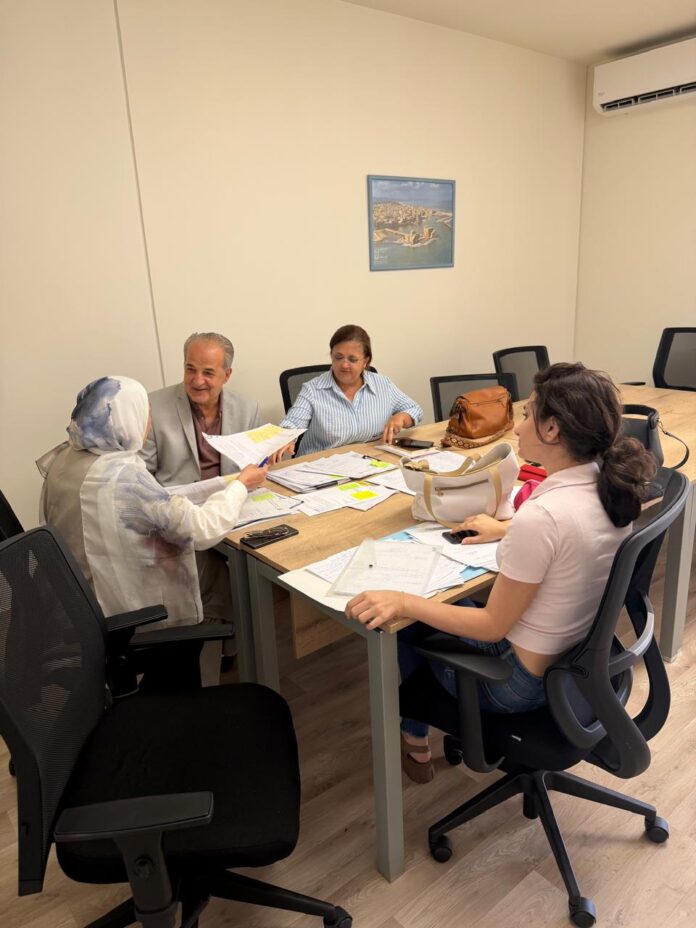
The National Human Rights Commission in Lebanon, including the Committee for the Prevention of Torture (NHRC-CPT), convened a working meeting at its headquarters in Beirut under the chairmanship of its President, Dr. Fadi Gerges, with the participation of the project team implementing the “Emergency Response to Reduce Prison Overcrowding” initiative.
The initiative is being implemented by the National Human Rights Commission in partnership with the Geneva Centre for Security Sector Governance (DCAF) as one of the key outputs of the Supporting Security Sector Oversight project, funded by the Norwegian Ministry of Foreign Affairs.
The meeting reviewed the progress achieved since 3 March 2026, when the escalation of Israeli hostilities against Lebanon began, creating unprecedented humanitarian and institutional challenges that have also affected detention facilities and the administration of justice.
During the meeting, the project team presented the preliminary results of the initiative. Since its launch, 132 applications for release on bail or conditional release have been prepared and submitted before the competent judicial authorities. As a result, 53 detainees have been released, while the legal team is currently preparing 65 additional applications for submission following a comprehensive legal review of the relevant case files.
Participants emphasized that these results demonstrate the importance of the initiative in supporting the Lebanese judiciary, strengthening procedural safeguards, and reducing overcrowding in places of detention, particularly under the exceptional circumstances created by the ongoing hostilities.
The initiative is implemented within the legal mandate of the National Human Rights Commission under Law No. 62/2016. Article 14 authorizes the Commission to communicate with Lebanese and foreign authorities and request any documents or information necessary for the performance of its mandate, while obliging the competent authorities to respond without delay. Article 25 further grants the Committee for the Prevention of Torture unrestricted access to information concerning places of deprivation of liberty, including the number and location of detention facilities, the identity of detainees, the legal basis for detention, and the duration of deprivation of liberty.
Dr. Fadi Gerges stressed that protecting the rights of persons deprived of liberty becomes even more critical during emergencies and armed conflicts, noting that reducing prison overcrowding constitutes an essential preventive measure to safeguard human dignity, improve detention conditions, and reduce the risk of torture, ill-treatment, and other human rights violations.
He stated:
“This initiative is not about granting unlawful privileges or bypassing judicial procedures. It is about ensuring the proper application of the law and enabling every detainee who meets the legal requirements to exercise their right to seek release through judicial processes. It simultaneously supports the justice system and contributes to improving detention conditions.”
The initiative relies on a team of specialized lawyers who conduct regular visits to prisons and detention facilities throughout Lebanon to review detainees’ case files and determine whether they meet the legal criteria for release. Working in close coordination with prison administrations and judicial authorities, the legal team examines the duration of detention, the progress of judicial proceedings, and the absence of legal or public security impediments before preparing release applications.
Beyond reducing prison overcrowding, the initiative seeks to strengthen respect for due process guarantees and improve detention conditions in accordance with the Lebanese Constitution and international standards, including the United Nations Standard Minimum Rules for the Treatment of Prisoners (the Nelson Mandela Rules). It also aims to alleviate the financial and administrative burden on the prison system while supporting families of detainees, many of whom continue to face severe hardship as a result of displacement and the humanitarian consequences of the conflict.
The initiative further contributes to improving the efficiency of the justice system by reducing the number of detainees who are legally eligible for release, allowing courts to devote greater attention to more complex criminal cases while helping reduce prolonged pre-trial detention.
Participants reaffirmed that the initiative represents an effective model of cooperation between the National Human Rights Commission, judicial authorities, prison administrations, and international partners in promoting the rule of law and protecting the rights of persons deprived of liberty.
The meeting concluded with agreement to continue expanding the initiative, complete the legal review of additional detainees’ files across Lebanese prisons, strengthen cooperation with the judiciary, and continue supporting legally justified release requests in order to improve detention conditions and uphold the human rights of all persons deprived of their liberty.
هذه المقالة متاحة أيضًا بـ:
 العربية (Arabic)
  Français (French)

