

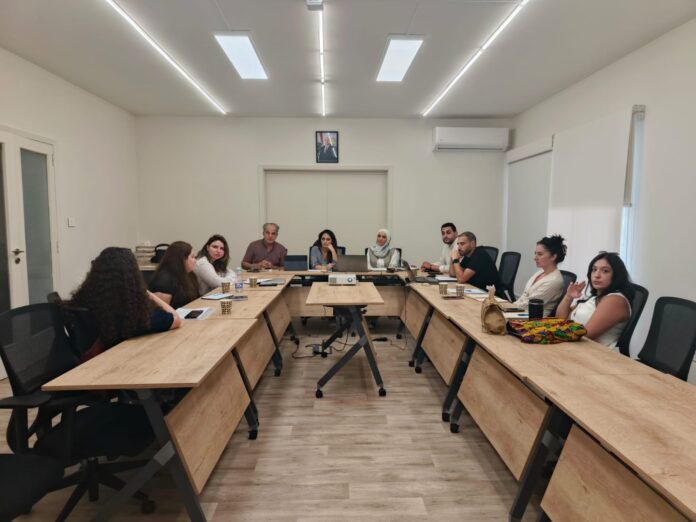
The National Human Rights Commission, including the Committee for the Prevention of Torture (NHRC-CPT), held a working meeting at its headquarters in Beirut, chaired by the Commission’s President, Dr. Fadi Gerges, with the participation of the project team implementing “Strengthening and Protecting the Rights of Internally Displaced Persons in Lebanon,” supported by the United Nations Development Programme (UNDP). The meeting reviewed the preliminary findings of the first phase of field visits covering 40 collective shelters across Lebanon’s governorates.
The meeting forms part of the Commission’s efforts to strengthen the independent monitoring of the human rights situation in the context of internal displacement resulting from the escalation of hostilities, while promoting a human rights-based approach to humanitarian response. These efforts are consistent with the Commission’s mandate under Law No. 62/2016 and Lebanon’s obligations under international human rights law and international humanitarian law.
At the outset of the meeting, the project team presented the key preliminary findings from the field visits, which focused on assessing living conditions in collective shelters and evaluating respect for the fundamental rights of internally displaced persons (IDPs). The assessment examined access to adequate housing, water, food, healthcare, sanitation, privacy, security, and essential services, while also identifying protection risks affecting women and girls, children, older persons, persons with disabilities, and other groups facing heightened vulnerability.
The project is being implemented at a time when collective shelters continue to constitute a cornerstone of Lebanon’s national response to internal displacement. According to the weekly situation report issued by the Disaster Risk Management Unit at the Grand Serail on 6 July 2026, 350 collective shelters remain operational across the country, hosting 36,213 internally displaced persons from 9,351 families. The visits to forty shelters constitute the first phase of a nationwide monitoring programme designed to establish a reliable evidence base on the situation of internally displaced persons, identify protection gaps, and support the development of more effective, evidence-based responses.
Participants discussed the main preliminary observations emerging from the monitoring process, which revealed significant disparities in the level of services provided across shelters, as well as challenges related to overcrowding, privacy, access to essential services, and the need to strengthen protection and referral mechanisms, particularly for the most vulnerable groups. The meeting also reviewed the methodology used for data collection and analysis to ensure compliance with international documentation standards, the protection of personal data, and the application of the “Do No Harm” principle throughout all monitoring and documentation activities.
Dr. Fadi Gerges, President of the Commission, stressed that internally displaced persons must be recognised as rights-holders, rather than merely beneficiaries of humanitarian assistance. He emphasized that respect for human dignity, equality, non-discrimination, and access to essential services constitute legal obligations binding on all relevant authorities.
He added:
“The Commission’s independent monitoring is intended not only to document realities on the ground, but also to generate reliable information and evidence-based legal analysis that supports decision-makers in developing more effective policies and responses, while ensuring that human rights remain at the centre of humanitarian action.”
The project “Strengthening and Protecting the Rights of Internally Displaced Persons in Lebanon” contributes to strengthening the institutional capacities of the National Human Rights Commission in field monitoring, documentation, legal analysis, data management, and evidence-based reporting. These capacities will enable the Commission to regularly and independently assess the human rights situation in collective shelters and displacement sites and to provide practical recommendations to national authorities and international partners aimed at improving the protection of internally displaced persons and strengthening accountability. The project also seeks to develop standardized national monitoring tools based on international standards and to enhance cooperation with public authorities, United Nations agencies, humanitarian organizations, and civil society organizations, thereby contributing to a more comprehensive, effective, and human rights-based national response.
The participants agreed to continue field visits across all Lebanese governorates and to complete the analysis of the data collected in preparation for a comprehensive national report. The report will provide an objective assessment of conditions in collective shelters, identify key challenges and protection needs, and present practical recommendations to governmental authorities and humanitarian partners with the aim of strengthening the protection of internally displaced persons and improving the quality of the national response.
هذه المقالة متاحة أيضًا بـ:
 العربية (Arabic)
  Français (French)

