

Can human rights remain a universal language of human dignity if they are applied selectively?
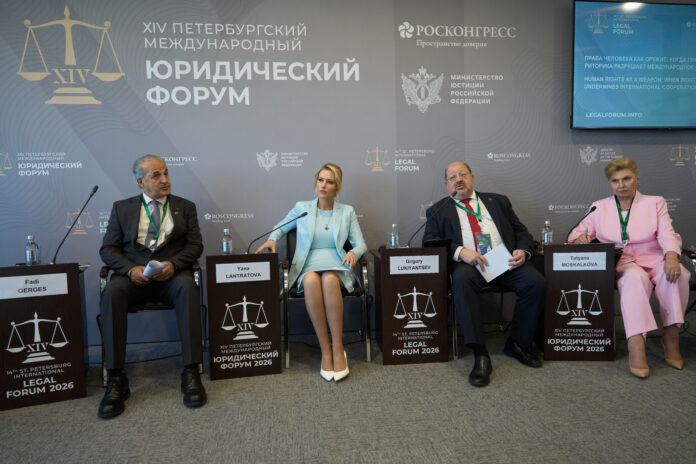
This was the central question raised by Dr. Fadi Gerges, President of the National Human Rights Commission of the Lebanese Republic (NHRC), during his intervention at the 13th St. Petersburg International Legal Forum (SPILF 2026), where international experts gathered to discuss the increasingly complex relationship between human rights and international politics.
Speaking during the high-level session titled “Human Rights as a Weapon: When Rights-Based Rhetoric Undermines International Cooperation,” Dr. Gerges warned that the credibility of the international human rights system depends not only on the principles it proclaims, but on the consistency with which those principles are applied.
Defending the Universality of Human Rights
Opening his remarks, Dr. Gerges recalled that the modern human rights system was created after the Second World War to protect human dignity, prevent abuses of power, and promote peace, justice, and solidarity among nations.
Quoting the 1993 Vienna Declaration and Programme of Action, he emphasized that all human rights are universal, indivisible, interdependent, and interrelated, stressing that these principles lose their meaning whenever they are implemented selectively or subordinated to political interests.
“The question before us is not whether human rights are universal,” he said. “It is whether we are prepared to defend that universality consistently.”
When Human Rights Become Political Instruments
Addressing the theme of the session, Dr. Gerges noted that the selective invocation of human rights has become one of the greatest challenges facing the international system.
He argued that when violations committed by some actors receive strong international condemnation while comparable abuses committed elsewhere attract little attention, confidence in international institutions inevitably declines.
According to Dr. Gerges, such double standards weaken multilateral cooperation because they create the perception that human rights are no longer governed by universal legal principles but by geopolitical calculations.
“Human rights lose credibility when they appear to be applied according to political convenience rather than universal standards,” he stated.
Lebanon’s Experience
Drawing on Lebanon’s own experience, Dr. Gerges described how recurrent conflicts, humanitarian crises, economic collapse, forced displacement, and repeated violations of international humanitarian law have reinforced the need for impartial application of international law.
He stressed that victims of armed conflict often ask why some humanitarian crises generate immediate international action while others receive limited attention.
“This perception of unequal treatment undermines trust in the international human rights system,” he observed. “Justice cannot depend on geography or political alliances.”
The Role of National Human Rights Institutions
Dr. Gerges reaffirmed the responsibility of National Human Rights Institutions to remain independent, objective, and faithful to the Paris Principles, ensuring that victims remain at the center of their work regardless of political circumstances.
Rather than questioning the international human rights framework itself, he called for strengthening its legitimacy through impartial implementation and renewed commitment to international law.
Among the priorities he identified were:
- reaffirming the universality and indivisibility of all human rights;
- rejecting double standards in the application of international law;
- strengthening independent multilateral institutions;
- promoting dialogue and cooperation among States;
- ensuring that victims’ rights to justice remain at the heart of international action.
A Bridge, Not a Weapon
Concluding his intervention, Dr. Gerges challenged participants with a question that resonated throughout the discussion:
“If human rights are truly universal, can we afford to champion them passionately in some contexts while remaining silent in the face of equally serious violations elsewhere?”
He cautioned that describing human rights as a “weapon” should not be understood as questioning their universal value. Rather, it reflects concern that selective or instrumental use of human rights discourse risks deepening international divisions and weakening confidence in global institutions.
Instead, he argued, human rights must remain what they were intended to be: a bridge between nations rather than an instrument of geopolitical confrontation.
“The future of the international human rights system,” he concluded, “depends on our collective ability to apply its principles with fairness, consistency, and universality. Human rights must remain a common language of dignity, justice, and cooperation—not a tool of political rivalry.”
A Strong Lebanese Voice in an International Legal Dialogue
The session, moderated by Evgeniya Pavlenko, Head of the Department of Human Rights at the Higher School of Law of the Russian Presidential Academy of National Economy and Public Administration, brought together an eminent panel of senior government officials, international legal experts, academics, and human rights practitioners. Among the speakers were Yana Lantratova, Commissioner for Human Rights in the Russian Federation; Grigory Lukiyantsev, Director of the Department of Multilateral Cooperation on Human Rights at the Ministry of Foreign Affairs of the Russian Federation and the Ministry’s Commissioner for Human Rights, Democracy and the Rule of Law; Professor Aslan Abashidze, Member of the United Nations Committee on Economic, Social and Cultural Rights; Professor Alena Douhan, UN Special Rapporteur on the negative impact of unilateral coercive measures on the enjoyment of human rights (online); Professor John Laughland of the ICES Catholic Institute of the Vendée (online); Professor Mark Entin, Vice-President of the Russian Association of International Law; and other distinguished experts from Europe and Asia.
The discussion explored the growing challenges facing the international human rights system in an increasingly polarized geopolitical environment. Participants examined the risks associated with the selective application of international human rights norms, the impact of double standards on the credibility of international institutions, and the importance of preserving the universality, impartiality, and integrity of human rights law. The panel also addressed ways to strengthen multilateral cooperation, reinforce the independence of national human rights institutions, and ensure that international legal mechanisms remain grounded in the principles of objectivity, equality, and the rule of law.
Dr. Fadi Gerges’ participation underscored Lebanon’s commitment to engaging constructively in international legal and human rights dialogue and reflected the growing international role of the National Human Rights Commission of Lebanon (NHRC-CPT) as an independent national institution operating in accordance with the UN Paris Principles. His intervention reaffirmed the Commission’s commitment to promoting universal human rights, combating torture and other serious human rights violations, strengthening international cooperation among National Human Rights Institutions, and advocating for the consistent and impartial application of international law.
Beyond his intervention, Dr. Gerges’ participation in the St. Petersburg International Legal Forum was further marked by the signing of a Memorandum of Cooperation between the National Human Rights Commission of Lebanon and the Commissioner for Human Rights in the Russian Federation. The agreement establishes a framework for institutional collaboration in areas including the exchange of expertise and best practices, human rights education, complaint-handling mechanisms, joint capacity-building initiatives, and cooperation on issues of mutual concern. Together, these engagements reflected the Commission’s broader vision of building international partnerships based on dialogue, mutual respect, institutional independence, and the shared objective of advancing the protection of human rights worldwide.
هذه المقالة متاحة أيضًا بـ:
 العربية (Arabic)
  Français (French)

