

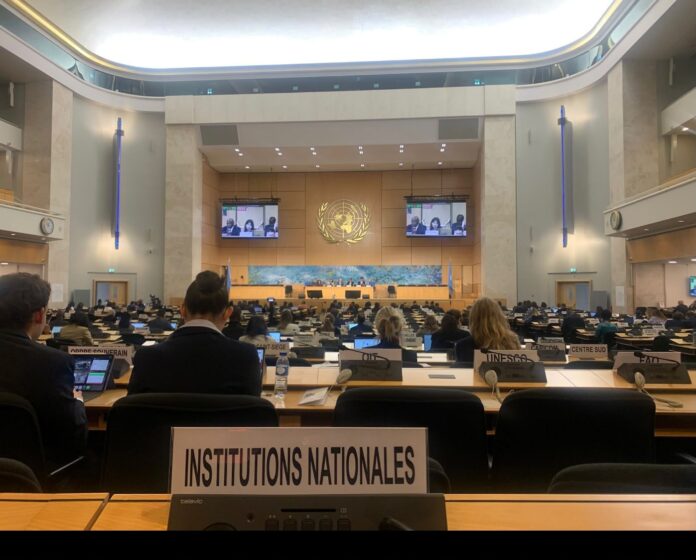
The National Human Rights Commission of Lebanon, including the Committee for the Prevention of Torture (NHRC-CPT), has commenced its participation in a specialized technical assistance programme on the accreditation process of national human rights institutions with the Global Alliance of National Human Rights Institutions (GANHRI). The programme is organized by the Office of the United Nations High Commissioner for Human Rights (OHCHR) in Geneva, at its initiative for the benefit of the National Human Rights Commission and with the support of the United Nations Development Programme (UNDP), from 15 to 17 June 2026.
The programme was originally scheduled to take place in person at OHCHR headquarters in Geneva. However, exceptional circumstances related to the G7 Summit being held in Evian, France, and the resulting travel restrictions in Switzerland, led to the training being converted into a virtual format.
The programme aims to strengthen the institutional and technical capacities of the National Human Rights Commission in Lebanon and support its preparations to fulfil the requirements for accreditation under the Paris Principles, the international standards governing the establishment and functioning of national human rights institutions. Accreditation will further enhance the Commission’s independence, effectiveness, and ability to engage with the United Nations system and international human rights mechanisms.
The opening session was attended by Mr. Abdoul Aziz Thioye, Deputy Director of the Global Operations Division at OHCHR, Mr. Mazen Shaqoura, Regional Representative of OHCHR for the Middle East and North Africa, and Ms. Cynthia Radert, Deputy Head of the National Institutions and Regional Mechanisms Section, together with a number of OHCHR officials and experts.
The National Human Rights Commission was represented by its President, Dr. Fadi Gerges, Treasurer and Commissioner for Complaints Mr. Ali Youssef, and Commissioner for International Relations Mr. Bassam Al Kantar.
In his opening remarks, Mr. Abdoul Aziz Thioye welcomed the Lebanese delegation and commended the Commission’s efforts to strengthen its institutional framework and complete the requirements for accreditation. He emphasized that national human rights institutions play a vital role in the promotion and protection of human rights at the national level and in translating international standards into tangible national policies and practices. He further noted that accreditation under the Paris Principles enhances the credibility, effectiveness, and engagement of national institutions within the Human Rights Council and other United Nations bodies.
Mr. Thioye also expressed OHCHR’s solidarity with Lebanon in light of the difficult humanitarian and security conditions facing the country. He highlighted the important role that the National Human Rights Commission can play in monitoring and documenting violations, contributing to accountability efforts, protecting victims, and promoting respect for international human rights law and international humanitarian law.
For his part, Dr. Fadi Gerges, President of the National Human Rights Commission, expressed his appreciation to OHCHR and UNDP for organizing the programme and providing the technical support required by the Commission. He stressed that this initiative represents an important milestone in strengthening the Commission’s capacities and advancing its institutional readiness for accreditation.
Dr. Gerges noted that despite the significant challenges faced by the Commission over recent years, including Lebanon’s political and economic crises, the COVID-19 pandemic, and the consequences of the recent war, the Commission has succeeded in achieving important progress in establishing its institutional structures, developing its internal regulations, and strengthening its administrative and financial independence.
During the first day of the programme, OHCHR experts delivered detailed presentations on the Paris Principles and the General Observations issued by GANHRI’s Sub-Committee on Accreditation (SCA). Discussions focused on the core accreditation requirements relating to institutional independence, legal mandate, pluralism, human and financial resources, and cooperation with civil society, public authorities, and the international human rights system.
The Commission’s delegation also presented the main developments achieved since the institution became operational, including the adoption of internal and financial regulations, the development of complaints-handling mechanisms, the establishment of several specialized commissions and committees, and strengthened cooperation with relevant national and international institutions.
Participants discussed a number of issues relating to the Commission’s legal and institutional framework, mechanisms to safeguard its financial and administrative independence, and the challenges associated with carrying out its mandate under Lebanon’s current exceptional circumstances. The discussions also addressed the Commission’s role in monitoring the human rights situation and following up on Lebanon’s implementation of its obligations under international human rights treaties.
The delegation further highlighted efforts to strengthen the work of the National Preventive Mechanism against Torture, monitor places of detention, and expand cooperation with civil society organizations, universities, and national human rights actors, with a view to broadening the Commission’s reach and enhancing its impact at the national level.
The programme will continue over the next two days through specialized technical sessions focusing on the preparation of the “Statement of Compliance with the Paris Principles,” the review of accreditation requirements and supporting documentation, and the practical steps necessary to finalize and submit the Commission’s accreditation application to GANHRI’s Sub-Committee on Accreditation.
This programme forms part of the ongoing partnership between the National Human Rights Commission, OHCHR, and UNDP, and reflects their joint efforts to strengthen the Commission’s independence and institutional capacities in line with international best practices, thereby enhancing its role in protecting human rights and promoting accountability and the rule of law in Lebanon.
هذه المقالة متاحة أيضًا بـ:
 العربية (Arabic)
  Français (French)

