
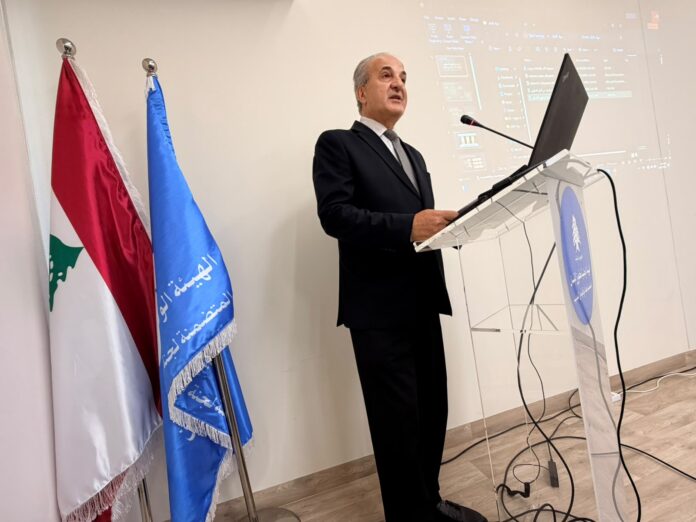
The National Human Rights Commission of Lebanon, including the Committee for the Prevention of Torture (NHRC-CPT), launched its new monthly dialogue forum, “Let’s Connect for Rights”, during a gathering held at the Commission’s headquarters in Beirut, bringing together parliamentarians, judges, lawyers, legal experts, representatives of civil society organizations, human rights defenders, academics, and stakeholders concerned with the promotion and protection of human rights and international humanitarian law.
The inaugural session focused on the anticipated role of the International Humanitarian Law Committee within the National Human Rights Commission in documenting violations of international human rights law and international humanitarian law resulting from the Israeli aggression against Lebanon.
Participants included Member of Parliament Paula Yacoubian, former Member of Parliament Rami Fanj, Judge Ayman Ahmad representing the National Committee on International Humanitarian Law, and retired Brigadier General Naim Ziadah, Ms. Joumana Sleilati and Ms. Cynthia Asmar, representing the National Commission for Lebanese Women (NCLW), as well as Ms. Reina Sfeir, representing the National Commission for the Families of the Missing and Forcibly Disappeared (NCFMD).
Opening the meeting, NHRC-CPT President Dr. Fadi Gerges stressed that the new monthly forum reflects the Commission’s commitment to maintaining open dialogue and structured engagement with civil society, human rights organizations, academic institutions, experts, and public stakeholders. He emphasized that strengthening human rights protection requires sustained cooperation, consultation, and exchange of expertise among all actors.
Dr. Gerges noted that the current situation in Lebanon, marked by ongoing hostilities and widespread harm to civilians, civilian infrastructure, cultural heritage, and the environment, requires enhanced national and international efforts to document violations, preserve evidence, and advance accountability.
He reaffirmed the importance of the establishment of the International Humanitarian Law Committee within the Commission as a specialized national mechanism tasked with monitoring and documenting serious violations of international humanitarian law and human rights law, supporting accountability efforts, and contributing to the preservation of evidence for future judicial processes.
The President also renewed the Commission’s call for the Lebanese Parliament to adopt the proposed International Crimes Law, which would criminalize genocide, crimes against humanity, and war crimes under Lebanese legislation, thereby strengthening Lebanon’s capacity to fulfil its international obligations and combat impunity.
During the session, Mr. Bassam Al Kantar, Chairperson of the Commission’s International Humanitarian Law Committee, presented an overview of the respective mandates of the governmental National Committee for International Humanitarian Law and the International Humanitarian Law Committee established within the National Human Rights Commission.
He explained that while the governmental committee primarily serves as a technical advisory body supporting legislative implementation of international humanitarian law obligations, the Commission’s committee exercises an independent monitoring and documentation role focused on recording violations, preserving evidence, supporting accountability processes, and contributing to national and international justice efforts.
Mr. Al Kantar also presented the Commission’s ongoing advocacy efforts before the United Nations Human Rights Council regarding the situation in Lebanon. He recalled the Commission’s formal request submitted to the Lebanese Government in April 2026, calling for an urgent special session of the Human Rights Council and the establishment of an Independent International Investigative Mechanism for Lebanon, mandated to investigate serious violations of international humanitarian law and international human rights law committed by all parties since 7 October 2023.
The Commission emphasized that such a mechanism would differ substantially from the assessment mission recently announced by United Nations High Commissioner for Human Rights Volker Türk. While the forthcoming OHCHR mission is expected to document violations and analyse legal patterns, an independent international investigative mechanism would possess broader investigative powers, dedicated resources, evidence-preservation capacities, and the ability to identify alleged perpetrators through confidential accountability files that may support future judicial proceedings.
Participants discussed the importance of preserving evidence in accordance with international standards, ensuring independence and impartiality in investigations, protecting victims and witnesses, maintaining chain-of-custody procedures, and supporting future accountability efforts at national, international, and universal-jurisdiction levels.
The Commission reiterated that accountability for serious violations remains essential to ensuring justice for victims, preventing recurrence, and strengthening respect for international law.
Concluding the meeting, the Commission announced that the second session of the “Let’s Connect for Rights” series will be held on 9 July 2026 and will focus on advancing the rights of persons with disabilities in Lebanon, including strengthening the role of the Commission’s Committee on the Rights of Persons with Disabilities and promoting implementation of the Convention on the Rights of Persons with Disabilities and Lebanon’s National Strategy for the Rights and Inclusion of Persons with Disabilities (2026–2030).
The Commission reaffirmed its commitment to maintaining the monthly forum as a permanent platform for dialogue, cooperation, and partnership in support of human rights, accountability, and the rule of law in Lebanon.
هذه المقالة متاحة أيضًا بـ:

