
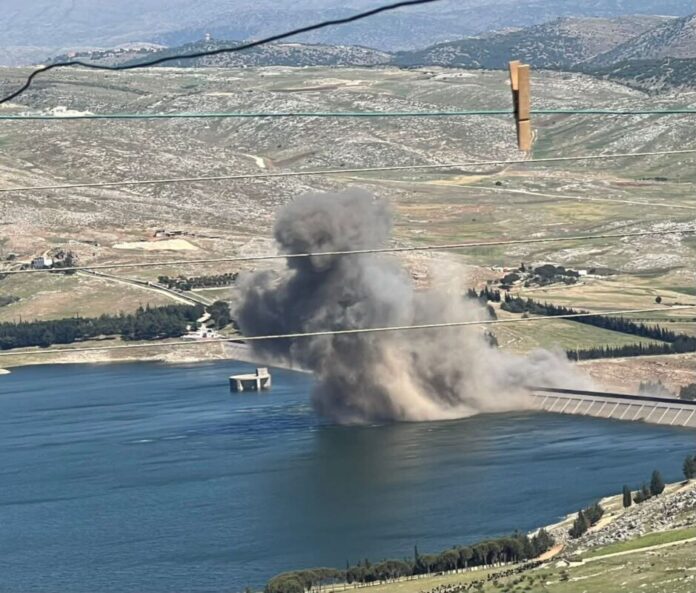
The Committee on International Humanitarian Law at the Lebanese National Human Rights Commission announced that the Israeli bombardment targeting the vicinity of the Qaraoun Dam and its associated facilities poses catastrophic risks to civilians, vital infrastructure, water security, and energy supply in Lebanon, while at the same time constituting a serious threat to installations that enjoy special protection under the rules of international humanitarian law.
In this context, the Committee stressed that the protection of dams and installations containing dangerous forces constitutes one of the well-established fundamental rules of international humanitarian law, given that any direct or indirect attack against them may unleash destructive forces capable of causing large-scale civilian casualties and severe harm to the environment, infrastructure, and essential services. The Committee further emphasized that the technical and engineering data related to the Qaraoun Dam indicate that any structural failure or military attack in its vicinity could lead to grave humanitarian and environmental consequences extending across large parts of the Litani River basin and reaching the Lebanese coast. This, the Committee noted, obliges all parties to the conflict to fully respect the principles of distinction and proportionality and to take all feasible precautions during military operations.
In light of the seriousness of the reported violations, the Committee called on the Lebanese judicial authorities, particularly the competent public prosecutors, to immediately initiate national criminal investigations into these attacks. The Committee also affirmed that the opening of effective and independent national investigations constitutes an essential step toward combating impunity, preserving the rights of victims and their families to truth, justice, and reparation, and strengthening Lebanon’s ability to resort to international accountability mechanisms, including the International Criminal Court and the exercise of universal jurisdiction, where the legal elements of potential international crimes are met.
Call on Public Prosecutors to Act Ex Officio to Document Attacks Against Civilian Objects
The Committee commends the step taken by the Government Commissioner to the Military Court, Judge Claude Ghanem, who approved the opening of an official record and the registration of testimony concerning the attack and the damage inflicted on the vicinity of the Qaraoun Dam. The Committee considers this step an important model in the process of national judicial documentation of attacks and violations linked to armed conflicts. The Committee also emphasized that it would be advisable for the Public Prosecutor at the Court of Cassation to act ex officio and open documentation records immediately upon receiving information or reports concerning attacks or targeting incidents, whether directed against individuals, public and private facilities, or civilian objects, as this constitutes a fundamental element in preserving evidence and ensuring that technical and judicial information related to potential violations is not lost.
During his official visit to Lebanon between 29 September and 10 October 2025, the United Nations Special Rapporteur on extrajudicial, summary or arbitrary executions, Dr. Morris Tidball-Binz, stressed the urgent legal importance of opening national criminal investigations into violations linked to Israeli attacks on Lebanon. He considered that relying solely on preliminary administrative or security reports does not satisfy Lebanon’s obligations under international human rights law and international humanitarian law. The Special Rapporteur particularly emphasized the central role of public prosecutors in initiating public proceedings immediately upon the occurrence of potential violations, considering that time is a decisive factor in preserving evidence and preventing its loss, tampering, or deterioration.
In this context, the Special Rapporteur noted that many incidents related to Israeli strikes are being handled through what are known as “information reports” prepared by security agencies, which merely provide preliminary documentation of incidents without opening actual judicial case files under the supervision of the Public Prosecutor. This results in evidence and information remaining within an internal administrative framework that is not systematically accessible to victims or their families. He considered that this approach threatens the integrity of the justice process because the absence of a formal criminal investigation prevents evidence from being secured in accordance with internationally recognized legal procedures, particularly with regard to the Chain of Custody, which constitutes a fundamental requirement for the admissibility of evidence before national or international courts.
The Special Rapporteur further clarified that the opening of criminal investigations is not solely linked to the objective of identifying individual responsibilities, but also constitutes a necessary legal mechanism to guarantee the “right to truth,” the “right to justice,” and the “right to reparation and compensation” for victims and their families. Pursuant to Article 6 of the International Covenant on Civil and Political Rights, the State is obligated to conduct effective, prompt, independent, and impartial investigations into all cases of arbitrary deprivation of the right to life, including violations occurring during armed conflicts. Accordingly, the failure of judicial authorities to open genuine investigations may be interpreted as a failure to comply with Lebanon’s international obligations relating to the protection of the right to life and the fight against impunity.
Tidball-Binz also pointed out that early criminal investigations acquire heightened importance in the context of potential international crimes, given that crime scenes related to armed conflicts are rapidly exposed to alteration, destruction, rubble removal, or the impact of natural and security-related factors. Consequently, any delay in judicial access to targeted locations may result in the loss of projectile traces, shrapnel, remnants of munitions, explosive residues, digital evidence, and live testimonies, all of which are essential elements for reconstructing events, determining the nature of the weapons used, and identifying the parties potentially responsible for the attacks. He also stressed the necessity of documenting strike sites, deaths, and injuries in accordance with international standards, particularly the 2016 Minnesota Protocol on the Investigation of Potentially Unlawful Death.
In his concluding recommendations, the Special Rapporteur called on the Lebanese authorities to open criminal investigations into all deaths that may have been unlawful, including those resulting from Israeli attacks, and to refer cases, where sufficient evidence exists, to the competent civilian courts. He also recommended the establishment of a specialized unit within the Office of the Public Prosecutor to investigate serious violations of international humanitarian law and international human rights law, including war crimes and violations linked to armed conflicts. He considered that developing this national judicial track constitutes an essential step not only for protecting the rights of victims, but also for preserving the possibility of future recourse to international justice mechanisms, including universal jurisdiction or the International Criminal Court, should full accountability prove impossible at the national level.
The Role of the Litani River National Authority in Documenting Damage and Risks
The Committee on International Humanitarian Law at the National Human Rights Commission commends the role played by the Chairman of the Litani River National Authority, Dr. Sami Allouiyeh, who initiated the assignment of the Authority’s engineer, Mohammad Kamal Omar, to proceed to the Qaraoun police station of the Internal Security Forces and request the drafting of an official report documenting the damage sustained by the dam and its surroundings. This also included the attachment of a technical assessment containing scenarios regarding the risks of a potential collapse of the Qaraoun Dam and the areas exposed to possible flooding in the event of any structural failure or attack against the dam. The Committee considered that this measure reflects an awareness of the responsibility of public institutions in the proactive documentation of risks and violations, and establishes a technical and legal database upon which any future accountability process may rely. The Committee further confirmed that it will continue its documentation efforts on the basis of this official report and will rely on its reference number and date in all documentation and legal analysis related to this attack, considering that this report constitutes an essential judicial reference in the accountability process, whether in relation to identifying potential perpetrators, characterizing the acts committed, or legally qualifying potential individual crimes, in preparation for accountability proceedings before national and international judicial mechanisms, including the International Criminal Court or national courts exercising universal jurisdiction.
According to the statement provided by Mohammad Kamal Omar, an engineer employed by the Litani River National Authority, and recorded in the official report, a review of video footage filmed near the spillway of the Qaraoun Dam at approximately 2:00 p.m. on Tuesday, 26 May 2026, revealed that the area was subjected to three consecutive airstrikes within seconds of one another. The strikes caused rocks and debris to scatter, resulting in damage to installations belonging to the dam and to the facility known as (NPS), in addition to power outages in certain areas and damage to electrical cables, utility poles, and part of the arches located within the facility. The technical statement further indicates that the targeted area is not merely an ordinary road or vehicle passageway, but rather forms an integral part of the dam’s rear structural formation and serves a critical engineering function consisting of stabilizing rocks and sediments and preventing landslides toward the base of the dam. The site also includes an engineered retaining wall intended to protect the body of the dam, preserve its stability, and prevent any landslides or movements that could threaten the safety of the main structure. The statement clarified that the road adjacent to the dam forms part of the engineering protection system directly linked to the safety of the Litani facility, in addition to serving as a vital passage connecting the western and eastern banks of the Litani River. Consequently, any repeated targeting of the vicinity of the dam and the said road constitutes a serious threat to the safety of the structure and the facilities associated with it.
Risks of Targeting and Scenarios of the Collapse of the Qaraoun Dam
The direct or indirect targeting of the Qaraoun Dam facilities may lead to grave risks threatening public safety, given that the dam constitutes a strategic civilian installation linked to water security, energy production, and irrigation in Lebanon. Any potential structural failure could also result in catastrophic consequences for the population, infrastructure, and facilities located downstream of the dam, including risks of large-scale flooding and collapse. Within the framework of the Litani River Basin Management Support Programme, the Litani River National Authority prepared an analytical study on scenarios relating to the collapse of the Qaraoun Dam and the areas exposed to potential flooding in the event of any structural failure or attack against the dam. It also developed an emergency evacuation plan for areas vulnerable to flooding in the lower Litani River basin extending to the river mouth. These studies were updated and deposited with the competent security and administrative authorities. The study contained in the report entitled “Dam Break Modeling for Qaraoun Dam,” issued in 2012 under the Litani River Basin Management Support Programme, indicates that the collapse of the Qaraoun Dam could lead to one of the most dangerous environmental and humanitarian disasters in Lebanon, given the enormous volume of stored water and the steep topography of the Litani River basin extending to the Mediterranean Sea.
The report presents a detailed engineering scenario for the collapse of the dam using the HEC-RAS model adopted by the United States Army Corps of Engineers, with the purpose of simulating the flow of the flood wave resulting from the dam breach and its propagation along the Litani River toward the southern coast. The report confirms that the most dangerous potential scenario would involve a strong earthquake causing structural weakening and a progressive collapse of the rockfill dam lined with concrete, followed by massive water discharge resulting from overtopping and erosion of the rock embankments. According to the simulation results, the collapse of the dam while the reservoir is completely full, with a storage capacity of approximately 220 million cubic metres, would generate a massive flood discharge exceeding 67,000 cubic metres per second at the dam site, a volume far greater than any natural flood ever recorded in Lebanon. The study further explained that the first flood wave could reach a height of approximately 40 metres in certain areas, with even greater heights recorded in narrow bends of the valley where the wave could exceed 50 metres. The study also demonstrates that the flood wave would move at extremely high speed due to the steep gradient of the Litani Valley, potentially reaching the sea within approximately two hours at a speed approaching 44 kilometres per hour.
The report identified the expected arrival times of the flood wave in several areas downstream of the dam, including Sohmor, Yohmor, Khardali, and Kfarsir, extending to the coastal plain and Qasmiyeh, leaving only a very limited timeframe for evacuation operations and emergency response measures. The report also notes that the consequences would not be limited to direct flooding but would include the destruction of infrastructure, bridges, roads, irrigation systems, and electricity networks, in addition to extensive environmental risks resulting from the movement of sediments and pollutants accumulated in Lake Qaraoun and along the Litani River toward agricultural and coastal areas. This would further aggravate the health and environmental crisis in southern Lebanon, particularly in light of the chronic pollution affecting the river basin. In its conclusion, the report recommended the preparation of detailed flood-risk maps for threatened areas and the establishment of a national emergency plan to protect communities located downstream of the dam, including early warning systems, evacuation plans, and the training of local authorities and residents in rapid response measures. The report also emphasized the importance of periodically updating simulation models and linking them to seismic and hydrological safety monitoring programmes for the dam.
Judicial and Technical Documentation as a Gateway to International Accountability and Justice
The Committee on International Humanitarian Law at the National Human Rights Commission draws attention to the fact that the existence of such studies reflects the scale of the real dangers that may result from any targeting of the dam or its facilities, and confirms that any attack carried out in the vicinity of these installations must be assessed in light of the principles of precaution and proportionality enshrined in international humanitarian law. The Committee also noted that a number of national and strategic projects funded by the World Bank are directly linked to the continued operation of the Qaraoun Dam facilities, including water transfer projects supplying the city of Beirut and projects aimed at rehabilitating the Litani hydroelectric plants within renewable energy programmes. Any threat to these facilities therefore constitutes a direct threat to water security, energy security, and the economic and social stability of Lebanon.
The Committee had previously called upon the Lebanese government to adopt urgent legal and institutional measures to strengthen the path toward accountability for serious violations of international humanitarian law, through:
First, accepting the jurisdiction of the International Criminal Court pursuant to Article 12(3) of the Rome Statute, as a preliminary step toward accession to the Statute.
Second, completing the drafting and adoption of national legislation criminalizing war crimes and other international crimes in line with Lebanon’s international obligations.
Third, providing full support to national judicial investigations and to the documentation efforts carried out by the National Human Rights Commission and other competent bodies, in a manner that guarantees the preservation of evidence and strengthens the prospects for accountability and the fight against impunity.
The Committee concluded by emphasizing that the early judicial and technical documentation of these attacks constitutes the cornerstone of any future accountability process, and that preserving evidence, technical and engineering data, and official testimonies represents a fundamental step toward ensuring that perpetrators of serious violations do not escape punishment, whether before national courts or within international mechanisms competent to address international crimes.
Protection of Dams and Water Installations under International Humanitarian Law
The Committee affirmed that dams and major water installations enjoy special protection under Article 56 of the 1977 Additional Protocol I to the Geneva Conventions. In addition, Customary International Humanitarian Law Rule 42 clearly enshrines this prohibition by forbidding attacks against dams or attacks on military objectives located near them if such attacks may cause the release of dangerous forces resulting in severe losses among the civilian population. This protection acquires a heightened character in view of the consequences that any structural failure or direct or indirect attack on the dam may entail, including large-scale flooding, destruction of infrastructure, and threats to civilian lives.
Article 56 of the 1977 Additional Protocol I to the Geneva Conventions constitutes one of the most important special protection rules under international humanitarian law, as it establishes enhanced protection for works and installations containing “dangerous forces,” foremost among them dams, dykes, and nuclear electrical generating stations. The legal rationale underlying this provision is based on the recognition that attacks against such installations do not merely result in conventional military damage, but may also trigger large-scale collective disasters due to the uncontrolled release of water, energy, or hazardous materials, leading to catastrophic human and environmental losses far exceeding the immediate military objective.
Article 56 expressly prohibits attacks against such installations “even where these objects are military objectives” if such attacks may cause the release of dangerous forces and consequent severe losses among the civilian population. In this regard, the provision is distinct from the general targeting rules under international humanitarian law because it imposes an additional restriction beyond the ordinary principle of proportionality. Thus, even in situations where an attack may offer a certain military advantage, the attack remains prohibited if the foreseeable consequence would be the release of dangerous forces producing catastrophic effects on civilians.
Article 56 also reflects an important evolution in the concept of special protection for civilian objects. It does not merely prohibit direct attacks against dams, but extends protection to military objectives located in their vicinity where attacks against such objectives could incidentally damage the dam or affect its structural integrity. This means that the legal obligation extends beyond refraining from striking the installation itself and includes the duty to assess indirect risks arising from military operations conducted nearby, including the effects of explosions, vibrations, or secondary damage that may result in the partial or total collapse of the structure.
This protection further carries a clear preventive dimension, obliging parties to the conflict to exercise the highest degree of caution when planning or conducting military operations near such installations, based on the principle of “due care” in avoiding foreseeable catastrophic harm. Article 56 also significantly narrows the scope of permissible exceptions, as protection may only cease under highly exceptional circumstances where the installation is being used in regular, direct, and significant support of military operations and where an attack is the only feasible means of terminating such support. Even in such circumstances, the rules of proportionality and precautions remain fully and strictly applicable.
Customary International Humanitarian Law Rule 42, as formulated by the International Committee of the Red Cross, further consolidated this prohibition as a customary rule binding upon all parties to armed conflicts, whether or not they are parties to Additional Protocol I. The importance of the customary nature of this rule lies in the fact that it reflects widespread State practice and a general legal conviction regarding the necessity of protecting dams and installations containing dangerous forces, given the humanitarian risks inherently associated with them.
Customary Rule 42 confirms that the special protection afforded to such installations is directly linked to the fundamental principles of international humanitarian law, particularly the principles of humanity and distinction. The release of water or dangerous forces resulting from attacks on dams cannot be confined to a specific military area, but by its nature produces indiscriminate and uncontrollable effects extending to civilians and civilian objects across wide geographic areas. Consequently, any attack likely to produce such consequences is inherently incompatible with the prohibition on indiscriminate and disproportionate attacks.
The customary nature of this rule also strengthens the possibility of international accountability for serious violations thereof, whether in the context of State responsibility or individual criminal responsibility. Deliberately targeting dams or conducting military operations with knowledge that they may release dangerous forces causing widespread civilian harm may constitute a serious violation of international humanitarian law and, depending on the circumstances of each case, may amount to a war crime giving rise to prosecution and accountability before national or international courts.
هذه المقالة متاحة أيضًا بـ:

