
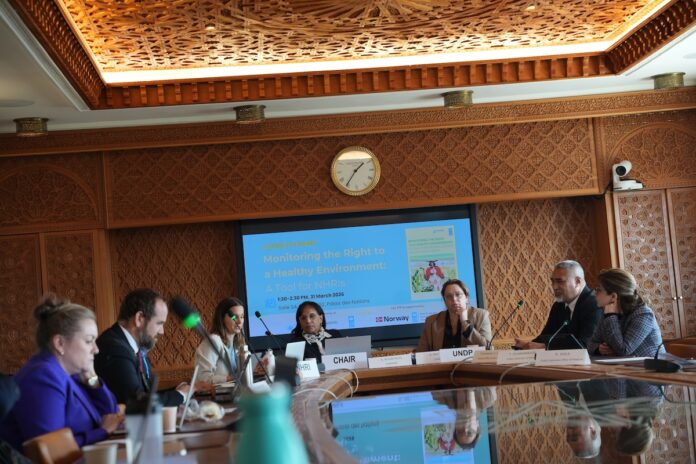
The National Human Rights Commission in Lebanon, including the Committee for the Prevention of Torture (NHRC-CPT), participated in a high-level side event held on the margins of the Global Alliance of National Human Rights Institutions (GANHRI) General Assembly, marking the official launch of the tool “Monitoring the Right to a Healthy Environment: A Tool for National Human Rights Institutions (NHRIs)”, developed by the United Nations Development Programme (UNDP), the Office of the High Commissioner for Human Rights (OHCHR), and GANHRI under their Tripartite Partnership.
The NHRC-CPT delegation, represented by Dr. Fadi Gerges, President of the Commission, and Mr. Bassam Kantar, Commissioner of International Relations, attended the event as part of their engagement in the GANHRI General Assembly in Geneva.
Reinforcing the Right to a Healthy Environment
The launch of the tool builds on the recognition by the United Nations General Assembly in 2022 of the human right to a clean, healthy, and sustainable environment, a right increasingly acknowledged as essential for the enjoyment of fundamental rights, including the rights to life, health, food, water, and development.
This recognition was further reinforced by the International Court of Justice in its 2025 Advisory Opinion, which affirmed that a healthy environment is a prerequisite for the realization of human rights.
A Strategic Tool for National Human Rights Institutions
The newly launched tool provides NHRIs with a practical and structured methodology to monitor environmental human rights obligations at the national level. It adopts a comprehensive TREE framework, examining:
- Legal and policy frameworks (Rules),
- Enforcement and oversight mechanisms,
- Actual environmental harms and impacts on communities.
The tool covers key thematic areas, including climate change, biodiversity, access to safe water, healthy food systems, and protection from toxic environments, while also addressing procedural rights such as access to information, participation, and access to justice.
Strengthening Monitoring, Accountability, and Advocacy
During the event, participants emphasized the central role of NHRIs in advancing environmental justice through monitoring, investigations, advocacy, and engagement with affected communities. The tool is expected to enhance the ability of NHRIs to:
- Identify environmental risks and violations,
- Support accountability and remedies,
- Inform evidence-based policies,
- Strengthen protection for environmental human rights defenders.
The tool was piloted in several countries, including Samoa, Malawi, Paraguay, and Georgia, demonstrating its applicability across diverse contexts.
NHRC-CPT Reaffirms Its Commitment
The NHRC-CPT welcomed the launch of this important tool and reaffirmed its commitment to integrating environmental dimensions into its human rights monitoring and reporting, particularly in light of the growing environmental challenges facing Lebanon and their direct impact on fundamental rights.
The Commission underscored that strengthening monitoring frameworks is essential to ensuring accountability, protecting vulnerable populations, and advancing a rights-based approach to environmental governance.
هذه المقالة متاحة أيضًا بـ:

