
Lebanon’s Fourth Universal Periodic Review: Strong International Support for NHRC-CPT Recommendations on Independence, Resources, and Access to Places of Detention
The National Human Rights Commission of Lebanon, including the National Preventive Mechanism against Torture (NHRC-CPT) welcomed the examination of Lebanon’s human rights record under the fourth cycle of the Universal Periodic Review conducted by the United Nations Human Rights Council.
The review took place on Monday, 19 January 2026, from 14:30 to 18:00 (GMT+1), during a public session of the UPR Working Group held in the Palais des Nations, Assembly Hall (Building A, third floor), Geneva, and was webcast live on UN Web TV.
203 Recommendations from 105 States, with Strong Focus on NHRC-CPT
During the interactive dialogue, 105 States delivered statements and put forward a total of 203 recommendations to Lebanon, addressing a wide range of civil, political, economic, social, and cultural rights.
NHRC-CPT particularly welcomed the seven recommendations that explicitly call for the strengthening, full operationalization, independence, and adequate resourcing of the National Human Rights Commission and the National Preventive Mechanism against Torture. These recommendations underscore growing international recognition of the central role played by independent national institutions in safeguarding human rights and preventing torture and ill-treatment.
In particular, States recommended that Lebanon:
Make further efforts to ensure that the National Human Rights Commission and the National Preventive Mechanism are provided with the institutional, financial, and operational resources to fulfil their mandates independently (Bulgaria);
Allow the National Human Rights Commission and the National Preventive Mechanism to have full, free, and regular access to all places of deprivation of liberty (Chile);
Ensure that the National Human Rights Commission, including the National Preventive Mechanism against Torture, is granted full, unhindered and regular access to all places of deprivation of liberty (Denmark);
Ensure that the National Human Rights Commission and the national preventive mechanism are fully resourced and able to operate independently in line with the Paris Principles (Gambia);
Continue efforts aimed at operationalizing the National Human Rights Institution, including the National Preventive Mechanism against Torture (Morocco);
Ensure that the National Human Rights Commission, including the National Preventive Mechanism against torture, is granted full, unhindered, and regular access to all places of deprivation of liberty (Ukraine);
Operationalize fully the national preventive mechanism on torture, including by allocating sufficient financial and other resources, and ensure independent investigation of all incidents of torture and ill-treatment (Croatia);
NHRC-CPT considers these recommendations to constitute a clear and coherent international roadmap for strengthening torture prevention, independent oversight of detention facilities, and Lebanon’s compliance with its obligations under the Convention against Torture and its Optional Protocol.
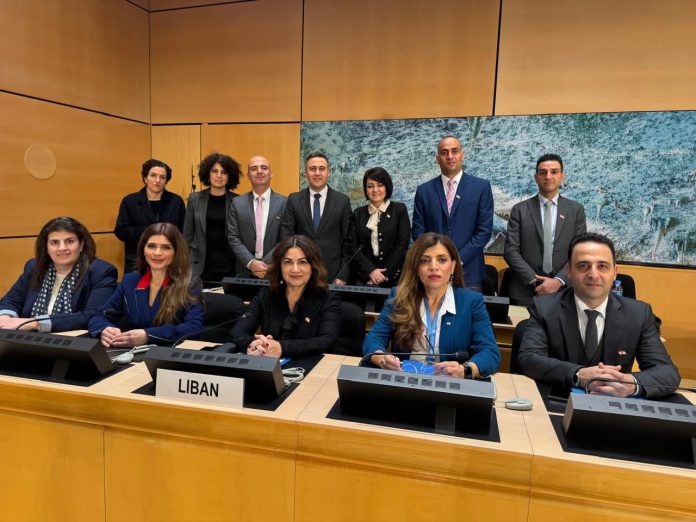
Lebanese Official Delegation
The Lebanese delegation was led by H.E. Ms. Haneen Sayed, Minister of Social Affairs, and included representatives of key state institutions, namely:
Ms. Caroline Ziadeh, the Permanent Representative of Lebanon to the United Nations Office and international organizations in Geneva
Ms. Rana El Khoury, First Secretary at the Permanent Mission in Geneva
Ms. Aya Al Zein, Prime Minister’s Office
Mr. Ayman Ahmad, Ministry of Justice
Mr. Rabih El Ghossainy, General Directorate of Internal Security Forces (ISF), Ministry of Interior and Municipalities
Mr. Rawad Sleeka, General Directorate of General Security, Ministry of Interior and Municipalities
Mr. Samer Molaeb, Lebanese Armed Forces, Ministry of National Defense
Ms. Micheline Elias Massaad, Executive Director of the National Commission for Lebanese Women
Ms. Marie Ghieh, Ministry of Social Affairs
Ms. Nadine Marouk, Lebanese-Palestinian Dialogue Committee
Members of the delegation delivered remarks, responded to questions raised by States, and provided clarifications on Lebanon’s legal framework, policies, institutional challenges, and reform priorities.
Review Framework and Documentation
Lebanon is one of 13 States reviewed during the UPR Working Group session held from 19 to 30 January 2026. Lebanon’s previous UPR reviews took place in November 2010, November 2015, and January 2021.
The review was based on three core documents:
- The national report submitted by the Government of Lebanon,
- A compilation of UN information, including reports from treaty bodies, special procedures, and other UN entities,
- A summary of stakeholders’ submissions, including those from national human rights institutions and civil society organizations.
In this context, NHRC-CPT submitted its independent stakeholder report, highlighting persistent challenges related to torture prevention, places of detention, institutional independence, access to facilities, and the urgent need for sustainable funding and legal safeguards.
Next Steps in the UPR Process
The UPR Working Group is scheduled to adopt the recommendations addressed to Lebanon on Friday, 30 January 2026, between 14:30 and 18:00 (GMT+1). Following adoption, the Lebanese authorities will indicate which recommendations they accept, note, or partially support, ahead of their presentation to the Human Rights Council plenary.
The three country representatives serving as rapporteurs (“troika”) for the review of Lebanon are Cyprus, the Dominican Republic and Mauritius.
Position of NHRC-CPT
NHRC-CPT reiterates that the fourth UPR cycle represents a critical opportunity to move from commitments to implementation. The Commission stresses that effective prevention of torture and protection of human rights cannot be achieved without:
- Full institutional independence,
- Adequate and sustainable financial resources,
- Unrestricted access to all places of deprivation of liberty,
- Constructive cooperation between state authorities, Parliament, the judiciary, and independent oversight bodies.
NHRC-CPT reaffirms its readiness to engage in constructive dialogue and cooperation with all national stakeholders and international partners to ensure that UPR recommendations are translated into concrete reforms that strengthen human dignity, accountability, and the rule of law in Lebanon.
هذه المقالة متاحة أيضًا بـ:

