
spot_img
spot_img

Other publications

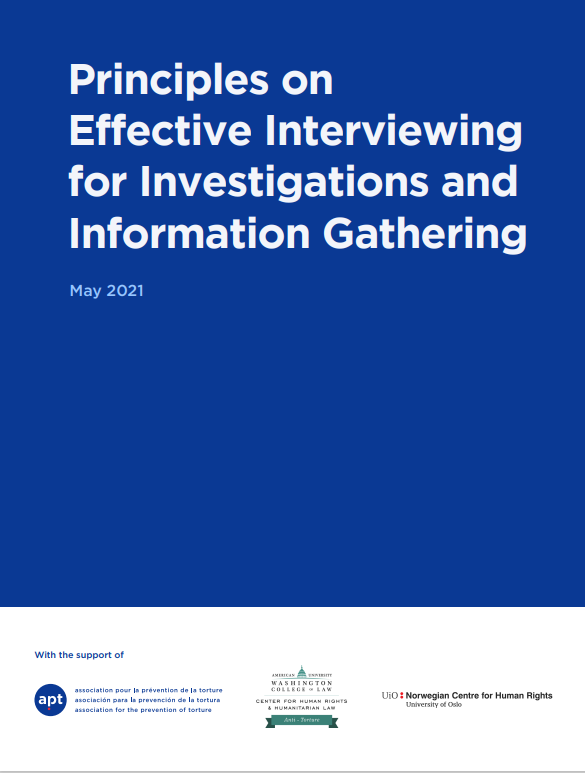
The Méndez Principles

The Principles on Effective Interviewing for Investigations and Information Gathering or the “Méndez Principles” aim to modify police practices by replacing coercive interrogations with rapport-based interviews.

Based on science, law, and ethics, the Méndez Principles propose a concrete alternative to interrogation methods that rely on coercion to extract confessions. They improve the results of investigations, fully respect human rights and enhance trust in the State.

Six core principles

Principle 1

On foundations 
Effective interviewing is instructed by science, law and ethics.


Principle 2

On practice
Effective interviewing is a comprehensive process for gathering accurate and reliable information while implementing associated legal safeguards.


Principle 3

On vulnerability 
Effective interviewing requires identifying and addressing the needs of interviewees in situations of vulnerability.

Principle 4

On training 
Effective interviewing is a professional undertaking that requires specific training.

Principle 5

On accountability
Effective interviewing requires transparent and accountable institutions.

Principle 6

On implementation 
The implementation of effective interviewing requires robust national measures.


هذه المقالة متاحة أيضًا بـ: العربية (Arabic)

NHRCLB
NHRCLBhttps://nhrclb.org
مؤسسة وطنية مستقلة منشأة بموجب القانون 62/ 2016، تتضمن آلية وقائية وطنية للتعذيب (لجنة الوقاية من التعذيب) عملاً بأحكام القانون رقم 12/ 2008 (المصادقة على البروتوكول الاختياري لاتفاقية مناهضة التعذيب). An independent national institution established under Law No. 62/2016, which includes a National Preventive Mechanism against torture (the Committee for the Prevention of Torture), in accordance with the provisions of Law No. 12/2008 (ratifying the Optional Protocol to the Convention against Torture). Une institution nationale indépendante établie en vertu de la loi n° 62/2016, qui comprend un mécanisme national de prévention de la torture (le Comité pour la prévention de la torture), conformément aux dispositions de la loi n° 12/2008 (ratifiant le Protocole facultatif se rapportant à la Convention contre la torture).