


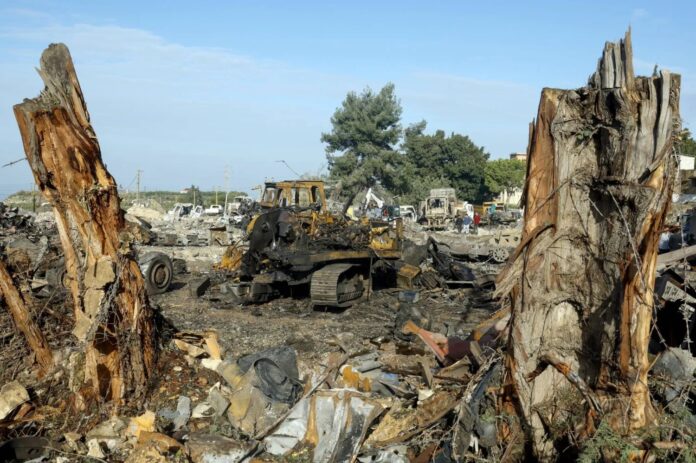
On the International Day for Preventing the Exploitation of the Environment in War and Armed Conflict, observed annually on 6 November, the National Human Rights Commission, including the Committee for the Prevention of Torture, calls for the protection of Lebanon’s environment and natural resources from the effects of military operations, independent scientific assessments of damage, the preservation of evidence, accountability and reparation, and the integration of environmental remediation into relief, return and reconstruction plans.
The Commission stresses that damage to soil, water, forests, crops and biodiversity affects the rights to life, health, food, water, housing, work, and a clean, healthy and sustainable environment. These effects may persist after hostilities cease, threatening people’s safety, livelihoods and ability to return to their homes and land.
Lebanon’s environment and livelihoods under the impact of war
The Commission emphasises that assessments of damage caused by Israeli military operations in Lebanon must address, alongside human casualties and damage to buildings, the burning of vegetation, land clearance, the destruction of crops and agricultural infrastructure, damage to water sources and irrigation networks, and risks associated with explosive remnants, debris and hazardous substances.
In this context, the report issued by the Commission’s International Humanitarian Law Committee on 15 October 2026 examined allegations concerning the destruction of, or damage to, agricultural land and crops during a principal reporting period covering 2 March to 15 June 2026, with subsequent developments assessed through the report’s date. It addressed airstrikes, shelling, burning, bulldozing, the alleged use of white phosphorus, and their effects on orchards, crops, infrastructure and access to agricultural livelihoods.
Consistent with the report’s methodology, the Commission stresses the need to distinguish between documented damage, the mechanism that caused it, the attribution of responsibility, and the legal characterisation of an incident. Assessments must also distinguish pre-existing damage from new damage, avoid combining estimates covering different periods or geographical areas, and prevent double counting.
Scientific assessments published by Lebanon’s National Council for Scientific Research document environmental damage, including fires and vegetation loss, and examine pollution risks and remnants of war. These assessments clarify that burned-area maps do not, by themselves, identify the cause of each fire, and that pollution studies involve different samples, periods and locations. Local findings must therefore not be generalised to areas that have not been tested.
The Commission further stresses that documenting the use of a particular munition or the occurrence of a fire does not, on its own, establish contamination of agricultural soil, water or crops. Establishing contamination, its extent, source and health effects requires sampling under scientific protocols, analysis by qualified laboratories, and the correlation of results with incident locations and dates.
Protecting the environment is a legal obligation during conflict
The Commission recalls that international humanitarian law protects the natural environment through the rules governing the conduct of hostilities, including distinction, proportionality and precautions. No part of the natural environment may be attacked unless it constitutes a military objective. Attacks expected to cause incidental environmental damage excessive in relation to the concrete and direct military advantage anticipated are prohibited. Reasonably foreseeable indirect environmental harm must also be considered.
The Commission also recalls the prohibition on methods or means of warfare intended, or expected, to cause widespread, long-term and severe damage to the natural environment. It stresses that damage falling below this high threshold is not automatically lawful: it remains subject to other applicable rules of protection.
The Commission further highlights the Principles on Protection of the Environment in Relation to Armed Conflicts, taken note of by the United Nations General Assembly in resolution 77/104, as an important reference for preventing, mitigating and remedying environmental harm before, during and after armed conflict, including in situations of occupation. These principles do not collectively constitute a separate treaty; they include existing rules and obligations as well as recommendations for strengthening protection.
The Commission’s recommendations
1. End unlawful conduct and prevent further damage.
The Commission calls on all parties to the conflict to respect the rules protecting civilians, civilian objects and the natural environment; refrain from unlawfully destroying land, crops, forests and water resources or pillaging natural resources; and take all feasible precautions to minimise foreseeable environmental harm.
2. Conduct an integrated national environmental damage assessment.
The Commission calls on the Ministry of Environment, working with the Ministries of Agriculture, Public Health, and Energy and Water, the National Council for Scientific Research, universities and municipalities, to assess soil, water, air, forests, biodiversity and agricultural land. The assessment should identify priority areas, gaps in available knowledge and further testing needs. Findings should be published in language accessible to affected communities.
3. Combine remote sensing with field verification.
The Commission recommends that the National Center for Remote Sensing and other specialist scientific centres contribute to dated damage maps using imagery from before and after incidents and seasonally comparable images. Changes in vegetation should be investigated to distinguish burning or bulldozing from drought, harvesting or disease. Satellite imagery must not replace laboratory analysis when assessing contamination.
4. Preserve evidence and ensure investigation and accountability.
The Commission calls for a georeferenced damage register recording incident dates, information sources, damage types and confidence levels, while preserving original images, samples and their chain of custody. It also calls on the competent judicial authorities to investigate incidents that may constitute violations, establish individual and command responsibility where the relevant conditions are met, and uphold affected persons’ rights to remedy and reparation.
5. Safely address remnants of war and debris.
The Commission stresses the need to coordinate with the Lebanese Armed Forces, particularly the Lebanese Mine Action Center, and relevant technical bodies to assess unexploded ordnance risks and secure hazardous sites. Debris should be sorted and assessed before transport or reuse. Uncontrolled waste burning and dumping in valleys, the sea or near water sources must be prevented.
6. Link return and reconstruction to environmental safety.
The Commission calls on the Disaster Risk Management Unit at the Presidency of the Council of Ministers and other relevant authorities to incorporate environmental assessment findings into return and recovery plans. This includes providing safe water, identifying hazardous sites, making information available to residents, and providing alternatives and support for people whose return or resumption of work is prevented by environmental risks.
7. Support farmers and restore ecosystems.
The Commission recommends scientifically informed programmes to rehabilitate soil, irrigation networks, orchards and forests, taking account of native species and biodiversity. Support should include smallholders, agricultural workers and women working in agriculture, and address continuing production losses throughout the recovery period.
8. Ensure participation, funding and transparency.
The Commission calls for affected communities to participate in setting priorities, sustainable funding for remediation and health and environmental monitoring, publication of criteria for allocating assistance and compensation, and accessible complaints mechanisms. Protection and assistance must not await the completion of criminal investigations.
The Commission stresses that the end of bombardment does not mean the end of harm. Reconstruction must also restore the soil, water and natural resources on which communities depend. Protecting the environment is part of protecting people, and restoring it is essential to safe return, equitable recovery and sustainable peace.
Resources and reference documents
- United Nations: International Day for Preventing the Exploitation of the Environment in War and Armed Conflict.
- General Assembly resolution 56/4 establishing the International Day.
- General Assembly resolution 77/104 and the Principles on Protection of the Environment in Relation to Armed Conflicts.
- General Assembly resolution 76/300 on the human right to a clean, healthy and sustainable environment.
- United Nations Environment Programme.
- International Committee of the Red Cross: Protecting the natural environment in armed conflict.
- ICRC: Guidelines on the Protection of the Natural Environment in Armed Conflict.
- National Council for Scientific Research: Environmental assessment within the preliminary report on conflict impacts in Lebanon.
- Transforming our world: the 2030 Agenda for Sustainable Development — General Assembly resolution 70/1.
هذه المقالة متاحة أيضًا بـ:
 العربية (Arabic)
 Français (French)

