

Amid escalating humanitarian challenges in Lebanon, the National Human Rights Commission submitted a comprehensive contribution to the 2026 global survey launched by the Global Alliance of National Human Rights Institutions (GANHRI), in collaboration with regional networks, with the aim of documenting reprisals and challenges faced by national human rights institutions and human rights defenders worldwide.
This survey is part of the follow-up to GANHRI’s Global Action Plan and will contribute to a confidential submission to the United Nations Secretary-General on cooperation with the UN system, highlighting the importance of protecting national institutions and those engaging with international mechanisms.
An increasingly complex and restrictive operating environment
In its contribution, the Commission shed light on an increasingly challenging operational environment, marked by overlapping administrative, legal, and security obstacles affecting its ability to effectively carry out its mandate. Among the most significant challenges documented are restrictions on access to places of deprivation of liberty, where prior authorization has in some cases been required or delays have been recorded in conducting visits. This undermines the principle of unannounced and preventive visits as set out in the Optional Protocol to the Convention against Torture (OPCAT), and limits the effectiveness of oversight of detention conditions.
The Commission also noted a marked decline in civic space, amid rising incitement and hate speech, particularly against internally displaced persons, as well as increasing pressure on civil society organizations in a highly sensitive context.
Human rights defenders under increasing pressure
The Commission’s contribution highlighted that human rights defenders in Lebanon face growing and multidimensional risks.
This includes journalists, environmental defenders, humanitarian workers, and activists documenting violations, who are increasingly exposed to:
- Organized smear campaigns, particularly in digital spaces,
- Legal and administrative pressures,
- Digital threats and surveillance-related risks,
- Social stigmatization and intimidation.
The Commission further emphasized the gendered dimension of these challenges, noting that women human rights defenders face higher levels of gender-based online violence, defamation, and targeted personal attacks aimed at undermining their participation in public life.
Direct impact on the Commission’s work
The Commission stressed that these challenges have not remained theoretical but have had direct implications on its work, leading to:
- Delays in engagement with official authorities,
- Difficulties in collecting and verifying information.
Despite these constraints, the Commission has continued to carry out its mandate through confidential complaint handling, preventive monitoring, documentation, and the issuance of reports and public positions, while strengthening data protection measures and source confidentiality.
Cooperation with the United Nations: relevance and limitations
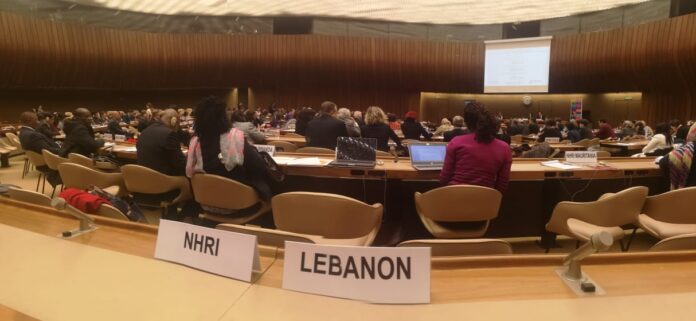
The Commission’s contribution also addressed its experience in engaging with UN mechanisms, including the Office of the High Commissioner for Human Rights (OHCHR), in relation to reprisals risks. It noted that such cooperation contributes to raising international attention and enhancing scrutiny and deterrence in some cases. However, its impact at the national level remains uneven, particularly in the absence of effective domestic protection frameworks and due to challenges related to political will and implementation.
Towards strengthened protection and effectiveness
In light of the above, the Commission stressed the urgent need to:
- Adopt a dedicated national legal framework for the protection of human rights defenders,
- Review laws that may be used to restrict freedom of expression and civic engagement,
- Strengthen the independence and capacity of the National Human Rights Commission in line with the Paris Principles,
- Ensure protection against reprisals, particularly in the context of cooperation with international mechanisms.
The Commission also called for strengthening the role of the international community in supporting national institutions and enabling them to operate in complex environments.
The Commission affirmed that ensuring safe and effective cooperation with the United Nations is not an option but a necessity to protect victims and promote accountability, reiterating its commitment to continue working to protect civic space, support human rights defenders, and uphold human dignity in Lebanon.
هذه المقالة متاحة أيضًا بـ:
 العربية (Arabic)
  Français (French)

