
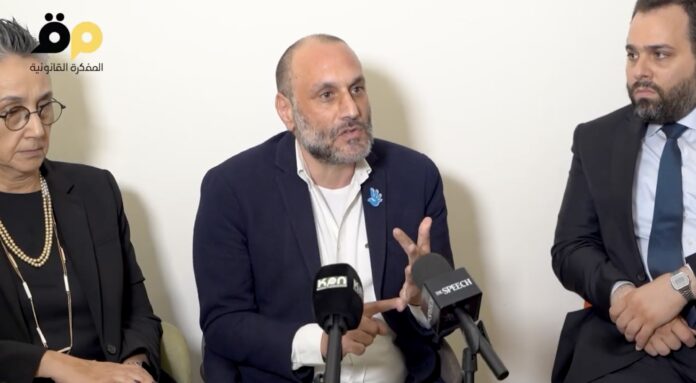
At the invitation of The Legal Agenda, and in collaboration with MPs Halime El Kaakour and Najat Aoun Saliba, Al-Janoubiyoun Al-Khodr (Green Southerners), the Socio-Economic Institute for Development, and Gherbal Initiative, and with the participation of civil society representatives, legal and environmental experts, and local activists from areas affected by cement quarries, a press conference was held today at the Press Syndicate in Lebanon.
The conference addressed the two government decisions issued on April 9 and 23, which open the door to licensing cement companies to blast Lebanon’s mountains in densely populated areas and outside the national land-use master plan, particularly in Koura, Batroun, and Chouf, in clear violation of the quarry regulation decree and the land-use planning decree.
Speakers at the conference included MP Najat Aoun Saliba, MP Halime El Kaakour, Clara Bou Gharious from the Gherbal Initiative, George Aïnati, head of the Kfarhazir Environmental Committee, Fares Nassif from the Guardians of the Earth Association, lawyer Choukri Haddad, Dr. Monzer Hamzeh from the Environmental Office of Dar al-Fatwa in Tripoli and the North, and Salim Al-Ayoubi, Mukhtar of Bdebhoun.
Bassam Al Kantar participated in the conference on behalf of the National Human Rights Commission, including the Committee for the Prevention of Torture, which had previously issued an opinion on the Cabinet decision allowing cement companies to resume quarry operations.
In his remarks, Al Kantar said that while the technical, administrative, and legal aspects of the quarries and crushers file had been thoroughly addressed, the issue must ultimately be understood as a human rights concern. He stressed that it cannot be reduced to an industrial or environmental debate, but directly implicates fundamental rights, foremost among them the right to a healthy environment, now widely recognized as a core component of the international human rights framework.
He noted that global experience shows environmental harm is often tied to alliances between powerful economic interests and weak or compromised public authorities, leading to resource depletion, ecosystem destruction, and the displacement of local communities. Lebanon, he said, reflects this pattern, with governance failures allowing narrow economic interests to prevail over the public good.
Al Kantar pointed to what he described as a structural imbalance in decision-making, marked by inconsistent policies, temporary decrees, and legal exceptions that frequently contradict advisory and judicial opinions. He argued that this approach has deepened environmental, health, and social harm, while shielding certain companies from accountability.
He outlined four key priorities. First, a comprehensive reform of the Higher Council for Quarries and Crushers to ensure its independence and strengthen its regulatory authority, particularly in linking licensing decisions to environmental impact assessments and human rights standards. Second, reaffirming the role of municipalities, whose approval, he said, is a substantive right reflecting the will of local communities, not a procedural formality. Third, ending reliance on temporary decrees and adopting a long-term strategy for the cement sector, including exploring less harmful production methods and fair import alternatives. Fourth, launching a transparent national debate on the sector’s economic model, including the sustainability of companies operating under conditions of protected monopoly.
Al Kantar also revealed that the Commission had submitted its opinion on the latest decree to the Presidency of the Council of Ministers, despite not being formally requested to do so, and confirmed it would continue to exercise its advisory and oversight role under Law 62/2016.
He warned that the impact of these policies is already being felt by communities from Chouf to Koura and Batroun, and extends beyond quarrying to include broader risks such as the import of substandard materials, posing additional threats to public health.
Concluding, he said the continuation of current practices amounts to a breach of environmental and health standards, undermines the right to a healthy environment, and risks encroaching on the right to life itself, calling for urgent action to halt violations and establish a credible path toward reform.
At the close of the conference, participants announced a joint statement rejecting the government decisions issued on April 9 and 23, 2026, which allow cement companies to operate quarries in environmentally sensitive areas for up to ten years, outside any coherent land-use planning framework.
In the midst of the war and within the span of two weeks, specifically on April 9 and 23, 2026, the government adopted two decisions concerning cement company quarries. The first was issued based on a proposal by the Minister of Industry, Joe Issa El Khoury, while the second was issued based on a proposal by the Minister of Environment, Tamara El Zein. Despite the differences between the two decisions and the two ministers, both ultimately led to the same outcome, namely opening the door to licensing cement companies to exploit quarries in populated areas with high environmental sensitivity, outside the national land-use master plan, particularly in Koura, Batroun, and Chouf, for a period of ten years. The government justified its decision on the grounds of protecting the cement sector as a key component of Lebanese industry, safeguarding jobs in these companies, and ensuring readiness for the launch of reconstruction efforts.
Accordingly, the Salam government, which we had welcomed for its decision to suspend previously granted licenses by the Mikati government in May 2025, lasted only 11 months in the “test of cement companies” before itself falling into the quagmire of illegality and the absence of the rule of law. This was done by reaffirming a government decision issued in 1997 that effectively allowed cement companies to continue exploiting their quarries without any environmental impact assessment.
As we work today, through all available democratic means, to overturn this decision, we consider it particularly important to draw public attention to the following:
First, contempt for legality and for 30 years of environmental protection efforts
The 1997 master plan, which the government has now reaffirmed, was developed following extensive political bargaining under the Syrian tutelage, and within a framework of resource-sharing that disregarded any environmental standards. Although it came as a continuation of the 1994 decree regulating quarries and crushers, it effectively fell with it when the State Council annulled that decree in its decision of July 7, 2009.
From this perspective, the return to this master plan not only reflects disregard for the residents of the affected areas and a dismissal of their long-standing struggles, but also constitutes a serious affront to legality. This is particularly evident as it results in a clear and explicit violation of two regulatory decrees: Decree No. 8803/2002 on the regulation of quarries and crushers, and Decree No. 2366/2009 on the comprehensive land-use planning framework, both of which strictly prohibit quarrying in the areas concerned.
Moreover, the decision demonstrates a profound disregard for the environmental studies that informed the 2002 master plan and the 2009 land-use decree, as well as for the studies conducted in 2019 as part of efforts to develop a new master plan. It is no exaggeration to say that the government has effectively erased, with a single stroke, 30 years of efforts aimed at identifying pathways to environmental protection.
Second, bypassing local authorities in violation of the principles of cooperation and balanced development
The government has also overridden the rights of local authorities by seeking to impose a new master plan with significant implications for municipalities in the affected areas, placing those that oppose or resist it under considerable pressure to accept the fait accompli. This approach runs counter to the principles of cooperation and balanced development. While we commend the resilience of the municipalities, we stress two key points:
(1) the government has no authority to amend the quarry master plan without consulting the concerned municipalities, in accordance with the Urban Planning Law and the Municipalities Law; and
(2) while the government may override a municipal refusal to grant a quarry license if that refusal is based on discretionary considerations, it cannot under any circumstances override such refusal when it is grounded in binding legal considerations, as is the case for quarrying in areas where such activity is explicitly prohibited. In such cases, no authority, whether local or national, may grant a license, as the very essence of legality requires all authorities to comply with the law and refrain from violating it.
Third, squandering public funds
Another serious violation lies in granting cement companies licenses to exploit quarries unlawfully without requiring them to settle outstanding dues owed to the state. The Ministry of Environment, in cooperation with the United Nations Development Programme, had estimated these dues for the period 2022–2023 at USD 370.2 million, representing around 10% of the total amounts owed by all investors during that period, which are estimated at nearly USD 3.7 billion.
This development contradicts the government decision issued on September 15, 2025, which explicitly required the Higher Council for Quarries and Crushers not to renew or grant any licenses to those subject to collection orders until all environmental and regulatory dues had been fully paid.
The situation is further aggravated by an annex to the decision setting out a series of environmental conditions, whereby cement companies are allowed to provide, as “environmental compensation,” land areas from their privately owned properties equivalent to the exploited quarry surfaces, where quarrying and construction would be prohibited without any financial compensation. The danger of this provision lies in enabling cement companies to accumulate wealth while paying minimal compensation for the severe environmental damage they have caused, damage estimated at hundreds of millions of US dollars.
Fourth, the substance of the decision reflects a clear abuse of power: spoils under the guise of reconstruction
Contrary to the justifications put forward by the government, most notably enhancing national readiness for reconstruction, the decision contains no safeguards to ensure such readiness, which appears instead to be a mere pretext for granting unlawful privileges to cement companies.
First, it sets no measures to ensure the availability of cement at reasonable prices aligned with production costs and regional market rates. This is particularly concerning given that, due to monopoly practices, cement prices have reached exorbitant levels, often exceeding more than double the cost of importation.
Second, the decision leaves export channels entirely unrestricted, with no limits other than those the government may decide to impose at a later stage.
Third, the government has taken no steps to facilitate the import of cement, effectively leaving the market and society at the mercy of the monopoly held by the three cement companies and the political networks linked to them.
In reality, had the government genuinely sought to enhance reconstruction readiness and ensure supply, it could have reinstated the measures adopted under the government of Hassan Diab, at the initiative of then Minister of Industry Imad Hoballah, which included setting an official price for cement, banning its export, and facilitating its import. Instead, by opening the door to licensing without any regulatory safeguards, the government has effectively sacrificed the public interest in favor of the interests of cement companies.
For these reasons, we categorically reject the government’s decision and commit to confronting it through all available democratic means, foremost among them supporting municipalities and affected communities, and resorting to the State Council, as the primary guardian of legality.
هذه المقالة متاحة أيضًا بـ: العربية (Arabic)

