

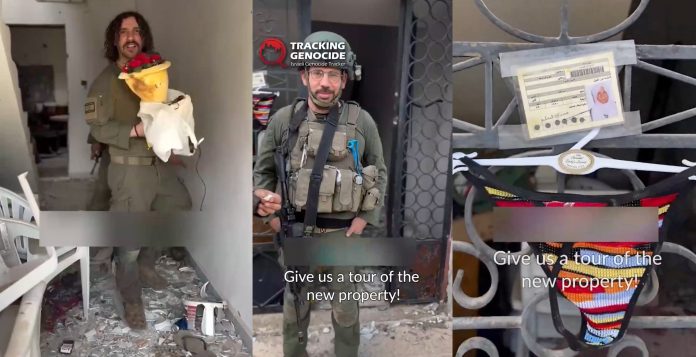
The National Human Rights Commission announces that its International Humanitarian Law Committee, within the framework of its monitoring mandate, has identified, collected, preserved, and analyzed a set of open-source digital materials, including two video clips circulating on social media platforms, sourced from the account Israel Genocide Tracker, which allegedly document the conduct of military personnel inside civilian homes in the town of Rab Thalathin in the Marjayoun District, southern Lebanon.
The first video, published on 17 March 2026, shows footage that allegedly documents military personnel entering civilian homes in Rab Thalathin, moving inside them, handling and disturbing their contents, and filming from within the premises. The nature and angles of the footage indicate that it was recorded داخل private residential spaces, which may point to a violation of the inviolability of homes and direct interference with protected civilian property in the context of an armed conflict. The video also displays personal documents, including a voter identification card belonging to Ms. Fatima Nour El-Din from Rab Thalathin in the Marjayoun District, which may enable the identification of the homeowners or associated residents, raising additional concerns regarding privacy and human dignity.
Israeli terrorists are back to their disgusting behavior, this time from the village of Marjayoun, during today’s invasion and occupation of southern Lebanon. pic.twitter.com/aRrAsIGc4D
— Israel Genocide Tracker (@trackingisrael) March 17, 2026
The second video, published on 3 March 2026 and accompanied by text stating that it was filmed “only hours after the reinvasion of southern Lebanon,” refers to what the source described as the “systematic destruction of the homes of displaced Lebanese.” From this context, it may be inferred that the documented acts are not limited to an isolated incident, but are alleged to form part of a broader and recurring pattern associated with the conduct of military operations, which, if substantiated, could amount to a systematic practice targeting civilian objects.
[videopress NXjfDQE1]
This documentation forms part of the ongoing work of the International Humanitarian Law Committee to monitor and document violations associated with armed conflicts, particularly since the escalation of military operations in early March 2026. It is carried out in line with the Committee’s mandate to assess compliance with international humanitarian law and to identify patterns of potential violations.
The Committee has initiated the necessary technical and legal measures to preserve these materials in accordance with recognized standards for digital evidence documentation. This includes preliminary source verification, content analysis, metadata extraction, and, to the extent possible, the determination of temporal and geographical context. These steps are intended to ensure the integrity of the evidence and its admissibility for use in any future accountability processes, whether at the national or international level.
While the Committee emphasizes that the final legal qualification of these incidents remains subject to the completion of verification and comprehensive legal assessment, it notes that the acts reflected in these materials, if substantiated, may constitute serious violations of international humanitarian law, particularly those relating to the protection of civilians and civilian objects. These potential violations include the unlawful entry into private homes, interference with their contents, appropriation of property, unjustified destruction, and violations of privacy and human dignity.
The Committee recalls that private homes and civilian property are afforded special protection under the 1949 Geneva Conventions and relevant customary international humanitarian law. Any attack against, use of, or destruction of such property in the absence of imperative military necessity constitutes a clear breach of these rules and may amount to war crimes, including pillage and the extensive destruction of property not justified by military necessity.
The Committee’s documentation also encompasses broader patterns of potential violations linked to the ongoing conflict, including acts that may undermine the dignity of civilians or be used as means of intimidation or coercion, as well as their profound psychological and material impact on affected populations, particularly displaced persons.
The Commission affirms that this documentation effort is part of its commitment to combating impunity and strengthening accountability, through the development of a reliable evidence database that can support victims’ rights and be relied upon by competent judicial bodies when appropriate.
The Commission reiterates that respect for international humanitarian law, including the principles of distinction, proportionality, and precaution, is a binding legal obligation on all parties to the conflict and must be upheld at all times and under all circumstances.
هذه المقالة متاحة أيضًا بـ:
 العربية (Arabic)
  Français (French)

