

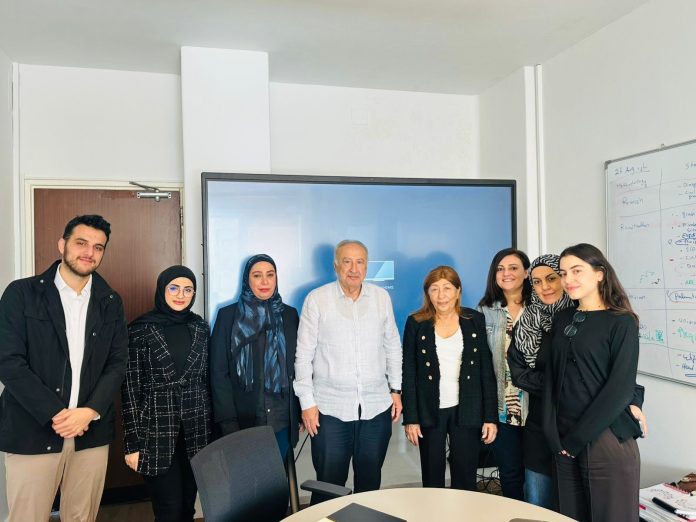
The working team “Integrating Anti‑Corruption Efforts and Promoting Equality” held its fifth meeting at the Ministry of State for Administrative Development Affairs, at a pivotal stage aimed at approving the final draft of the strategic recommendations and the executive action plan, in preparation for submitting them to the Technical Committee assisting the Ministerial Committee for Combating Corruption. This came after a cumulative participatory process that extended over a series of meetings and specialized discussions.
Meeting Context and Importance
This meeting comes within a delicate national context, in which governance crises, economic contraction, and declining trust in public institutions intersect with worsening manifestations of structural corruption and widening inequality gaps—especially affecting women, persons with disabilities, youth, and marginalized groups. From this standpoint, the working team formed a comprehensive technical‑policy space aimed at systematically linking anti‑corruption efforts on the one hand with the promotion of equality, inclusivity, and social justice on the other, considering them integrated and inseparable approaches.
Statement by the Team Chair
The Chair of the team, Mr. Ali Youssef, Secretary‑Treasurer of the National Human Rights Commission, opened the meeting by stressing that the current phase requires moving from conceptual discussions to establishing the final form of the recommendations, clarifying that prioritization of implementation remains within the authority of the Technical Committee assisting the Ministerial Committee, while the role of the working team is limited to preparing coherent, integrated, and actionable recommendations without reopening previously agreed discussions from earlier meetings.
Presentation of Recommendations and the Action Plan
Consultant expert Nada Maki presented a comprehensive overview of the strategic recommendations and the proposed action plan, including objectives, themes, activities, relevant stakeholders, and timelines. During the meeting, feedback from the Ministry of Social Affairs was reviewed, and amendments were adopted to strengthen the approach to empowering marginalized groups, enhancing community participation, knowledge and data production, and digital transparency, in line with international human rights standards and Lebanon’s national commitments.
Summaries of Sectoral Discussions
The meeting witnessed qualitative contributions reflecting the depth of the participatory approach. Judge Therese Alawi, representing the National Anti‑Corruption Commission, emphasized that combating corruption is not limited to punitive mechanisms but begins with education and building a culture of integrity, affirming that corruption is a cross‑sectoral phenomenon and responsibilities should not be confined to specific ministries or departments. She also noted the importance of giving special attention to persons with intellectual disabilities when formulating public policies, due to the compounded vulnerability they face.
Professor Sherine Quteish, representing the National Commission for Lebanese Women Affairs, stressed the importance of institutional precision in using official designations to reflect respect for legal frameworks and enhance clarity of roles and responsibilities.
Team members also underscored the need to restrict the involvement of non‑governmental organizations to those that are effectively active within implementation mechanisms to ensure efficiency and prevent fragmentation, in addition to the importance of providing transportation allowances for members and experts to ensure the institutional sustainability of the team’s work.
Strategic Recommendations: A Comprehensive Approach to Combating Corruption
The team adopted a package of integrated strategic recommendations distributed across five main axes:
1. Legal Framework
Recommendations focused on reviewing and updating key laws related to combating corruption, such as access to information, illicit enrichment, protection of whistleblowers, and public procurement laws, integrating gender equality and inclusivity perspectives. They also stressed aligning national legislation with international conventions—especially the Convention on the Elimination of All Forms of Discrimination Against Women and the Convention on the Rights of Persons with Disabilities—updating laws on prisons, juveniles, labor, and sexual harassment, issuing a unified optional personal status law, adopting a women’s quota of no less than 30%, and a representative quota for persons with disabilities.
2. Institutional and Administrative Framework
Recommendations called for re‑establishing the Ministry of Design and Planning, activating law‑modernization committees, and appointing gender focal points and disability rights officers in public administrations. They also emphasized strengthening judicial independence, establishing specialized courts for violence against women, improving complaint systems, and enhancing the role of oversight bodies, the National Human Rights Commission, and the National Prevention of Torture Committee to reinforce accountability and limit impunity.
3. Empowering Marginalized Groups and Enhancing Participation
Recommendations stressed the necessity of involving marginalized groups in all stages of the strategy, from planning to evaluation, enhancing inclusive digital transformation, empowering inmates with their rights, developing rehabilitation programs, supporting women’s economic roles, integrating persons with disabilities into the labor market, strengthening entrepreneurship, and economically empowering youth.
4. Awareness Raising, Educational and Cultural Frameworks
Recommendations called for launching national awareness campaigns on inequality‑based corruption, enhancing the role of the media, updating educational curricula, and integrating concepts of integrity, human rights, and rights of persons with disabilities into formal education to consolidate a culture of citizenship and accountability.
5. Knowledge and Data Production and Digital Transparency
Recommendations focused on building a national system for disaggregated data from an equality and inclusivity perspective, strengthening cooperation between the Central Administration of Statistics, public administrations, and universities, and developing digital platforms for complaints and a unified digital identity for persons with disabilities to enhance transparency and facilitate access to rights and services.
Action Plan: From Recommendations to Implementation
These recommendations were translated into a detailed action plan, specifying activities, relevant stakeholders, timelines, and responsibilities, enabling the transition from strategic approach to practical implementation, with a focus on building institutional capacities, mobilizing resources, ensuring sustainability, and linking anti‑corruption with sustainable development and social justice.
Next Steps
The meeting concluded with the adoption of the final form of the recommendations as non‑amendable and the approval to submit them, along with the amended action plan, to the Technical Committee assisting the Ministerial Committee for Combating Corruption for approval and the start of the implementation process. This path represents an advanced stage in building an integrated national approach to combating corruption, based on rights, equality, inclusivity, and accountability, affirming that any real reform cannot succeed unless it places the human being and dignity at the core of public policies. The team hopes that these recommendations and the action plan will constitute a real lever to restore trust in institutions, strengthen the rule of law, and build a more just and equitable social contract in Lebanon.
هذه المقالة متاحة أيضًا بـ:
 العربية (Arabic)
  Français (French)

