

According to a statement published by Amnesty International on 12 March 2026, Israeli airstrikes targeting sites linked to the Al-Qard Al-Hassan institution in Lebanon should be investigated as war crimes, as the facilities do not appear to constitute legitimate military objectives under international humanitarian law.
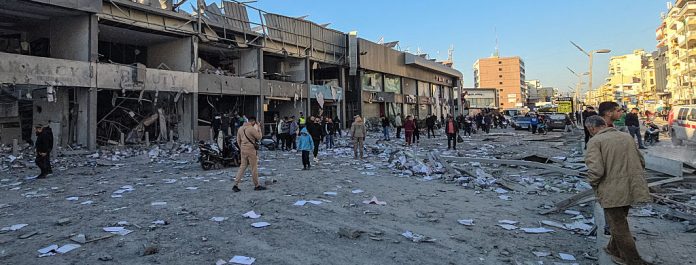
According to the Israeli military, the strikes began on 2 March and targeted branches of the institution across several regions of Lebanon. By 10 March, the Israeli army announced that it had struck approximately 30 facilities during the previous week. Many of these offices were located in residential buildings or densely populated neighborhoods, including in Beirut’s southern suburbs, southern Lebanon, and the Bekaa Valley. The attacks reportedly destroyed facilities relied upon by tens of thousands of civilians to access financial services, including small loans used to cover school fees, medical expenses, or transportation costs for work.
Heba Morayef, Amnesty International’s Regional Director for the Middle East and North Africa, stated that merely alleging that an institution is linked to Hezbollah does not make it a legitimate military target. She emphasized that the principle of distinction between military objectives and civilian objects is one of the cornerstones of international humanitarian law. While Hezbollah functions as both a political and military actor, it also operates social and charitable institutions where civilians work and which provide services to local communities.
Amnesty International stressed that civilians and civilian objects do not become legitimate targets simply because of an alleged association with a particular party to a conflict. The organization warned that the destruction of branches of a financial institution relied upon by thousands of civilians raises serious concerns and requires an independent investigation to determine the legality of the attacks.
The organization reported that it reviewed the Israeli military’s claims regarding the strikes and verified video footage of four sites hit on 2 and 9 March. It also conducted interviews with twelve individuals from diverse backgrounds who had used the financial services provided by the institution. For security and privacy reasons, pseudonyms were used in these testimonies.
Al-Qard Al-Hassan is one of the most prominent providers of microloans in Lebanon. The institution has operated since 1987 under a license granted by the Lebanese government as a non-governmental organization. However, it does not hold a license from the Banque du Liban to operate as a financial institution. The organization has also been subject to United States sanctions since 2007 due to its alleged links to Hezbollah.
International humanitarian law protects civilian objects, including financial institutions, and permits attacks only against military objectives. A military objective is defined as an object that effectively contributes to military action and whose destruction offers a definite military advantage under the circumstances prevailing at the time. Amnesty International stated that it found no evidence presented by Israeli authorities demonstrating that the targeted branches met these criteria.
In the statements announcing the strikes, the Israeli military did not claim that the offices were directly used for military operations. Instead, officials alleged that funds deposited by civilians in the institution were used to provide financial services to Hezbollah. According to Amnesty International, even if such allegations were true, they would not in themselves remove the buildings’ protected civilian status under international humanitarian law.
The attacks occurred in two main waves, on 2 and 9 March. On 2 March, an Israeli military spokesperson announced that Israeli forces would strike what were described as “infrastructure” belonging to Al-Qard Al-Hassan. Residents within a 300-meter radius of 18 identified sites were instructed to evacuate immediately. Maps indicating the targeted locations were published, covering areas including Beirut’s southern suburbs as well as locations in the Bekaa, Tyre, and other parts of southern Lebanon.
Videos verified by Amnesty International show air-dropped munitions striking multi-story buildings in residential and commercial areas. In the city of Tyre, a three-story building located in a residential and commercial district was destroyed, causing severe damage to nearby shops, including a department store, restaurants, and a pharmacy. Less than two kilometers away, another eleven-story building housing a separate branch of the institution was also destroyed, with nearby residential buildings sustaining damage.
On 9 March, the Israeli military announced an additional round of strikes against what it described as infrastructure linked to the institution in Beirut’s southern suburbs. Unlike the detailed warnings issued on 2 March, the warning issued on 9 March did not specify precise locations or include maps. Approximately two hours later, a new wave of airstrikes struck more than ten buildings in the area, including buildings that housed branches of the institution.
Amnesty International noted that this is not the first time the Al-Qard Al-Hassan institution has been targeted by Israeli military operations. In October 2024, during a previous escalation, the Israeli military announced that it had struck approximately thirty branches of the institution across Beirut, its southern suburbs, southern Lebanon, and the Bekaa Valley. Amnesty International had also called at that time for those attacks to be investigated as potential war crimes.
Following the announcement of a ceasefire in December 2024, the institution reported that it had reopened sixteen branches across Lebanon. However, the latest wave of attacks has once again disrupted the activities of several of these offices, even in cases where the buildings themselves remained standing.
Testimonies collected by Amnesty International indicate that the financial services provided by the institution are widely used by families across Lebanon, particularly in the context of the country’s severe economic crisis. Some individuals explained that they relied on these loans to pay their children’s school fees or to finance small income-generating activities. One 61-year-old woman said she had obtained a loan by pawning jewelry in order to purchase a motor for her sewing machine, which represents her family’s only source of income.
Other testimonies suggest that the institution’s services are used by individuals from different communities and regions of Lebanon. Some users reported turning to the institution because of the difficulty of obtaining loans from traditional banks or because its loans are offered without interest.
Amnesty International warned that targeting institutions providing financial services to civilians in the context of Lebanon’s deep economic crisis could have serious humanitarian and economic consequences for the population.
In conclusion, the organization called on states with influence over Israel to take steps to ensure accountability for attacks targeting civilian objects in Lebanon, warning that the absence of accountability risks perpetuating a pattern of serious violations of international humanitarian law.
Source: Amnesty International, “Lebanon: Israeli airstrikes on Al-Qard Al-Hassan should be investigated as war crimes,” 12 March 2026.
هذه المقالة متاحة أيضًا بـ:
 العربية (Arabic)
  Français (French)

