


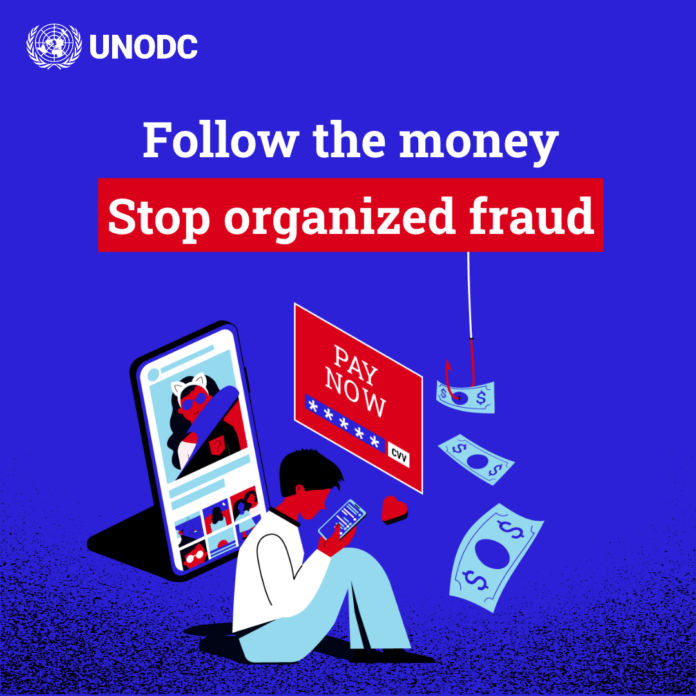
On the International Day for the Prevention of and Fight against All Forms of Transnational Organized Crime, observed annually on 15 November, the National Human Rights Commission, including the Committee for the Prevention of Torture, calls for stronger prevention efforts, the prosecution of criminal networks and those benefiting from their proceeds, and protection for victims and witnesses, including their rights to justice, effective remedies and compensation.
The Commission stresses that organized crime undermines the rule of law, fuels corruption and exploitation, and threatens human rights and economic and social security. Addressing it requires independent judicial and oversight institutions, effective international cooperation, and policies that protect people most vulnerable to exploitation while respecting fair trial guarantees, privacy and non-discrimination.
Organized fraud: financial losses and human harm
The United Nations message, “Follow the money. Stop organized fraud,” highlights the importance of investigating illicit financial flows, identifying those benefiting from fraud proceeds, and disrupting criminal networks’ ability to expand across borders.
The Commission notes that fraud takes many forms, including fraudulent investment offers, impersonation of financial institutions or public authorities, deceptive job offers, extortion and romance scams. Artificial intelligence and deepfake technologies may be used to produce seemingly credible messages or recordings that induce people to transfer money or disclose personal information.
The consequences extend beyond stolen funds. They may include the loss of savings and livelihoods, debt, blackmail, privacy violations, and psychological and social harm. The Commission stresses that victims must not be blamed or publicly shamed, and that early reporting should receive a professional and confidential response.
It also emphasises that establishing the existence of transnational organized crime requires investigating its legal elements. An incident of online fraud does not, by itself, establish the involvement of an organized criminal network.
People recruited for work and then forced to commit fraud
The Commission warns against the recruitment of people through deceptive job offers, followed by their confinement, intimidation and coercion into carrying out online scams. United Nations bodies have documented this connection between trafficking in persons and forced criminality, calling for responses centred on victims’ rights and safety.
The Commission stresses the need for early screening for indicators of trafficking and coercion among people found in scam centres, without assuming that everyone has the same status. The principle of non-punishment of trafficking victims for unlawful acts committed as a direct consequence of being trafficked must be respected, alongside individual assessments, legal assistance, interpretation, and protection against retaliation and re-trafficking.
Priorities for Lebanon: prevention, investigation and rights protection
The Commission considers that protecting people in Lebanon from fraud and exploitation requires a coordinated response involving the judiciary, competent law enforcement bodies, financial and regulatory authorities, and the Ministries of Justice, Interior, Labour, Social Affairs and Foreign Affairs, in cooperation with financial institutions, telecommunications companies, digital platforms and civil society.
Particular attention should be paid to deceptive employment, travel and investment offers; the exploitation of people’s need for income or migration opportunities; and fraud involving the impersonation of organisations providing assistance or public services. These efforts must avoid stigmatising targeted groups or blaming them for crimes committed against them.
The Commission affirms that combating organized crime does not justify torture, arbitrary detention or unlawful surveillance. Nor does it permit treating migrants, refugees or workers in particular sectors as suspects solely because of their status or nationality.
The Commission’s recommendations
1. Trace criminal proceeds and their beneficiaries.
The Commission calls for stronger financial investigations conducted alongside fraud investigations, identifying money flows and the people who ultimately control or benefit from them. Freezing, seizure and confiscation measures must comply with the law and judicial oversight, while protecting the rights of victims and bona fide third parties.
2. Facilitate reporting and rapid responses.
The Commission recommends clear, accessible official reporting channels, public guidance on urgent steps following fraudulent transfers, and rapid coordination with financial institutions to preserve records and assess whether transfers can be stopped or funds recovered, without offering unrealistic guarantees of recovery.
3. Protect victims and witnesses and ensure access to remedies.
The Commission calls for legal assistance, psychological and social support, data protection and measures against retaliation. Victims must be able to seek compensation and restitution, while defence rights are respected. The United Nations Convention against Transnational Organized Crime addresses these safeguards through its provisions on victim and witness protection and assistance.
4. Strengthen trafficking victim identification and referral to protection.
The Commission recommends training judicial, law enforcement and consular authorities and labour inspectors to recognise indicators of deceptive recruitment, coercion and exploitation in fraud operations, and to provide safe referrals to specialist services. Essential assistance should not depend on a victim’s willingness to participate in investigations. The best interests of children and the needs of persons with disabilities must be respected.
5. Improve international cooperation and preserve digital evidence.
The Commission calls for effective mutual legal assistance and information exchange through competent channels, and the timely preservation of digital evidence before it is lost, while respecting jurisdictional rules, privacy, data protection and human rights safeguards. The Organized Crime Convention provides an important framework for such cooperation within its scope of application.
6. Strengthen the responsibility of financial institutions and digital platforms.
The Commission recommends improving mechanisms to detect and report fraudulent transactions and activities in accordance with the law, verify investment advertisements and job offers, and respond to complaints. Discriminatory measures and unjustified financial exclusion must be avoided, and people must be able to challenge erroneous decisions.
7. Invest in awareness and prevention.
The Commission calls for accessible, multilingual campaigns explaining fraud methods and verification and reporting procedures, reaching schools, universities, workplaces and local communities. These should warn against sharing passwords and verification codes, and against paying entities claiming to guarantee the recovery of previously lost funds.
8. Publish reliable data and strengthen institutional accountability.
The Commission recommends regular publication of anonymised data on reports, investigations, judgments, recovered funds and assistance provided to victims. Suspicion, accusation and conviction must be clearly distinguished, and measures should be assessed for their effectiveness rather than solely by the number of arrests.
The Commission affirms that success in combating organized crime is measured by dismantling exploitative networks and depriving them of their proceeds, and by victims’ ability to obtain protection, access justice and recover their rights. It calls for a response combining prevention, investigation, accountability and international cooperation, with human dignity and rights at its centre.
Resources and reference documents
- United Nations: International Day for the Prevention of and Fight against All Forms of Transnational Organized Crime.
- General Assembly resolution 78/267 establishing the International Day.
- United Nations Convention against Transnational Organized Crime and the Trafficking in Persons and Smuggling of Migrants Protocols — resolution 55/25.
- Protocol against the Illicit Manufacturing of and Trafficking in Firearms, Their Parts and Components and Ammunition — resolution 55/255.
- UNODC: Organized crime.
- UNODC: Issue paper on organized fraud.
- UNODC: The United Nations Convention against Transnational Organized Crime and International Human Rights Law.
- OHCHR: Human rights-based solutions to trafficking into cyber scam operations.
هذه المقالة متاحة أيضًا بـ:
 العربية (Arabic)
 Français (French)

