

The National Human Rights Commission welcomes the opening of a judicial investigation in France into the Israeli military’s bombing of artist and filmmaker Ali Cherri’s apartment in Beirut on 26 November 2024. It calls on the Lebanese authorities to support the judicial proceedings and implement an effective national strategy to investigate international crimes allegedly committed in Lebanon and hold those responsible to account.
According to the International Federation for Human Rights (FIDH), the investigation follows the complaint it filed jointly with Cherri on 1 April 2026 and concerns the suspected war crime of intentionally directing an attack against a civilian object. Two investigating judges from France’s specialised war crimes judicial unit have been appointed to examine the case.
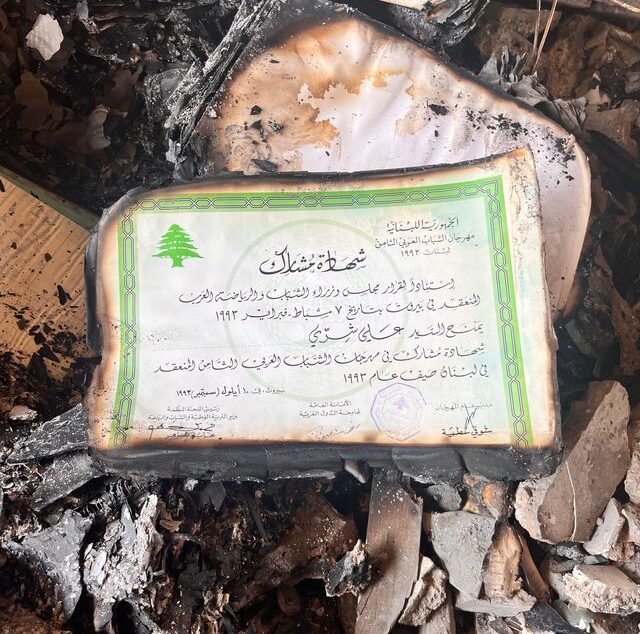
The Israeli strike targeted a residential building in Beirut’s Nweiri neighbourhood, killing 7 civilians, including Cherri’s parents, Mahmoud Naim Cherri and Nadira Hayek, and Birke Nigessa, the family’s domestic worker. The bombing destroyed Cherri’s apartment on the 9th floor, as well as apartments on the 7th and 8th floors.
Bassam Al Kantar, Head of the International Humanitarian Law Committee at the National Human Rights Commission, said: “The opening of a judicial investigation into this Israeli strike is an important step towards establishing the truth and determining criminal responsibility. This process must be supported through the preservation of evidence, effective judicial cooperation, and the protection of victims and witnesses. Anyone suspected of ordering or carrying out unlawful attacks must be independently investigated and, where sufficient evidence exists, prosecuted in proceedings that guarantee a fair trial.”
Judicial proceedings abroad require parallel action in Lebanon
The Commission notes that the French investigation has a defined jurisdictional scope. According to FIDH’s explanation, it concerns the bombing of Cherri’s apartment on the basis of his French nationality and does not cover the killings of victims who did not hold French nationality. The Commission considers that this limitation underscores the need for complementary judicial avenues capable of addressing the full extent of the harm suffered by victims and their families.
The Commission specifically addressed Cherri’s complaint in its advisory opinion issued on 29 October 2026, calling for effective cooperation with competent foreign courts and an operational accountability plan setting out responsibilities, resources, deadlines, and mechanisms for informing the public of progress. Judicial proceedings abroad support justice, but do not relieve Lebanon of its obligations.
The Commission stresses that families’ access to justice concerning any Israeli attack in Lebanon must not depend on a family member holding foreign nationality. It calls on the Lebanese authorities to investigate alleged crimes, support legitimate judicial proceedings abroad, and ensure that all victims, including migrant workers, can seek truth, justice, and reparation without discrimination.
Preserving evidence and facilitating judicial cooperation
The Commission calls on the competent Lebanese authorities to respond without undue delay to lawful requests from the French judiciary, facilitate access to relevant records and statements, and preserve original evidence within a documented chain of custody ensuring its traceability and integrity. This includes remnants of weapons and ammunition, medical records and forensic reports, documentation of deaths, ownership and damage, and photographs and recordings in their original file formats.
It also stresses the need to provide victims and witnesses with clear, accessible information, make legal assistance and interpretation available where needed, and protect them from intimidation and reprisals. Evidence must be collected and shared in accordance with judicial procedures, with due respect for confidentiality and consent requirements where applicable.
Turning accountability commitments into concrete action
The Commission renews its call to reconsider the available avenues for activating the jurisdiction of the International Criminal Court, alongside serious national investigations and cooperation with foreign courts. It also requests clarification as to whether paragraph 13 of the Trilateral Framework has affected accountability initiatives, and an explanation of the safeguards protecting victims’ rights and judicial independence. Political commitments must not be interpreted in a way that obstructs compliance with applicable legal obligations.
The Commission stresses that seeking to hold those responsible for alleged international crimes to account is a legitimate pursuit of justice. Humanitarian assistance and reconstruction are essential, but cannot replace investigations, the determination of responsibility, and effective remedies for victims. It emphasises that the opening of the French investigation does not in itself establish individual criminal responsibility, and that accountability must be based on independent investigations and fair proceedings that respect the presumption of innocence.
The Commission expresses its solidarity with Ali Cherri and the families of the 7 civilians killed in the Israeli strike. It commends the efforts of victims, their legal representatives, and human rights organisations, and calls on the Lebanese authorities to translate their commitments to justice into concrete measures whose implementation can be monitored and evaluated.
Background
In an interview conducted by journalist Nabila Ghossein and published by The Legal Agenda on 4 November 2026 under the title “French judiciary begins investigating the Nweiri strike that killed artist Ali Cherri’s parents”, the Lebanese–French artist reported that two investigating judges had been appointed and that his testimony was scheduled to be heard in December 2026. He expressed hope that the circumstances of the attack would be established and that those responsible for ordering and carrying it out would be identified and held accountable. He explained that his decision to pursue judicial proceedings stemmed from his commitment to his family’s right to justice and to challenging impunity.
An investigation by Amnesty International concluded that residents had not received an effective advance warning before the attack, which killed seven civilians, including Cherri’s parents, and found no military objectives in the vicinity of the site. The organisation considered that these findings provided reasonable grounds to conclude that the attack violated international humanitarian law and should be investigated as a war crime.
The case forms part of the broader context of casualties resulting from Israeli attacks on Lebanon. According to Lebanon’s Ministry of Public Health, 8,956 people had been killed and 30,664 injured between October 2023 and 30 October 2026.
A French citizen of Lebanese origin had also filed a complaint accusing the Israeli military of uprooting and stealing more than 500 centuries-old olive trees from his land in Zawtar al-Sharqiyah, which his ancestors had planted more than 250 years ago. The complaint cited the destruction and uprooting of these trees as acts that could constitute war crimes in southern Lebanon.
Another citizen also filed a complaint concerning alleged war crimes after Israeli occupation forces targeted a residential building in the city of Tyre on 16 April 2026 without prior warning, killing four members of his family.
هذه المقالة متاحة أيضًا بـ:
 العربية (Arabic)
 Français (French)

