
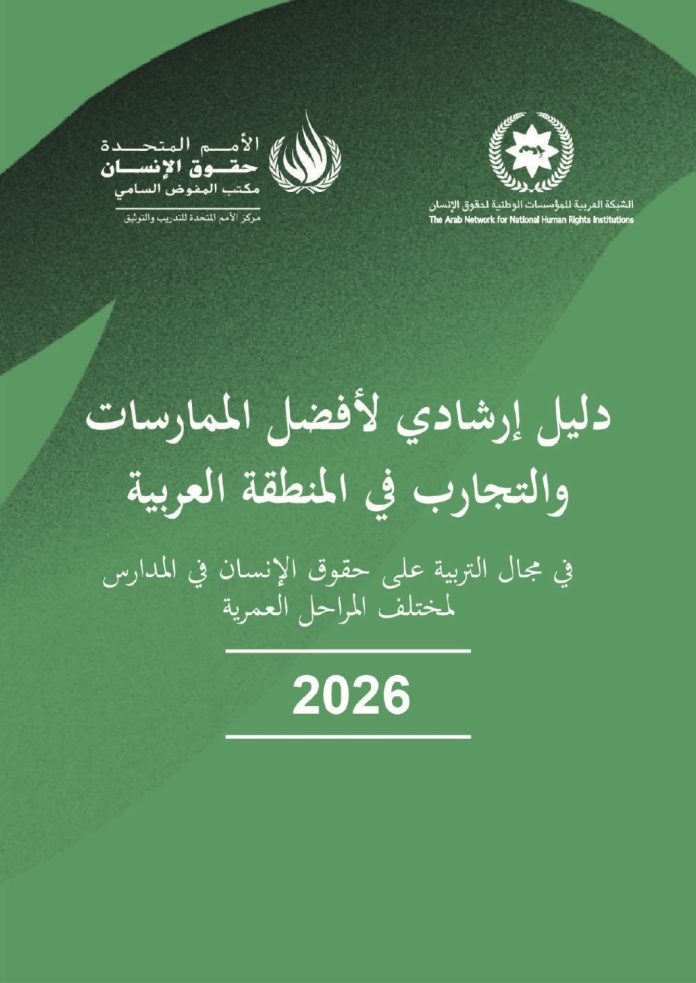
The Arab Network for National Human Rights Institutions, in partnership with the Office of the United Nations High Commissioner for Human Rights, has launched a new guidance manual entitled “Guidance Manual on Best Practices and Experiences in Human Rights Education in Schools across Different Age Groups – 2026.” This initiative aims to strengthen the culture of human rights within educational systems across the Arab region and to reinforce the principles of human dignity, equality, and citizenship within the school environment. The manual is the result of cooperation among several national human rights institutions in the Arab region and their international partners, as part of broader efforts to support human rights–based education and enhance its role in building more just, tolerant, and sustainable societies.
The manual was prepared with the contribution of a distinguished group of experts and academics specializing in human rights and education from several Arab countries. Representatives from ministries of education, educational experts, and researchers from national human rights institutions across the region participated in developing the manual’s content, alongside academic contributions from universities and specialized research centers. This broad partnership aimed to ensure that the manual reflects best educational practices and practical experiences in the field of human rights education and that it can be applied across diverse educational contexts in the Arab region.
The manual provides a comprehensive practical and pedagogical framework to assist teachers, educational institutions, and education policymakers in integrating human rights concepts into everyday teaching practices, not only through school curricula but also through interactive activities and modern teaching methods that encourage critical thinking, participation, and dialogue within classrooms. It emphasizes transforming schools into educational spaces that nurture the values of freedom, equality, and mutual respect, thereby contributing to the development of generations that are aware of their rights and responsibilities within society.
Those involved in developing the manual stress that human rights education represents a fundamental pillar for building democratic and stable societies. It contributes to raising students’ awareness of shared human values and strengthening their ability to respect diversity and live peacefully with others. It also serves as an essential tool to combat discrimination, violence, and hate speech, while promoting solidarity and social responsibility among individuals, particularly in light of the social and political transformations taking place in the region.
The manual includes a wide range of pedagogical principles and international legal references that form the conceptual foundation for human rights education, foremost among them the Universal Declaration of Human Rights and key international human rights treaties. It also draws on various educational guidelines and standards adopted by the United Nations and international organizations working in the fields of education and human rights. Furthermore, the manual reviews the development of international attention to human rights education, particularly within the framework of the World Programme for Human Rights Education launched by the United Nations to promote the integration of human rights principles into educational systems worldwide.
One of the key features of the manual is that it does not limit itself to presenting a theoretical framework for human rights concepts. It also provides a comprehensive set of practical educational activities designed for different age groups within schools. These include interactive exercises, educational projects, classroom dialogue models, and analytical activities that help students understand concepts such as human dignity, justice, equality, the right to participation, and freedom of opinion and expression. The activities also encourage students to develop critical thinking skills and engage constructively with social and human issues.
The manual dedicates entire sections to a number of fundamental rights, including the right to education, the right to an adequate standard of living encompassing food, water, and housing, and the right to health, as well as the rights of groups particularly vulnerable to violations, such as children and persons with disabilities. These rights are presented in an accessible educational manner that enables students to understand them and relate them to their everyday lives, while highlighting the role of schools and communities in protecting and promoting them.
In addition, the manual emphasizes the importance of adopting participatory teaching methods that move beyond traditional rote learning and instead rely on dialogue, interaction, and group work. Teachers are encouraged to use diverse educational tools such as classroom discussions, case studies, research activities, presentations, and educational games to enhance student participation and stimulate analytical thinking. According to the authors, such approaches contribute to strengthening students’ personalities, self-confidence, and their ability to express their views while respecting the opinions of others.
The manual also places particular importance on enabling teachers to use it as a flexible educational resource that can be adapted to the educational and cultural context of each country. It allows educators to select activities appropriate to each age group and provides practical models for designing and evaluating classroom activities, making it easier to integrate human rights education across different school subjects rather than limiting it to civic or social education courses.
In this context, the authors emphasize that schools play a central role in promoting and spreading a culture of human rights within society. Schools are often the first environment where children learn the values of justice, equality, and mutual respect. By integrating these values into educational processes, schools can contribute to building more tolerant and cohesive societies and prepare students to become active citizens capable of participating in public life and defending their own rights as well as the rights of others.
The manual also highlights the importance of cooperation between ministries of education, national human rights institutions, civil society organizations, and academic institutions to develop comprehensive educational programmes on human rights education. It stresses that the success of such programmes requires adequate teacher training, the development of educational curricula, and the integration of human rights values into national education policies to ensure the sustainability and long-term impact of these efforts.
In light of the challenges facing many societies in the Arab region, including conflicts and economic and social crises, this manual represents an important step toward strengthening the role of education in promoting the values of peace, justice, and respect for human dignity. It provides a practical framework that supports educational institutions in preparing new generations capable of addressing these challenges with a spirit of responsibility, solidarity, and respect for human rights.
The authors hope that this publication will serve as a practical reference for teachers, researchers, and education policymakers throughout the Arab region, and that it will contribute to the development of innovative educational initiatives that strengthen the culture of human rights both within and beyond schools, thereby promoting the values of citizenship, justice, and equality and contributing to the building of more equitable and stable societies in the future.
هذه المقالة متاحة أيضًا بـ:

