
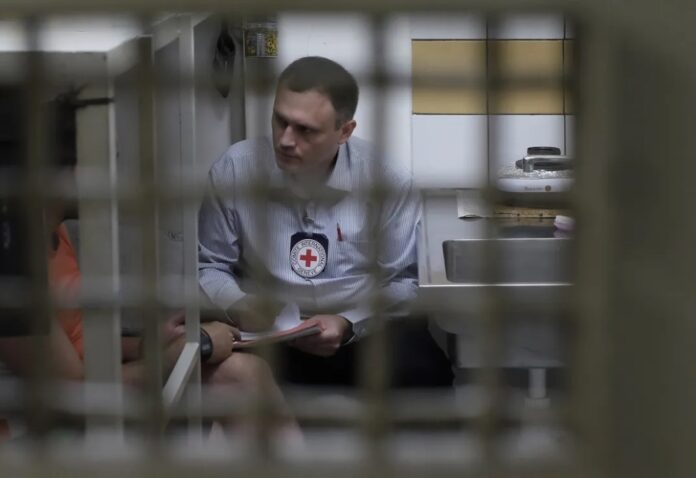
The National Human Rights Commission of Lebanon, including the Committee for the Prevention of Torture (NHRC-CPT), welcomes the ruling issued by the Israeli Supreme Court on 4 June 2026, ordering the Israeli authorities to restore access for the International Committee of the Red Cross (ICRC) to Palestinian detainees and to resume the transmission of information concerning them to their families. The decision comes after more than two and a half years during which such visits and information exchanges had been suspended, depriving detainees and their families of an essential humanitarian safeguard and a fundamental means of maintaining family contact.
In this context, the Commission calls upon the ICRC to urgently exercise this restored right and ensure that its visits extend to all prisons, detention facilities, and places of confinement where Lebanese prisoners, detainees, or Lebanese missing persons whose fate remains unknown may be held, whether they are civilians or other persons protected under international humanitarian law.
The Commission considers this decision an important step toward compliance with obligations arising under international humanitarian law, particularly the Geneva Conventions of 1949, which affirm the necessity of allowing the ICRC access to detainees and prisoners, monitoring their humanitarian conditions, and ensuring communication with their families.
The Commission notes that the suspension of visits affected approximately 9,000 detainees held in Israeli prisons and detention facilities and coincided with increasing reports of deteriorating detention conditions, allegations of ill-treatment and violence, and the denial of adequate food and medical care, while one of the most important independent humanitarian monitoring mechanisms remained excluded. The absence of independent visits and the interruption of communication channels with families also deepened the suffering of relatives and raised serious concerns regarding cases of enforced disappearance and the failure to disclose the fate and whereabouts of detainees.
The Commission emphasizes that the significance of this ruling extends beyond the restoration of humanitarian visits. It reaffirms the fundamental principle that the protection of human dignity and the basic rights of persons deprived of their liberty must not be subject to political or security considerations, nor to the principle of reciprocity, but remain legal and humanitarian obligations under all circumstances. Furthermore, the right of families to know the fate and whereabouts of their detained or missing relatives is a fundamental right protected under both international humanitarian law and international human rights law.
In this regard, the Commission calls upon the International Committee of the Red Cross to:
- Verify the situation and whereabouts of all Lebanese detainees and missing persons believed to be held by the Israeli authorities;
- Provide their families with regular and transparent information regarding their location and their health and legal status;
- Facilitate the exchange of family messages between detainees and their relatives through the humanitarian mechanisms established by the ICRC;
- Monitor their health and humanitarian conditions and ensure that they receive necessary medical care and protection from torture and other cruel, inhuman, or degrading treatment or punishment;
- Work to clarify the fate and whereabouts of all Lebanese missing or disappeared persons whose families remain unaware of their location or destiny.
The Commission stresses that the ICRC plays an indispensable humanitarian role in situations of armed conflict and that granting it full, regular, and unhindered access to all detainees and prisoners constitutes an essential safeguard for protecting human dignity and preventing enforced disappearance and other serious violations of human rights and international humanitarian law.
The Commission further calls upon the ICRC to closely monitor the effective and sustainable implementation of the court ruling and to ensure that access to detainees is conducted regularly and effectively, allowing for the assessment of their humanitarian, health, and legal conditions, the transmission of messages and information to their families, and contributing to the prevention of violations and the promotion of accountability.
Finally, the Commission renews its call on all concerned parties to fully cooperate with the International Committee of the Red Cross, respect the rules of international humanitarian law, and ensure the clarification of the fate and whereabouts of all Lebanese prisoners and missing persons, while enabling their families to exercise their legitimate right to know and communicate with their loved ones. This remains a legal and humanitarian obligation that cannot be restricted or diminished under any circumstances.
هذه المقالة متاحة أيضًا بـ:

