

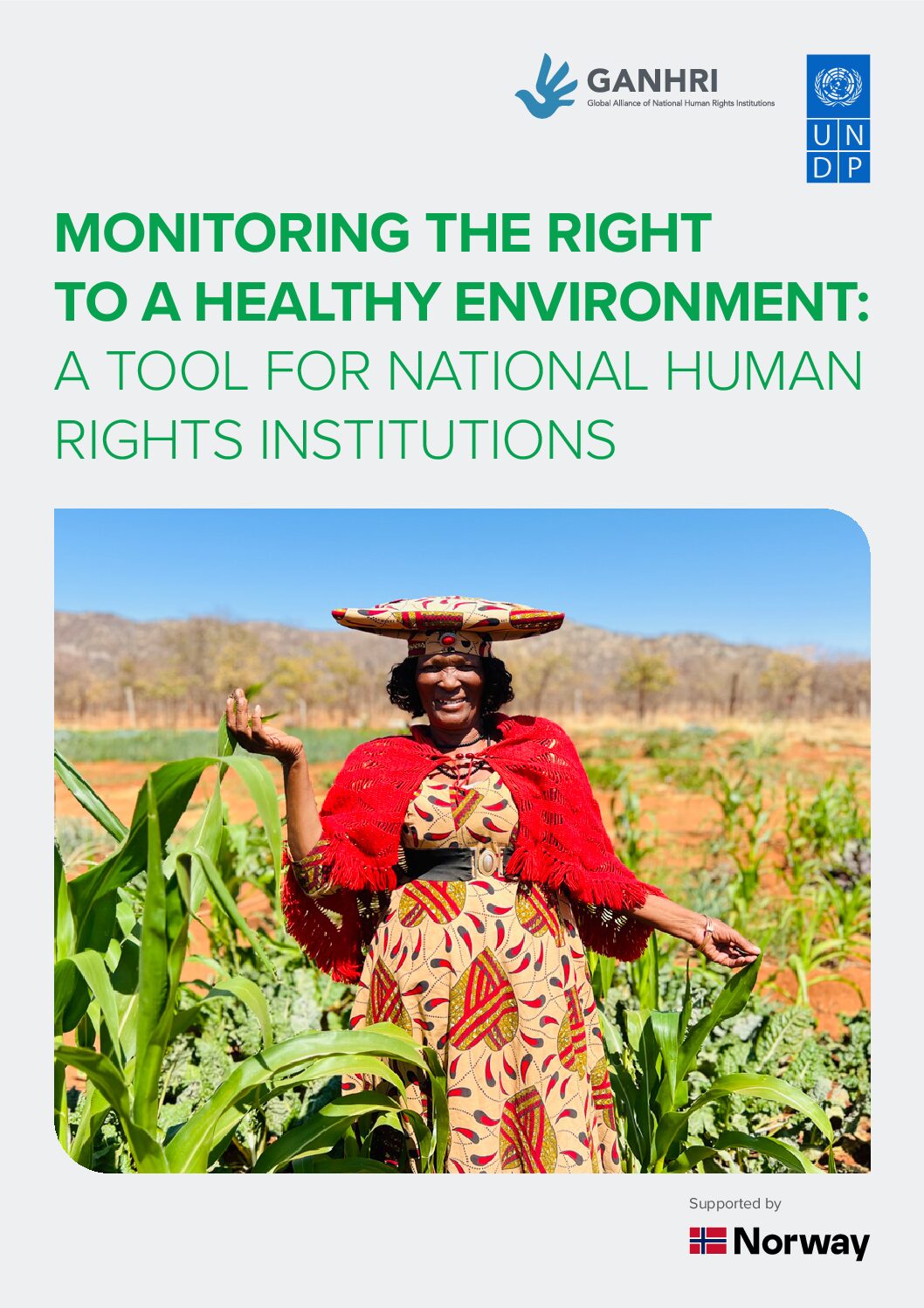
The Monitoring the Right to a Healthy Environment (R2HE) Tool is a practical framework developed by the United Nations Development Programme (UNDP), the Office of the High Commissioner for Human Rights (OHCHR), and the Global Alliance of National Human Rights Institutions (GANHRI). It aims to support National Human Rights Institutions (NHRIs) in systematically assessing and promoting the implementation of the human right to a clean, healthy, and sustainable environment.
The tool builds on the recognition by the UN General Assembly in 2022 of this right as fundamental, and its reaffirmation by the International Court of Justice in 2025 as a precondition for the enjoyment of other human rights.
Purpose and Objectives
The tool is designed to:
- Enable NHRIs to monitor environmental conditions through a human rights lens,
- Strengthen accountability for environmental harm,
- Support evidence-based advocacy and policy reform,
- Facilitate follow-up actions and recommendations at the national level.
It is also accessible to civil society organizations and environmental human rights defenders, broadening its impact beyond state institutions.
Key Features
1. TREE Framework
The tool applies a structured TREE approach, focusing on:
- Rules: Legal and policy frameworks governing environmental protection,
- Enforcement and oversight: Institutional effectiveness and accountability mechanisms,
- Environmental harms: Real-life impacts experienced by individuals and communities.
This integrated model links normative standards with implementation gaps and lived realities.
2. Comprehensive Scope
The tool covers both:
Substantive elements of the right, including:
- Safe climate
- Biodiversity
- Non-toxic environments
- Water and sanitation
- Food systems
Procedural elements, including:
- Access to information
- Public participation
- Access to justice
3. Adaptability and Practical Use
The tool is designed to be:
- Flexible, allowing adaptation to national priorities and capacities,
- Operational, providing guidance for monitoring, reporting, and follow-up,
- Field-oriented, linking data collection to real environmental harms and human rights impacts.
It has been piloted in Samoa, Malawi, Paraguay, and Georgia, demonstrating its applicability across diverse contexts.
Relevance for National Human Rights Institutions
The tool reinforces the role of NHRIs, in line with the Paris Principles, to:
- Conduct independent monitoring and investigations,
- Address environment-related human rights violations,
- Support vulnerable communities affected by environmental degradation,
- Bridge international standards and domestic implementation.
Key Implications
- Strengthens the integration of environmental issues within human rights mandates,
- Enhances accountability and access to remedies,
- Supports data-driven advocacy and reporting, including contributions to UN mechanisms,
- Promotes a rights-based approach to climate and environmental governance.
هذه المقالة متاحة أيضًا بـ:
 العربية (Arabic)
  Français (French)

