
Perched on a hillside in the Mount Lebanon region just north of Beirut stands Roumieh Central Prison, the largest and most emblematic detention facility in Lebanon. Built in 1963 and inaugurated in 1971, Roumieh was designed as a modern prison at a time when Lebanon’s penal system was expanding. More than five decades later, however, the prison has become a stark symbol of the country’s justice system under strain, reflecting deeper social, economic, and institutional crises.
A Prison Built for Another Era
Roumieh was originally intended to hold about 1,300 detainees, but today it houses several times that number. Government estimates place the official capacity at around 3,000 detainees, yet the population has reached approximately 4,200 prisoners, pushing the facility far beyond what international standards would consider acceptable.
By the standards recommended by the International Committee of the Red Cross, which propose 3.4 square meters of living space per detainee, Roumieh’s actual capacity would be closer to 1,050 inmates. The discrepancy highlights the depth of the overcrowding crisis that defines daily life behind its walls.
Roumieh is not simply a single building. The complex is divided into five main blocks, each designed to house different categories of prisoners.
Block A (Maison Centrale): this block was not intended to house prisoners. However, due to over-
crowding, it is currently being used to hold detainees, both pre-trial and sentenced.
Block B: this block holds detainees in pretrial or sentenced for crimes related to religious radical-
ism. It is divided into 3 floors with 57 cells on each floor (divided into 3 aisles) with a total of 171 cells
in the block.
Block C: this block is divided into 3 floors with around 50 to 57 cells on each floor (divided into 3
aisles) with a total of 171 cells in the block. It holds detainees, both pre-trial and sentenced.
Block D: Blue building: it is divided into 3 floors with around 50 to 57 cells on each floor (divided into
3 aisles) with a total of 171 cells in the block. It hosts inmates with mental disorders and those with
HIV-positive status.
Juveniles Section: it consists of 2 floors that are separated from the rest of complex. It houses
male juvenile detainees.
Although the blocks were meant to separate prisoners according to legal status or vulnerability, overcrowding has often made such distinctions impossible.
Waiting Without Trial
One of the most striking realities inside Roumieh is that many detainees have not yet been convicted of a crime. Across Lebanon’s prison system, the majority of inmates are awaiting trial, a result of slow judicial procedures, lengthy investigations, and systemic delays in the courts.
As a result, Roumieh has become a place where individuals can spend months or even years awaiting their first hearing, blurring the line between detention and punishment.
Living Conditions Under Pressure
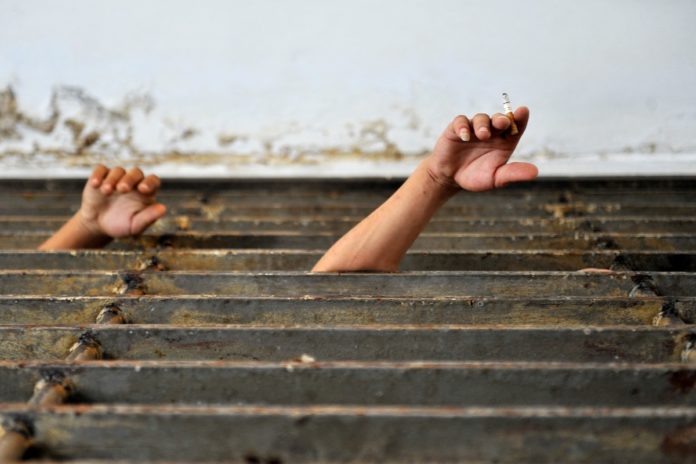
Overcrowding shapes nearly every aspect of life in Roumieh. Cells built for far fewer occupants often contain more than a dozen detainees, while larger dormitories may house over one hundred prisoners. Beds, blankets, and pillows are scarce, forcing many inmates to sleep on thin mats or improvised bedding.
Ventilation is poor, humidity is high, and heating or cooling systems are limited. These conditions have contributed to respiratory illnesses, skin infections, and other health problems among detainees.
Hygiene conditions are equally challenging. The prison struggles with shortages of soap, detergents, cleaning products, and other basic sanitation supplies. Toilets and shower facilities are often insufficient for the number of inmates using them, and infrastructure maintenance has become increasingly difficult as Lebanon’s economic crisis limits public funding.
Food, Water, and the Cost of Crisis
Lebanon’s financial collapse has also reached Roumieh’s kitchen. The prison administration has struggled to maintain adequate food supplies as prices for basic goods have surged.
Meals are often simple and repetitive, and the quantity of meat served has been reduced. Fresh produce and dairy products are rarely available, and prisoners sometimes share fruit between them.
Clean drinking water presents another challenge. Water filtration systems require maintenance, and detainees often lack the financial means to purchase bottled water.
The result is a daily struggle for basic necessities inside a system already under immense pressure.
Healthcare Under Strain
Healthcare services in Roumieh are limited compared with the scale of the prison population. There is a shortage of doctors, nurses, and specialized medical staff, including psychiatrists and dentists. Prisoners requiring specialized treatment often face administrative delays before they can see a specialist.
Some detainees must rely on medications provided by NGOs or by their families. Hospital transfers for serious conditions such as cancer, dialysis, or major surgery can also be difficult due to financial constraints and logistical challenges.
Despite these obstacles, recent efforts have integrated Roumieh’s medical center into Lebanon’s Primary Healthcare Center network, a step that may help improve access to certain treatments and chronic medications.
Rehabilitation and the Role of Civil Society
In theory, prisons are meant to rehabilitate as well as detain. In practice, overcrowding and limited resources have made rehabilitation programs in Roumieh difficult to sustain.
Education, vocational training, psychosocial support, and recreational activities are often organized by civil society organizations, which attempt to fill the gaps left by state institutions. These initiatives include computer courses, vocational workshops, and group counseling sessions.
Yet the scale of these programs remains small compared with the needs of thousands of detainees.
A System in Transition
Roumieh prison is administered by the Internal Security Forces under the Ministry of Interior, even though legal reforms have long envisioned transferring prison administration to the Ministry of Justice.
Prison officers, typically trained as police personnel rather than specialized correctional staff, face demanding conditions themselves. Low salaries, overcrowded facilities, and limited resources complicate their work.
More Than a Prison
Roumieh is often portrayed solely as a place of confinement, yet it also reflects broader structural challenges facing Lebanon: a struggling judiciary, economic collapse, and underfunded public institutions.
Behind its walls are thousands of men whose stories intersect with these wider national realities, individuals waiting for trial, serving sentences, or hoping for a chance to rebuild their lives after release.
Roumieh’s future will likely depend not only on reforms within the prison itself, but on deeper changes across Lebanon’s justice system, from faster court procedures to improved alternatives to detention.
Until then, the prison remains a powerful symbol of the country’s ongoing struggle to balance justice, human dignity, and institutional resilience.
هذه المقالة متاحة أيضًا بـ:

