


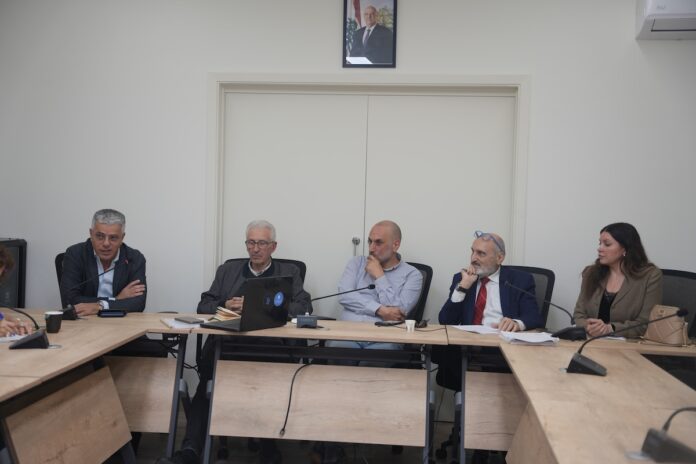
On Thursday, 19 November 2026, Lebanon’s National Human Rights Commission, including the Committee for the Prevention of Torture, held the sixth meeting in its “Connecting for Rights” series in cooperation with the Arab NGO Network for Development. The meeting was titled “Economic and Social Rights in Lebanon and the Impact of Overlapping Crises on Their Protection and Promotion.”
The meeting took place at the Commission’s headquarters in Beirut, with participants joining in person and online. Bassam Al Kantar, the Commission’s Commissioner for International Relations and Media, moderated the discussion. Ziad Abdel Samad, Executive Director of the Arab NGO Network for Development, attended.
The meeting examined how war, the financial crisis and the weakening of public institutions have affected the rights to work, health, education, housing, food, water and social security. The speakers explored the ability of national and international institutions to protect rights in wartime, avenues for accountability for the financial crisis and for curbing impoverishment, and the State’s responsibility to ensure access to telecommunications services.
The fate of rights amid war and weakened state institutions
Adib Nehmeh, a development and poverty reduction adviser, opened his presentation, “The Fate of Rights Amid War and a State Without Authority,” by placing the Lebanese discussion in its international context. He said that international law, international agreements and judicial institutions concerned with human rights were coming under growing pressure as the effects of wars spread and competition among major powers intensified. In his view, these developments affect the ability of states and societies to rely on shared rules to protect rights and hold perpetrators accountable.
Nehmeh cited pressure on the International Criminal Court as an example of efforts by major powers to influence the reach of international accountability. He observed that these powers may take similar positions when accountability touches on their interests or influence, even as they compete with one another. He linked this trend to the erosion of the balance of power that emerged after the Second World War and to the declining ability of less influential states to shape the rules governing international relations.
Turning to Lebanon, Nehmeh identified three overlapping sources of power. He pointed to arms, violence and repression, to the influence of money, banks and economic interests, and to the grip of traditional political leaders on institutions. In his view, understanding how these sources of power interact helps explain why institutions struggle to protect rights and hold powerful actors accountable, particularly when war increases people’s need for public services and institutions capable of protecting them.
Addressing the financial crisis, curbing impoverishment and combating impunity
Professor Fadl Daher, the Commission’s Commissioner for Studies, Monitoring and Development, presented his approach to addressing the financial crisis and curbing impoverishment, drawing on his paper “A Historical Document to Protect All Rights and Prevent Impunity.” He linked the financial and banking policy choices he discussed to their consequences for daily life, from growing difficulties in securing food, healthcare and education to depositors’ inability to access their savings. He called for recovery policies to be assessed by their impact on people’s rights and their ability to halt impoverishment.
Daher discussed the role of forensic financial auditing in documenting facts and identifying matters that warrant judicial investigation. He raised questions about the scope of the audit of Banque du Liban, how extensively it drew on information held by the competent authorities, and what further work was needed to establish responsibility. He also discussed the role of the Special Investigation Commission in cooperating with the judiciary and providing access to information through established procedures. He raised the issue of conflicts of interest when oversight powers overlap with functions whose activities are themselves subject to audit.
Daher discussed the mechanisms available under Lebanese law to combat money laundering and terrorist financing, as well as avenues for international cooperation against corruption. He called for these mechanisms to be used to trace funds and document suspicious transactions, and for seizure, confiscation and asset recovery measures where the legal requirements are met. He stressed the judiciary’s role in investigating and establishing responsibility, and the need to protect depositors’ rights in the response to the crisis.
Daher called on civil society organizations to help monitor and document relevant facts and on the Beirut and Tripoli bar associations to provide legal support for these efforts. He also discussed how international bodies could provide technical assistance within their mandates to support the work of the Lebanese authorities responsible for investigations and asset recovery.
The future of telecommunications and its impact on the exercise of rights
Wassim Mansour, a telecommunications expert and former general manager of touch, discussed the sector’s future in terms of its impact on the economy and society. He explained that connectivity has become essential infrastructure for education, work and health, as well as for access to services provided by the State, institutions and businesses. He called for government policies to be assessed by their ability to make reliable, affordable services available to all groups and across all regions of Lebanon.
Mansour explained that the State is responsible for putting in place a modern legislative and regulatory framework that ensures fair competition among operators and protects users. That responsibility also includes ensuring service quality, continuity and availability across the country. He noted that cost and geographic disparities affect access to services that depend on connectivity, with direct consequences for people’s opportunities to work, learn and use public services.
Mansour also discussed the State’s responsibility to safeguard public funds and make effective use of the sector’s resources. He stressed the need to preserve the value of public assets when considering privatization or partnerships with the private sector and to assess these options by their ability to attract investment and generate revenue. He also emphasized the importance of the telecommunications regulator’s administrative and financial independence for transparent regulatory decisions and accountability for the quality of services provided to users.
The discussion covered the role of the Commission and civil society in documenting the impact of the crises on economic and social rights and using this evidence to monitor financial recovery policies and the management of public services. Participants focused in particular on how the burdens of the crisis are distributed and whether people on low incomes can afford essential services.
The Commission thanked the Arab NGO Network for Development, the speakers and everyone who took part in person and online.
هذه المقالة متاحة أيضًا بـ:
 العربية (Arabic)
 Français (French)

