


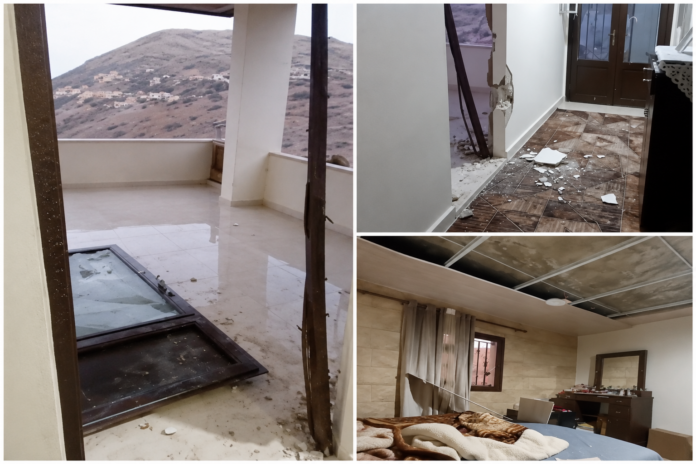
The International Humanitarian Law Committee of the National Human Rights Commission condemns the raid reportedly carried out by a force belonging to the Israeli occupation army on the home of brothers Asaad Fares Hamdan and Mohammad Fares Hamdan in the Al-Qateh neighbourhood of Shebaa, Hasbaya district, southern Lebanon, on the morning of Monday, 16 November 2026, and their removal to an unknown location. It calls for the immediate disclosure of their whereabouts, health status and the legal basis for their detention; guarantees of their safety; access to their family and an independent lawyer; and access by the International Committee of the Red Cross.
Multiple media reports this morning indicated that an Israeli force entered the neighbourhood and took the two brothers from their home. Footage was also published showing damage and disorder inside the house following the raid. This information warrants an urgent, independent investigation into the circumstances of the operation, the brothers’ transfer and place of detention, and the damage to property.
Damage to the home and preservation of evidence
The available images show a door panel with a dark frame and a glass section lying at an opening leading to the balcony, with fragments and debris around the threshold. They also show broken sections of the wall or its covering beside the door frame, white fragments scattered across the corridor floor, and a tilted frame at the opening.
In one room, open cardboard boxes, household items, bags and pieces of fabric are scattered across the floor. The images also show exposed sections of the suspended ceiling’s metal framework, with several covering panels missing, and large panels fallen or leaning near the bedroom window and beside the bed, as well as white fragments on the mattress and disordered bedding.
The Commission clarifies that the images document the visible condition of the home after the incident. However, they are not sufficient on their own to establish when each instance of damage occurred, how it occurred or who was responsible, nor to establish the route of the brothers’ transfer or their place of detention. Further documentation requires preserving the original recordings and photographs and their metadata, interviewing the homeowners and witnesses, and conducting an on-site inspection when possible. Damaged property and any items reported missing should also be documented, without presuming that they were seized before verification.
Connection with the case of their brother Maher Hamdan
The incident is particularly serious because Asaad and Mohammad are the brothers of Maher Fares Hamdan, whose case the Commission previously documented in its report, The Legal Status of Lebanese Prisoners of War, Detainees, Forcibly Disappeared Persons and Missing Persons Held by Israel, published on 15 September 2026.
The report addressed the detention of Maher, a shepherd from Shebaa born on 7 April 1994, on 7 June 2025 while tending sheep on the outskirts of the town and the slopes of Mount Hermon. It noted discrepancies between sources regarding the precise location of his apprehension and called for official disclosure of his whereabouts, health status and the legal basis for his detention; the provision of arrest, transfer and medical treatment records; and guarantees of contact with his family and lawyer and visits by independent humanitarian bodies.
The Commission stresses that the detention of three brothers in successive incidents requires an investigation into the circumstances of each incident and any possible connection between them. Family ties are not a lawful basis for detention, and family members must not be used to exert pressure, retaliate or extract information. At the same time, establishing collective punishment or hostage-taking requires verification of the purpose and circumstances of the acts; neither can be inferred automatically from family ties alone.
Statement by the Commission
The Commission’s International Humanitarian Law Committee states:
“Taking people from their homes amid an absence of official information about their place of detention and safeguards for their protection requires urgent action to protect their lives and safety and prevent their disappearance or exposure to torture. The Hamdan family has the right to know the fate of its three sons, and the Israeli authorities must provide official, individual answers concerning each of them. No security claim justifies placing a person outside the protection of the law, nor does raiding a home confer unlimited authority to damage its property or interfere with its contents.”
Legal framework: a preliminary assessment, not a judicial finding
The Commission’s assessment is based on the rules of international humanitarian law applicable to the international armed conflict between Lebanon and Israel, and on the need to establish each detainee’s status, the circumstances of their apprehension and the legal basis for any continued detention. Applying the law of occupation to a specific location requires verification of effective control under the relevant legal criteria; an isolated military incursion is insufficient to establish the existence of occupation.
The following legal frameworks are relevant because they regulate the lawfulness of deprivation of liberty, prohibit disappearance, protect family contact and oversight of detention, and establish the conditions for examining responsibility for violations.
Prohibition of arbitrary detention and disappearance, and the duty to register detainees
Rules 98, 99, 117 and 123 of the ICRC’s study on customary international humanitarian law address, respectively, the prohibition of enforced disappearance; the prohibition of arbitrary deprivation of liberty; the adoption of feasible measures to account for missing persons and inform their families; and the recording of personal details of persons deprived of their liberty.
These rules are directly relevant to the Hamdan brothers’ cases because they require documentation of apprehension, transfer and detention, prohibit keeping detainees outside official records and legal safeguards, and support demands for official information about their fate.
Specific safeguards for civilians under the Fourth Geneva Convention
Articles 42 and 43 impose strict limits on the internment of protected civilians in the territory of a party to the conflict, including absolute security necessity and initial and periodic review of the internment decision. Article 78 governs internment or assigned residence in occupied territory and requires imperative security reasons, a regular procedure, a right of appeal and periodic review.
These provisions do not constitute general authorization to apprehend residents of border areas. They require application of the appropriate provision within its geographical and personal scope and an individual assessment of each case. Nor may they be invoked to justify an unlawful transfer and then treat the person’s presence in the detaining power’s territory as a basis for rendering that transfer lawful.
Articles 106 and 107 provide civilian internees covered by their provisions with safeguards concerning notification of their family of their internment, address and health status, and correspondence. Article 147 lists unlawful confinement and unlawful deportation or transfer of protected persons among grave breaches. Consequently, if such acts are established, responsibility for them must be investigated, subject to establishing their legal and factual elements.
The visible damage to the home also requires investigation into its causes and lawfulness. Searches or apprehensions do not authorize arbitrary destruction or pillage.
Human rights and the risk of enforced disappearance
Article 9 of the International Covenant on Civil and Political Rights guarantees protection against arbitrary arrest, the right to be informed of the reasons for arrest, and the right to challenge the lawfulness of detention before a court. Article 14 guarantees fair trial rights when criminal charges are brought, including the presumption of innocence, access to a lawyer and protection against compelled confession. These safeguards remain relevant to persons subject to a state’s authority or effective control, including outside its territory.
The International Convention for the Protection of All Persons from Enforced Disappearance provides a standard for assessing a possible disappearance: deprivation of liberty carried out by the state or by persons acting with its authorization, support or acquiescence, followed by a refusal to acknowledge it or concealment of the person’s fate or whereabouts, placing that person outside the protection of the law. A lack of initial information is not, by itself, sufficient to establish that the crime has been completed, but it requires urgent intervention to prevent it. Reliance on this definition must be distinguished from determining treaty obligations according to each state’s status under the Convention.
Conditions for examining crimes against humanity and the regional framework
Articles 7(1)(e) and 7(1)(i) of the Rome Statute address imprisonment or other severe deprivation of liberty and enforced disappearance as crimes against humanity where the specific elements of each crime are satisfied and the act is committed as part of a widespread or systematic attack directed against a civilian population, with knowledge of the attack. The information currently available is insufficient on its own to establish that this threshold has been met. Reference to the Rome Statute also does not mean that the International Criminal Court automatically has jurisdiction.
Urgent demands for protection, investigation and accountability
The Commission calls on the Israeli authorities to disclose immediately and officially the whereabouts and health status of Asaad, Mohammad and Maher Hamdan; provide records of their apprehension, transfer and detention; ensure their humane treatment, access to medical care and contact with their family and lawyers; and allow the International Committee of the Red Cross access to them. It also calls for their release unless there is an individual, lawful basis for each person’s continued detention, subject to effective review, and for an investigation into any unlawful apprehension, transfer or detention and any unlawful destruction of property.
The Commission urges the Lebanese authorities to undertake urgent diplomatic and judicial action; document statements from the family and witnesses and the material damage; preserve original recordings; and gather information available to the Lebanese Armed Forces and UNIFIL within their respective mandates. It also calls for documented cases to be referred to the relevant UN mechanisms, including the Working Group on Enforced or Involuntary Disappearances and the Working Group on Arbitrary Detention, according to the elements of each case.
The Commission stresses that clarification of fate, protection of life and safety, and contact with family are urgent obligations that must not be made conditional on political negotiations or exchange arrangements. Independent investigation and preservation of evidence are essential to establishing responsibility and ensuring the right of those affected to an effective remedy and reparation.
هذه المقالة متاحة أيضًا بـ:
 العربية (Arabic)
 Français (French)

