


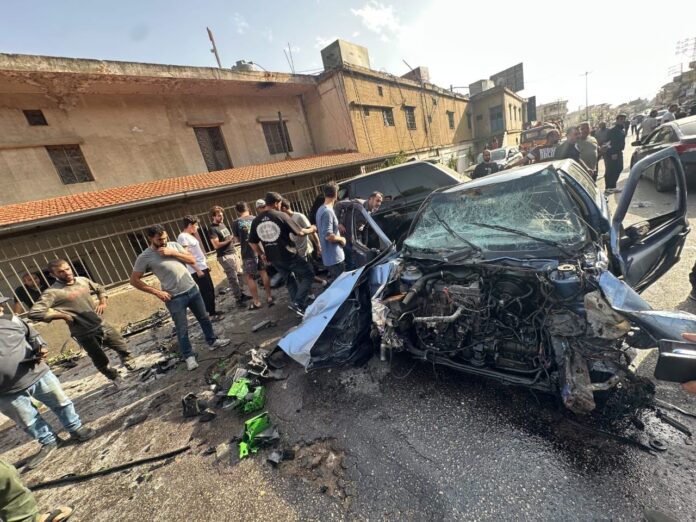
On the World Day of Remembrance for Road Traffic Victims, observed on the third Sunday of November each year and falling on 15 November 2026, the National Human Rights Commission, including the Committee for the Prevention of Torture, remembers those who have lost their lives or been injured on Lebanon’s roads. It expresses solidarity with survivors and victims’ families and calls for the National Road Safety Council, chaired by the Prime Minister, to be made fully operational and for the implementation of a sustainable national policy protecting the rights to life, health and safe mobility.
The Commission stresses that commemorating this occasion requires translating remembrance into measures that prevent deaths and serious injuries and ensure emergency assistance, treatment, rehabilitation, psychological and social support, and access to justice and compensation. It also pays tribute to ambulance crews, emergency responders, rescue workers and healthcare professionals for their role in saving lives and supporting injured people and their families.
An occasion to remember, support and act
The United Nations General Assembly endorsed this observance through resolution 60/5 in 2005, providing an occasion to honour those killed or injured, recognise their families’ suffering, highlight the role of emergency services, advocate stronger legal responses and support services, and promote evidence-based measures to prevent road deaths and injuries.
According to updated World Health Organization data, road traffic crashes cause approximately 1.16 million deaths annually, and road traffic injuries remain the leading cause of death among children and young people aged 5–29 years. Pedestrians, cyclists and motorcyclists account for more than half of road traffic deaths worldwide.
The Commission notes that the consequences extend beyond the crash itself. Families may face long-term treatment costs, loss of income, care responsibilities and disruption to education or employment, alongside grief and psychological trauma. The rights of people who acquire disabilities as a result of injuries must be upheld, and barriers to their independence, return to education and employment, and participation in community life must be removed.
Lebanese figures underline the need for prevention and transparency
According to statistics from the Directorate General of the Internal Security Forces, Lebanon recorded approximately 2,680 road traffic crashes in 2025, resulting in 451 deaths and 3,177 injuries. This toll calls for the publication of detailed official tables and the methodology used to compile them, enabling trends to be verified and prevention priorities to be identified. The Ministry of Interior and Municipalities also announced, in connection with a National Road Safety Committee meeting, that ISF data attributed 33% of crashes to speeding and 40% to driver inattention during the second half of August 2026 specifically.
In an official statement dated 20 October 2026, the ISF announced that it had recorded 73,981 traffic violations between 7 September and 18 October 2026, and impounded 2,485 cars and 5,825 motorcycles. The Commission considers that these figures demonstrate the scale of enforcement activity but are insufficient, on their own, to assess its effectiveness. Its impact on deaths, serious injuries, speeds and compliance with protective measures must also be measured.
A Safe System and clear institutional responsibilities
The Commission stresses that prevention cannot be reduced to asking individuals to exercise caution. The Safe System approach recognises that people make mistakes and that transport systems must be designed and operated to prevent those mistakes from resulting in death or serious injury. Responsibility extends to those involved in road design and maintenance, vehicle safety, speed management, enforcement, emergency assistance and post-crash care.
In Lebanon, Traffic Law No. 243 of 22 October 2012, as amended, established the National Road Safety Council, chaired by the Prime Minister and comprising the Ministers of Interior and Municipalities, Public Works and Transport, Justice, and Education and Higher Education. It provides for the Council to meet once every three months and whenever necessary. The law also established the National Road Safety Committee under the Council, chaired by the Minister of Interior and Municipalities and required to meet at least monthly, as well as a Secretariat responsible for follow-up, coordination, and analysis of statistics and high-risk locations.
The Commission notes the National Committee’s meetings and the recommendations circulated by the Ministry of Interior following its 24 August 2026 meeting. These included enforcement against dangerous violations, the use of speed radars, the integration of safety requirements into road projects, and stronger school-based awareness. It calls for published implementation updates identifying achievements, delays, responsible authorities and corrective deadlines.
The Commission’s recommendations
1. Ensure regular Council meetings and adopt a funded plan to reduce deaths and injuries.
The Commission calls on the Prime Minister to ensure regular meetings of the National Road Safety Council and dedicate a meeting to reviewing the national toll and existing measures. The Council should adopt a publicly available implementation programme specifying annual targets, responsibilities, resources and deadlines, consistent with the 2021–2030 Decade of Action for Road Safety goal of reducing deaths and injuries by at least 50% by 2030.
2. Strengthen the Secretariat and ensure monthly follow-up.
The Commission recommends providing the Council’s Secretariat with adequate human, technical and financial resources and establishing a unified dashboard to track implementation of decisions. It also calls on the National Committee to review progress monthly, refer matters requiring government decisions or funding to the Council, and publish periodic summaries of results.
3. Publish unified and updated national data.
The Commission calls for coordination of data from the ISF, hospitals, ambulance services and other relevant bodies, and publication of the 2025 totals and 2026 figures through the latest completed month, with clear definitions and reporting coverage. Deaths occurring within 30 days of a crash and serious injuries should be tracked. Anonymised data should be published by location, age and road-user category, and different datasets should not be combined before their comparability has been verified.
4. Address high-risk locations and maintain roads according to published priorities.
The Commission recommends that the Council coordinate with the Ministry of Public Works and Transport, municipalities and the Council for Development and Reconstruction to identify priority locations and publish a schedule addressing potholes, lighting, drainage, barriers, signs, road markings and pedestrian crossings. Diversions and work zones must be secured, and damage to roads and bridges, including war-related damage, must be addressed before they are reopened for normal use.
5. Protect pedestrians, children, persons with disabilities and two-wheeler users.
The Commission calls for continuous, unobstructed pavements, accessible crossings, traffic calming near schools, hospitals and residential areas, and low speed limits, including 30 km/h where motor vehicles mix with pedestrians and cyclists, informed by site assessment and design. It also recommends motorcyclist protection plans covering compliant helmets, training and vehicle safety, without stigma or discrimination.
6. Enforce the law fairly and measure campaign outcomes.
The Commission calls for sustained enforcement against speeding, driving under the influence of alcohol or substances that impair driving, mobile phone use, and failure to use seat belts, helmets and child restraints. Enforcement must be transparent and non-selective, with the right to challenge decisions guaranteed. Campaigns should be evaluated through safety outcomes across comparable periods and locations, taking changes in traffic volumes into account.
7. Ensure vehicle safety and safe school and professional transport.
The Commission recommends publishing the operational status of vehicle roadworthiness inspections and a plan to ensure their effectiveness and integrity. Checks on brakes, tyres, lighting and loads should be strengthened, particularly for school transport, public transport and trucks. It also calls for regulated driving and rest periods and a review of delivery deadlines and incentives that encourage drivers and delivery workers to speed or drive while fatigued.
8. Guarantee emergency assistance, treatment, rehabilitation and family support.
The Commission calls for support for ambulance and emergency services, improved coordination and response across the country, and safeguards against administrative or financial procedures delaying life-saving interventions. Continuity of treatment, rehabilitation, and psychological and social support must be ensured, alongside respect for the rights of persons with disabilities and assistance to affected families.
9. Ensure investigation, accountability and access to compensation.
The Commission stresses the need for effective investigations into deaths and serious injuries, preservation of technical and medical evidence, and examination of road and vehicle conditions, road-user behaviour and any relevant failures by responsible bodies. Victims and their families must have access to information, legal assistance and procedures for pursuing insurance and compensation claims, while the presumption of innocence and defence rights are respected.
10. Involve survivors and victims’ families and strengthen awareness.
The Commission recommends involving representatives of survivors and victims’ families, alongside health and emergency services and specialist organisations, in policy development and service evaluation through available legal mechanisms. It also calls for sustained awareness activities in schools, universities and workplaces, and media coverage that respects victims’ dignity and privacy, avoids distressing imagery and does not prejudge investigation findings.
The Commission affirms that honouring road traffic victims in Lebanon requires funded decisions, clear responsibilities, published data, accessible care and effective justice. Success must be measured by reductions in deaths and serious injuries and by survivors’ and victims’ families’ ability to obtain support, access remedies and rebuild their lives.
Resources and reference documents
- United Nations: World Day of Remembrance for Road Traffic Victims.
- International website of the World Day of Remembrance for Road Traffic Victims.
- Traffic Law No. 243/2012 — copy published on the ISF website — in Arabic.
- Presidency of the Council of Ministers: Circular No. 24 of 1 August 2019 on road safety and coordination with the National Council — in Arabic.
- World Health Organization: Road traffic injuries.
- Lebanon country profile in the Global Status Report on Road Safety 2023.
- Global Plan for the Decade of Action for Road Safety 2021–2030.
- Pedestrian safety: A road safety manual for decision-makers and practitioners.
- Data systems: A road safety manual for decision-makers and practitioners.
- General Assembly resolution 60/5 on improving road safety and commemorating victims.
- General Assembly resolution 74/299 on improving global road safety and proclaiming the 2021–2030 Decade of Action.
- Political declaration on improving global road safety — resolution 76/294.
هذه المقالة متاحة أيضًا بـ:
 العربية (Arabic)
 Français (French)

