
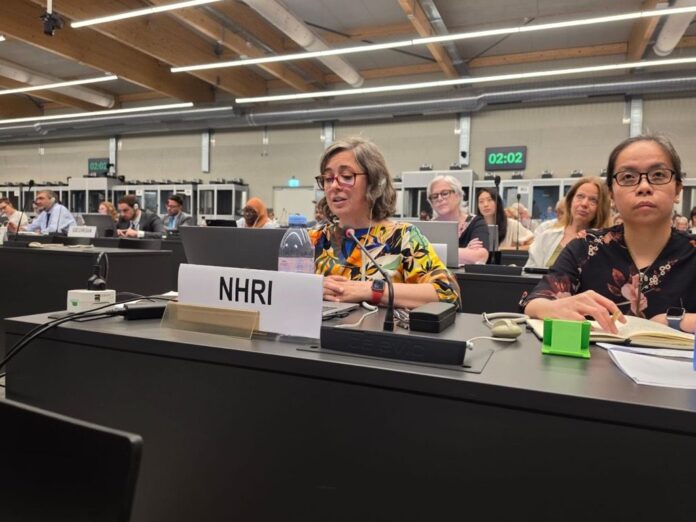
The National Human Rights Commission of Lebanon, including the Committee for the Prevention of Torture (NHRC-CPT), welcomes the convening of the First Session of the Open-ended Intergovernmental Working Group on Older Persons, held at the Palais des Nations in Geneva from 13 to 17 July 2026, marking the formal commencement of negotiations on a legally binding international instrument on the human rights of older persons.
The Commission considers the opening of this drafting process to be a historic milestone in the development of international human rights law. It represents a decisive step towards addressing existing protection gaps and moving beyond non-binding standards to a legally binding treaty that recognizes older persons as equal rights-holders entitled to the full enjoyment of all human rights and fundamental freedoms, rather than as passive recipients of care or protection.
The Commission emphasizes that global demographic changes require a comprehensive human rights-based approach capable of addressing the challenges faced by older persons, including age discrimination, social exclusion, unequal access to services, and emerging issues related to digitalization, artificial intelligence, climate change, humanitarian crises, and armed conflicts.
In the Commission’s view, the future international instrument should be firmly grounded in the Charter of the United Nations, the Universal Declaration of Human Rights, the International Covenants on Human Rights, and other relevant international standards. It should also build upon the normative framework developed by the United Nations on ageing, including the Vienna International Plan of Action on Ageing (1982), the United Nations Principles for Older Persons (1991), the Proclamation on Ageing (1992), the Madrid International Plan of Action on Ageing (2002), and the recommendations and general comments adopted by the United Nations human rights treaty bodies.
The Commission believes that the five United Nations Principles for Older Persons—Independence, Participation, Care, Self-fulfilment, and Dignity—should constitute the guiding framework of the new treaty, ensuring that older persons are empowered to make decisions concerning their own lives, participate fully in society, access appropriate health, social and legal services, pursue lifelong learning, and live free from violence, abuse, neglect and exploitation.
The Commission further stresses that the treaty should be guided by the principles of respect for inherent dignity, equality and non-discrimination, individual autonomy, full and effective participation, social inclusion, accessibility, gender equality, respect for diversity among older persons, intergenerational solidarity, and protection from all forms of violence, abuse, neglect and exploitation.
It also calls for the treaty to address existing normative and legal gaps by explicitly guaranteeing protection against age discrimination, the right to long-term care and support, legal capacity and supported decision-making, independent living, comprehensive social protection, universal access to healthcare, digital inclusion, and the protection of older persons in situations of emergency, disasters, humanitarian crises and armed conflict.
The Commission further advocates for robust implementation and monitoring provisions, including the establishment of an independent international monitoring mechanism, regular reporting obligations for States Parties, systematic data collection, and effective legislative, administrative and judicial measures to ensure full implementation of the future convention.
The Commission welcomes the position expressed by the Global Alliance of National Human Rights Institutions (GANHRI), which calls for a shift from welfare-oriented approaches to a human rights-based framework and emphasizes the meaningful participation of older persons, National Human Rights Institutions, and civil society organizations throughout the drafting process, including during intersessional work.
The National Human Rights Commission reaffirms its readiness to contribute actively to this international process through its mandate to promote and protect human rights. The Commission stands prepared to support national and regional consultations, provide legal expertise, and cooperate with all stakeholders to help develop a strong, comprehensive and effective international convention that guarantees the dignity, equality and full human rights of older persons.

