
On 2 October, the International Day of Non-Violence offers Lebanon an opportunity to reflect on how to protect human dignity, confront injustice and resolve differences peacefully. For a country shaped by successive wars, displacement and deep social divisions, promoting non-violence requires concrete action: protecting civilians, preventing torture, safeguarding peaceful expression, supporting survivors and ensuring accountability.
Every year, the United Nations marks the International Day of Non-Violence on 2 October, the birthday of Mahatma Gandhi. The General Assembly established the observance through Resolution A/RES/61/271, adopted on 15 June 2007, to promote non-violence through education and public awareness and encourage a culture of peace, tolerance and understanding.
For the National Human Rights Commission, including the Committee for the Prevention of Torture (NHRC-CPT), this occasion invites reflection on the relationship between peace and human rights. A society’s commitment to non-violence must be visible in the way its institutions exercise authority, its communities address disagreement, and its laws protect people from abuse.
In Lebanon, these questions carry particular urgency. The suffering caused by armed conflict, the consequences of displacement, and the pressures experienced by families and public institutions make the protection of human life and dignity a national priority. The International Day of Non-Violence provides a framework for discussing how Lebanon can break recurring patterns of harm and build public confidence in peaceful, lawful ways of securing rights.
Non-violence as a means of confronting injustice
The United Nations describes non-violence as the rejection of physical violence to achieve social or political change. It identifies three broad categories of non-violent action: protest and persuasion, non-cooperation, and non-violent intervention. This understanding recognises people’s ability to challenge injustice through organised, peaceful action.
Non-violence therefore requires space for people to speak, organise, protest and demand change. It depends on institutions that hear grievances and provide credible remedies. Asking people to resolve disputes peacefully carries meaning when they can access justice, report violations without fear, and participate in decisions affecting their lives.
For Lebanon, a commitment to non-violence should strengthen the voices of victims, human rights defenders, journalists, workers, young people and communities facing exclusion. It should support their ability to claim their rights safely and effectively.
Accountability is central to this approach. Investigating violations, identifying responsibility and providing remedies help prevent recurrence. A sustainable culture of peace requires society to acknowledge harm and address its causes.
Protecting civilians and upholding international law
The importance of this observance is especially clear in the context of the violence experienced in Lebanon. In April 2026, the UN Human Rights Office published a report examining deaths and displacement during the first three weeks of the escalation that began in March. Such documentation underlines the need to place civilian protection and scrutiny of potential violations at the centre of the response to conflict.
For Lebanon, the practical priorities include protecting civilians, preserving access to essential services, supporting displaced families, and ensuring that alleged violations are independently investigated. The needs and rights of survivors must guide recovery efforts, including access to healthcare, psychosocial support, education and effective remedies.
Reconstruction must also restore the conditions that allow communities to live safely and with dignity. Families need confidence that they can return to their homes, children can attend school, and institutions will respond when their rights are threatened.
The International Day of Non-Violence offers an opportunity to reaffirm the importance of diplomacy and peaceful conflict resolution while insisting that international law must be respected and violations addressed.
Protecting peaceful civic participation
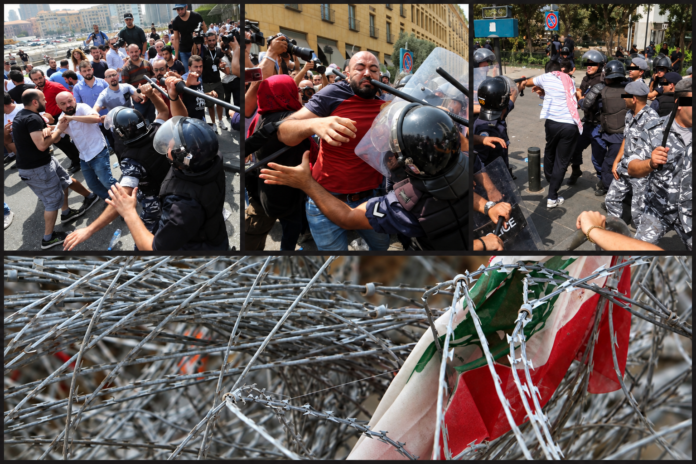
Lebanon’s future depends on people being able to participate in public life without intimidation. Peaceful demonstrations, public debate, journalism, advocacy and civic organising provide essential channels through which communities can express grievances and seek reform.
The UN Human Rights Committee’s General Comment No. 37 explains that restrictions on peaceful assembly must satisfy the requirements of legality, necessity and proportionality. Authorities bear the responsibility of justifying restrictions, and broad appeals to public order cannot support excessive limitations on the right.
This is particularly relevant wherever frustration with public institutions is high. Protecting peaceful participation allows grievances to be heard and addressed through democratic processes. Authorities should facilitate assemblies, protect participants, and ensure that responses to public gatherings respect human rights.
Political and community leaders also have a responsibility to encourage discussion that preserves the dignity of those who disagree. Differences of opinion are part of public life. Threats, intimidation and incitement undermine the conditions needed for peaceful participation.
Preventing torture and violence in detention
A commitment to non-violence must extend to places where people are deprived of their liberty. Prisons, police stations and other detention facilities place individuals under the authority and control of the State, making effective safeguards and independent scrutiny essential.
International law prohibits torture at all times and in all places, including during armed conflict or a public emergency. There are no exceptions.
For Lebanon, preventing torture and other ill-treatment requires sustained attention to detention conditions, access to healthcare, legal safeguards, complaints mechanisms and investigations into alleged abuse. People in detention must retain their dignity, and those who report violations must be protected from retaliation.
The NHRC-CPT’s mandate connects the promotion of human rights with the prevention of abuse. Established under Law No. 62/2016, the Commission provides an independent institutional framework for protecting and promoting rights in Lebanon, including through its torture prevention functions.
The International Day of Non-Violence is therefore an opportunity to reinforce the principle that lawful public authority must be exercised with respect for every person’s physical and psychological integrity.
Giving children the opportunity to grow without violence
The protection of children deserves particular attention. Children can experience violence through armed conflict, abuse at home, bullying, harmful disciplinary practices and unsafe environments. Preventing these harms is essential to their development and to Lebanon’s long-term social well-being.
UNICEF’s September 2026 brief on Lebanon’s education system examines the effects of hostilities since 2 March 2026 and identifies recovery priorities that combine school rehabilitation, learning recovery, psychosocial well-being and protection for children and education personnel.
These priorities show why peacebuilding must include investment in children’s daily lives. Restoring classrooms should go hand in hand with helping children feel safe, regain stability and receive support after distressing experiences.
UNICEF Lebanon also identifies violent discipline at home as a major child protection concern and highlights that violence can occur in schools and community settings.
Families, educators and public institutions should promote discipline and conflict resolution that respect children’s dignity. Listening to children, providing appropriate support, and responding promptly to abuse can help prevent harm and teach practical ways of managing disagreement.
Children learn from the conduct of adults and institutions. When they see problems addressed through fairness, dialogue and accountability, they gain confidence in those approaches.
Addressing discrimination and everyday violence
The relevance of non-violence extends into everyday relationships and public discourse. Lebanon’s cultural, religious and social diversity makes equal dignity and mutual respect essential foundations for coexistence.
A culture of non-violence requires attention to people who face heightened risks of exclusion or abuse, including women and girls, persons with disabilities, refugees, migrant workers and people experiencing poverty. Protection should be accessible regardless of nationality, legal status, social background or other personal characteristics.
Public discourse also matters. Political rhetoric, media coverage and online communication can influence how people perceive and treat one another. Responsible communication should resist dehumanisation and collective blame while preserving the right to question policies, criticise public officials and debate matters of public interest.
Community dialogue can help address tensions, but it must be accompanied by practical protection and fair treatment. People need confidence that institutions will respond to violence and discrimination and that assistance will be provided according to need.
Building trust through justice and responsive institutions
Non-violence becomes more sustainable when people believe that public institutions can respond to their concerns fairly.
For Lebanon, this means strengthening access to justice, improving complaints mechanisms, and making public services more transparent and responsive. It also means listening to communities whose experiences are too often absent from policy discussions.
The Secretary-General’s message for the International Day of Non-Violence in 2026 highlights the dangers posed by rising division, conflict, poverty and inequality. António Guterres also warns that the foundations of peace and development—including human rights, international law, diplomacy and dialogue—are being disregarded. He calls for renewed efforts to heal divisions, end suffering and build peace through non-violence.
For Lebanon, this message reinforces the need to connect peacebuilding with fair institutions and social protection. Financial hardship and exclusion require serious policy responses. Public confidence grows when people can see that their concerns are heard and their rights receive equal protection.
Turning the observance into action in Lebanon
The International Day of Non-Violence should encourage sustained work beyond the annual commemoration. Relevant priorities for Lebanon include:
- Protecting civilians and supporting survivors: Ensure that protection, essential services and recovery efforts respond to people’s needs and uphold their dignity.
- Strengthening accountability: Investigate alleged violations independently and provide accessible remedies.
- Safeguarding civic space: Protect peaceful assembly, expression, journalism and human rights advocacy.
- Preventing torture and ill-treatment: Strengthen safeguards, independent monitoring and effective responses to complaints in places of detention.
- Protecting children: Promote safe schools, non-violent discipline, psychosocial support and accessible reporting mechanisms.
- Addressing discrimination: Ensure equal protection and access to services, particularly for people facing exclusion.
- Investing in human rights education: Help schools, universities, public institutions and communities develop the knowledge and skills needed for peaceful participation.
- Supporting inclusive dialogue: Create opportunities for people to discuss shared concerns and contribute to decisions affecting their lives.
These priorities require cooperation among public authorities, independent institutions, civil society, educators, the media and communities. They also require resources and mechanisms for assessing whether commitments produce meaningful improvements.
For the NHRC-CPT, the significance of this day lies in its connection to the daily work of protecting and promoting human rights. Monitoring violations, hearing complaints, advancing rights education and encouraging institutional reform can help create the conditions in which peaceful action is effective.
On 2 October, Lebanon has an opportunity to reaffirm a practical commitment: every person should be able to live with dignity, seek justice, express concerns and participate in public life without violence or fear. Building that reality requires sustained protection, accountable institutions and the determination to resolve differences through peaceful means.
هذه المقالة متاحة أيضًا بـ:

