
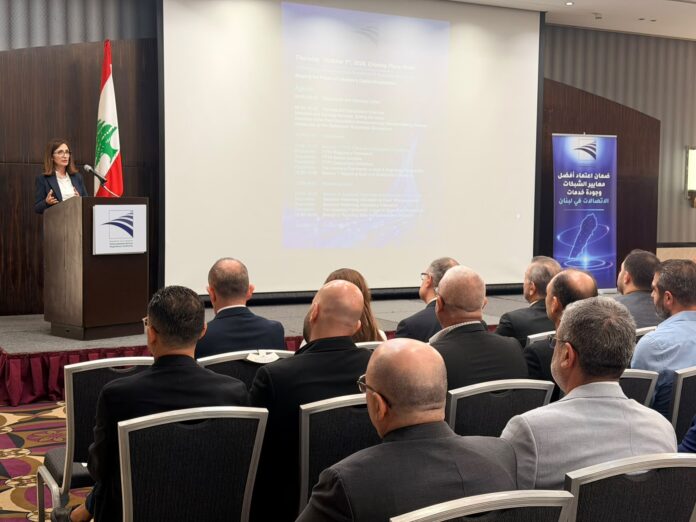
The National Human Rights Commission of Lebanon, including the Committee for the Prevention of Torture (NHRC-CPT), is participating today in the consultation process organised by the Telecommunications Regulatory Authority (TRA) on the policy for licensing and deploying fibre-to-the-home (FTTH) access networks. A specialised workshop is discussing 15 consultation responses and submissions received by the TRA, including the Commission’s official submission, with the aim of reviewing the comments received and reaching shared conclusions to help shape the sector’s future regulatory framework.
The Commission is represented at the workshop by Bassam Al Kantar, Commissioner for International Relations and Information. Held today, Thursday, at the Crowne Plaza Hotel under the title “FTTH Policy, Implementation Guidelines and Spectrum Refarming: Shaping the Future of Lebanon’s Digital Infrastructure,” the workshop brings stakeholders together in roundtable discussions on the regulatory framework for FTTH networks, market structure, network deployment guidelines and licensing, alongside spectrum refarming and its associated legal and regulatory aspects.
The Commission’s submission is being discussed as one of 15 responses to the public consultation received by the TRA, with the aim of developing shared conclusions that help shape Lebanon’s digital infrastructure and ensure that human rights are integrated into digital policies.
The Commission submitted its official response to the public consultation pursuant to its mandate under Law No. 62/2016, particularly its authority to provide opinions on legislation, decisions and public policies affecting respect for human rights. In its submission, it stressed that reliable and affordable internet connectivity has become a practical prerequisite for exercising fundamental rights, including freedom of expression, access to information, education, health, work, participation in public affairs and access to public services.
From written consultation to direct discussion
Today’s workshop is particularly significant because it moves the consultation process from receiving written responses to direct discussion among stakeholders. The submissions and comments received by the TRA are scheduled to be presented and discussed at the workshop, allowing participants to compare different approaches and work towards shared conclusions before proceeding to subsequent stages of decision-making.
The Commission considers its participation particularly important because it brings human rights, the public interest and digital sovereignty directly into a debate often approached primarily from technical, investment and commercial perspectives.
In its submission, the Commission argued that the future FTTH network should be treated not merely as an investment project or a competitive market, but as critical national digital infrastructure. Public administrations, hospitals, schools, financial services, emergency services and economic sectors will depend on it, alongside individuals who increasingly rely on connectivity in their daily lives.
Today’s discussions demonstrate that the Commission’s contribution is not an isolated position outside the technical debate. It forms part of the same dialogue involving 15 respondents to the consultation, including national, regional and international institutions and companies operating in telecommunications and technology.
In its submission, the Commission called for immediate or comprehensive open access to FTTH network infrastructure. Private-sector stakeholders, including Nokia, FIBERWAVES, GDS, Trisat and other participants, share this position. This convergence matters because it shows that the Commission’s call for open access—grounded in human rights, non-discrimination, fair competition and users’ access to services—also aligns with the positions of technical and commercial market participants. The Commission stressed that open-access obligations should apply as soon as each part of the network enters commercial service, covering infrastructure and wholesale services under transparent and non-discriminatory conditions.
The Commission’s participation also brings issues of human rights, digital equity, rural coverage, affordability, data protection, cybersecurity, digital sovereignty and the protection of public assets to a predominantly technical and commercial discussion. At the same time, today’s exchanges reveal areas of common ground between these priorities and other participants’ proposals, providing a basis for shared conclusions.
Seven core priorities advanced by the Commission
The Commission’s contribution to today’s discussion emphasises that the proposed policy must extend beyond investment and competition to explicitly address digital sovereignty, cybersecurity, national resilience, human rights, universal access, data protection, and the preservation of public assets and the State’s strategic control over digital infrastructure. In its conclusions, the Commission called for the policy to be redrafted on this basis and for a hybrid model that preserves State ownership and strategic control over core assets while allowing competitive, time-limited private-sector participation.
The Commission also stressed that fibre deployment must not deepen the digital divide between Beirut and other urban centres, on the one hand, and rural and underserved areas, on the other. It proposed linking investment in profitable areas to measurable coverage obligations in underserved areas, alongside affordable service packages, accessibility for persons with disabilities, and priority connections for schools, hospitals and public institutions.
On the regulatory model, the Commission proposed a third, hybrid option that separates strategic ownership from competitive operation. Under this model, the State would retain ownership of strategic infrastructure, while qualified entities would receive time-limited rights to operate or deploy parts of the network, subject to conditions safeguarding open access, coverage, cybersecurity and human rights.
Public consultation must shape the final decision
The Commission stresses that the value of consultation is measured not only by the number of submissions received, but by the extent to which evidence-based comments are reflected in the final policy, licensing conditions, and implementation, oversight and accountability mechanisms.
Discussing the Commission’s submission alongside the other fourteen responses therefore offers an opportunity to develop a more integrated approach—one that considers technical, economic and legal factors while placing users’ rights, the public interest, security, resilience and digital sovereignty at the heart of regulatory choices.
The Commission also called for the FTTH policy to be considered together with the rights-of-way framework and fibre deployment guidelines; for supporting documents and market data to be published; for an assessment of the policy’s potential impact on human rights, cybersecurity, public finances and competition before its adoption; and for broader participation by municipalities, consumer associations, civil society, experts and communities outside Beirut.
As its submission is discussed today, the Commission reiterates that the future of Lebanon’s digital infrastructure must be built not only on the pace of investment or the intensity of competition, but on an affordable, secure, resilient and accountable network that protects privacy and public assets, reduces inequalities and respects human rights.
هذه المقالة متاحة أيضًا بـ:

