
Bassam Al Kantar, a member of the National Human Rights Commission, said that honoring slain journalist Amal Khalil, along with all journalists, aid workers, first responders, medical staff, and civilians killed across the country, requires a sustained commitment to ending impunity.
He stressed that justice will not come through “stale complaints” left to languish at the United Nations Security Council, nor through statements of condemnation, regardless of their source. “Accountability is the only path forward,” he said, underscoring that holding perpetrators to account and bringing them to trial remains the essential condition for justice.
Al Kantar said Amal Khalil, “a flower of the South”, an exemplary journalist and committed activist who championed the rights of detainees and prisoners and worked to uncover the fate of the missing, deserves to be honored through an immediate decision by the Council of Ministers to accept the jurisdiction of the International Criminal Court, in order to hold accountable all those involved in violations of human rights and international humanitarian law in Lebanon.
He stressed that prosecuting perpetrators and holding them individually accountable, alongside pursuing accountability for the occupying power for acts “whose brutality defies description”, represents the only genuine path to justice.
He also underlined that ending impunity requires the establishment of independent international commissions of inquiry to investigate the ongoing and repeated crimes committed by occupation forces.
Al Kantar concluded that honoring Amal Khalil, and every martyr, means preserving their legacy, uncovering the truth, and exposing perpetrators before cameras and public opinion, insisting that this alone constitutes a meaningful tribute to “the flower of the South”, the “flower of journalism”, and the “flower of detainees, prisoners, and the missing.”
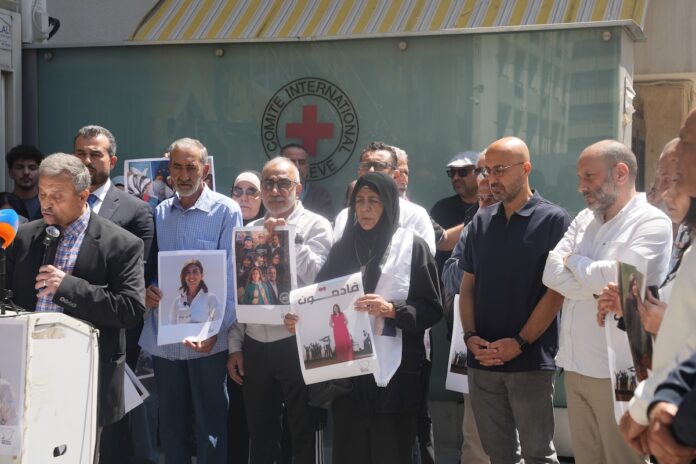
His remarks were made during a vigil held in tribute to the slain journalist and activist Amal Khalil, organized by the Khiam Rehabilitation Center for Victims of Torture in front of the headquarters of the International Committee of the Red Cross in Beirut, in the presence of official and political figures, representatives of civil society organizations, former detainees, and the victim’s family and friends.
Hassib Abdel Hamid, Deputy Secretary-General of the Khiam Center, said the choice of location for the vigil carried symbolic significance, marking “the first step in the martyr’s path of struggle.” He noted that despite her young age, headscarf, and the many risks she faced, Amal Khalil succeeded in becoming the voice of the Center in both local and international advocacy, representing it “in the best possible way.” He concluded by wishing a speedy recovery to the wounded activist Zeinab Faraj.
Mohammad Safa, head of the Khiam Center, addressed a message to Information Minister Paul Morcos, urging him to “approve Lebanon’s acceptance of the International Criminal Court’s jurisdiction in the Council of Ministers and to expedite the filing of an urgent complaint.” He added that he never imagined he would be speaking about Amal as a martyr, but rather believed she would one day be the one documenting the history and achievements of the Khiam Center and the Committee of Detainees. “Amal carried the photos of detainees and former prisoners from all backgrounds, visited their families, and stood close to them. Today, the loyal carry her image,” he said.
For her part, Wadad Halwani, head of the Committee of the Families of the Kidnapped and Missing, said her connection with Amal began through the cause of Lebanon’s war missing and the push to implement Law 105/2018 to uncover the fate of the disappeared. She noted that Amal approached the issue through her activism and humanitarian commitment within the Khiam Center, standing in solidarity and following the cause as both a journalist and a partner. “Amal, daughter, lover, and guardian of the South, excelled in her profession defending its people, its land, its trees, and even its animals, while exposing the crimes of the Israeli enemy,” she said.
Zahra Abdel Latif delivered a tribute on behalf of “Beit Atfal al-Sumoud,” saying that “while a missile may succeed in stopping a body, it fails to assassinate meaning.” She added, “With her blood, the martyr proved that words are written with conviction and can turn into fragments that pierce awareness. Though Amal has departed in body, she has left behind a legacy that time cannot erase.”
Activist Ghina Nahfaoui said, “We bid farewell to a spirit that was among us an unextinguished beacon, and we mourn a towering figure of the free word.” She noted that Amal Khalil had been a companion in struggle since their work within the “Follow-Up Committee for Supporting Lebanese Detainees in Israeli Prisons” and the Khiam Rehabilitation Center for Victims of Torture. “Amal stood by survivors in the darkness of memory, helped organize sit-ins for detainees, documented their names, translated their files and testimonies, and later carried the pen and camera to turn the wounds of the oppressed into testimony before the world,” she added.
Former detainee Anwar Yassin said Amal “will remain a voice of courage and freedom,” adding that “she has left her heartbeat in the land of the South, and her voice has become a prayer echoing in every corner.”
Tracy Khoury, speaking on behalf of the Lebanese Center for Human Rights, said Amal Khalil “was not merely a media voice, but a living conscience that stood for truth and justice despite mounting challenges.” She added that Khalil’s career embodied the highest standards of professional and humanitarian commitment, as she conveyed suffering and exposed violations despite pressure and risk.
Former detainee Georges Abdallah described Amal as “a bright face of popular resistance,” saying her legacy would remain etched in the conscience of every activist. “She was a central pillar of resistance through media, word, and stance, and will remain alive in our hearts,” he said.
Dr. Omar Nashabe, speaking on behalf of the newspaper Al-Akhbar, said Amal “bridged journalism and human principles, becoming a model for media professionals.” Addressing the International Committee of the Red Cross in solidarity, he called for “action to ensure the implementation of international conventions,” stressing the need for international complaints, prosecutions for shared crimes, and the opening of investigations before the International Criminal Court.
In a family tribute, Amal’s brother Ali Khalil said she was “both a martyr and a witness to the crimes of the enemy,” adding that she became a target because she provided colleagues with information and documentation until her final moments. Her niece concluded with remarks in Arabic and English, saying, “Amal Khalil cannot be fully honored with words. She believed in walking the path of truth regardless of how few take it. She never compromised, and though the price was high, her voice will endure and will never fade.”
هذه المقالة متاحة أيضًا بـ:

