

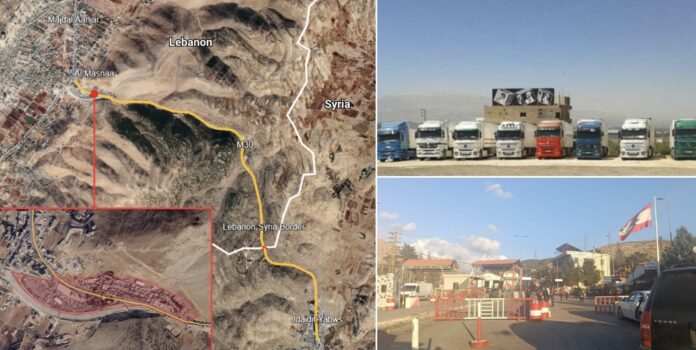
On 4 April 2026, the Israeli army’s Arabic-language spokesperson issued a public warning indicating that the Masnaa Border Crossing and the adjacent route linking it to Syria via the Jdeidet Yabous crossing (M30 highway) could be targeted. The warning alleged that these routes were being used by Hezbollah for military purposes, including the transfer of weapons[1].
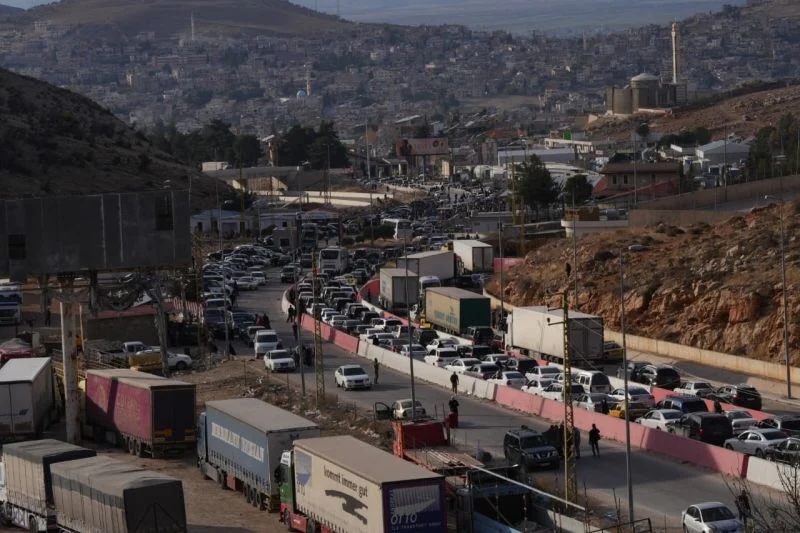
The announcement triggered an immediate and near-total disruption of activity at the crossing. Movement of civilians, freight trucks, and administrative operations was halted, and the area was evacuated in anticipation of a potential strike.
Subsequent developments indicate that, following diplomatic mediation, the crossing was not attacked. It later resumed operations, and as of 11 April 2026, no strike had been carried out against it despite the prior threat[2].
At the same time, Syrian and Lebanese authorities publicly rejected the allegations of military use, maintaining that the crossing is designated exclusively for civilian transit and is not utilized for armed activity.
Given the serious legal and humanitarian implications of such claims, the National Human Rights Commission has undertaken a preliminary investigative review to assess their credibility against available evidence and applicable international standards.
Methodology
This assessment is grounded in the Commission’s established methodology, which includes the verification of publicly available information, cross-referencing with official Lebanese authorities, and the review of statements by relevant stakeholders. It further involves the application of international human rights and international humanitarian law standards, alongside strict adherence to the “do no harm” principle in the dissemination of sensitive information. The Commission emphasizes that allegations alone do not constitute evidence, particularly when issued by a party to an armed conflict.
Legal Framework for Distinguishing Between Civilian Objects and Military Objectives
The principle of distinction constitutes a cornerstone of international humanitarian law and serves as the decisive criterion for determining the lawfulness of targeting objects. This principle requires parties to a conflict to distinguish at all times between civilian objects and military objectives, such that attacks may only be directed against military objectives.
Pursuant to Article 48 of Additional Protocol I to the Geneva Conventions, parties to the conflict are obligated to distinguish between the civilian population and combatants, and between civilian objects and military objectives. The definition of military objectives is set out in Article 52(2) of the same Protocol, which provides that:
“Military objectives are limited to those objects which by their nature, location, purpose or use make an effective contribution to military action and whose total or partial destruction, capture or neutralization, in the circumstances ruling at the time, offers a definite military advantage.”
Conversely, Article 52(1) stipulates that all objects which do not fall within this definition shall be considered civilian objects and shall be protected from attack.
This definition establishes that classifying an object as a military objective requires the cumulative fulfillment of two criteria:
- Effective contribution to military action
- Definite and direct military advantage
In addition, Rule 10 of the customary rules of the International Committee of the Red Cross affirms that civilian objects are all objects that are not military objectives, and that in case of doubt, objects must be presumed to be civilian, this is known as the rule of doubt.
Legal Status of the Al-Masnaa Border Crossing
Al-Masnaa Border Crossing is one of the six official crossings between Lebanon and Syria. It is a civilian facility used to regulate the movement of persons and goods under the supervision of competent Lebanese authorities, including General Security, Customs, Internal Security Forces, and the Lebanese Army.
Civilian Nature of the Crossing
By its nature, the crossing is an administrative and service facility dedicated to civilian and commercial transit, and it is managed by the Lebanese State. Accordingly, it is prima facie classified as a civilian object.
Absence of Evidence of Military Use
Based on the available information, there is no reliable or verifiable evidence demonstrating that the crossing is being used for military or military logistical purposes, such as the transfer of weapons or combat equipment. Moreover, there are no official or independent reports documenting seizures or violations of a military nature at this crossing under current conditions.
Lack of Effective Contribution to Military Action
In the absence of evidence indicating military use, the crossing cannot be considered as making an effective contribution to military action, whether by its nature, use, purpose, or location.
Failure to Meet the “Definite Military Advantage” Requirement
Even in cases where dual-use is alleged, any lawful targeting must yield a definite and direct military advantage. In the absence of established military use, this requirement is not satisfied.
The Rule of Doubt in Favor of Civilian Protection
Where doubt exists, international humanitarian law requires that an object be considered civilian and therefore not subject to attack. Accordingly, unsubstantiated allegations are insufficient to alter the legal classification of the crossing.
The Issue of “Consent” and Alleged Military Use
It is a well-established principle that transforming a civilian object into a military objective requires actual use in military operations, not mere allegations or speculative claims. In this context:
- There is no indication that Lebanese authorities have authorized or consented to the use of Al-Masnaa Border Crossing for military purposes.
- On the contrary, the crossing remains under the supervision of official civilian and security institutions operating within a legal framework, reinforcing its civilian character.
- Any unlawful use, if it were to occur, by non-state actors would not automatically deprive the object of protection unless it reaches the threshold of actual and continuous military use meeting the criteria of Article 52(2), which has not been established.
Nature of the Allegations
Lebanon and Syria are connected through six official land border crossings, of which the al-Masnaa crossing is the principal and most heavily trafficked, serving as the main transit point between the two countries.
The central allegation under review asserts that the al-Masnaa border crossing serves as an active conduit for the smuggling of weapons and military equipment between Syria and Lebanon, and that such activity continues unabated despite evolving regional dynamics, including the emergence of new governance structures in Syria. It further suggests that ostensibly civilian transport systems, including commercial trucking networks and routine cross-border logistics operations, are being systematically exploited to facilitate these transfers under the cover of legitimate economic activity. These claims, by their nature, carry serious legal and humanitarian implications, particularly insofar as they may influence the characterization of civilian infrastructure and the justification of potential military actions. However, upon examination, the Commission finds that these assertions are not supported by verifiable evidence, nor are they corroborated by independent or neutral sources. Rather, they appear to rely predominantly on unsubstantiated claims and generalized assumptions, without the requisite factual foundation needed to meet established standards of proof in contexts involving allegations of this gravity.
Absence of Verifiable Evidence
A critical and comprehensive review of all available material reveals a clear absence of substantiated proof supporting the allegation of ongoing smuggling activity through the al-Masnaa crossing. Notably, there are no documented cases of weapons seizures recorded at the crossing by competent Lebanese authorities, nor is there any satellite imagery or visual documentation that would credibly confirm the occurrence of illicit transfers. Furthermore, no records have been identified from customs services or border inspection authorities indicating anomalies, irregular cargo movements, or breaches in inspection protocols. Equally significant is the lack of findings or reporting from independent monitoring bodies, whether international or domestic, that would corroborate such claims. In contexts where allegations carry serious legal and security implications, the absence of such evidence is particularly consequential. As a result, the claims in question remain unverified and unsupported by empirical data, falling short of the evidentiary threshold required to substantiate assertions of this nature.
It is also essential to address references to historical smuggling networks and individuals previously subject to international sanctions. In this regard, available records confirm that Khodr Ali Taher (also known as Khadr Abu Ali) was designated by the U.S. Department of the Treasury in September 2020 under the framework of the Caesar Syria Civilian Protection Act, on the basis of his alleged involvement in economic networks linked to the Syrian government at the time[3]. While such designations provide insight into past patterns of illicit economic activity during the period associated with the government of Bashar al-Assad, they are intrinsically tied to a specific historical and political context.
From an evidentiary and legal standpoint, reliance on such outdated or context-specific findings does not meet the requirements of contemporaneity and relevance necessary to substantiate present-day allegations. No credible, updated information demonstrates the continued operation of these networks, their linkage to current border governance structures, or their involvement in ongoing activities at the al-Masnaa crossing in 2026. Accordingly, historical sanctions listings, in the absence of current corroboration, cannot be considered probative evidence of ongoing smuggling activity and should not be relied upon to support contemporary claims.
Reliance on Speculative Reasoning
The narrative underpinning the allegations relies heavily on inference and generalized assumptions rather than verifiable facts. This includes assertions that smuggling operations “cannot occur without internal cooperation,” as well as claims that such cooperation “likely continues” under current conditions. These formulations are inherently speculative, as they are not grounded in documented incidents, verified testimonies, or material evidence, but instead rest on hypothetical reasoning and presumed continuity of past patterns. As such, they do not meet the threshold of factual verification required in the assessment of allegations with serious legal and security implications.
This speculative framing is further compounded by attempts to draw tenuous or misleading associations with identifiable individuals operating within the legitimate transport sector. In this regard, reference is made to Ahmed Hussein, head of the Refrigerated Truck Union in Lebanon, in a manner that implicitly suggests relevance to the allegations. However, available information indicates that Hussein publicly rejected the claims on 5 April, affirming that the al-Masnaa crossing functions as a humanitarian and commercial passage for goods and food, is not affiliated with any armed actor, and remains subject to official supervision and regulatory control.
Additional details cited about Hussein, including his residence in Majdal Anjar, ownership of a fleet of transport vehicles operating at the crossing, and his professional interactions with officials from the Ministry of Transport, are presented without evidence of wrongdoing and do not, in themselves, establish any link to illicit activity. Similarly, his appearance in a photograph alongside officials, including the Director-General of the Ministry of Maritime and Land Transport, or his meeting with the Director-General of General Security during an official visit to the crossing, reflects routine institutional engagement rather than evidence of complicity.
The inclusion of such references, absent substantiation, risks creating unfounded insinuations and undermines the integrity of the analysis. Accordingly, these elements must be understood as speculative and uncorroborated, reinforcing the conclusion that the allegations rely on analytical conjecture rather than evidence-based findings.
Internal Inconsistencies in the Claims
The allegations under review reveal a fundamental logical inconsistency that undermines their credibility, particularly when considered across both sides of the Lebanese–Syrian border under current governance structures. On the one hand, the al-Masnaa crossing, on the Lebanese side, is described as a highly regulated and tightly controlled point of entry, subject to formal oversight by Lebanese authorities, including routine inspections, scanning procedures, and coordinated security measures. On the other hand, the corresponding Syrian crossing at Jdeidet Yabous is likewise presented as operating under the authority and control of the new Syrian government, with functioning border management and security presence.
Despite this dual framework of control, the allegations simultaneously portray these same crossings as sites of systematic, continuous, and large-scale smuggling operations involving weapons and military equipment. This dual assertion implies not only the failure of one system, but the concurrent failure or complicity of both Lebanese and Syrian border authorities. Such a claim carries a high evidentiary burden, as it presupposes either widespread operational breakdowns or coordinated facilitation across two sovereign administrations.
However, no documentation has been presented to substantiate such failures. There is no evidence of inspection breakdowns, or specific incidents demonstrating that prohibited materials have transited through these official crossings under current conditions. Nor is there credible information linking the present Syrian authorities to any form of complicity or inability to enforce border controls. In the absence of such evidence, the claim that tightly monitored crossings on both sides are simultaneously facilitating systematic smuggling remains internally inconsistent and unsubstantiated. This contradiction further reinforces the conclusion that the allegations are based on conjecture rather than verifiable and coherent factual findings.
Absence of Independent Corroboration
The Commission underscores the notable absence of corroboration from independent and international actors that would typically be expected to document or verify allegations of this nature. This includes relevant United Nations agencies, international monitoring and investigative bodies, as well as the Border Control and Monitoring Committee, which includes representatives from Germany and the European Union. Despite the seriousness of the claims, no reports, alerts, or findings have been issued by these entities indicating the existence of ongoing smuggling activities through official border crossings.
In contexts involving allegations with potential implications for international peace and security, such actors play a critical role in providing impartial verification through field monitoring, reporting mechanisms, and oversight functions. The absence of any such independent confirmation is therefore highly significant. It suggests that the allegations have not been substantiated through credible, neutral sources and do not reflect a verifiable pattern of activity recognized by the international community. Accordingly, in the absence of independent corroboration, the claims remain unverified and fall short of the evidentiary standards required to support conclusions of this gravity.
Legal Implications of Unverified Allegations
Under the framework of international humanitarian law, the circulation and operational reliance on unverified allegations carry significant legal consequences. Allegations concerning the military use of civilian infrastructure, such as border crossings, must be grounded in reliable, credible, and independently verified intelligence before they can be invoked to justify any form of military action. The principle of distinction, a cornerstone of the Geneva Conventions and their Additional Protocols, obliges all parties to an armed conflict to clearly differentiate between civilian objects and military objectives at all times. In parallel, the principle of precaution requires that all feasible measures be taken to verify targets and to avoid, or at a minimum minimize, harm to civilians, explicitly prohibiting actions based on uncertain or speculative information.
In this context, the propagation of unsubstantiated claims risks producing serious legal and humanitarian consequences. It may lead to the mischaracterization of civilian infrastructure, such as officially regulated border crossings, as legitimate military targets without sufficient basis. It may also contribute to the justification of unlawful targeting, in violation of international legal obligations, and ultimately result in the endangerment of civilian populations, including travelers, workers, and surrounding communities who rely on such infrastructure for essential services and livelihoods.
Conclusion and Recommendations to the Lebanese Government
Based on its review, the National Human Rights Commission Lebanon concludes that the allegations of ongoing smuggling through the al-Masnaa crossing are not supported by verifiable evidence, and instead rely on speculation, historical precedent, and single-source assertions. The Commission finds no substantiated indication that such activities are occurring under current border control conditions on either the Lebanese or Syrian sides, including those involving the present Syrian authorities. In this context, the persistence of such claims, absent credible verification, raises serious concerns regarding their potential use in shaping military narratives and operational decisions.
In light of these findings, the Commission calls upon the Lebanese Government to formally raise this matter within the framework of violations of international humanitarian law, including by the Israel Defense Forces, particularly where unverified allegations may contribute to the mischaracterization of civilian infrastructure as military objectives and, consequently, to the justification of potential targeting. The Government is urged to address this issue in a clear and substantiated manner within its official communications and submissions to the United Nations Security Council, emphasizing the legal risks associated with reliance on unsubstantiated claims and the corresponding threat to the protection of civilians and civilian objects.
[1] The Times of Israel, “IDF issues pre-strike warning for Lebanon-Syria border crossing, says Hezbollah uses it for ‘military activity’,” 4 April 2026, available at: https://www.timesofisrael.com/liveblog_entry/idf-issues-pre-strike-warning-for-lebanon-syria-border-crossing-says-hezbollah-uses-it-for-military-activity/ (last accessed 11 April 2026).
[2] Reuters, “Israel refrains from striking Lebanese-Syrian border crossing after mediation efforts, source says,” 7 April 2026, available at: https://www.reuters.com/world/middle-east/israel-refrains-striking-lebanese-syrian-border-crossing-after-mediation-efforts-2026-04-07/ (last accessed 11 April 2026).
[3] U.S. Department of the Treasury, “Treasury Sanctions Networks Providing Support to Syria’s Assad Regime,” 30 September 2020, available at https://ofac.treasury.gov/recent-actions/20200930
هذه المقالة متاحة أيضًا بـ:

