
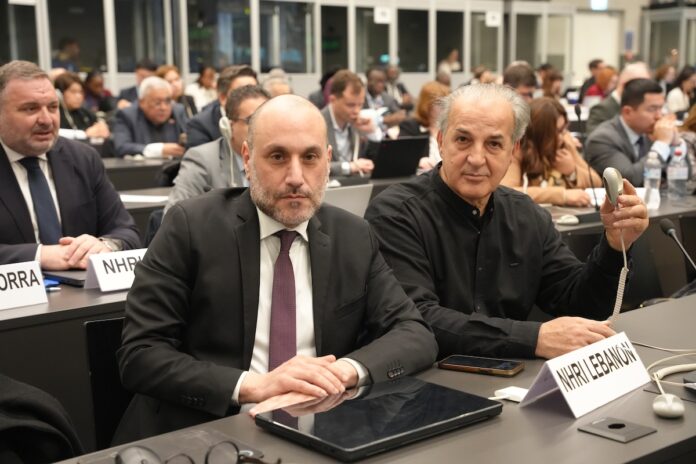
Further to its ongoing collaboration with international human rights mechanisms and its sustained commitment to the promotion and protection of human rights, the National Human Rights Commission of Lebanon, including the Committee for the Prevention of Torture (NHRC-CPT), participated in the 2026 General Assembly of the Global Alliance of National Human Rights Institutions (GANHRI), held from 30 March to 1 April 2026 at the Palais des Nations in Geneva.
The Lebanese delegation was represented by Dr. Fadi Gerges, President of the National Human Rights Commission, and Mr. Bassam Kantar, Commissioner of International Relations. Their participation reflects the Commission’s active engagement within the global network of National Human Rights Institutions (NHRIs) and its continued efforts to contribute to international human rights dialogue and policy development.
The GANHRI General Assembly constitutes the principal global forum bringing together NHRIs from all regions to exchange experiences, strengthen institutional cooperation, and advance collective action in response to emerging human rights challenges. The 2026 session took place in a global context marked by increasing pressure on multilateralism, shrinking civic space, and complex humanitarian and political crises, all of which underscore the critical role of independent NHRIs in safeguarding rights and promoting accountability.
During the Assembly, participants engaged in high-level discussions addressing key institutional, thematic, and governance issues. The agenda included the adoption of the General Assembly programme, the ratification of new and renewed Bureau members, and updates from GANHRI leadership and regional networks. These discussions reaffirmed the importance of effective governance structures within GANHRI, including the role of the Bureau as the executive body responsible for guiding the Alliance’s strategic direction and ensuring the implementation of its mandate.
A central component of the Assembly was the presentation of the GANHRI progress report covering the period from March 2025 to March 2026, which highlighted significant developments across the network. These included strengthened engagement of NHRIs within United Nations mechanisms, expanded capacity-building initiatives, and continued efforts to uphold the Paris Principles as the international standard for independent and effective national human rights institutions.
The Assembly also provided an opportunity to review and adopt the GANHRI workplan for 2026, which is anchored in the Strategic Plan 2023–2027. This framework emphasizes four core objectives: supporting the establishment and strengthening of NHRIs, enhancing global collaboration among members, reinforcing leadership in international human rights fora, and ensuring effective and accountable governance. These priorities are particularly relevant in light of the evolving global landscape, where NHRIs are increasingly called upon to address interconnected challenges such as climate change, digital transformation, inequality, and armed conflict.
The participation of the NHRC-CPT delegation also allowed for engagement with GANHRI working groups and thematic caucuses addressing key human rights issues, including business and human rights, climate change, and the rights of older persons. These platforms facilitate knowledge exchange, peer learning, and coordinated advocacy efforts, enabling NHRIs to contribute to global policy processes and strengthen their national impact.
In this context, the NHRC-CPT reaffirmed its commitment to advancing human rights in Lebanon in line with international standards, including through its role as a National Preventive Mechanism under the Optional Protocol to the Convention against Torture (OPCAT). The Commission also emphasized the importance of strengthening cooperation with international partners, including GANHRI, the Office of the United Nations High Commissioner for Human Rights (OHCHR), and the United Nations Development Programme (UNDP), in order to enhance institutional capacity and ensure effective protection of rights at the national level.
The participation of Dr. Fadi Gerges and Mr. Bassam Kantar further provided an opportunity to present the Commission’s ongoing work in areas such as monitoring detention conditions, documenting violations of international human rights and humanitarian law, and advocating for legislative and institutional reforms. These efforts contribute to reinforcing the role of the NHRC-CPT as a key national actor in promoting accountability, transparency, and the rule of law.
Moreover, the Assembly underscored the importance of preserving the integrity of multilateral human rights frameworks at a time when they face increasing contestation. In this regard, the NHRC-CPT reiterated its position that respect for internationally agreed standards, good faith engagement, and adherence to consensus-based processes remain essential to maintaining the credibility and effectiveness of the international human rights system.
هذه المقالة متاحة أيضًا بـ:

