
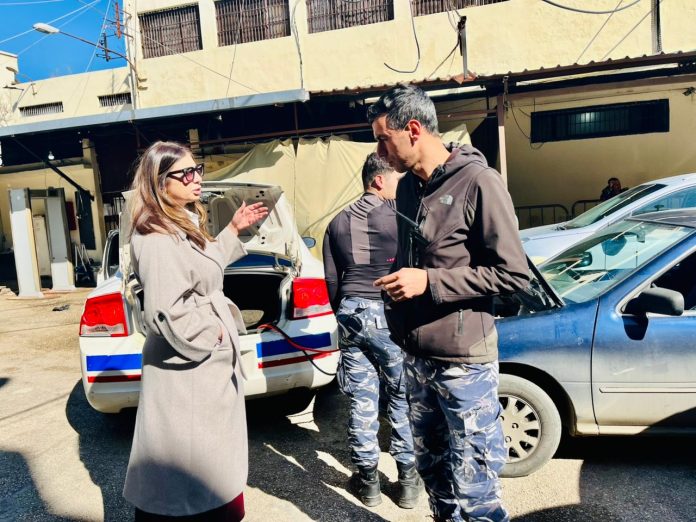
The National Human Rights Commission, including the Committee for the Prevention of Torture, conducted a field visit today to Qobbeh Prison for men and women in the city of Tripoli, northern Lebanon. The visit took place as part of the Commission’s ongoing monitoring of prisons and detention facilities and its efforts to assess the conditions of prisoners and detainees—particularly in light of recent overcrowding resulting from the transfer of inmates from prisons and detention centers located in areas affected by the Israeli aggression.
The Commission’s delegation included Committee for the Prevention of Torture member Rida Azzar and volunteer lawyer Monawer Haddad. The visit partially covered both the men’s and women’s sections of the prison. The delegation met with Qobbeh Prison commander Lieutenant Colonel Abdel Latif Al-Shaar, who briefed them on the current situation in the facility and the challenges arising from the increased number of detainees and prisoners transferred from other detention centers.
During the visit, the delegation distributed clothing and personal hygiene kits to several female inmates in the women’s section. The supplies had been received by the Commission as an in-kind donation and were distributed as part of a humanitarian initiative aimed at supporting inmates’ basic needs and promoting human dignity within places of detention.
The delegation also listened to the concerns and demands of prisoners and detainees, particularly regarding access to legal assistance to benefit from release requests in accordance with Article 108 of the Code of Criminal Procedure, which sets limits on pre-trial detention.
In addition, a group of 27 Syrian prisoners requested legal assistance to benefit from the provisions of Decree No. 2574, issued on 19 February 2026. The decree approves the conclusion of an agreement between the Lebanese Republic and the Syrian Arab Republic on the transfer of convicted persons from the country where the sentence was issued to the country of the prisoner’s nationality. The agreement was signed on 6 February 2026.
The Commission stressed that the visit falls within its oversight mandate under Law No. 62/2016 establishing the National Human Rights Commission, including the Committee for the Prevention of Torture. The law authorizes the Commission to conduct periodic or unannounced visits to places of detention in order to prevent torture and ill-treatment and to promote respect for the dignity and rights of detainees.
The Commission emphasized the importance of strengthening legal safeguards for detainees, accelerating judicial procedures, and reducing prison overcrowding—especially under the exceptional circumstances currently facing Lebanon. It reaffirmed its commitment to continue monitoring prison conditions and coordinating with relevant judicial and security authorities to ensure that the rights of prisoners and detainees are respected in accordance with national and international human rights standards.
The Commission also announced that it continues to work toward the success of the initiative it launched in 2024 to address overcrowding in Lebanese prisons and alleviate the burden on families amid the ongoing Israeli aggression against Lebanon. In this context, it continues coordinating with judicial, security, and military authorities to accelerate the submission and processing of release requests for those eligible.
The Commission further recalled the two circulars issued by the Public Prosecutor at the Court of Cassation, Judge Jamal Al-Hajjar, on 29 October 2024 and 10 April 2025. These circulars aim to activate the implementation of Article 108 of the Code of Criminal Procedure and expedite related procedures in cooperation with the National Human Rights Commission (including the Committee for the Prevention of Torture) and the Internal Security Forces Directorate. A mechanism has been established to facilitate the submission of release requests by detained defendants and ensure their access to the competent judicial authority handling their cases.
هذه المقالة متاحة أيضًا بـ:

 لعدد من السجينات في سجن النساء،)