
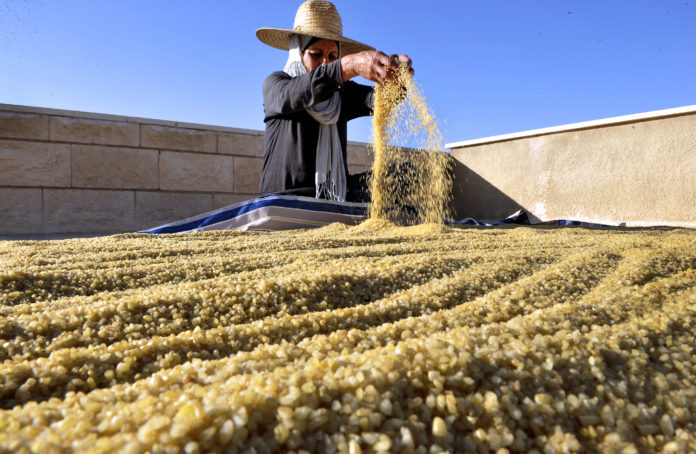
Across Lebanon’s villages and agricultural communities, women help sustain food production, preserve local knowledge and support household livelihoods. They cultivate crops, process food, manage small enterprises and organise collective initiatives. Yet recognising their contribution must go beyond celebrating their perseverance: it requires fair economic opportunities, effective protection and a meaningful voice in decisions affecting rural life.
The International Day of Rural Women, observed on 15 October, provides an opportunity to put these priorities at the centre of Lebanon’s recovery. In a country facing overlapping economic, environmental and conflict-related pressures, supporting rural women is essential to rebuilding livelihoods and strengthening food security.
The observance also falls within the International Year of the Woman Farmer 2026. Led by the Food and Agriculture Organization of the United Nations (FAO), the year highlights women’s contributions across agrifood systems and calls for action on barriers involving land tenure, finance, technical support, services and education.
The Beijing+30 theme cited on the supplied United Nations page—“Rural women rising – shaping resilient futures with Beijing+30”—belongs to the 2025 observance. Its emphasis on livelihoods, leadership and rights remains relevant, but should not be presented as a confirmed theme for 2026.
Making rural women’s contribution visible
Rural women’s work extends beyond employment formally recorded in farms or businesses. It includes seasonal agricultural labour, food processing, family production and responsibilities that sustain households.
UN Women’s research on Lebanon’s agriculture and agrifood sectors describes women’s work as frequently invisible or unaccounted for. It also highlights the seasonal, informal and often part-time nature of rural women’s employment, alongside particular protection concerns affecting Syrian refugee women working in agriculture.
For Lebanon, this creates a practical policy challenge. If assistance programmes recognise only registered business owners or people with formal employment records, they may overlook women whose work is essential to production but poorly documented.
Agricultural support should therefore identify who actually works, who controls resources and income, and who receives the benefits of assistance. Women should be recognised as producers, workers and decision-makers in their own right.
Recognition also requires better data. Historical figures should be clearly dated, and global statistics on agricultural wages or land ownership should not be presented as measurements of conditions in Lebanon.
Cooperatives offer a foundation for economic participation
Lebanon has documented experience in supporting women’s cooperatives and producer groups.
In July 2024, FAO reported that its Canada-funded project, implemented with the Ministry of Agriculture and the Directorate General of Cooperatives, had developed the capacities of 255 women’s groups since its launch in 2019. These included cooperatives, associations and informal groups. Cooperative Business Schools provided training in business planning, marketing and communication, alongside awareness of gender equality and women’s rights.
This experience illustrates the value of combining equipment or grants with sustained guidance. A production unit needs more than machinery: it needs realistic costing, reliable supplies, food safety practices, buyers and the capacity to manage financial risks.
Future support should help women’s groups move towards sustainable income. This can include shared processing facilities, storage, packaging, transport and connections with retailers and institutional buyers.
Cooperative membership should also translate into influence. Women need opportunities to participate in management, understand financial decisions and help determine how earnings are distributed.
Rural women are already contributing to recovery
A story documented by FAO in May 2025 shows how investment in women’s skills and organisation can support communities during crisis.
In Dalhamieh, in the Bekaa, Mirna Soleh and a group of women had established a fruit and vegetable drying unit with project support. When conflict disrupted markets and restricted movement, they worked with a local relief association to turn the facility into a community kitchen.
At the time of FAO’s reporting, the women were preparing and distributing more than 1,250 hot meals daily to displaced families and vulnerable households, while receiving a small daily stipend.
The example demonstrates how rural women’s enterprises can contribute to both livelihoods and emergency response. It also raises an important policy question: how can such contributions become adequately paid, protected work rather than an additional expectation placed on women during every crisis?
Recovery programmes should recognise the costs of women’s time and labour. Their participation should bring fair compensation, safe conditions and opportunities that continue beyond emergency funding.
Protecting agricultural livelihoods during conflict
Rural recovery must address the disruption of farming, production and access to markets.
In April 2026, the Ministry of Agriculture and FAO announced a Japan-funded initiative intended to support approximately 230 vulnerable farming households engaged in crop and livestock production in the South and Nabatiyeh governorates. The announced design specified that at least 30 per cent of beneficiaries would be women, including female-headed households.
Such commitments are useful, but implementation should examine more than participation numbers. Programmes should assess whether women receive suitable assistance, retain control over productive assets and income, and can continue their activities safely.
Support should be adapted to different circumstances. A woman managing a farm, a seasonal worker and a member of a food-processing cooperative may need different forms of assistance.
Recovery planning should also avoid encouraging return to unsafe land or premises. Restoring livelihoods requires coordination between agricultural support, safety assessments, infrastructure repair and access to essential services.
Economic empowerment requires legal protection
Skills training and enterprise grants cannot resolve every obstacle facing rural women.
UN Women’s review of the legislative framework governing women in Lebanon’s agrifood sector identifies legal protection as a central concern. Its recommendations include bringing women farmers within the categories covered by the Labour Code.
This provides a basis for examining protection gaps affecting agricultural work and developing reforms informed by women’s experiences.
Priorities should include clear payment arrangements, occupational safety, protection from harassment and exploitation, and accessible ways to seek assistance when rights are violated. Seasonal and informal workers should be included in these discussions.
Legal advice must also be practically accessible. Rural women should be able to obtain understandable information about employment, cooperative membership, land use and business registration without prohibitive travel or cost.
Economic empowerment becomes meaningful when women can earn income, exercise control over it and claim their rights.
Closing the information and digital gaps
Access to timely information can determine whether a farmer protects a crop, finds a buyer or makes a sound investment.
FAO’s April 2026 reporting on an initiative to keep Lebanon’s farmers connected stated that it reached 1,193 farmers, of whom 44 per cent were women. The initiative also supported women’s engagement in group discussions and decision-making. These are programme participation figures, rather than national agricultural workforce statistics.
For Lebanon, digital support should combine connectivity with practical training. Women may need help using market information, weather updates, digital payments and online sales tools.
Programmes should also provide alternatives for people who lack smartphones, reliable internet or confidence using digital services. In-person agricultural extension and trusted local networks remain important.
Digital inclusion should improve women’s choices and bargaining power while protecting their privacy and financial security.
Climate resilience must include women’s knowledge and needs
Agricultural adaptation should involve the women who cultivate, process and manage food.
For Lebanon, practical support could include water-efficient irrigation, soil protection, suitable crop choices, safe storage and energy-efficient processing. Training should be linked to affordable tools and follow-up support.
Women should participate in decisions about shared water resources, cooperative investments and local adaptation priorities. Their experience can help identify which measures are workable under actual household and production conditions.
Environmental stewardship should also be supported economically. Preserving local varieties, reducing food loss and adopting sustainable practices should not become additional unpaid responsibilities.
Public services are part of rural economic policy
A woman’s ability to participate in training, employment or cooperative management depends partly on services outside the agricultural sector.
Affordable transport, healthcare, childcare, reliable water and electricity can make economic opportunities usable. Without them, a programme may be technically available but practically inaccessible.
Training schedules should account for care responsibilities and travel constraints. Facilities should be accessible to women with disabilities, and information should reach women who are not already connected to established organisations.
Supporting rural livelihoods therefore requires coordination between agricultural institutions, municipalities, social services and organisations working on women’s rights.
Giving rural women a voice in decisions
Rural women should help shape the policies intended to support them.
Their participation matters in agricultural planning, municipal development, cooperative governance and recovery programmes. Consultation should include small producers, seasonal workers, women with disabilities and women whose activities remain informal.
Institutions should explain how women’s recommendations influence decisions and report back on results. Participation becomes meaningful when it can change priorities, budgets or programme design.
Independent human rights institutions can contribute by examining discrimination, receiving complaints within their mandates and recommending improvements. A rights-based approach connects economic recovery with equality, protection and accountability.
Priorities for Lebanon on 15 October
The International Day of Rural Women should encourage concrete commitments:
- Recognise women’s work: improve data on paid, informal and unpaid contributions to rural economies.
- Strengthen legal protection: address gaps affecting agricultural workers and access to remedies.
- Invest in viable enterprises: connect grants and training with markets, infrastructure and continued support.
- Ensure fair recovery assistance: assess women’s access to assets, income and safe livelihood opportunities.
- Expand public services: make transport, healthcare, childcare and accessible training part of rural development.
- Support climate and digital inclusion: provide practical tools alongside information and skills.
- Share decision-making power: involve rural women in programme design, governance and monitoring.
Lebanon’s rural women are already contributing to food production, community support and recovery. Public policy should match that contribution with rights, resources and influence. On 15 October, the commitment should be to build rural communities where women’s work is visible, their livelihoods are protected and their leadership can shape the future.
Official references
- United Nations: International Day of Rural Women
- UN Women: “Rural women rising” statement for the 2025 observance
- FAO: International Year of the Woman Farmer 2026
- UN Women Lebanon: Women in the Agro-Food Sector—A Review of the Legislative Framework
- FAO: Supporting women’s cooperatives and developing their capacities in Lebanon
- FAO: Anchors of Hope—Women driving recovery and resilience in Lebanon
- United Nations Lebanon: Ministry of Agriculture and FAO launch a Japan-funded recovery project
- FAO: Empowering Women in Crisis—Keeping Lebanon’s Farmers Connected
هذه المقالة متاحة أيضًا بـ:

