
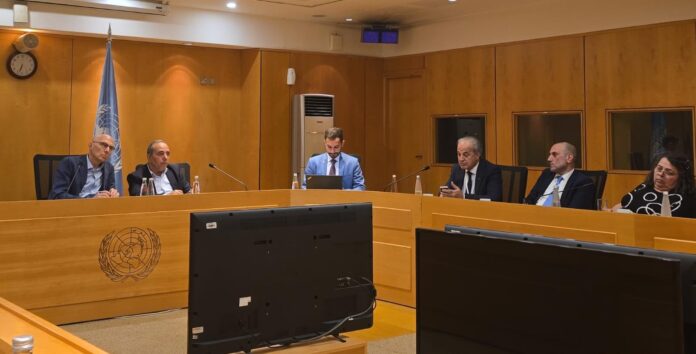
The National Human Rights Commission of Lebanon (NHRC-CPT) participated in the expanded meeting convened by the United Nations High Commissioner for Human Rights, Mr. Volker Türk, with representatives of independent national institutions and human rights organizations in Lebanon, as part of his official visit to Beirut.
The Commission was represented by its President, Dr. Fadi Gerges, and Commissioner for International Relations and Information, Bassam Al Kantar. During the meeting, the NHRC delegation presented the Commission’s assessment of the current human rights situation in Lebanon and outlined its key priorities and recommendations.
Full Support for the OHCHR Assessment Mission
At the outset of the meeting, the Commission welcomed the ongoing work of the OHCHR Assessment Mission currently deployed in Beirut. It reaffirmed its full commitment to supporting the mission by making all of its logistical capacities and institutional resources available to facilitate its fieldwork, ensure direct access to victims, witnesses, and affected communities, and provide the mission with the documentation, evidence, and forensic and human rights materials collected by the Commission’s field teams to assist ongoing investigations.
Ending Impunity and Ensuring Accountability
During its dialogue with the High Commissioner, the NHRC stressed that ending impunity is the indispensable foundation for achieving justice for victims and affected communities. The Commission emphasized that victims must be able to exercise their fundamental rights to truth, justice, and adequate reparation for both material and moral harm.
The Commission also called for the activation of international accountability mechanisms to investigate and prosecute all those responsible for serious violations and crimes committed during the recent Israeli military offensive against Lebanon, in accordance with international human rights law, international humanitarian law, and the Geneva Conventions.
Independent National Mandate and Continued Monitoring
The NHRC delegation presented an overview of the Commission’s ongoing field and institutional work, including monitoring and documenting human rights violations, receiving and following up on complaints submitted by citizens and residents, and maintaining constructive cooperation with international human rights mechanisms.
The Commission reaffirmed its unwavering commitment to preserving the independence of its national mandate, as guaranteed by its founding law, and to continuing to fulfill its constitutional and human rights responsibilities in coordination with both national and international partners to protect human rights and uphold human dignity.
Concerns over Publication of Findings and Call for an International Mechanism
The Commission also expressed its strong interest in the findings of the ongoing OHCHR assessment. At the same time, it voiced serious concern that the results of the mission could be delayed, withheld, or not made publicly available to victims and the wider public.
The NHRC stressed that the mission’s findings should include the identification of those allegedly responsible for the violations under investigation.
The Commission further reiterated its longstanding call upon the United Nations and the international community to urgently establish an independent and impartial international mechanism to collect evidence and investigate the most serious war crimes committed in Lebanon. Such a mechanism, the Commission emphasized, is essential to preserve evidence in accordance with international criminal standards, identify those responsible, combat impunity, and pave the way for fair and effective judicial proceedings.
هذه المقالة متاحة أيضًا بـ:

