
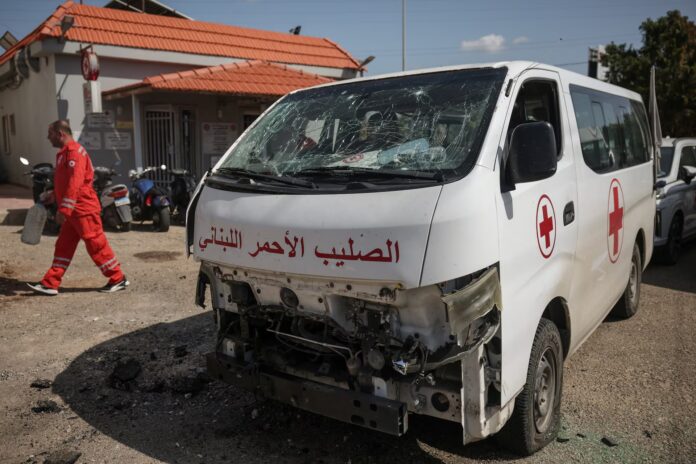
The National Human Rights Commission in Lebanon expresses its deep shock and grave concern over the continued targeting and harm inflicted upon humanitarian and medical personnel across the country. These incidents include the killing and injury of first responders while they were carrying out life-saving missions.
Saving lives must never come at the cost of losing one’s own. Humanitarian and medical workers are protected under international law and must be afforded full protection at all times, particularly in situations of armed conflict.
Recent data underscores the alarming scale and pattern of these attacks. Between 2 March and 7 April, the Lebanese Ministry of Public Health recorded at least 20 attacks on medical and ambulatory centers, as well as 93 attacks on Emergency Medical Services, resulting in damage to at least 75 medical vehicles. These figures point to a sustained and systematic impact on the ability of healthcare providers and first responders to operate safely and effectively.
Further analysis, including findings from the SAHA research project, highlights the severity of these incidents. Out of 113 reported attacks, at least 28 involved the killing of paramedics, indicating that approximately one quarter of such incidents were lethal. As of 7 April, the Ministry of Public Health reported 57 fatalities among healthcare workers. However, field-based documentation, including by the SAHA research team, suggests that the actual number of casualties may be higher, particularly given that many emergency responders are volunteers and may not be fully captured in official records. Efforts to identify victims by name underscore the human cost behind these figures and the importance of preserving their dignity beyond statistical representation.
The Commission emphasizes that humanitarian and medical personnel must be respected and protected while carrying out their duties. This obligation extends to hospitals, medical units, and ambulances exclusively assigned to medical purposes, as well as to the protective emblems under which they operate. All feasible measures must be taken to ensure their safety.
The Commission underscores that attacks against medical and humanitarian personnel, facilities, and transport constitute serious violations of international humanitarian law, including the principles of distinction, proportionality, and precaution. Such acts may amount to war crimes and require prompt, independent, and impartial investigation, as well as accountability for those responsible.
The International Humanitarian Law Committee within the Commission continues to monitor and document all reported incidents involving harm to humanitarian and medical personnel. This work includes the collection and verification of data from official and field sources, with a view to ensuring accurate documentation and supporting future accountability processes.
In light of these developments, the Commission calls on all parties to the conflict to:
- Respect and ensure respect for international humanitarian law in all circumstances,
- Immediately cease all attacks against humanitarian and medical personnel, facilities, and transport,
- Ensure full respect for the protective emblems and guarantees afforded to medical missions,
- Take all feasible measures to ensure the safety and security of first responders,
- Guarantee safe, rapid, and unimpeded access for humanitarian and medical personnel to carry out their duties.
The Commission further urges the Lebanese authorities to:
- Ensure thorough, independent, and transparent investigations into all reported incidents,
- Strengthen protective frameworks for emergency and healthcare workers,
- Raise these violations at the international level, including before relevant United Nations bodies and mechanisms.
The National Human Rights Commission reiterates its unwavering commitment to documenting violations, upholding the rule of law, and advocating for the protection of all civilians, particularly those who risk their lives to save others under extremely dangerous conditions.
هذه المقالة متاحة أيضًا بـ:

