
On 4 November 2025, the President of the Republic issued Decree No. 1713 determining the most representative bodies of the sectors composing the Economic, Social and Environmental Council (ESEC). The decree comes as part of the process of reconstituting the Council after the expiry of the previous council’s mandate, which had continued operating in a caretaker capacity since 2020.
The decree implements the amendments introduced by Law No. 288 of 12 April 2022, which modified the founding Law No. 389 of 1995 governing the Council. The amendments broadened the Council’s scope by introducing new sectors, notably the environmental sector and civil society organizations, reflecting evolving approaches to public policy participation.
Under Article 2, paragraph 9 of the decree, several organizations were designated as among the most representative bodies of the civil society sector. These include The Legal Agenda, the Lebanese Center for Policy Studies, Policy Initiative, the Lebanese Association for Taxpayers’ Rights, and the Arab Network for Economic and Social Rights.
Pursuant to Article 8 of the amended law, these organizations must submit lists of nominees comprising at least three times the number of seats allocated to them, from which the Council of Ministers will appoint the final members representing the sector within the Council.
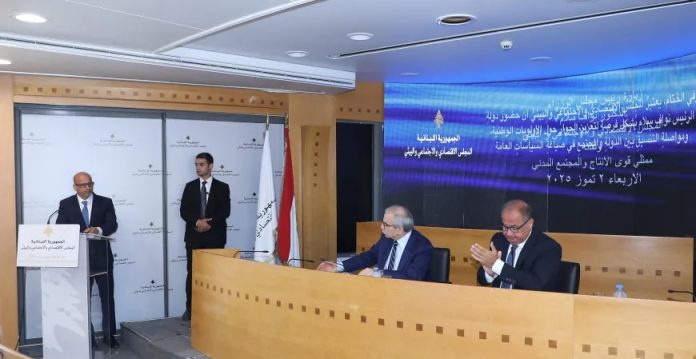
The Economic, Social and Environmental Council is an independent consultative and representative body tasked with providing opinions on the country’s economic, social, and environmental policies. The 2022 amendments expanded its mandate to include reviewing draft laws, national plans, and government programmes related to sectors represented in the Council. The Council may also organize public consultations and receive citizens’ petitions signed by at least 5,000 individuals. However, its opinions remain advisory, as the government is required to consult the Council but is not bound by its recommendations.
The Council is composed of 80 members representing nine sectors, including employers, trade unions, liberal professions, cooperatives and social institutions, environmental organizations, civil society, Lebanese expatriates, and experts in economic, social, legal, and cultural fields. Members serve four-year terms renewable once.
The creation of the Council traces back to the 1989 Taif Agreement, which called for establishing a body that would enable various economic and social sectors to participate in shaping national policies. The Lebanese model was inspired in part by the French Economic, Social and Environmental Council.
Nevertheless, the expansion of the Council’s powers has raised constitutional questions, particularly concerning the possibility for Parliament to refer draft legislation to the Council for opinion. Unlike the French system, where the Council is expressly established in the Constitution, the Lebanese Council exists only by statute, leading some observers to question whether certain consultative mechanisms are fully consistent with the constitutional framework governing legislative procedures.
The Council’s recent performance has also been the subject of debate. Since the beginning of Lebanon’s financial crisis in 2019, the Council has largely functioned as a forum for dialogue and consultation, with limited visible influence on policymaking despite its expanded legal mandate.
With the issuance of Decree No. 1713, the process of appointing a new Council is expected to move forward. The renewed body will include representatives from economic, social, environmental, and civil society sectors, potentially strengthening the Council’s role as a platform for policy dialogue at a time when Lebanon faces multiple economic, social, and environmental challenges.
هذه المقالة متاحة أيضًا بـ:

